Is a Dog Harness Better Than a Collar? A Practical Answer
As an Amazon Associate we earn from qualifying purchases. Details
Is a dog harness better than a collar? Neither is automatically better for every dog. A harness is the more relevant choice when chest-girth fit and body coverage match your walking needs. A collar remains practical when neck fit, a leash attachment, or a close-control handle is what you need. There is no supported blanket health or safety winner here, so the useful answer comes from fit and function rather than slogans. This guide helps you choose between them, measure the right area, assess a puppy’s changing fit, and avoid confusing a harness, collar, and leash. It also compares five actual collar types without pretending they provide the same coverage as a harness.
Quick answer
A harness is not universally better than a collar, and a collar is not universally better than a harness. Choose by the job and by the measurements the item requires. Chest girth is usually the most important measurement for harnesses. Neck girth is central to collar fit. Measure your standing dog with the tape snug, not tight, and allow two fingers beneath it. Then use the maker’s size chart rather than breed labels alone.
For a growing puppy, recheck fit instead of assuming one adjustment will last. For a dog that slips out, prioritize the design and size chart intended for that problem. If pulling, discomfort, or a medical issue affects the choice, ask your vet or a certified trainer. A leash is still a separate connection; it is not an alternative to either wearable.
At a glance
Neck-fit figures stated in this guide.
| Item | Figure stated |
|---|---|
| Example neck size | 18 inches |
| Margin added when comparing adjustment ranges | 0.5 inch |
| Neck-fit check value | 18.5 inches |
Do not choose from a small, medium or large label alone.
Why the better choice depends on the job
The question “is a harness better than a collar?” combines several different jobs. Identification, ordinary leash attachment, close handling, escape management, and a growing puppy do not create the same requirements. Start by naming the job. Only then compare products that actually perform it.
A harness is sized mainly around the body. The verified fitting guidance says most dog gear uses back length, chest girth, and neck girth. Chest girth means the largest part of the rib cage, usually just behind the front legs, and it is typically the most important harness measurement. That makes a guide to adjustable puppy harnesses relevant when growth is the central problem.
A collar is sized at the neck. The five collar listings below illustrate how much the details can differ. Some give a specific neck interval. Others provide only a named size or breed class. Some have a D-ring, reflective material, padding, or a handle. Those features can refine a collar choice, but none turns a collar into a harness.
Do not assume every harness prevents injury, stops pulling, or prevents escape. Likewise, do not assume every collar is appropriate for every walk. Treat those broad statements as claims requiring support from a maker, veterinarian, or certified trainer. For a dog that backs out of gear, compare products made for that need in the escape-resistant harness guide.
How harness and collar fit work in plain words
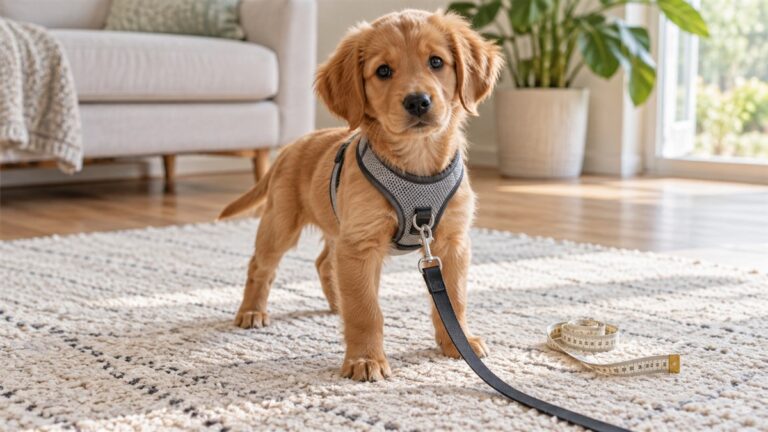
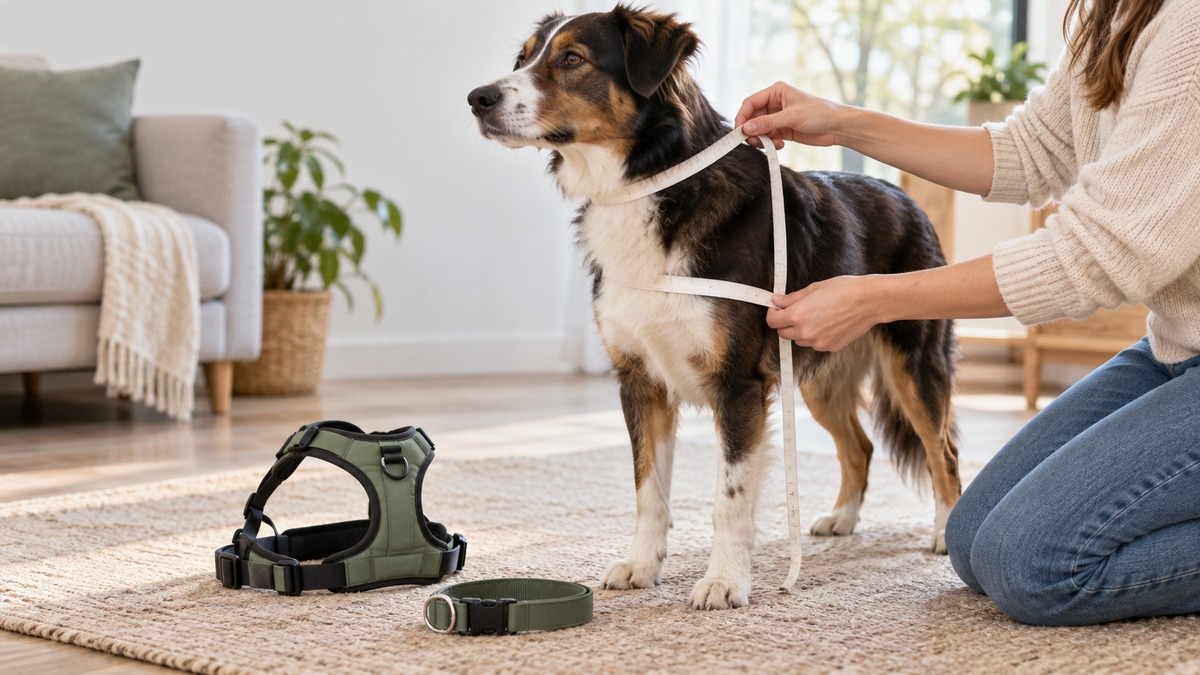
Fit starts with the part of the dog the gear surrounds. For a harness, measure the chest at the largest part of the rib cage, usually behind the front legs. Also record the neck and back length if the maker’s chart asks for them. For a collar, measure the neck where that design is intended to sit.
Keep the dog standing. Hold the tape snug but not tight, then check that two fingers fit between the tape and the dog. If you lack a soft tape, a string, ribbon, or shoelace can take the measurement; compare its marked length with a ruler afterward. These steps provide measurements, not a size by themselves. Match them to the specific maker’s chart.
Do not choose from a “small,” “medium,” or “large” label alone. In this comparison, one listed medium collar gives no neck interval, while one listed large collar specifies a neck range of 17–20.5 inches. Another large item gives dimensions but no stated neck range. The shared size word therefore does not establish equivalent fit.
Adjustment range matters for a puppy because the measurement can change as the puppy grows. There is no universal recheck interval stated here. Check the fit before use and whenever it appears different. If you specifically need a small-dog design, compare the maker’s chest range in the padded small-dog harness guide.
A neck-fit check
Take a standing dog whose neck measures 18 inches today, and add a 0.5-inch margin when comparing listed adjustment ranges. These figures show the method and are not a recommendation.
First calculation: 18 inches + 0.5 inch = 18.5 inches. Recheck it in reverse: 18.5 inches – 0.5 inch = 18 inches. The listed large collar with a 17–20.5-inch neck range contains both the measured 18 inches and the estimated 18.5 inches.
Second check: the dog is 18 inches – 17 inches = 1 inch above the listed minimum. Reverse verification gives 17 inches + 1 inch = 18 inches. At the other end, 20.5 inches – 18.5 inches = 2 inches of listed range beyond the 18.5 inch figure. Adding it back confirms 18.5 inches + 2 inches = 20.5 inches.
This arithmetic only screens the stated range. It does not prove comfort, security, or suitability. Apply the maker’s fitting directions and two-finger check. If you were choosing a harness instead, repeat the selection with chest girth and the harness chart; do not substitute the 18-inch neck figure for chest girth.
Five collars that show the trade-offs
These five products are collars, not harnesses. They help answer when a collar’s listed construction or feature matches the job. None has a stated body-girth range, so none should be bought as a substitute for a harness. Product cards appear here:
1. Joytale Reflective Dog Collar, Adjustable Neoprene Padded, Teal L (Best overall collar)
Specs from the listing (checked 2026-10-10):
- Material: Metal, Neoprene, Nylon
- Item Display Dimensions: 24 x 1 inches
- Animal Collar Type: Basic Animal Collar
- Product Care Instructions: Clean after Use
Pros
- The listing specifies a solid black metal D-ring and reflective threads.
- Neoprene padding and a quick-release snap buckle are listed.
Cons
- The listing does not state an adjustable neck range or dog weight limit.
Best for: Owners seeking a large padded reflective everyday collar with a stated D-ring.
Skip if: You need a confirmed neck range before ordering.
View on Amazon (affiliate link)
2. DAGANXI Tactical Dog Collar, Adjustable Military Training Nylon Dog Collar with Control Handle (Best accessory bundle)
Specs from the listing (checked 2026-10-10):
- Material: Nylon
- Breed Recommendation: Medium, Large Breeds
- Included Components: Leash
- Item Dimensions L x W: 14.98″L x 3.08″W
Pros
- The listing states 1000D nylon, inner padding, and a control handle.
- An AirTag protective case and two patches are included.
Cons
- The listing gives size L but no exact neck range or dog weight range.
Best for: Medium- or large-breed owners who want the listed handle, case, and patches.
Skip if: You need an exact stated neck or weight interval.
View on Amazon (affiliate link)
3. Tactical Dog Collar, Adjustable Military Training Nylon Pet Collar, Black L (Best stated neck range)
Specs from the listing (checked 2026-10-10):
- Material: Nylon
- Item Length: 20.5 inches
- Size: Large :Width 1.5″,Neck 17-20.5″
- Product Care Instructions: Hand wash with mild soap and water, let dry thoroughly, check regularly for wear or damage.
Pros
- The selected size states a 17–20.5-inch neck range and 1.5-inch width.
- The listing includes a control handle and a separate tag-and-leash loop.
Cons
- The listing gives no dog weight limit.
Best for: A dog whose measured neck fits the selected 17–20.5-inch interval.
Skip if: You require a stated weight limit or do not want a 1.5-inch-wide collar.
View on Amazon (affiliate link)
4. Reflective Dog Collar, Adjustable Soft Neoprene Padded,Teal,M (Best machine-washable collar)
Specs from the listing (checked 2026-10-10):
- Material: Nylon
- Dog Breed Size: Medium
- Product Style: Safety-Reflective, Teal
- Product Care Instructions: Machine Wash
Pros
- The listing identifies reflective straps, neoprene padding, and an adjustable buckle.
- Care instructions state machine wash.
Cons
- No medium neck interval or dog weight range is stated.
Best for: Owners prioritizing the listed reflective design and machine-wash care.
Skip if: You need a handle or cannot verify the current medium size chart.
View on Amazon (affiliate link)
5. Tactical Dog Collar Adjustable Military Nylon Dog Collar with Control Handle and Heavy Duty Metal (Best adult handled collar)
Specs from the listing (checked 2026-10-10):
- Material: Metal
- Age Range Description: adult
- Item Weight: 100 g
- Item Dimensions L x W: 20.5″L x 1.6″W
Pros
- The listing states a control handle, 1000D reinforced nylon, and a metal buckle.
- It gives a 1.5-inch width and hand-wash instructions.
Cons
- The selected size has no stated neck range or dog weight range.
Best for: Adults needing the listed handled tactical construction after chart verification.
Skip if: You are sizing a puppy or need a published fit interval in the listing.
View on Amazon (affiliate link)
Joytale reflective padded everyday collar
The Joytale collar is a large basic collar for owners who want a conventional leash attachment plus visibility-related detailing. Its listing gives 24 x 1 inches for display dimensions and 24 inches long by 1 inch wide for item dimensions. Construction is listed as metal, neoprene, and nylon. A solid black metal D-ring is the stated leash attachment, while reflective threads are included for visibility during night walking.
The listing also describes soft, breathable neoprene padding and a quick-release snap buckle. Those specifics make it the most broadly equipped everyday collar in this set. The named breed recommendation includes Rottweiler, Golden Retriever, Pitbull, and Bulldog, but a breed list is not a measurement.
The important limitation is that this large listing does not state an adjustable neck interval or weight limit. Its 24-inch overall length cannot safely be treated as a 24-inch usable neck size. Skip it if you need a confirmed neck range before ordering. Measure your dog’s neck and check the current size chart. Owners who need body coverage should instead compare a properly sized harness.
DAGANXI padded tactical collar with accessories
The DAGANXI collar targets medium and large breeds and adds a control handle. Its listing names 1000D nylon fabric, a padded inner surface, a quick-release metal clasp, and an integrated hook-and-loop element. It also includes an AirTag protective case and two patches. Those details suit an owner specifically seeking a handled collar with the listed accessories.
The recorded item dimensions are 14.98 inches long by 3.08 inches wide, and the product dimensions add a 0.1-inch depth. The size is simply listed as L. The maker tells buyers to measure the neck carefully and leave a two-finger gap. That direction agrees with the general measuring method described above.
Its limitation is decisive: no exact neck range or dog weight range is stated. The breed category does not repair that omission, and item dimensions are not presented as a fit range. Skip this collar if you need to settle the size from the listing alone. Also skip it if you do not need its handle and accessory bundle. Compare your neck measurement with the current maker chart before considering it.
Black tactical collar with stated neck ranges
The black large tactical collar is the easiest one here to screen numerically. The selected large size is listed at 1.5 inches wide with a 17–20.5-inch neck range. The bullet also shows medium at 1.5 inches by 13.5–16.5 inches and extra large at 1.5 inches by 20–24 inches. These are maker-listed choices, not interchangeable labels.
Its construction is described as 1000D nylon with a strong metal buckle and padded inner surface. A control handle is included. A separate loop is listed for dog tags and a leash. Care instructions say to hand wash with mild soap and water, dry thoroughly, and check regularly for wear or damage.
The listing names small, medium, and large breed sizes, but it gives no dog weight limit. Skip this collar if a confirmed weight range is essential, or if a 1.5-inch-wide collar is not what you want. This is still neck-worn gear; owners seeking chest-based sizing should use a harness chart instead.
Lightweight teal reflective basic collar
The teal medium reflective collar is a basic collar listed for everyday wear. It weighs 1.76 ounces in the package details. Nylon is the stated material, with a sturdy D-ring among the included components. The listing also names reflective straps, neoprene padding, an adjustable ABS quick-release buckle, 14 colors, and 5 sizes.
Care is a practical distinction: this listing says machine wash. That separates it from the hand-wash directions on the black tactical and heavy-duty metal collars and the “clean after use” direction on the Joytale. The collar is therefore worth considering when the stated care method and reflective construction matter more than a handle.
The listing does not give the medium neck range or a dog weight range. It also names medium as the breed size, which is not enough to establish fit. Skip it if you cannot verify the current size chart before ordering, or if you need a close-control handle. Owners considering an over-the-head body design can instead review over-the-head harnesses.
Adult collar with handle and five listed sizes
The heavy-duty metal collar is an adult tactical collar with a control handle. The listing identifies 1000D reinforced nylon fabric, a metal buckle, and a soft, breathable padded lining. Its collar width is stated as 1.5 inches. It uses a button, metal buckle, and hook-and-loop element in the described closure arrangement.
The selected item is large, and its item dimensions are 20.5 inches long by 1.6 inches wide. The listing also reports an item weight of 100 g and says five sizes are available. Care instructions call for hand washing in cold water and air drying. This collar best fits someone who wants that particular handled construction and will verify the correct size separately.
The listing does not state the neck range for the selected size or any dog weight range. The 20.5-inch length is not labeled as usable neck circumference. Skip it if exact fit must be established from the listing details shown here, or if an adult-only listing does not match your puppy. A measured chest-based product remains the relevant alternative when you need a harness.
Common misunderstandings to avoid
A harness and leash are not competing products
The question “are dog harnesses better than leashes?” mixes a wearable with a connector. A harness or collar provides an attachment point; a leash connects to that point. Decide on the wearable first, then confirm that the attachment hardware suits the intended setup. Do not treat a leash alone as a wearable.
A feature does not establish complete fit
Reflective threads, padding, a handle, and a quick-release buckle describe features. They do not provide chest or neck measurements. Likewise, an overall item length is not necessarily the same as an adjustable neck range. Prefer an explicit fit interval and follow the size chart.
Breed names do not replace measurements
Several listings use breed classes or examples. The verified guidance still requires measurements. Take neck girth for a collar and chest girth for a harness. Keep the dog standing, keep the tape snug rather than tight, and use the two-finger check.
“No-pull” language does not settle the question
Do not assume a particular design will stop every dog from pulling. If pulling drives your choice, ask a certified trainer about the behavior question and assess the maker’s stated attachment and fitting instructions. The large-dog harness guide can narrow products by size, but fit still depends on the individual dog.
A martingale collar is not automatically better
Is a martingale collar better than a harness? No martingale design appears among the five collars here, and there is no basis for a universal comparison. Check the exact product type, measurements, and maker instructions. For escape behavior or a medical concern, ask a qualified professional rather than inferring suitability from the category name.
Puppy sizing is not a one-time choice
Is a harness better than a collar for a puppy? The answer still depends on purpose and current fit. The useful distinction is measurement: a harness commonly relies most on chest girth, while a collar relies on neck fit. Remeasure instead of predicting fit from age or breed.
A simple way to choose
Choose a harness path when the intended product is sized by chest girth and its body coverage matches your stated walking need. Record chest, neck, and back length if the chart uses all three. For a dog with an unusual body shape, the long-body harness guide offers a more focused starting point.
Choose a collar path when a neck-worn attachment is the job and the exact neck range contains your dog’s measurement. Then compare only relevant features: D-ring, reflective elements, padding, handle, closure, and stated care method. Reject any collar whose fit you cannot verify.
Choose neither product yet when discomfort, a medical issue, or behavior concerns make the choice uncertain. Ask your vet about medical considerations or a certified trainer about behavior. A shopping label cannot answer either question.
FAQ
Are harnesses better for dogs than collars?
Not in every case. The verified difference here is how you evaluate fit: chest girth is typically most important for a harness, while a collar requires an appropriate neck fit. Choose by the job, measurements, and maker’s instructions.
Are collars better than harnesses for identification?
There is no universal winner for identification stated here. Some listed collars include a separate loop for tags, but that feature applies only to those products. Check the exact collar or harness listing for the attachment you need.
Is a harness better than a collar for a puppy?
Neither wins based on age alone. Measure the puppy while standing and recheck fit as it changes. Use chest girth for the harness chart and neck girth for the collar chart. Do not rely only on a puppy or breed label.
Which measurements should I take before ordering a harness?
Measure around the largest part of the rib cage, usually just behind the front legs. Keep the tape snug but not tight while the dog stands. Slip two fingers beneath the tape. Record neck girth and back length if the chart requests them.
How do I measure my dog for a collar?
Measure the neck where the collar is intended to sit. Keep the dog standing and use the snug, two-finger method. Compare the result with the maker’s neck range; do not convert an overall product length into a fit range yourself.
Is a martingale collar better than a harness?
The five collars here do not include a martingale collar, so they cannot support a direct product comparison. Compare the exact design, stated fit range, and intended job. Ask a certified trainer if escape or pulling behavior is driving the choice.
Can I choose by my dog’s weight or breed?
Use those only when the maker provides them, and still measure. The verified fitting guidance centers on back length, chest girth, and neck girth. Several collars above omit weight limits, so their breed labels cannot confirm fit.
What if my dog slips out of walking gear?
Do not assume a standard collar or harness solves that problem. Look for a design whose listing addresses escape and whose size chart matches your dog. Confirm the maker’s fitting directions, or ask a certified trainer for help.
Bottom line
A harness is the better fit when chest-based sizing and body coverage fit the job. A collar is the better fit when you need neck-worn gear and can verify its neck range and features. Measure first, reject vague fit, and use the maker’s chart. If health or behavior changes the stakes, ask your vet or a certified trainer before buying.
Sources
- American Kennel Club guide to measuring dog gear: supports the three core measurements, chest-girth location and importance, standing measurement, snug tape, two-finger rule, and substitute measuring materials.