Dog Heating Pad Large: Safety Checks Before You Buy or Use One
As an Amazon Associate we earn from qualifying purchases. Details
Updated 19 October 2026 | Author: Editorial team, bestdogsstuff.com
A dog heating pad large enough for a big dog’s bed or crate is a question about electrical cords, overheating and placement before it is a question about size. The person typing dog heating pad large usually wants a warm spot for a bigger dog during cold months and wants to know what makes it safe. The AKC pages we opened agree on the main checks: a chew-resistant cord kept out of reach, supervised use, room for the dog to move away from the heat, and a dog-specific product rather than a heating pad made for people.
Quick answer
- Choose a heated bed or pad made for dogs, with a chew-resistant cord that the dog cannot reach.
- Supervise use, and keep the dog able to move away from the heat.
- Do not use a heating pad made for people under a dog, because it runs at different temperatures.
- The sources we opened do not give wattage, size or voltage figures, so compare those on the product page with your vet’s advice.
Why cords and room matter more than the pad size
Most of the risk with a heated pad comes from two places: a cord that a dog can chew, and a warm surface the dog cannot leave. Size matters for fit and for comfort, but the safety checks do not change with size. A large pad with a cord the dog can reach is a larger version of the same hazard. So the order of checks is cord first, then supervision, then the dog’s ability to leave the heat.
The AKC heated bed article is the most direct source for this. It says: “When buying a heated dog bed, look for a chew-resistant cord and keep the cord out of your dog’s reach to avoid injury.” The word that matters most in that sentence is the last one. A cord the dog can reach is a hazard, and the injury the article names is the one a chewing dog is most likely to cause.
The same article says that “It’s important to supervise your dog any time they’re using a heated dog bed or pet heating pad.” That sentence applies to every size of pad. A large pad may cover more of the dog’s body, so the dog has less room to choose a cooler spot on its own. Supervision is the simplest protection for a dog that settles into a warm pad and sleeps for hours.
What the AKC says about placement and room to leave
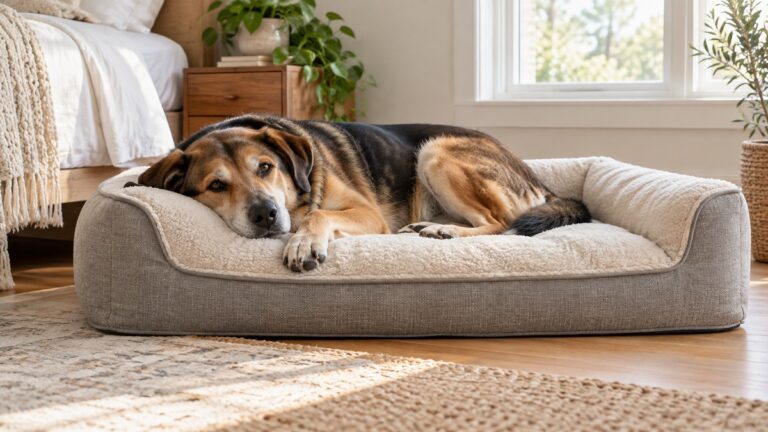
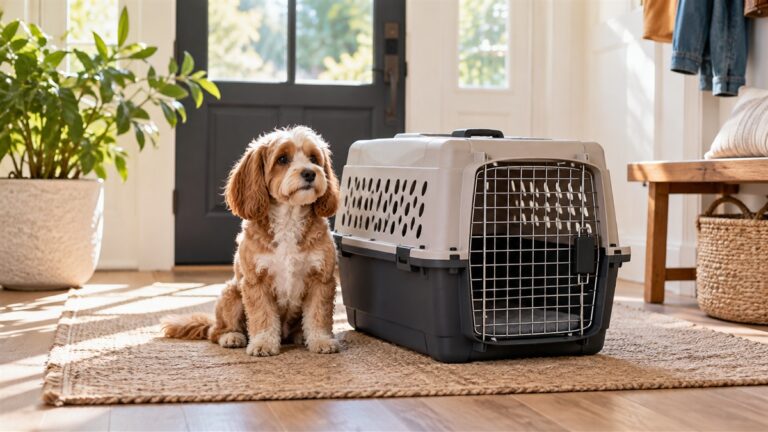
The heated-bed article also addresses crates and pens. It says: “If you’re looking for a bed to fit inside your dog’s crate or pen, make sure there’s enough space for your dog to move away from the bed if they get too hot.” This is the check most owners skip. A large pad that fills a crate leaves the dog no cooler corner, so the crate may be too warm even if the pad is set to a low level.
The article also points out that some heated beds have an electrical cord that needs to be plugged into an outlet. A cord that runs across the floor to a wall outlet is a trip and chewing risk in its own right. Measure the path from the outlet to the bed before you set it up, and keep the cord where the dog cannot reach it from the bed or the crate.
Kennel and crate safety in winter
The AKC winter kennel guidance covers heaters in outdoor and shared spaces, and its advice carries over to crate and kennel pads. It says: “Make sure your kennel heaters are clean, in proper working order, and properly ventilated to the outside.” It also says to keep materials away from the heat source and to make sure a dog or another animal cannot knock or push anything into or over the heat source. For a pad, that means checking that the pad is flat, that nothing is stacked on it, and that the crate or pen stays where a dog cannot drag bedding onto the pad.
For exposed cords, the same guidance says to “Use an approved electric conduit pipe to cover exposed cords to help prevent a chewing hazard.” That advice is aimed at heat lamps and kennel wiring, but it applies to any pad cord that runs along a wall or floor where a dog can reach it. A cord cover or a route that keeps the cord out of reach is a sensible step to ask about before you buy.
A checklist from the sources, in a table
The table sorts each check by what the source says and by what to do at home. It contains no product numbers, because the sources we opened do not give any.
| Check | What the source says | What to do at home |
|---|---|---|
| Cord | Look for a chew-resistant cord and keep it out of reach | Route the cord away from the bed and the crate; use a cord cover if the dog reaches it |
| Supervision | Supervise any time the dog uses a heated bed or heating pad | Use the pad only when someone is home and awake, and turn it off when you leave |
| Room to leave | Make sure a dog in a crate or pen can move away from the heat | Leave one part of the crate or pen unheated, and check that the dog can reach it |
| Human heating pads | Do not share a human electric blanket or heating pad with a dog | Buy a product made for dogs rather than using one from the bedroom |
| Overheating | A dog’s internal temperature above 105.8 degrees Fahrenheit may mean heatstroke | Check the dog’s comfort, and stop the pad if the dog pants heavily or seems unwell |
The only number in the table comes from the AKC heatstroke article. It is a threshold, not a setting. The sources we opened do not tell you what temperature a pad should reach.
How to use a heated pad safely, step by step
- Choose a pad made for dogs. The AKC heated-bed article says dogs should get a dog-specific heated bed rather than a human electric blanket or heating pad.
- Check the cord and the plug before you connect it. Look for damage, and choose a model that describes a chew-resistant cord.
- Set the pad where the dog can move away. In a crate, leave a cool area open. In a bed, make sure the dog can step onto the floor.
- Route the cord out of reach. Keep it away from the dog’s bed, chew spots and any spot where the dog naps.
- Supervise the first several sessions. Watch for chewing, digging at the pad, or a dog that lies still for a long time with its body pressed to the heat.
- Check the dog’s comfort and the pad regularly. A dog that pants heavily, drools or looks unwell should be moved to a cool area, and a vet should be called if the dog does not settle.
Signs that the setup is wrong
Stop using the pad and rethink the setup if the cord shows any wear, if the dog has chewed the cord or the cover, or if the dog cannot get away from the warm spot. Also stop if the pad is in a crate with bedding that could be pulled onto it, or if the dog is a puppy or senior dog left alone with the heat on. The AKC article says puppies and senior dogs need extra care and supervision with heated beds, so a long unsupervised session is the wrong setup for those dogs.
Mistakes to avoid
- Buying a large pad and assuming size makes it safer. The cord and the escape route matter more than the size of the pad.
- Sharing a heating pad made for people. The AKC heated-bed article advises against it because the dog’s needs differ.
- Leaving the pad on overnight in a crate with no cool area. The AKC article says regular dog beds should be the go-to for overnight sleeping.
- Running the cord along the floor where the dog can reach it.
- Placing the pad where the dog can drag bedding onto it, or where the crate sits in a draft that hides the warmth from the owner.
How we chose
We started from the question a dog owner would type: what should I check before buying a large dog heating pad. We searched for guidance from veterinary, kennel-club and welfare sources on heated dog beds, winter kennel heat and overheating. We opened three AKC pages and the AKC heatstroke article on 19 October 2026 and kept only sentences that appear word for word in the saved text. The pages were the AKC article on heated dog beds, the AKC article on kennel safety in winter, and the AKC article on heatstroke in dogs.
We opened no product page for this post, so it contains no product picks and makes no claim about any pad’s power, size or safety rating. Search results that listed heated pads for sale were not used as sources.
What we could not verify
- Wattage, voltage, heat setting and size figures for any large pad. The sources we opened do not give them, and the post does not supply any.
- Whether a particular pad has a certification mark. We have no source for the certifying body of any product, and the post makes no certification claim.
- How long a dog can safely stay on a heated pad in any given room temperature. The sources give the cooling and heatstroke warnings but not a time limit for heated pads.
- Whether a heated pad is appropriate for a particular dog’s health. Ask your vet, especially for senior dogs, dogs with joint pain or dogs with heart or kidney conditions.
FAQ
Is a dog heating pad large safe to leave on overnight?
The AKC article says regular dog beds should be the go-to for overnight sleeping, and that heated dog beds need supervised use. The sources we opened do not give a safe overnight setting. If you use a heated pad, keep the cord out of reach and make sure the dog can leave the warm spot.
Can I use a heating pad made for people under my dog?
The AKC heated-bed article advises against it. It says a dog should have its own heated bed because the dog’s body temperature and needs are different, and that a product made for dogs heats to a safer level and works on low voltage.
What should I do if my dog chews the cord?
Unplug the pad, move the cord out of reach, and stop using it until the cord is replaced or covered. The AKC guidance on exposed cords recommends an approved conduit pipe to help prevent a chewing hazard. If your dog has swallowed a piece of cord or a plug, call your vet immediately.
Does a larger pad need a different setup?
The sources we opened do not address pad size. The same checks apply: a chew-resistant cord out of reach, supervision and room to leave the heat. A large pad covers more of the dog’s body, so check that the dog can still move away from it.
How do I know if my dog is overheating?
The AKC heatstroke article says that when a dog’s internal temperature exceeds 105.8 degrees Fahrenheit, it may suffer heatstroke. Heavy panting, weakness or collapse are reasons to move the dog to a cool area and call a vet. Do not use ice water to cool a dog, because the AKC article says extremely cold water can cause shock.
Bottom line
Before you buy a dog heating pad large, check that it is made for dogs, that the cord is chew-resistant and out of reach, and that the dog can move away from the warmth. Supervise the first sessions, and keep a cool area in every crate or pen where the pad is used.
If your dog sleeps in a crate or pen, you may also want to read our guide to chew-proof kennel pads, a crate pad guide, or our roundup of dog kennel mats before choosing a base layer for the crate.
Sources
- AKC, heated dog beds: chew-resistant cords, supervision, room to move away, no human heating pads
- AKC, dog kennel safety in winter: ventilated heaters, keeping animals and materials away from heat sources, approved conduit for exposed cords
- AKC, heatstroke in dogs: 105.8 degree threshold for heatstroke; cold water can cause shock