How to Measure Dog for Coat: A Step-by-Step Guide
As an Amazon Associate we earn from qualifying purchases. Details
This guide explains how to measure dog for coat sizing, whether the garment is a sweater, a jacket or a raincoat. Most dog clothing uses the same three measurements: back length, chest girth and neck girth. Take them with the dog standing still, write each one in inches, and compare them with the size chart of the coat you plan to buy. The AKC guide we opened says chest girth is typically the most important measurement for clothing, so start there and then check the other two.
Quick answer
- Measure three things with the dog standing: back length, chest girth and neck girth.
- AKC says a sweater, jacket or raincoat still needs all three measurements, even though each garment type varies slightly by design and sizing.
- Keep the tape snug but not tight, and check that two fingers fit between the tape and the dog.
- Measure back length from the base of the tail to the base of the neck along the spine, because a coat that is too short in the back can fall short during potty time, according to AKC.
- PetMD advises adding 1 or 2 inches to a measurement for a snug but unrestricting fit. Check whether the coat chart already includes that allowance before you add anything.
- Each brand and design may differ, so follow the chart’s own measuring points when it names them.
How we chose these steps
We opened three pages on October 23, 2026: the AKC guide to measuring a dog for gear, the PetMD guide to measuring a dog, and an AKC guide to dog backpacks. The measurement names, the two-finger check and the body points in this guide come from those pages. Where a page does not cover a point, we say so in “What we could not verify” at the end. We did not add numbers from memory.
This is a how-to guide. It names no products, gives no prices and does not rank coats. A coat that matches the chart numbers still needs a fit check on the dog, and the steps below cover that check.
What to have ready
- A soft fabric measuring tape, the kind used for sewing. Rigid metal tape does not wrap around the body well.
- A pen and a note. Write the dog’s name, the date and the three numbers.
- A helper, if one is available, to keep the dog still and calm.
- The coat size chart you plan to use, open on a phone or printed. Do not measure from memory of an older chart.
AKC notes that dogs should be measured while standing, because a dog that slouches or leans gives a less accurate reading. Ask the dog to stand square on a flat floor with its weight even on all four legs.
Step 1: Measure back length
Back length is the length of the dog’s topline, from the base of the neck to the base of the tail. AKC says this measurement is important for knowing the correct length of clothing, and it warns that without it you might end up with a raincoat or sweater that falls too short during potty time.
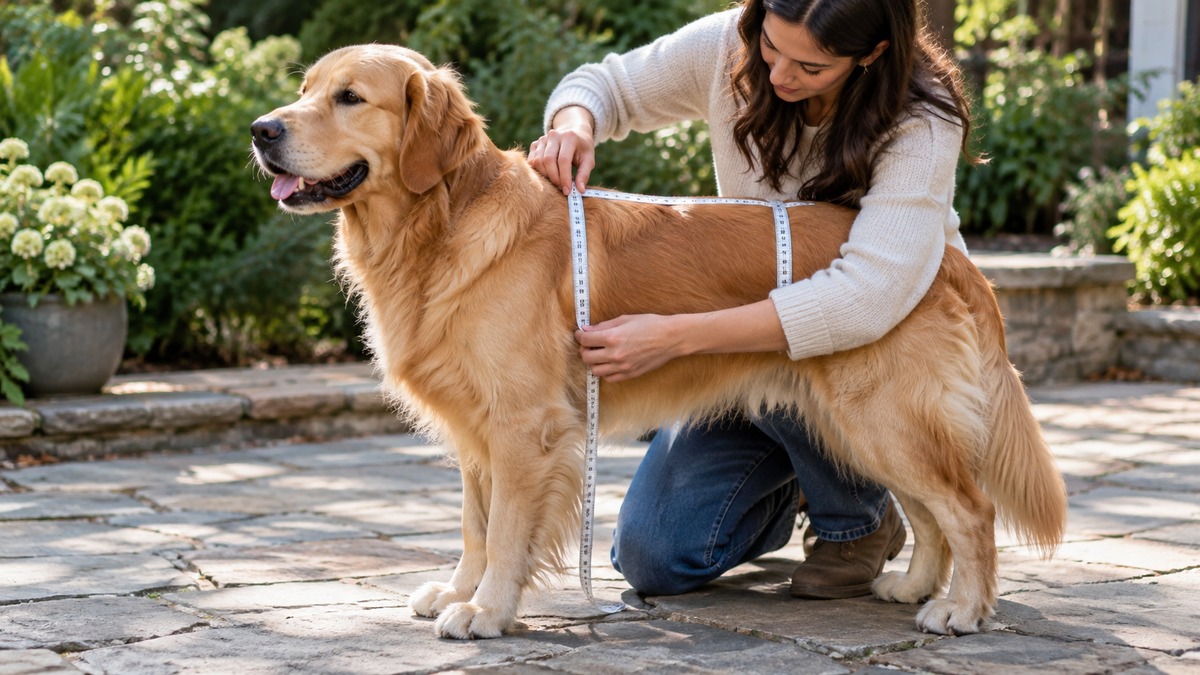
PetMD gives a method. Place the tape measure at the base of the tail, where the tail meets the body and not the end of the tail, and run it forward to the base of the neck. Measure along the spine on top of the back to get the most accurate reading. Keep the tape flat along the back and do not let it drop down the sides.
If the tape keeps slipping, use a string. Lay the string along the spine, mark where it starts and ends, then lay it flat against a ruler and read the length. AKC describes a similar method with string, ribbon or a shoelace when a tape is not on hand.
Write the back length down first, because it is the number most likely to be missed when people buy a coat by chest size alone.
Step 2: Measure chest girth
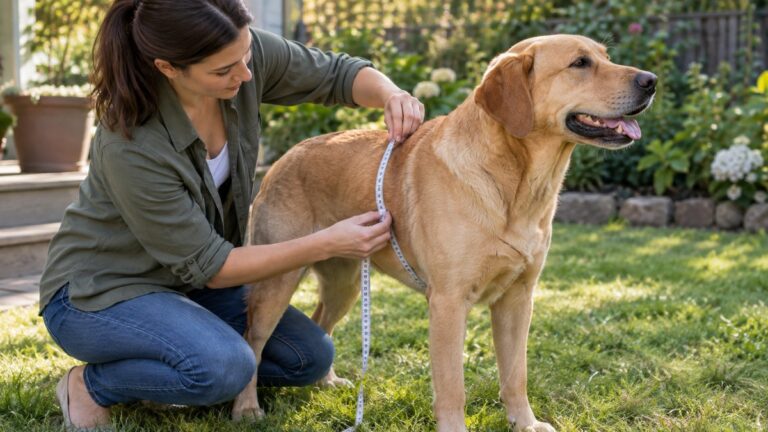
Chest girth is the measurement around the widest part of the rib cage. AKC describes the spot as the largest part of the rib cage, usually just behind the front legs. Wrap the tape around that spot while the dog stands, then read the number where the tape overlaps.
AKC says chest girth is typically the most important measurement for clothing and harnesses, because it reflects the widest part of the body. For a coat, this number is the main guide to whether the garment will sit across the chest without bunching or pinching.
Keep the tape snug but not tight. Use the two-finger rule: slip two fingers between the measuring tape and the dog. If you cannot slide two fingers under the tape, loosen it and measure again. If the tape moves freely around the body, tighten it slightly.
Measure at least twice. If the two numbers are far apart, measure a third time and use the figure that repeats. The sources we opened do not give a tolerance, so this is practical advice rather than a source rule.
Step 3: Measure neck girth
Neck girth is the circumference of the neck where a collar normally sits. AKC describes it as the circumference of the neck, generally where the collar sits, and it says the neck measurement helps when picking clothing and harnesses. It also says that collars primarily use the neck number.
AKC gives a more exact starting point. Begin near the withers, the ridge between the shoulder blades, and wrap the tape around to the front of the chest. Keep the tape close, but not tight, and use the two-finger rule there too. The page says to position the tape from the withers to the top of the chest.
For dogs with long necks, AKC notes that collars tend to sit higher on the neck, closer to the head. The same page advises measuring lower on the neck, between the withers and where a standard collar would rest. Use that lower point when the coat chart asks for a neck measurement, and write down which point you used.
PetMD describes the neck measurement the same way: the area where a collar typically sits. It also says you should be able to fit a finger or two between the dog’s skin and the item you are measuring for.
Step 4: Check height only if the chart asks for it
Some coat charts ask for height. PetMD says measuring height is particularly important when sizing a dog for a comfortable crate or harness. Its method is to measure to the highest point where the shoulder blades and neck meet.
If your coat chart uses height, hold the tape upright beside the dog and read the number at the top of the shoulders. Do not measure to the top of the head. Check the chart’s diagram before you measure, because some charts use a different point.
How to read a coat size chart
Coat charts are not the same from one maker to the next. AKC says each brand and design may differ slightly, so do not assume that a size M from one maker matches a size M from another. Check the garment type on each chart, because AKC says sweaters, jackets and raincoats each vary slightly by design and sizing.
Fill in the worksheet below before you compare charts. Leave the chart columns blank until you have read the chart.
| Measurement | Your dog (inches) | Chart label for this point | Chart range for the size you want |
|---|---|---|---|
| Back length | Write your number | Check the chart | Check the chart |
| Chest girth | Write your number | Check the chart | Check the chart |
| Neck girth | Write your number | Check the chart | Check the chart |
| Height (if asked) | Write your number | Check the chart | Check the chart |
If your dog falls between two sizes, the pages we opened do not give a general rule. Write down both options, check the return policy, and follow the maker’s own sizing advice. Do not guess.
Read the chart’s measuring instructions. Some charts ask for measurements over the dog’s bare skin. Others ask you to measure a garment the dog already wears. A chart that lists the garment’s measurements is not the same as one that lists the dog’s, so check which one you have. PetMD and AKC both describe measuring the dog, not the garment.
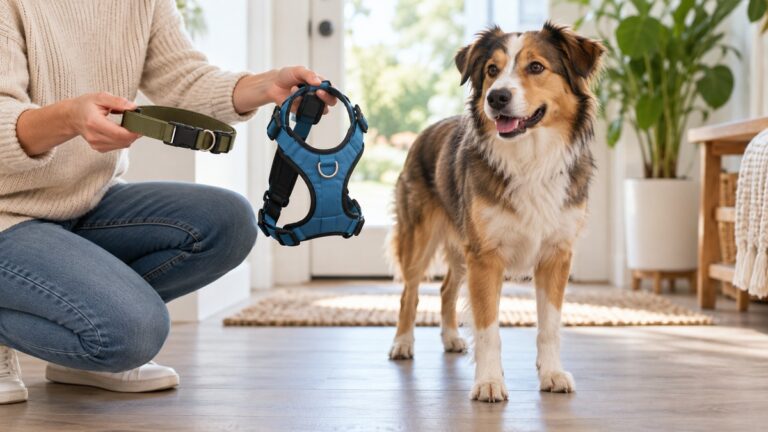
If you want a coat that works with a harness, the harness also needs its own measurements. For a coat that is worn with a harness, read waterproof dog coat with harness first. If both charts ask for chest or neck numbers, measure once and check each chart’s own measuring point before you compare.
Fit check once the coat arrives
Measuring is only part of the job. After the coat arrives, put it on the dog and check it before going outside. If the dog also wears a harness, see best dog harness to wear all the time for a separate look at harness use, and check the coat and harness together.
Use the two-finger rule again. AKC’s backpack guide describes the same kind of check for straps, asking you to fit one or two fingers beneath each strap. Apply that check to the coat’s neck and chest openings and any straps or fastenings.
Look for these signs during the check:
- The back of the coat reaches the base of the tail without sitting too high or too low on the back.
- The chest section lies flat without pulling at the front legs.
- The neck opening sits where the collar normally sits and does not ride up toward the head.
- You can slide two fingers under the edges at the neck and chest.
- The dog can sit, stand, lie down and walk without the coat shifting.
If anything feels wrong, loosen the fastenings, walk the dog indoors a few steps, and check again. A coat that looks right on the hanger may still shift once the dog moves.
Common mistakes
- Measuring a dog that is sitting, lying down or leaning. AKC says measuring while the dog stands gives a more accurate result.
- Skipping back length. AKC says a garment without the right back length can fall short during potty time.
- Buying by chest size alone. AKC says a sweater, jacket or raincoat still needs all three measurements.
- Pulling the tape too tight. Use the two-finger rule for every circumference.
- Measuring the neck at the wrong spot. Start near the withers when the chart does not name a point.
- Treating one brand’s chart as the same as another’s. Each brand and design may differ slightly.
- Trusting a breed name in place of a measurement. The pages we opened do not give breed sizing.
What we could not verify
- We could not verify a general rule for dogs whose measurements fall between two coat sizes. The pages we opened do not give one.
- We could not verify how much room each maker builds into a coat. Some charts include ease and some do not, and the sources we opened do not say which.
- We could not verify how a coat’s material affects warmth, water resistance or comfort. The pages we opened do not compare coat materials, so this guide makes no claim about them.
- We could not verify a measuring method for every coat style, including coats with a built-in harness opening or a hood. The pages we opened describe the three main measurements in general terms.
- We could not verify breed-based sizing for coats. The pages we opened do not list breed sizes.
- Where a coat chart asks for a point this guide does not cover, the chart is the authority for that maker.
FAQ
Which measurement matters most for a dog coat?
According to AKC, chest girth is typically the most important measurement for clothing and harnesses. Measure it first, then check back length and neck girth against the chart.
Do I need to measure back length for a sweater or raincoat?
Yes. AKC says sweaters, jackets and raincoats still need back length, chest girth and neck girth, and a garment with the wrong back length can fall short during potty time.
How tight should the tape be?
Keep it snug but not tight. AKC recommends the two-finger rule, which means you should be able to slip two fingers between the measuring tape and your dog.
Should I add extra inches to my dog’s measurements?
PetMD advises adding 1 or 2 inches to a measurement to get a snug but unrestricting fit. The sources we opened do not say whether a coat chart already includes that allowance, so check the chart’s instructions before you add anything.
Can I use string instead of a tape?
AKC says string, ribbon or a shoelace can work when a tape is not available. Wrap it snugly, mark where it overlaps, then lay it flat against a ruler to read the length.
What if my dog is between two coat sizes?
The pages we opened do not give a general rule. Write down both options, check the return policy and the maker’s sizing advice, and do not guess from the breed.
Bottom line
Measure back length, chest girth and neck girth with the dog standing, keep the two-finger rule on every measurement, and compare the numbers with the maker’s own chart. Then check the fit on the dog before the first walk.
Sources
- https://www.akc.org/expert-advice/lifestyle/measure-dog-gear/
- https://www.petmd.com/dog/general-health/how-to-measure-dog
- https://www.akc.org/expert-advice/lifestyle/teach-dog-wear-backpack/