How to Choose Dog Crate Size: A Measuring Guide
As an Amazon Associate we earn from qualifying purchases. Details
This guide explains how to choose dog crate size by measuring your dog and then checking the crate against what the dog needs to do inside it. The most useful test, according to Cornell’s Riney Canine Health Center, is room to stand up without ducking the head and room to turn around and lie down comfortably. Measure height and body length first, compare the numbers with the crate’s own dimensions, and then check the fit with the dog if you can. This guide names no products and ranks no crates.
Quick answer
- Measure your dog’s height and body length before you shop, because PetMD says height matters for sizing a dog for a crate.
- A crate should give enough space to stand up without ducking the head, and enough room to turn around and lie down comfortably, according to Cornell.
- ASPCA says a crate for travel should be large enough for the pet to stand, sit, lie down and turn around in.
- A crate that is too large can let a dog use one end as a toilet, so Cornell notes that a divider can help when a crate is bought for a growing puppy.
- If you buy for a puppy, Cornell advises a crate big enough to fit the dog as an adult, with a divider to make it smaller while the puppy grows.
- The sources we opened do not give a sizing formula or breed chart, so check each crate’s own dimension labels before you buy.
How we chose these steps
We opened four pages on October 23, 2026: the Cornell Riney Canine Health Center page on dog crates, the ASPCA travel safety page, the AKC crate training guide and the PetMD guide to measuring a dog. The measuring points and the stand, sit, lie down and turn-around test in this guide come from those pages. We did not add numbers from memory. Where a page does not cover a point, we say so in “What we could not verify.”
This is a how-to guide, not a buying list. It does not name crates, prices or ratings, and it does not rank sizes by brand.
What you need before you measure
- A soft fabric measuring tape. A metal tape bends and can pinch when you run it along the body.
- A pen and a note with the dog’s name, the date and each number in inches.
- A way to keep the dog still. Treats and a helper make the job easier, and you can stop and try again later if the dog moves.
- The crate’s dimension chart, saved or printed. Note whether the chart lists the outside size or the inside size, because the two are not the same.
Step 1: Decide what the crate must do
Before you measure, decide what the crate is for, such as sleeping at night, travel or daytime rest, and whether the dog is a puppy that is still growing. The measuring steps below are the same for each use, but the stage of growth changes how you plan the size.
Cornell says a crate needs room for the dog to stand up without ducking its head. It also needs room to turn around and lie down comfortably. Keep those four actions in mind as you measure, because they set the minimum that the dog’s body needs.
For travel, ASPCA lists the same four actions: stand, sit, lie down and turn around. It also says a crate or carrier should be well-ventilated and secure, so it does not slide or shift in the event of an abrupt stop. Ventilation and securing the crate are not sizing questions, so this guide does not compare them further.
Step 2: Measure height
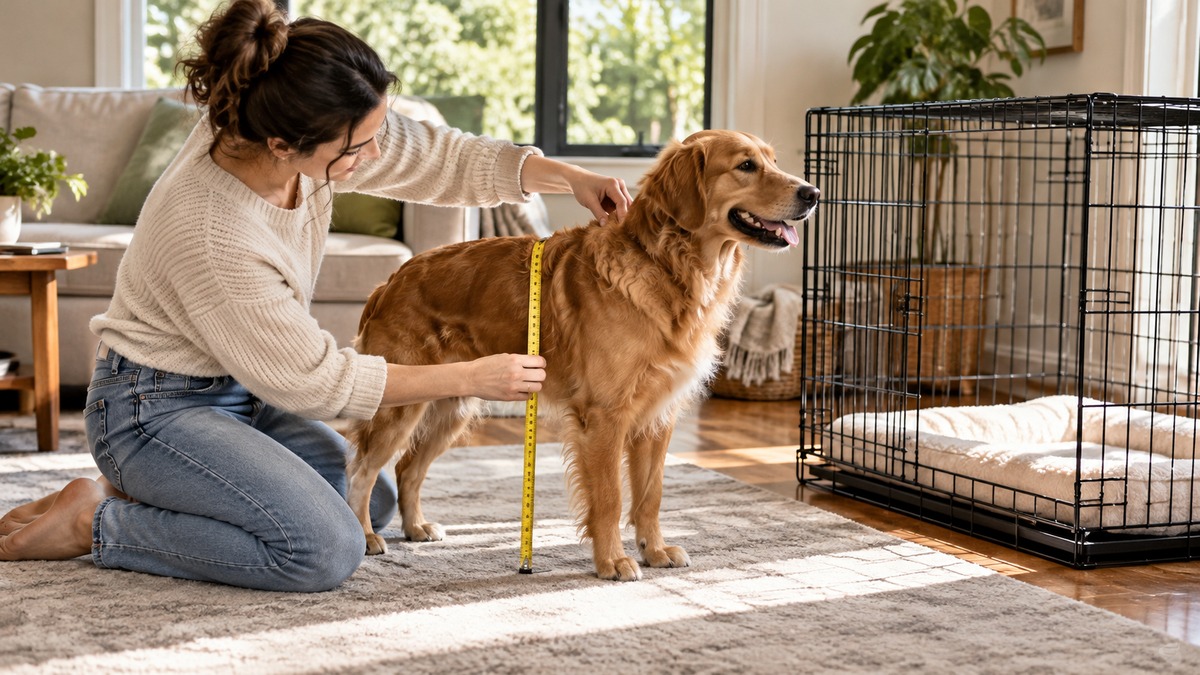
PetMD says that measuring height is particularly important when sizing a dog for a comfortable crate. Use the same standing posture every time. Ask the dog to stand square on a flat floor with its weight even on all four legs.
Hold the tape upright beside the dog and measure to the highest point where the shoulder blades and neck meet. Do not measure to the top of the head or the ear tips. Write the number down.
If the dog is a puppy, measure the height at its current size and write the date. You will want a second measurement later if the puppy is still growing, as Cornell’s advice on planning for adult size suggests.
Step 3: Measure body length
Body length is the other measurement that most crate charts use, although the crate chart may name it differently. PetMD describes the body length method for dogs: place the tape at the base of the tail, where the tail meets the body, and run it forward to the base of the neck. Measure along the spine on top of the back to get the most accurate reading.
Use the same method each time, and write the number down. Some crate charts ask for the length from the nose to the base of the tail instead. The sources we opened do not describe that method, so if the crate chart uses it, follow the chart’s own instructions and note which method you used.
Do not guess the length from the breed. The sources we opened do not give breed-based crate sizes, and a breed name does not tell you how long a particular dog is.
Step 4: Compare the numbers with the crate chart
Compare your height and length with the crate’s inside dimensions, not the outside. Check the chart’s labels before you compare, because a chart may list the outside size, the inside size or both.
Use this worksheet. Fill in your dog’s numbers first, then read the crate chart and fill in the last two columns.
| Measurement | Your dog (inches) | Crate chart label | Inside dimension of the crate |
|---|---|---|---|
| Height | Write your number | Check the chart | Check the chart |
| Body length | Write your number | Check the chart | Check the chart |
| Stand without ducking | Yes or no | Check the chart | Check the chart |
| Turn around and lie down | Yes or no | Check the chart | Check the chart |
If the crate’s inside height is close to your dog’s height, check whether the dog can stand without ducking its head. Cornell’s test asks for room to stand up, so check that point directly rather than relying on the height number alone.
Also check the width. The sources we opened do not give a width rule, but the turn-around and lie-down test implies that the dog needs enough room to move in both directions. If the chart lists a width, make sure it fits the dog’s lying position.
Step 5: Check the fit with the dog
If you can, check the fit with the dog before you commit to a size. Put the crate in a room the dog uses, with the door open and a blanket inside. Watch the dog go in, stand, turn around and lie down.
Look for these signs:
- The dog can stand up without touching the top of the crate with its head or ears.
- The dog can turn around without pressing into the sides.
- The dog can lie down in a comfortable position, such as on its side or stretched out.
- The dog does not look cramped or restricted while it moves inside.
If the dog cannot do one of these things, the crate is probably too small. If the dog can move freely with a lot of extra room, the crate may be too large, which is a different problem covered below.
When a crate is too large
Cornell says that if a kennel is too large, the dog may use one side as a bed and the other as a toilet. For that reason, a crate that is much bigger than the dog is not always better, even when the dog is still growing.
Cornell suggests a practical solution for growing puppies: a divider. Wire crates often come with dividers so a young dog can grow into the kennel size it will need as an adult. The divider makes the space smaller while the puppy is young and lets you move it back as the dog grows.
If you do not have a divider, the sources we opened do not say what size is right at each stage of growth. Ask your veterinarian or a trainer for help with the puppy stage, and do not rely on a single measurement taken months ago.
Puppy versus adult size
Cornell says that if the dog is a puppy, buy a crate that is big enough to fit the dog as an adult, to avoid buying several crates of different sizes. That advice depends on the dog’s adult size, which is not always known. Use the adult size from your veterinarian or breeder if you have it, and use the current size if you do not.
If you cannot tell the adult size, use a divider and plan to measure again as the puppy grows. Write each new measurement in the same note, so you have a record of the changes.
AKC’s crate training guide says that choosing the right crate size is an important part of successful crate training. The page does not give a size table, so the practical steps above are the way to choose.
Once the size is settled, bedding is the next question. For a bedding idea, read best blanket over dog crate at night, and for a puppy crate setup, best no bedding in puppy crate. Use them after you have the crate size right, because bedding takes up some of the inside space.
Mistakes to avoid
- Measuring to the top of the head instead of the shoulder point that PetMD describes.
- Comparing the crate’s outside size with your dog’s inside measurement. Check the inside dimensions.
- Buying a crate that is only just tall enough for the dog to stand, then forgetting that the dog may stretch or lift its head.
- Buying the largest crate by default. Cornell says a kennel that is too large can let the dog use one end as a toilet.
- Measuring a puppy once and never measuring again as it grows.
- Assuming a breed chart is accurate for your dog. The sources we opened do not give breed sizes.
- Skipping the fit check with the dog. A crate that looks right on paper may still feel cramped to the dog.
What we could not verify
- We could not verify a sizing formula for crates, such as a set amount of extra inches to add to height or length. The sources we opened do not give one.
- We could not verify breed-based crate sizes, weight-based charts or age-based charts. The sources we opened do not provide them.
- We could not verify how a crate’s material, wall thickness or frame affects the inside dimensions. Check the chart’s labels for those numbers.
- We could not verify how much extra room a particular crate size gives a particular dog. The sources we opened do not compare crates.
- We could not verify a general rule for how long a puppy should stay in a divided crate. Ask your veterinarian for that.
- We could not verify whether one crate style is better than another for a given dog. This guide does not make that comparison.
- Where a crate chart asks for a point this guide does not cover, the maker’s chart is the authority for that crate.
FAQ
How do I know what size crate my dog needs?
Measure your dog’s height and body length, then check the crate’s inside dimensions. Cornell’s test is that the dog can stand up without ducking its head and can turn around and lie down comfortably.
Should I buy a crate big enough for my puppy as an adult?
Cornell advises that a puppy’s crate be big enough to fit the dog as an adult, so you do not need to buy several sizes. A divider can make the space smaller while the puppy is young.
Is a bigger crate always better?
No. Cornell notes that if a kennel is too large, the dog may use one side as a bed and the other as a toilet. A crate that gives room to stand, turn around and lie down is the goal.
What height should I measure my dog to?
PetMD says to measure to the highest point where the shoulder blades and neck meet. Do not measure to the top of the head.
Can I use the breed to pick a crate size?
The sources we opened do not give breed-based sizes. Measure the dog and use the crate’s inside dimensions instead.
Does a crate used for travel need the same size?
ASPCA says a travel crate should be large enough for the pet to stand, sit, lie down and turn around in. Use the same four actions as the sizing test, and check that the crate is secure for the trip.
Bottom line
Measure your dog’s height and body length, compare them with the crate’s inside dimensions, and check that the dog can stand, turn around and lie down. If the crate is for a puppy, use a divider rather than buying a crate that is too large for the dog to use safely.
Sources
- https://www.vet.cornell.edu/departments-centers-and-institutes/riney-canine-health-center/canine-health-topics/dog-crates-when-use-them-and-how-pick-one
- https://www.aspca.org/pet-care/general-pet-care/travel-safety-tips
- https://www.akc.org/expert-advice/training/crate-training/
- https://www.petmd.com/dog/general-health/how-to-measure-dog