How to Clean a Dog Kennel: Step-by-Step Guide
As an Amazon Associate we earn from qualifying purchases. Details
If you want to know how to clean dog kennel setups without skipping a step, the order is what matters: clear out waste and debris first, scrub the surfaces with a detergent, rinse, and dry. When you need to disinfect, use a diluted household bleach solution on surfaces that bleach will not damage, let it sit for a full 10 minutes, then rinse and dry again. The Maddie’s Fund cleaning handout we opened lists crates and pens among the objects that can carry germs from a sick animal, and it describes the same clean-then-disinfect sequence for them. This guide covers the routine and the points the sources leave open.
Quick answer
- Clear waste and debris first. The handout says cleaning always comes first, and a surface cannot be disinfected until it has been cleaned.
- Scrub the kennel with a detergent such as Dawn, rinse, and dry. The handout describes a detergent as the agent that removes dirt and grease.
- Disinfect with a diluted bleach solution where bleach will not damage the surface, leave it on for a full 10 minutes, then rinse and dry.
- Clean on a schedule: the handout advises at least weekly when all animals are healthy, and at least daily when an animal has an infectious disease.
Why a kennel is a cleaning job, not just a wipe-down
A dog kennel holds several things at once: the floor, the walls, the bedding, the bowls, and often the toys and collars that go in with the dog. The Maddie’s Fund handout lists floors, walls, bedding, toys, food and water bowls, and crates and pens among the objects and surfaces that a sick pet can come into direct contact with. Those are the parts of the kennel that need the full routine, not a quick spray.
The handout treats surfaces differently depending on what they are made of. It describes tile and vinyl floors, countertops, and tile walls as particularly easy to clean and disinfect, and it lists bleach-safe objects such as bathtubs, tile, and stainless-steel bowls, which would not be damaged by a 1:10 or 1:32 dilution of household bleach. It also says that bedding, carpet, and upholstered furniture would be damaged by the same dilutions. A kennel is usually a mix of these materials, so the cleaning method has to match each part.
If you are shopping for the kennel setup itself, our guide to blanket over dog crate at night covers the soft layer that goes inside, and the Coolaroo elevated pet bed guide covers a raised bed style. Both are useful alongside the cleaning steps here.
How we chose
This guide is based on four sources we opened and read on 2026-10-23: the Maddie’s Fund cleaning and disinfection handout for foster homes, the EPA-registered bleach label, the AKC article on cleaning a dog bed, and a UC Davis handwashing handout. We used the steps, cautions, and frequency guidance that those sources state. We did not rank kennels or recommend any product. Where a point is outside the sources, such as outdoor runs or a specific kennel material, it is listed under “What we could not verify.”
Step-by-step: cleaning the kennel
Step 1: Remove the dog and clear the kennel
Take the dog out before you start, and remove the bedding, bowls, toys, and any loose items. The handout’s first step for any object is to remove all debris, including fur, food, and waste, before you use a cleaning agent. Put bedding aside to be washed separately, using the hot-water laundry route the handout describes.
Remove waste first. The handout lists waste such as poop, pee, vomit, and nasal discharge among the debris that must be removed from a surface before it is cleaned. Pick up solids and dispose of them, then move to scrubbing.
Step 2: Scrub with a detergent
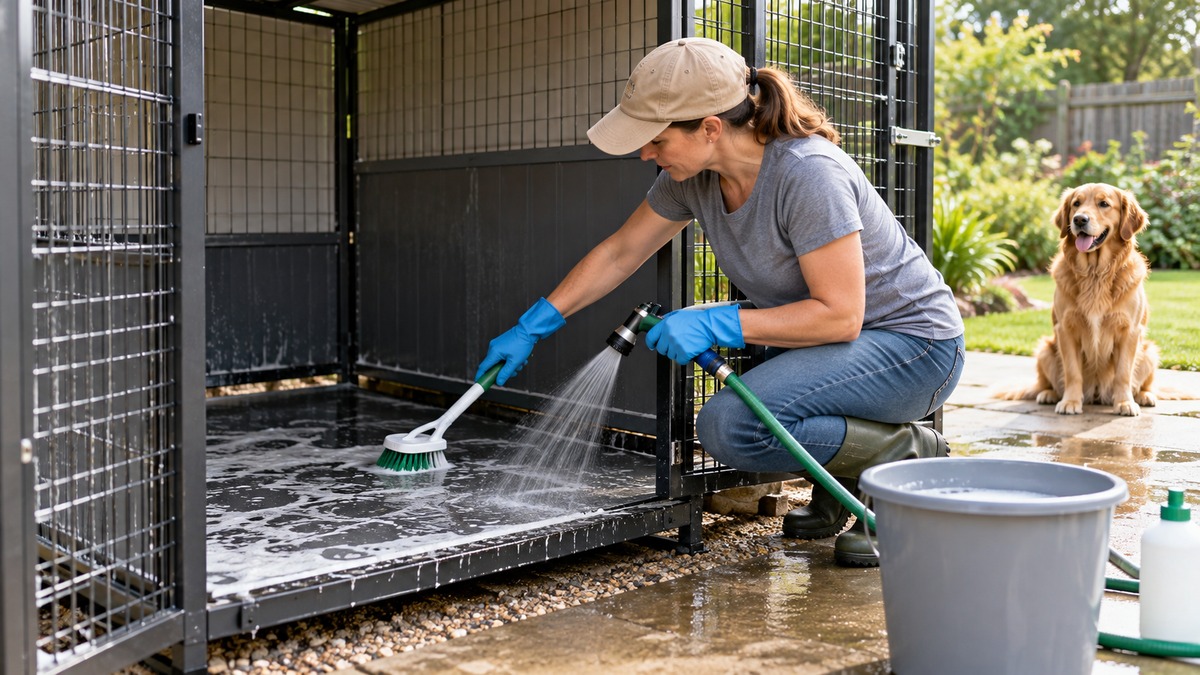
Use a detergent. The handout describes a detergent as a cleaning agent that helps remove dirt and grease from surfaces, and it names a dishwashing detergent such as Dawn as a good choice. For greasy residue, the handout describes a degreaser as a stronger option. Scrub the floor, walls, and any bars or corners where dirt collects, because the handout’s sequence for hard surfaces is to scrub with the detergent before any disinfecting.
Do not limit the scrub to the open floor. The handout’s routine applies to the whole surface of each object, so the walls and corners need the same attention.
Step 3: Rinse and dry
Rinse the kennel with clean water until no detergent remains, and let every surface dry before you disinfect or return the dog. The handout’s sequence for bleach-safe objects is to scrub, rinse, and dry before any bleach is applied. Leftover detergent can affect the bleach, so do not skip the rinse.
Step 4: Disinfect with diluted bleach where it is safe to do so
The handout describes a dilution of household bleach as the best choice for disinfecting in a foster home. A 1:32 dilution kills most infectious diseases except ringworm, and ringworm needs a stronger 1:10 dilution. For an 8.25% bleach, the handout gives 1/3 cup of bleach per gallon of water for a 1:32 dilution and 1 cup per gallon for a 1:10 dilution. Check the concentration printed on your own bottle first, since the handout notes that most household bleach is 8.25% even though most labels no longer state it.
Apply the solution only to hard surfaces that bleach will not damage, such as tile, and cover the surface. Let it sit for a full 10 minutes of contact time, then rinse and dry. The handout explains that the bleach needs that time to work, and that a quick rinse is not enough. Apply enough solution that it does not evaporate before the 10 minutes is up.
The handout gives this warning: remember that bleach can burn. People should wear gloves and masks, avoid exposing animals to the fumes, and keep the area well ventilated. The EPA-registered bleach label we opened lists pet kennels among the hard, nonporous surfaces where the product can be used, and it says not to use the product at full strength for cleaning surfaces and to always dilute it strictly in accordance with the directions.
Step 5: Handle bedding and soft surfaces separately
Bedding, carpet, and upholstered furniture would be damaged by diluted bleach used as a surface disinfectant, so do not spray them with the bleach solution. The handout’s approach is to launder bedding in hot water, separately from other laundry, and to vacuum carpet thoroughly before cleaning it. For a soft kennel cushion or pad, check the care label before washing, and dry it fully before the dog returns.
The AKC article on dog bed cleaning says that high-temperature washing programs can kill germs and parasites, recommends a fragrance-free, pet-friendly detergent, and advises air drying where possible, because a damp bed encourages mold and mildew.
Step 6: Clean the bowls, toys, and tools in the same session
The handout treats food and water bowls and toys as part of the kennel routine. Stainless-steel bowls are bleach-safe and very easy to clean and disinfect, according to the handout, while plastic dishes, rubber or plastic toys, and bedding are not as easy. Clean the bowls and toys in the same session, following the routine for each material. Throw away cardboard items, which the handout says cannot be cleaned or disinfected.
Clean the tools you use as well. The handout reminds readers that cleaning equipment can itself be a fomite, which is why the vacuum and steam cleaner should be cleaned after use.
How often to clean a dog kennel
The Maddie’s Fund handout gives the most direct frequency guidance in our sources. It advises cleaning and disinfecting before any new animals come into the household, at least daily when an animal has an infectious disease, at least weekly when all animals are healthy, and as needed to clean up messes such as vomit, diarrhea, and nasal discharge.
These are foster-home figures. The sources we opened do not give a single schedule for a household dog kennel. A practical plan is to pick up waste every day, scrub and rinse on the weekly schedule, and wash the bedding in the same week, and to step up to daily cleaning with disinfecting whenever a dog in the house is ill.
Hand washing after cleaning
Cleaning a kennel means handling waste and surfaces the dog has touched. The UC Davis handwashing handout says to wash hands after touching animals or their living area, and after leaving the animal area. It asks people to wet their hands with clean running water, apply soap, scrub well including the backs of the hands and under the fingernails, rub hands together for at least 20 seconds, rinse, and dry with a clean paper towel or air dry them. The handout names young children, older adults, and people with weakened immune systems as the groups to take particular care.
Common mistakes
- Disinfecting before the kennel is clean. The handout is clear that cleaning comes first.
- Rinsing the bleach off too soon. The handout says the bleach needs its full 10 minutes.
- Using a bleach solution on bedding or carpet. The handout says those items would be damaged.
- Using a recipe built for a different bleach strength. The handout notes the concentration matters, and that recipes built on 5.25% bleach no longer match most store bottles.
- Mixing bleach with other cleaning products. The label directions are the guide here, and the sources we opened do not describe safe combinations.
- Skipping the drying step. The handout’s sequence ends with rinse and dry.
What we could not verify
- Whether an outdoor run, a chain-link enclosure, or a kennel with a concrete base can be disinfected with bleach. The handout’s bleach-safe examples are tile, bathtubs, and stainless steel, and the sources do not cover concrete or outdoor surfaces.
- Whether a wire or metal kennel frame can take a bleach solution without damage. The sources do not say.
- Whether a plastic kennel tray or base can take diluted bleach. The handout lists plastic dishes as harder to clean and disinfect, but it does not say whether they are bleach-safe.
- How often a kennel needs cleaning in a household where no dog is ill. The handout’s frequency figures are written for foster homes.
- Whether a steam cleaner gives the same result as a bleach solution on a kennel floor. The handout mentions steam cleaning only for carpet and furniture.
- The exact disinfecting method for a specific kennel product. Check the kennel maker’s care label, because the sources we opened do not cover individual kennel products.
FAQ
How often should I clean a dog kennel?
The Maddie’s Fund handout advises at least weekly cleaning when all animals are healthy, at least daily cleaning and disinfecting when an animal has an infectious disease, and cleaning as needed after vomit, diarrhea, or nasal discharge. Those are foster-home figures, so follow them as a guide rather than a fixed rule for every household.
What is the best way to disinfect a dog kennel?
The handout recommends a dilution of household bleach for foster homes. Use 1:32 for most infectious diseases and 1:10 for ringworm, based on 8.25% bleach. Clean first, apply the solution to a surface bleach will not damage, let it stand for 10 minutes, then rinse and dry.
Can I use bleach on a kennel floor?
The handout lists tile and vinyl floors as particularly easy to clean and disinfect, and it lists tile among the bleach-safe surfaces. It does not cover concrete or other floor materials, so check the kennel and floor maker’s advice before using bleach on a different surface.
Should I wash the kennel bedding in the same load as my clothes?
No. The handout says bedding and similar items should be laundered in hot water, separately from other laundry. The AKC article adds that high-temperature programs can kill germs and parasites.
Do I need gloves and a mask when I use bleach?
The handout says people using bleach should wear gloves and masks, make sure there is adequate ventilation, and avoid exposing animals to the fumes. The EPA-registered label says to dilute strictly according to the directions and not to use the product at full strength for cleaning surfaces.
Should I wash my hands after cleaning the kennel?
Yes. The UC Davis handwashing handout says to wash hands after touching animals or their living area, and to rub hands together with soap for at least 20 seconds before rinsing and drying.
Bottom line
Remove the dog and the debris, scrub with a detergent, rinse, and dry. Disinfect the surfaces that bleach will not damage with a freshly made 1:32 solution, or 1:10 for ringworm, left on for a full 10 minutes. Launder bedding separately in hot water, and clean the kennel on the weekly or daily schedule the handout describes, depending on whether a dog is ill.
Sources
- https://www.maddiesfund.org/cleaning-and-disinfection-in-foster-homes/presentation_content/external_files/Educational%20Handout-%20Cleaning%20and%20Disinfection%20in%20Foster%20Homes.pdf
- https://www3.epa.gov/pesticides/chem_search/ppls/005813-00001-20060925.pdf
- https://www.akc.org/expert-advice/lifestyle/how-to-clean-a-dog-bed/
- https://ucfoodsafety.ucdavis.edu/sites/g/files/dgvnsk7366/files/inline-files/200948.pdf