Best Dog Water Bottle
As an Amazon Associate we earn from qualifying purchases.
The best dog water bottle is easy to operate before a thirsty dog loses patience, carries enough water for the outing, and has a drinking surface that suits the dog’s muzzle. The 27-ounce stainless-steel PupFlask is the strongest all-around candidate in this group because its capacity, low listed bottle weight, and broad fold-over silicone cup are clearly documented. Smaller outings may favor the 12-ounce MalsiPree, while the 750 ml SÄKER trades a rigid body for a collapsible silicone format. Capacity should be chosen from the trip plan, not from a breed label alone.
Quick answer
- Best overall candidate: the 27-ounce PupFlask combines a stainless-steel bottle, reversible silicone drinking cup, and 4.7-ounce listed item weight.
- Best compact rigid bottle: MalsiPree holds 12 ounces and uses a built-in trough with one-hand water control.
- Best collapsible design: the 750 ml SÄKER is silicone and folds down as it empties.
- Best for carrying treats too: Cibaabo adds a 100 g food container to a 300 ml water bottle.
Capacity is a trip-planning number, not a promise
A portable bottle has two jobs: transport water without creating a mess and present that water in a shape the dog can drink from. Capacity determines how much can leave home, but it does not determine how long the supply will last. Weather, activity, dog size, coat, diet, and access to refill points all change the amount needed. None of the product entries provides an individual hydration schedule, so the right capacity cannot be inferred from the bottle’s breed recommendation.
The selected options span from 300 ml to 750 ml. MalsiPree is titled as a 12-ounce model, though its structured capacity field says 500 ml; that inconsistency deserves caution. Anipaw states 14 ounces. Cibaabo’s selected model is 300 ml, with a separate 100 g food compartment. The lesotc bottle holds 520 ml, SOICTA holds 560 ml, PupFlask is listed at 27 fluid ounces or 765 ml depending on the field, and SÄKER holds 750 ml. The two largest stated metric capacities are therefore very close.
| Bottle | Published capacity | Listed item weight | Body material | Drinking format |
|---|---|---|---|---|
| PupFlask | 27 fl oz / 765 ml | 4.7 oz | Stainless steel | Reversible silicone cup |
| MalsiPree | 12 oz in title; 500 ml in specifications | 6 oz | Plastic | Integrated trough |
| Anipaw | 14 oz | 10.1 oz | Stainless steel | Silicone cup and button flow |
| Cibaabo | 300 ml plus 100 g food container | 7.1 oz | ABS and polycarbonate | Built-in bowl with return flow |
| SÄKER | 750 ml | 7 oz | Silicone | Fold-over lip forms bowl |
| lesotc | 520 ml / 18 oz | 4.8 oz | LDPE and silicone | Fold-cap bowl |
For a common-unit comparison, use milliliters ÷ 29.5735 = US fluid ounces. SÄKER’s 750 ml works out to about 25.36 fluid ounces, and lesotc’s 520 ml is about 17.58 fluid ounces. Cibaabo’s 300 ml is about 10.14 fluid ounces. Those conversions reveal minor differences between rounded marketing labels and metric specifications without suggesting that every container can be filled to the rim in normal use.
Capacity also adds carried weight. Water itself is much heavier than these empty bottles: the listing weights cover the product, not a filled setup. A larger reservoir makes sense when refill access is uncertain, but it becomes a poorer choice if its size causes the handler to leave it behind. Think in segments: travel to the activity, the activity itself, and the return. If the supply appears insufficient for that plan, carry additional water rather than stretching what remains.
The bowl shape has to work for the dog in front of you
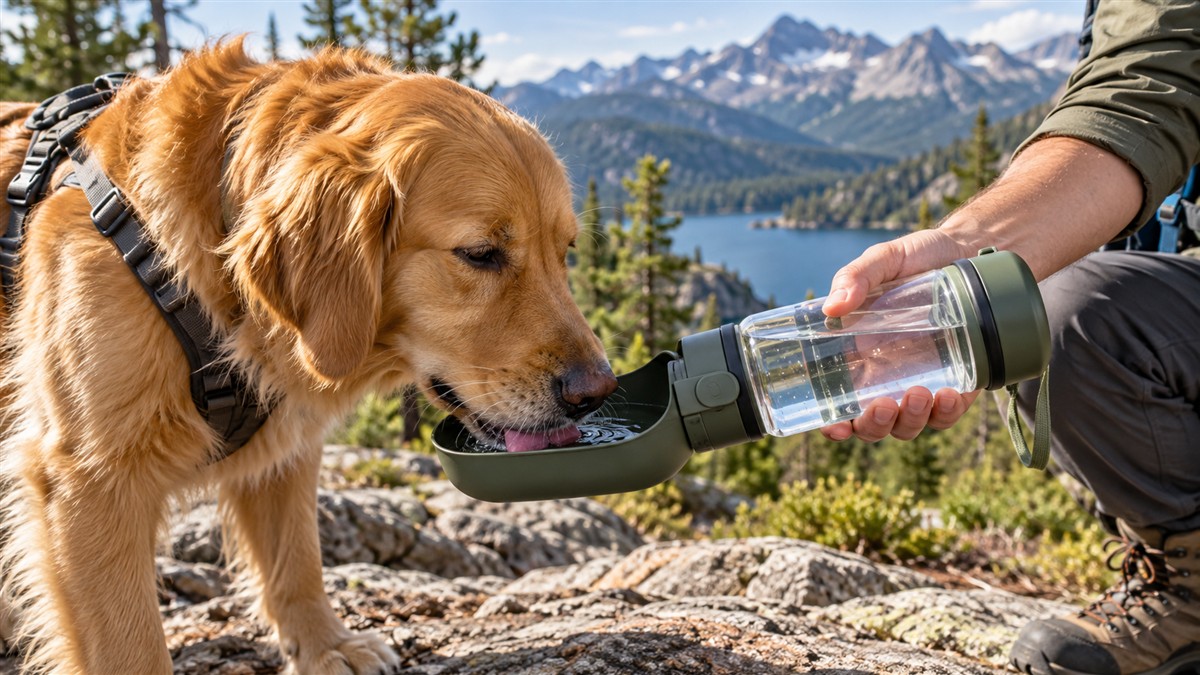
Integrated bowls remove the need to pack a separate dish, but their shapes vary. PupFlask uses a leaf-like silicone cup that flips up for drinking and folds against the bottle afterward. SÄKER turns a flexible lip outward to create a bowl. Lesotc also uses a fold-cap concept. MalsiPree, Anipaw, Cibaabo, and SOICTA direct water into a rigid or semi-rigid trough attached to the bottle.
A broad cup may be easier for a wide muzzle, while a narrow trough may pack more neatly. The supplied information does not give usable internal bowl dimensions for most models, so muzzle compatibility cannot be proven from overall bottle width. The PupFlask is listed at 3.75 inches across in one entry, Anipaw at 2.95 inches, and MalsiPree at 3.6 inches, but those are overall dimensions rather than confirmed drinking-area measurements.
Observe how the dog normally drinks. Some dogs will lap from a shallow channel; others need more surface area and may spill from the sides. A dog that refuses an unfamiliar trough still needs access to water, so introduce the bottle at home before relying on it during travel. Put a small amount into the cup, let the dog approach without pressure, and learn how much can be presented without overflowing.
A crate-mounted bowl solves a different problem because it stays in place rather than traveling in a hand or pack. For that setup, see our guide to water bowls designed for dog crates. A bottle-shaped chew toy is also unrelated to hydration; our article on water-bottle-style dog toys covers that separate use.
Rigid bottles and collapsible bottles solve different packing problems
PupFlask and Anipaw use stainless-steel bottle bodies. Their empty shapes remain constant, which makes them easy to slide into a bottle pocket but means the same space is occupied after the water is gone. PupFlask lists a 4.7-ounce item weight at 27 fluid ounces, while Anipaw lists 10.1 ounces for a 14-ounce capacity. Those figures describe the complete listed items and should not be read as a material-only comparison because the caps, bowls, locks, and construction differ.
SÄKER is the only fully collapsible reservoir selected. Its silicone body can fold as it empties, and the listing says the empty bottle compacts to roughly the size of a banana. That comparison is qualitative, not a measured packed dimension. Its stated full-size dimensions are 3.15 by 3.15 by 7.68 inches. A flexible bottle saves space after use but may feel different to hold and store when full.
MalsiPree, Cibaabo, and the SOICTA alternative use plastic bodies. Cibaabo identifies ABS and polycarbonate; lesotc identifies low-density polyethylene and silicone. Material names help distinguish construction, but they do not establish durability, odor retention, temperature tolerance, or service life across brands. The listings make various food-contact and BPA statements, yet they do not provide a shared certification record or test report in the supplied fields.
Water control matters more than a dramatic leak claim
A travel bottle usually controls flow with a button, lock, valve, or squeezable body. MalsiPree describes a water key and leak lock. Anipaw uses a button that releases water while pressed and adds a separate lock against accidental operation. Cibaabo directs unused water back into the bottle when its lock button is held. SOICTA likewise describes one-touch release and return flow. SÄKER uses quick-release buttons for outward and return flow.
Return flow can conserve water, but it also sends water that contacted the drinking bowl back into the reservoir. The listings do not address how owners should handle returned water after dirt, saliva, or debris enters the cup. In a clean setting this may be convenient; on a dusty trail, discarding visibly contaminated water may be more sensible. Clean the drinking surface and bottle according to the maker’s instructions after use.
“Leak-proof” appears across the listings, but no shared test duration, orientation, pressure, or drop method is supplied. Treat every closure as a feature to inspect rather than permission to place the bottle beside electronics without protection. Fill it at home, close it exactly as directed, turn it through the positions it will encounter in a bag, and check the seal. Repeat that inspection when a gasket is removed for cleaning or shows wear.
Several models use silicone sealing rings. A seal can only work when it is present, clean, seated correctly, and paired with a fully closed lock. Cibaabo explicitly reminds users to lock the bottle after use. Anipaw adds a lock intended to prevent accidental button contact. The bottle that best fits your routine is the one whose closed state is obvious enough that you will confirm it every time.
Food compartments and filters add functions that need upkeep
Cibaabo is the only selected bottle that includes a dedicated food container. The selected configuration holds 300 ml of water and 100 g of food. That can consolidate a short outing into one object, but it also creates more pieces to wash and dry. The food figure is mass, while the water figure is volume; the two numbers cannot be added into a meaningful combined capacity.
The same model includes a carbon filter according to its listing. The entry does not state a replacement interval, contaminant-removal standard, flow rate, or independent performance result. A filter should not be treated as authorization to fill from a questionable source. Start with water you consider suitable for the dog, and follow any replacement directions supplied with the actual product.
If the bottle is used to carry training treats, keep the roles separate in your plan. Water breaks should not depend on whether food remains, and the food compartment should be cleaned so residue does not transfer into wet components. The 100 g figure is a container rating from the listing, not a feeding recommendation.
Cleaning instructions can decide which bottle stays useful
A bottle with a valve, return channel, gasket, or fold-over bowl has more surfaces than an ordinary open dish. Disassemble only as the maker directs and let every washable component dry before reassembly. Pay attention to the underside of silicone cups and the narrow area where water enters the trough. A quick rinse may remove visible debris without reaching every seam.
Cibaabo describes its ABS and polycarbonate bottle as dishwasher safe. Lesotc explicitly lists hand washing. SOICTA says not to place its bottle in a dishwasher or another very high-temperature setting. The other selected specifications do not all provide a complete wash method. Do not transfer one brand’s care instructions to another product simply because the bottles look similar.
The product entries also differ in opening size. SÄKER identifies a 1.5-inch neck and says it can accept ice cubes. The remaining listings do not provide comparable mouth diameters. A wider opening can simplify filling and access for a brush, but cleaning still depends on whether valves and seals can be reached.
How to choose without relying on a breed label
Begin with the longest outing you actually take and whether refills are reliably available. Select a capacity with reserve rather than planning to empty the bottle exactly at the finish. Then compare the drinking shape with the dog’s muzzle and habits. Next, decide whether a rigid bottle pocket or a collapsible shape fits the bag. Finally, examine the control: the lock should be easy for the handler to use intentionally and hard to activate accidentally.
None of these listings supplies a complete dog-weight interval for the selected bottle. Some include broad breed-size fields such as small, medium, large, giant, or all sizes, but those labels do not calculate water need and do not prove bowl fit. Each selected product card therefore notes that a dog-weight range is absent.
For car travel, secure the bottle so it cannot roll around the cabin, and plan water stops independently of the bottle’s marketing language. A portable dispenser carries and presents water; it does not monitor the dog or decide when a break is needed. If you have concerns about an individual dog’s drinking, exercise tolerance, or health, ask a veterinarian rather than using a generic capacity rule.
How we chose
We used the eight products in the supplied research file and compared their ASINs, titles, bullets, and published specifications. One of the two 27-ounce PupFlask entries was selected because they describe essentially the same construction in different colors. Removing that duplicate left room to compare a compact rigid bottle, a button-controlled stainless model, a bottle with food storage, a collapsible silicone reservoir, and a fold-cap dispenser.
Capacity and drinking interface received the most weight. We then considered empty item weight, body material, water-control method, stated leak features, dimensions, carrying aids, and care instructions. Conflicting fields were preserved as conflicts rather than silently resolved. Seller claims about leakage, material safety, temperature, filtration, and durability were not converted into independently established results.
Products were eligible only when the listing described a portable drinking bottle or dispenser for dogs. The list does not include decorative bottles or bottle-shaped toys. We favored meaningful differences over minor color changes, and no product was ranked by a size label alone.
What we could not verify
The listings do not state a common leak test, drop test, food-contact certification, odor-retention test, valve-cycle result, or filter standard. They do not provide internal bowl dimensions suitable for comparing muzzle access. No listing gives a dog-weight range that determines how much water its selected capacity will cover, and no listing provides an individualized hydration schedule.
MalsiPree’s title says 12 ounces while its structured capacity says 500 ml, which is approximately 16.91 fluid ounces. PupFlask is described as 27 fluid ounces and 765 ml, figures that are reasonably close after rounding. We could not verify fill-line conventions or usable capacity after the drinking mechanism is installed. Long-term seal life and replacement-part availability are also not stated consistently.
Best dog water bottles by travel style
PupFlask 27-ounce stainless bottle: best overall candidate
PupFlask combines a 27-fluid-ounce stainless-steel reservoir with a reversible silicone cup that lies against the bottle between drinks. The selected blue model lists a 4.7-ounce item weight and dimensions of 3.75 by 3.75 by 9 inches. Its broad cup format and relatively large capacity make it the most balanced candidate for an owner who does not need the bottle to collapse.
Skip if: a rigid nine-inch bottle will not fit your carrying setup.
Limitation: no dog-weight range is stated, and the listing does not give the cup’s internal drinking dimensions.
MalsiPree pink bottle: best compact one-hand candidate
MalsiPree uses a plastic reservoir, integrated trough, water key, and lock. The selected item is titled as a 12-ounce bottle and weighs six ounces. Its listed dimensions are 3.6 by 3.6 by 11.5 inches, though a separate product-dimensions field gives different measurements. It is intended for one-hand dispensing without a separate bowl.
Skip if: you require an unambiguous published capacity before choosing.
Limitation: the title says 12 ounces while the capacity field says 500 ml, and no dog-weight range is stated.
Anipaw 14-ounce stainless bottle: best lock-and-button format
This 14-ounce bottle uses a stainless-steel body, silicone drinking cup, button-controlled flow, sealing ring, and separate control lock. It weighs 10.1 ounces and measures 2.95 inches across by 10.83 inches tall. The narrower overall width may fit some bottle pockets more readily than broader cup designs.
Skip if: empty bottle weight is a primary concern.
Limitation: no dog-weight range or internal cup measurement is stated.
Cibaabo 300 ml bottle: best bottle-and-food combination
Cibaabo pairs a 300 ml water compartment with a 100 g food container, a built-in bowl, a silicone seal, a lock button, and a carbon filter. Water can flow back toward the reservoir when the control is held. The ABS and polycarbonate unit weighs 7.1 ounces. This is the most feature-dense selection for a short outing that also requires treats.
Skip if: you prefer fewer removable parts or need more than about 10.14 fluid ounces of stated water capacity.
Limitation: no dog-weight range or filter replacement interval is stated.
SÄKER 750 ml bottle: best collapsible candidate
The SÄKER uses a silicone reservoir and a fold-over lip that becomes a drinking bowl. Quick-release controls send water outward or back, and the 1.5-inch neck is described as wide enough for ice cubes. It holds 750 ml, weighs seven ounces, and measures 3.15 by 3.15 by 7.68 inches before considering its collapsed state.
Skip if: you want the stable shape of a rigid metal bottle.
Limitation: the collapsed size is not numerically stated, and no dog-weight range is provided.
lesotc 520 ml fold-cap bottle: best light mid-capacity candidate
Lesotc combines a 520 ml reservoir with a silicone fold-cap bowl, button lock, sealing ring, extension strap, and carabiner. It weighs 4.8 ounces and is listed for hand washing. At approximately 17.58 fluid ounces by conversion, it sits between the small rigid options and the two largest reservoirs.
Skip if: dishwasher compatibility is required.
Limitation: no dog-weight range or drinking-area dimensions are stated.
FAQ
How large should a dog water bottle be?
Choose capacity from the outing length, activity, conditions, refill access, and the individual dog rather than a universal breed rule. The selected bottles range from 300 ml to 765 ml. Carry reserve water when access is uncertain. If you are concerned about how much a particular dog drinks or should drink, ask a veterinarian for individualized guidance.
Is stainless steel better than plastic or silicone?
Each material changes the design rather than creating an automatic winner. Stainless bottles stay rigid; silicone can collapse; plastic supports compact button-and-trough layouts. The supplied listings do not provide a shared durability, odor, or temperature test. Choose the drinking shape, capacity, weight, and care instructions that fit the trip, then inspect the actual product regularly.
Can unused bowl water go back into the bottle?
Several selected designs permit return flow, including Cibaabo and SÄKER. That can reduce waste, but water in the bowl may collect saliva, soil, or debris. The listings do not give a contamination threshold. Use judgment based on what entered the cup, discard visibly dirty water, and clean the components after the outing.
How can I tell whether the bottle will leak in my bag?
Follow the exact closing sequence, inspect the seal, and perform a filled-bottle check at home in the positions the bottle will encounter. A seller’s leak wording does not reveal a shared test standard. Keep the dispenser separated from moisture-sensitive items until you understand how its lock and gasket behave in normal carrying conditions.
Should I carry a separate bowl?
An integrated cup may be enough when your dog willingly drinks from it and the shape allows comfortable access. A separate bowl gives another presentation option and may be useful for a dog that rejects narrow troughs. Introduce the travel bottle before the trip rather than discovering incompatibility when no alternative is available.
How often should I clean a portable dog bottle?
Clean it after use and do not store it with trapped moisture or residue. Follow the product-specific care directions: Cibaabo lists dishwasher use, lesotc specifies hand washing, and SOICTA warns against dishwasher or very high heat. Pay special attention to valves, seals, return channels, and the underside of folding cups.
Bottom line
Choose enough capacity for the planned outing, then let drinking shape, packed form, and cleaning method break the tie. PupFlask is the strongest general candidate when a rigid 27-ounce bottle fits your bag. Pick MalsiPree for a compact one-hand format, SÄKER when collapsing the empty reservoir matters, or Cibaabo when a small food compartment is genuinely useful. Do not use a breed label as a water plan.
Sources
- American Kennel Club health advice — opened October 25, 2026
- Merck Veterinary Manual for dog owners — opened October 25, 2026
- Cornell Riney Canine Health Center — opened October 25, 2026