Best Puppy Body Collar: Neck Fit, Harness Choice and Picks
As an Amazon Associate we earn from qualifying purchases. Details
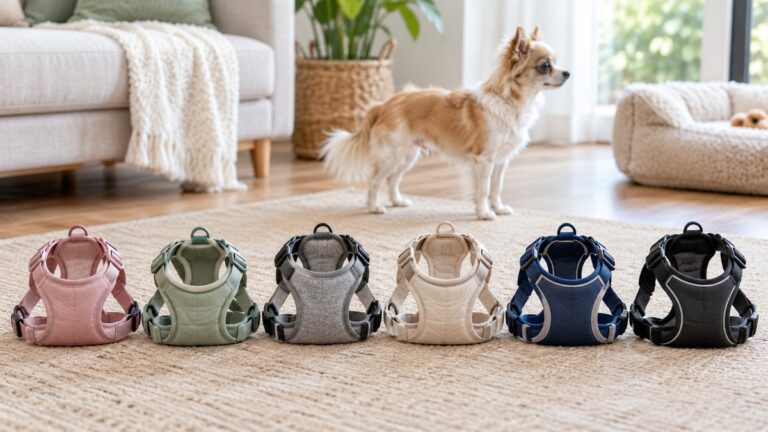
A puppy body collar is a search that many owners try when they want gear that fits a growing dog snugly. None of the listings in this guide is a body-style collar. All three are neck collars sized for puppies and small dogs, so this guide compares those neck collars, explains how to measure a puppy’s neck, and shows when AKC suggests a harness instead. You can use it to shortlist a collar, or to decide that a harness is the better piece of gear for your puppy.
Quick answer
Measure your puppy’s neck first, then choose a collar whose listed neck range covers that number with some room to adjust. Check that the listing states a neck range, not just a size label. For a puppy that is only starting to learn the leash, AKC says a standard dog collar is the best choice. AKC also says a harness is generally a better option for puppies, as long as it fits so the puppy cannot slip out. Read both points, then decide which fits your puppy’s walking style. The first pick below states a neck range that starts near the small end of the scale, and it is the only one that lists a break-away closure.
What these listings are
The listings in this guide are flat neck collars. They have a buckle or a break-away closure, a strap that sits around the neck, and a D-ring or loop for a leash or tag. They are not body-style gear, and no listing here describes a collar that wraps the chest or body.
This matters for the search. If your puppy needs a body fit, a collar will not give you that. A harness or a body-style vest is a different product, and it should be compared on chest and neck figures rather than neck figures alone.
Every collar in this guide is a neck collar, so the choice comes down to four things: neck size, closure, material and visibility. The product cards below show what each listing states for those four points.
Measure the neck first
AKC names three core measurements for most dog clothing and gear: back length, chest girth and neck girth. For a collar, the neck girth is the figure that matters. Take it while the puppy stands still, with the tape around the neck where the collar would sit.
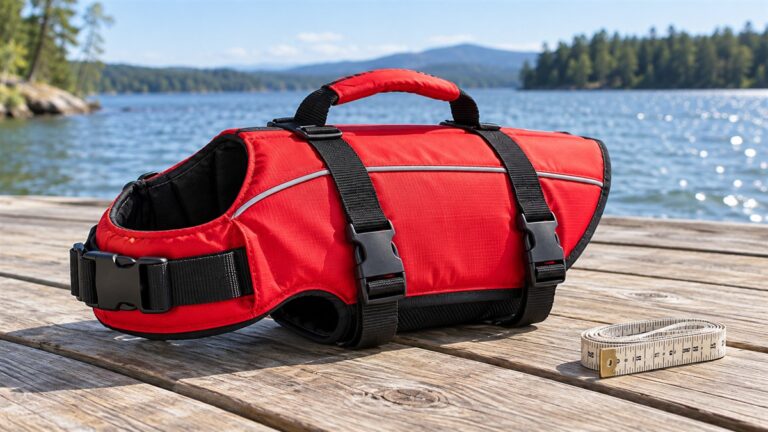
Keep the tape snug but not tight. Slip two fingers between the tape and the puppy’s neck, using the same test AKC describes for measuring gear. A string, ribbon or shoelace works if you do not have a tape. Mark the point where the string meets itself, then lay it flat against a ruler to read the length.
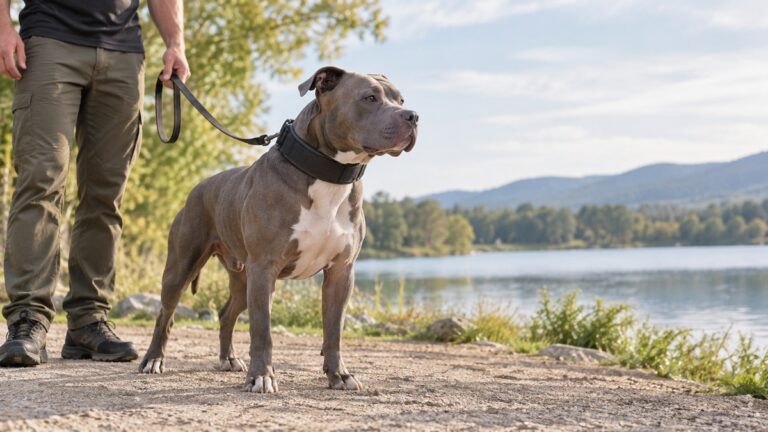
AKC also gives a rule for collar fit. You should be able to slip one finger between the dog’s skin and the collar for small dogs, or two fingers for large-breed dogs. A collar that is too loose lets the dog wiggle out and escape. A collar that is too tight is uncomfortable and can rub the skin.
Compare the neck reading with the listing’s neck range, not with the size label. Some listings give the neck range in inches, and some give a width and a range together. Use the range that matches your puppy’s measurement.
Collar or harness for a puppy
AKC makes two points that point in different directions, and both matter for a young dog.
First, for puppies who are just learning to walk on a leash, AKC says it is best to stick with a standard dog collar. Many dog trainers recommend beginning leash training with a four-foot leash and a flat collar. A flat collar is the kind of product this guide compares.
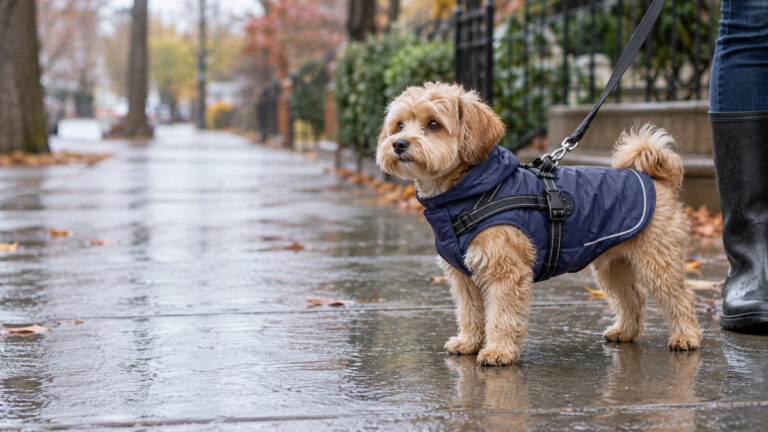
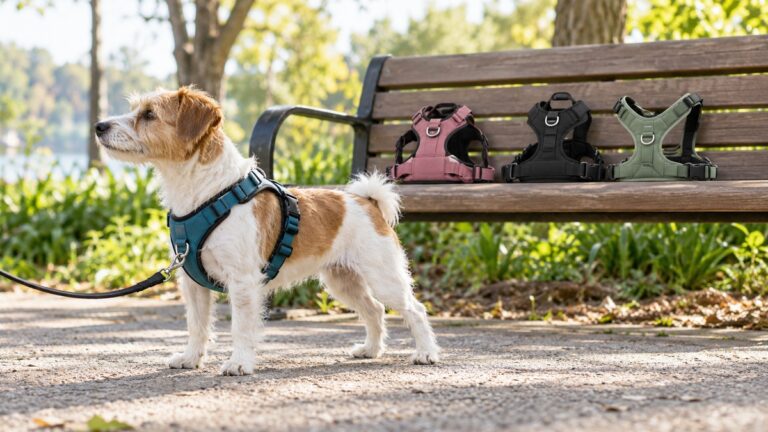
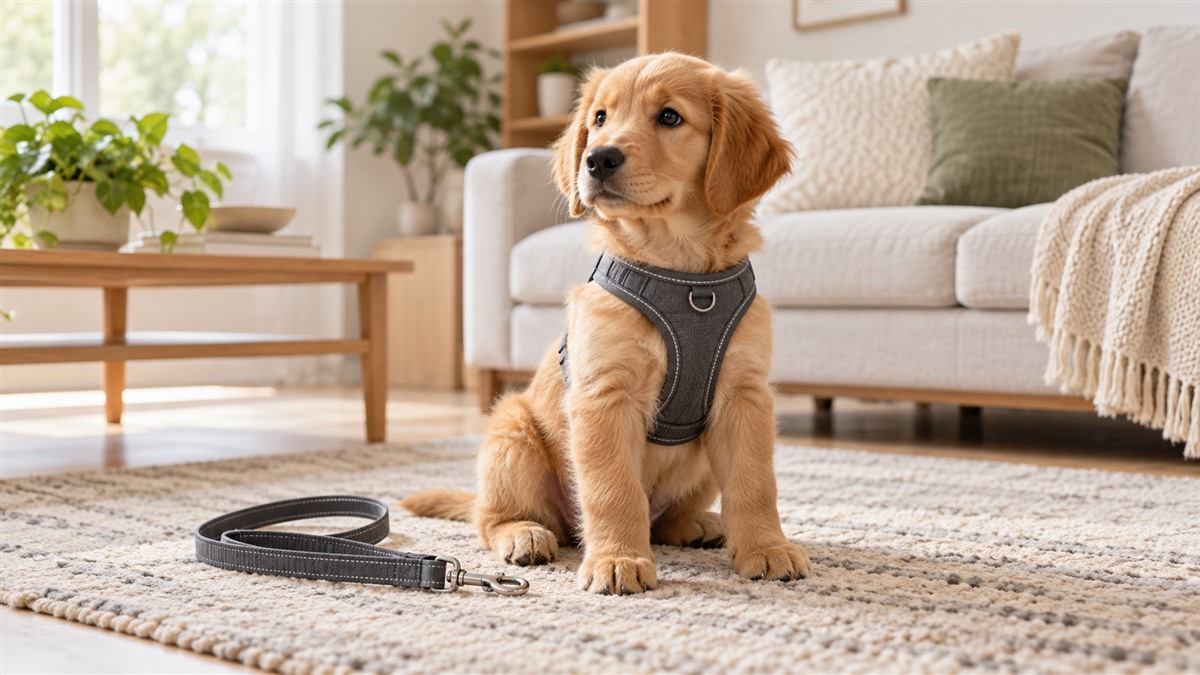
Second, AKC says a harness is generally a better option for puppies, so there is no pressure on the neck if they pull. The same guidance adds that the harness must fit so the puppy cannot slip out. A harness that is too big can let a dog wiggle out, and one that is too tight can be painful, especially in hot weather.
Read both points together. A collar may suit a puppy that walks calmly on a leash, while a harness may suit a puppy that pulls or lunges. If you lean toward a harness, the guide to the best tiny harness for a puppy covers the smallest sizes. Neither choice replaces a fit check, and a collar that fits poorly is worse than a harness that fits well.
Leash training starts early
AKC says it is best to begin leash training as soon as you bring a puppy home. Puppies are not born knowing what a leash is, and leash walking is a trained skill. Start with short sessions, and reward the puppy for walking near you. If you want a collar and leash sold together, the best puppy collar and leash guide compares that kind of set.
AKC also says to avoid retractable leashes and to choose a lightweight six-foot leash for loose-leash training. A retractable leash gives a puppy more room than it can handle, and it can tangle or snap back at the collar.
Use a reward method that works in the moment. AKC suggests a marker word or a clicker, followed right away by a treat, and rewarding eye contact and attention while the leash is attached. Keep the leash attached during the reward, so the puppy links the collar with calm walking.
Escape and fit
A collar is one of the first things a puppy tries to slip. A loose collar can come off during a walk or when the puppy shakes its head. Check the neck strap after each walk for the first few weeks, and tighten it one step at a time until the one-finger or two-finger test is right.
Some collars use a martingale design, which tightens slightly when the dog pulls. AKC describes martingale collars as suited to dogs whose necks are about the same size as their heads. That design is not one of the products in this guide, so compare it separately if you want to try it.
Break-away closures release under strain, which some owners prefer for safety. The listing for one pick names a break-away closure. It does not give a test standard or a release figure, so read the maker’s instructions before you rely on that feature.
Puppies grow fast, so an adjustable range matters more than a perfect fit on the day you buy. A collar with a wide range can stay in use longer, but it must still fit well at every stage of growth. For a harness that adjusts as a puppy grows, see the best adjustable dog harness for a growing puppy guide.
Visibility and reflective trim
Reflective stitching on a collar helps you see a puppy at dusk. It does not produce light on its own.
High-visibility color helps in daylight. Yellow and orange are the most common high-visibility colors, and the listings here use a range of colors. Choose a color you can see easily on your puppy’s coat and in the places you walk.
Do not rely on visibility alone at night. If you walk at dusk or after dark, add a separate light to the leash or to a clip, and keep the puppy close.
Materials you will see
Nylon is a synthetic polymer with amide linkages, and nylon fibers can be melt-processed into fibers and films. Nylon collars are common, and the care line on each listing decides how you clean them.
Acrylonitrile butadiene styrene (ABS) is a thermoplastic in common use since the 1950s. Some buckles and clips use ABS, and the listing names the material when it uses it. A plastic buckle is light, but check that the buckle clicks fully before you walk.
Neoprene and cotton appear on some listings. The listing states the material, and that statement is what you should check against your puppy’s needs. Do not assume a material performs in a certain way unless the listing says so.
Care matters. One listing says nylon collars can typically be cleaned with mild soap and water and then air dried. Follow the care line on the listing you buy, and check it again after the first wash.
How to choose: rules for a puppy
Choose a collar whose stated neck range covers your puppy’s measurement with room to adjust. A common rule of thumb is to avoid a collar that is at the very edge of its range, because a growing puppy will reach the limit soon.
Choose a collar with a clear closure if your puppy is still learning to walk on a leash. A buckle that clicks shut is easy to check at home.
Choose a reflective collar if you walk your puppy at dusk. Choose a plain collar if reflective trim is not a priority, because the listing’s visibility features do not change the fit.
Choose a harness instead if your puppy pulls hard, or if AKC’s fit guidance points you toward a harness for your dog. Compare harnesses on chest and neck figures, not on the collar’s neck figure alone.
Skip any collar whose neck range stops short of your puppy’s measurement. Skip a collar whose listing says the neck is one size while the bullets say another, until the seller confirms the size. Skip any collar whose closure you cannot check at home.
Use the product cards below to compare the three collars. Each card shows the specs the listing states, the pros and cons that come from those specs, and who should skip it.
1. Premium Dog Collar, Cute Dog Collars Luxury Style, Durable Pet Collars with Metal Buckle Safety (Break-away closure, small neck range)
Specs from the listing (checked 2026-10-11):
- Size: Small
- Closure Type: Break Away
- Item Length: 14.1 inches
- Breed Recommendation: Small Breeds
Pros
- The bullets state a neck girth range of 9.6 to 13.7 inches, and the Size field reads Small
- The listing names a break-away closure in its specs
- The bullets name a welded D-ring and a cotton-nylon webbing that the listing describes as soft
Cons
- The listing gives a width of 5/8 inch in one bullet and 1 inch in the specs, so the listing does not agree on the width
- The care line is not stated in the listing, so washing needs a check with the maker
- The bullets mention a matching leash without naming it, and the listing does not state its size
Best for: Owners of a puppy whose neck measures inside 9.6 to 13.7 inches and who want a break-away closure.
Skip if: Skip it if the width matters to you until the listing's width figures agree, or if you need a stated care line.
View on Amazon (affiliate link)
2. Reflective Dog Collar, Puppy Collar with Buckle Adjustable, Pink XS (Reflective XS collar with ABS buckle)
Specs from the listing (checked 2026-10-13):
- Size: X-Small :Width 5/8″,Neck 8-12″
- Material Type: Acrylonitrile Butadiene Styrene, Nylon
- Closure Type: Buckle
- Product Care Instructions: [INF] Nylon collars can typically be cleaned with mild soap and water, then air dried.
Pros
- The Size field gives an X-Small width of 5/8 inch and a neck range of 8 to 12 inches
- The bullets say highly reflective threads keep the collar visible at night
- The care line says nylon collars can typically be cleaned with mild soap and water, then air dried
Cons
- The sizing bullet gives the same 8 to 12 inch neck range for two sizes, XXS and XS, so the listing does not settle the exact range
- The buckle is made of ABS, which the listing describes as quick release, and the listing gives no load figure for it
- The breed recommendation says All Breed Sizes while the Dog Breed Size field says Small, so the listing does not name one size group
Best for: Owners of a very small puppy with a neck that measures inside 8 to 12 inches, who want reflective threads.
Skip if: Skip it if your puppy's neck is above 12 inches, or if you need a single clear size from the listing.
View on Amazon (affiliate link)
3. 2 Pack Reflective Dog Collars for Medium Dogs Girl Boys,Female Male,Nylon Dog Collars for Puppy (Two-pack with reflective stitching)
Specs from the listing (checked 2026-10-13):
- Size: M
- Material: Neoprene, Nylon
- Closure Type: Buckle
- Number of Items: 2
Pros
- The listing is a two-pack, and the bullets say its reflective stitching reflects light for evening walks
- The buckle is described as a quick-release safety buckle with one-touch locking
- The material is listed as neoprene and nylon, with padded neoprene on the back of the collar
Cons
- The bullets say sizing may differ from other brands and ask you to measure the neck, so the listing gives no neck range in its specs
- The bullets use the words chew proof and indestructible, but no collar is indestructible
- The Size field reads Medium, while the title says the collars suit puppy, small and large dogs, so the listing does not confirm one size
Best for: Owners who want two collars in a single pack and reflective stitching for evening walks.
Skip if: Skip it if you need a stated neck range before you order, because the specs give none.
View on Amazon (affiliate link)
A 12-inch neck against the first pick
Suppose your puppy’s neck measures 12 inches, the top of the second pick’s 8 to 12 inch neck range. Set it against the neck range of the first pick, which runs from 9.6 to 13.7 inches.
Check the bottom of the range first. 12 inches – 9.6 inches = 2.4 inches of room above the bottom of the range.
Then check the top of the range. 13.7 inches – 12 inches = 1.7 inches of room below the top of the range.
The measurement sits inside the range. The room below the top is the number that matters over time, because a puppy that grows will move toward the top. A neck below 9.6 inches would sit under this range, and you would need a different collar.
Common mistakes
- Buying from a size label. A label such as small or XS does not give the neck range, so read the figure on the listing.
- Measuring a puppy that is moving or pulling. Measure while the puppy stands still, or the reading will be too large or too small.
- Ignoring the one-finger and two-finger test. A collar that passes the test on the day you buy may be too loose a week later.
- Assuming indestructible means durable. No collar or bed is indestructible, and the listings in this guide do not support that claim.
- Walking with a retractable leash. AKC advises against retractable leashes when you are teaching a puppy to walk.
- Skipping the closure check. A buckle or break-away closure must click or lock fully before every walk.
Fit check at home
Put the collar on a dry puppy before the first walk. Fasten the closure, then check the one-finger and two-finger test. Watch the puppy walk a few steps and sit. A collar that slides up toward the ears or drops down to the shoulders needs a different size.
Repeat the check after the first walk and after any swim or wash. Materials can stretch or shrink, and the neck can change as the puppy grows.
If the puppy scratches at the collar or rubs its neck on the floor, remove the collar and check the fit again. A collar that rubs may be too tight or may have a rough edge at the buckle.
FAQ
What is a puppy body collar?
The term describes gear that fits a puppy’s body. The three collars here are neck collars, not body-style gear, so this guide compares them on neck fit and visibility.
How do I measure my puppy for a collar?
Measure the neck while the puppy stands still, with the tape snug but not tight. Compare the reading with the neck range on the listing, and use the two-finger test to check the fit.
Is a collar or a harness better for a puppy?
AKC says a standard collar is best for puppies who are just learning to walk on a leash. It also says a harness is generally a better option for puppies, as long as it fits so the puppy cannot slip out. Choose based on how your puppy walks.
Can a puppy use a collar with reflective stitching at night?
Reflective stitching helps when a light shines from near the viewer. It does not produce light on its own, so add a separate light for walks after dark.
How tight should a puppy collar be?
AKC says you should be able to slip one finger between the dog’s skin and the collar for small dogs, or two fingers for large-breed dogs. Check the fit after each walk for the first few weeks.
Do I need a break-away collar?
A break-away closure releases under strain, which some owners prefer. The listing does not give a release figure or a test standard, so read the maker’s instructions before you rely on it.
How do I clean a puppy collar?
Follow the care line on the listing. One nylon listing in this guide says mild soap and water, followed by air drying. Check the closure after each wash, and replace the collar if the strap frays.
Bottom line
Measure your puppy’s neck, choose a collar whose listed neck range covers that number with room to adjust, and check the closure at home. Use a collar for early leash training if AKC’s guidance fits your puppy, and consider a harness if your puppy pulls or the fit suggests it. None of the listings here is a body-style collar, so if you need a body fit, compare harnesses on chest and neck figures instead.
Sources
- AKC, measuring dog gear: neck girth is one of three core measurements, and the two-finger rule
- AKC, dog harness vs collar: one-finger and two-finger collar fit, martingale collars, and harness fit cautions
- AKC, teach your puppy to walk on leash: begin leash training early, harness generally better for puppies, avoid retractable leashes
- Wikipedia, retroreflector: a retroreflector reflects light back toward its source with minimal scattering