Best Dog Water Bowl for Small Dogs: Six Bowls Compared
As an Amazon Associate we earn from qualifying purchases. Details
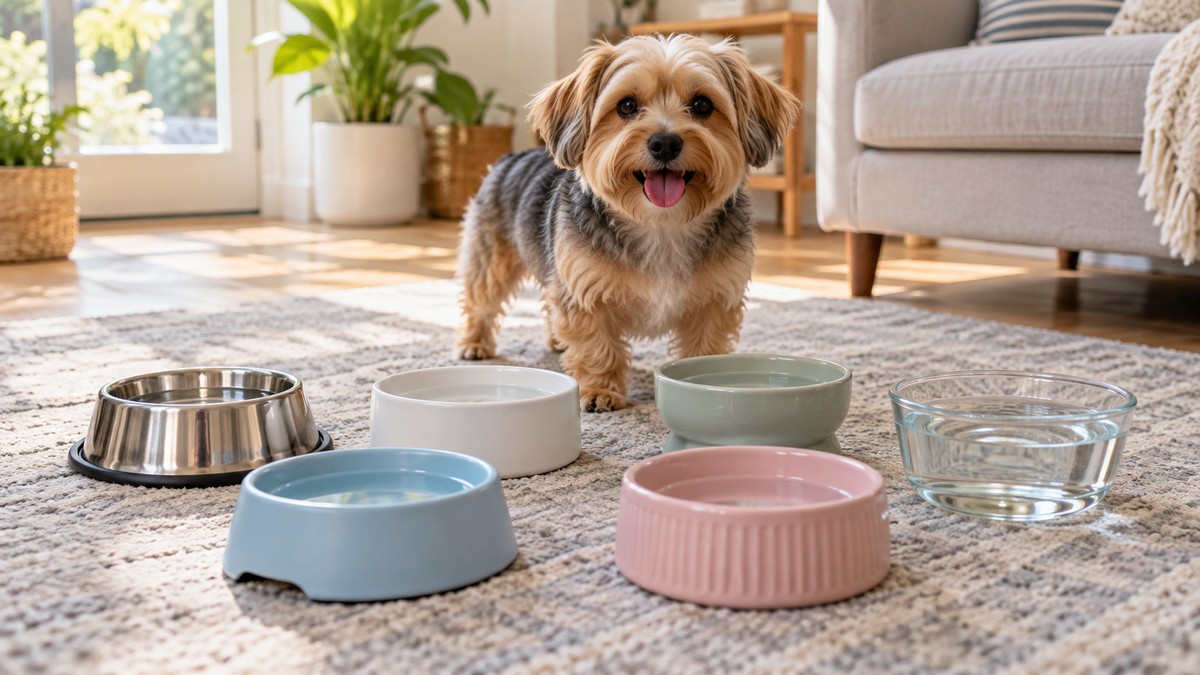
The best dog water bowl for small dogs is the one with a size your dog can drink from comfortably, a base that stays put on your floor, and a cleaning routine you will actually follow. The sources we opened agree on the basics. The ASPCA says clean, fresh water should be available at all times, and the AKC advises a constant supply of clean, clear water. This guide compares six bowls whose listings name small dogs, and it marks which figures come from each listing and which come from our own arithmetic on a source.
Quick answer
- Capacity is the least likely limit for a small dog. Cornell’s rate puts a 5 pound dog at roughly 91 to 136 milliliters a day (our calculation), and the smallest bowl here holds 1.5 cups, about 355 milliliters.
- Cleaning comes next. The ASPCA says to wash water dishes frequently, and all six listings include a dishwasher-safe line. The PEGGY11 care line also says hand wash only, so check that before you buy.
- Choose the base for your floor. Each listing describes a base meant to reduce sliding or tipping, but the designs differ: a suction cup, a non-skid silicone base, a weighted base, a broad base, and a rubber base.
- Check the size label. Neater Pet Brands lists extra small and small breed sizes and says its bowls are not intended for medium or large breed dogs.
Why water access matters for a small dog
The AKC gives a general rule: “As a general rule, dogs require at least one ounce of water per day for each pound of body weight.” The same article adds that “Depending on the weather and temperature, they may need more water on some days than others,” so any single number is a starting estimate, not a fixed target.
The Cornell University Riney Canine Health Center uses a different unit. Its article on excess thirst says dogs “drink approximately 40-60 milliliters of water for every kilogram of body weight,” and it adds that “Fortunately, most healthy dogs just know to drink the right amount of water.” That sentence describes healthy dogs, not a required amount. Because the article is about excess drinking, we use its figure only as a description of normal intake.
The two rules are close but not identical. Converted to the same unit, the AKC rule works out to about 65 milliliters per kilogram, a little above the Cornell range of 40 to 60. The table below shows the working for four weights.
The AKC also explains the main cause of dehydration. It says “Lack of water intake is the primary cause of dehydration,” and that this “generally occurs when a dog doesn’t have proper access to water or won’t drink enough.” The same article lists puppies, senior dogs, nursing mothers and toy dog breeds as groups that may have an increased risk of dehydration. Small dogs are not all toy breeds, so that list does not cover every small dog, but it is worth reading if your dog falls into one of these groups.
The ASPCA’s General Dog Care page is shorter. It says “Clean, fresh water should be available at all times, and be sure to wash food and water dishes frequently.” For dogs that spend time outdoors, it advises shade and plenty of cool water in hot weather.
If you want a bowl designed around spill control, our spill-free water bowl guide covers a separate set of products. If your dog gulps its water, our slow drinking water bowl guide looks at that problem.
Daily water figures for four weights
| Dog weight | AKC rule: 1 ounce per pound per day | Cornell rate: 40 to 60 milliliters per kilogram per day |
|---|---|---|
| 5 lb | 5 oz (about 148 mL) | about 91 to 136 mL |
| 10 lb | 10 oz (about 296 mL) | about 181 to 272 mL |
| 15 lb | 15 oz (about 444 mL) | about 272 to 408 mL |
| 20 lb | 20 oz (about 591 mL) | about 363 to 544 mL |
How the numbers are worked out: the AKC column takes the weight in pounds as the number of ounces, and one ounce is about 29.6 milliliters. The Cornell column converts pounds to kilograms by dividing by 2.2046, then applies the 40 and 60 milliliter rates. Both columns are our arithmetic on the two sources, rounded to the nearest milliliter.
Two things follow. First, these are estimates, and the AKC notes that the need changes with the weather. Second, even the largest figure for a 5 pound dog is well under the smallest bowl in the comparison table, so capacity alone does not show whether a bowl is enough. The ASPCA’s advice is about access, which depends on how often the bowl is refilled and washed.
Comparison table
Every cell below comes from the listing’s title, bullets or specifications. Where a listing gives two values, both are shown. “Not stated” means the listing text we read does not give that detail.
| Bowl | Capacity | Size | Material | Base | Dog size on listing |
|---|---|---|---|---|---|
| Should We Go? silicone bowl, charcoal | 2 cups | 6 x 6 x 1.25 in | Silicone | Suction cup | Dog Breed Size: Small; Breed Recommendation: All Breeds |
| Neater Pet Brands, two stainless steel bowls, black | 2 cups (16 oz) | 5.1 x 3.9 x 2.2 in | Stainless steel with silicone bottom | Non-skid silicone base | Extra Small and Small; not intended for medium or large breed dogs |
| MALACASA ceramic bowl | 1.5 cups | 5.5 in across and 2 in tall (bullets); 6.75 x 6.75 x 2.76 in (specifications) | Ceramic; lead-free glaze (listing) | Broad base (listing) | Dog Breed Size: Small; Breed Recommendation: puppies, medium-sized dogs, large puppies, retrievers, cats |
| LE TAUCI ceramic bowl set with acacia wood stand | 1.8 cups per bowl | 5.6 in across and 1.8 in tall (bullets); 5 x 5 x 5 in (specifications) | Ceramic | Weighted non-slip base | Dog Breed Size: Small; Breed Recommendation: Small Breeds |
| PEGGY11 stainless steel bowls, two-pack | 3.8 cups each (title) | 6.9 x 6.9 x 2.1 in | Stainless steel with silicone nonslip bottom | Silicone nonslip bottom | Dog Breed Size: Small; Breed Recommendation: Medium, Small |
| Loving Pets Dolce Bamboo bowl, small, oat beige | 22 fluid ounces (specifications); 18 to 76 ounces across three sizes (bullets) | 5.5 x 5.5 x 2.25 in | Bamboo | Skid-free rubber base | Dog Breed Size: Small |
Five listings give capacity in cups. Loving Pets gives it in fluid ounces, and its two figures disagree. Two listings, MALACASA and LE TAUCI, give dimensions in their bullets that differ from their specifications, and we explain both under What we could not verify. Across the six, the stated width runs from about 5 inches to 6.9 inches, and the stated capacity runs from 1.5 cups to 3.8 cups.
Product picks
Each pick below gives who it suits, one strength and one limit, all taken from the listing, and a skip condition. The sources we opened do not compare bowls, so none of the strengths below is a sourced claim about performance.
Should We Go? silicone bowl, charcoal
Who it suits: An owner who wants one flexible silicone bowl for both food and water, used indoors or outdoors.
Strength: The listing says the bowl is dishwasher safe, microwave safe and freezer friendly, and that its suction cup base keeps it from tipping.
Limit: The listing calls the silicone sturdy and flexible but gives no wall thickness, so its firmness cannot be checked against the stainless and ceramic bowls here.
Skip if: A suction base is not what you want for your floor, because the listing names no other way the bowl stays in place.
Neater Pet Brands stainless steel bowls, black, two-pack
Who it suits: An owner of an extra small or small dog who wants two matching metal bowls, one for food and one for water.
Strength: The listing describes extra thick, food-grade stainless steel with a non-skid silicone bottom, and says the set includes two bowls.
Limit: The listing gives a 30 day warranty against manufacturer defects, and it says the bowls are not intended for medium or large breed dogs.
Skip if: Your dog is a medium or large breed, since the listing says these bowls are not meant for that size.
MALACASA ceramic bowl, 1.5 cups
Who it suits: An owner of a puppy or small dog who wants a ceramic bowl with a wide base.
Strength: The listing says the bowl is microwave safe and dishwasher safe, with a broad base that resists tipping and a lead-free glaze.
Limit: The listing gives two dimension sets that disagree, and its breed recommendation names medium-sized dogs and cats as well as small dogs.
Skip if: You need more than 1.5 cups in one bowl, because this is the smallest capacity in the comparison.
LE TAUCI ceramic bowl set with acacia wood stand
Who it suits: An owner who wants a stand that holds two ceramic bowls for a small puppy or small dog.
Strength: The listing describes ceramic bowls with an active glaze that can be washed by hand or in the dishwasher, and a weighted non-slip base.
Limit: The listing gives two sets of dimensions that disagree, and the stand is natural wood, so its grain and color vary from piece to piece.
Skip if: You want a single bowl, because the listing describes a set of two bowls with a stand.
PEGGY11 stainless steel bowls, two-pack
Who it suits: An owner who wants two stainless steel bowls with a silicone bottom and a larger capacity than most others here.
Strength: The title gives a capacity of 3.8 US cups each, and the listing says the bowls stack for compact storage.
Limit: The care line says both dishwasher safe and hand wash only, so the cleaning method is not clear from the listing.
Skip if: You want one cleaning method you can rely on, because the listing gives two.
Loving Pets Dolce Bamboo bowl, small, oat beige
Who it suits: An owner who wants a bamboo bowl for indoor food or water.
Strength: The listing says the bowl is dishwasher safe, and that a skid-free rubber base keeps it stable on a mat.
Limit: The specifications give 22 fluid ounces of capacity, but the bullets give 18 to 76 ounces across three sizes, so the figure to rely on is unclear.
Skip if: You need a capacity figure you can check, because the two figures in this listing do not agree.
1. The Perfect Dish – Silicone Dog Bowl for Food & Water, 6" x 1.25"-Charcoal (Silicone bowl with a suction cup base)
Pros
- The listing says the bowl is dishwasher safe, microwave safe and freezer friendly
- The listing describes a suction cup base and an anti-flip design
- The listing says the bowl works indoors or outdoors
Cons
- The listing gives no wall thickness for the silicone, so its firmness is unverified
- The listing names no stability feature other than the suction cup
Best for: An owner who wants one flexible bowl for food and water, used indoors or outdoors
Skip if: You want a bowl whose stability does not depend on suction
View on Amazon (affiliate link)
2. Neater Pet Brands Stainless Steel Dog Bowls with Non-Slip Rubber Bottom – 2 Cup (16 oz), Black (Two stainless steel bowls with a silicone bottom)
Pros
- The listing describes extra thick, food-grade stainless steel
- The listing says the set includes two bowls with a non-skid silicone bottom
- The listing gives dimensions of 5.1 by 3.9 by 2.2 inches
Cons
- The listing says the bowls are not intended for medium or large breed dogs
- The listing gives a 30 day warranty against manufacturer defects
Best for: An owner of an extra small or small dog who wants matching metal bowls for food and water
Skip if: Your dog is a medium or large breed
View on Amazon (affiliate link)
3. MALACASA Dog Bowls, Ceramic Dog Food and Water Bowls for Small Size Dogs, 1.5 Cups Capacity Pet (Ceramic bowl with a broad base)
Pros
- The listing says the bowl is microwave safe and dishwasher safe
- The listing says the glaze is lead-free
- The listing describes a broad base that resists tipping
Cons
- The listing gives two dimension sets that disagree
- The breed recommendation names medium-sized dogs and cats as well as small dogs
Best for: A puppy or small dog owner who wants a ceramic bowl with a wide base
Skip if: You need more than 1.5 cups in one bowl
View on Amazon (affiliate link)
4. LE TAUCI Dog Bowl Set with Acacia Wood Stand – 1.8-Cup Ceramic Puppy Bowls for Small Dogs, Dual (Two ceramic bowls on an acacia wood stand)
Pros
- The listing describes ceramic bowls with an active glaze that cleans by hand or in the dishwasher
- The listing describes a weighted non-slip base
- The listing gives 1.8 cups of capacity per bowl
Cons
- The listing gives two sets of dimensions that disagree
- The stand is natural wood, so grain and color vary from piece to piece
Best for: An owner who wants a stand that holds two ceramic bowls for food and water
Skip if: You need a single bowl, since the listing describes a set
View on Amazon (affiliate link)
5. Nonslip Stainless Steel Dog Bowls, 3.8 US Cup Each, 2 Pack (Two larger stainless steel bowls that stack)
Pros
- The title gives a capacity of 3.8 US cups each
- The listing says the bowls stack for compact storage
- The listing describes a silicone nonslip bottom that helps reduce sliding and noise
Cons
- The care line says both dishwasher safe and hand wash only
- The breed recommendation lists medium dogs as well as small dogs
Best for: An owner who wants two stainless steel bowls with a larger capacity that stack for storage
Skip if: You want a bowl with one cleaning method, since the care line gives two
View on Amazon (affiliate link)
6. Loving Pets – Dolce Bamboo – Eco-Friendly Pet Bowls & Dishes for Dog, Cats, Puppy Food and Water (Small bamboo bowl with a skid-free rubber base)
Pros
- The listing says the bowl is dishwasher safe
- The listing describes a skid-free rubber base
- The listing names indoor use and a bamboo material
Cons
- The listing gives 22 fluid ounces in the specifications but 18 to 76 ounces across three sizes in the bullets
- The sources we opened do not cover bamboo bowls
Best for: An owner who wants a bamboo bowl for indoor food or water
Skip if: You need a capacity figure you can check, because the listing's two figures do not agree
View on Amazon (affiliate link)
How we chose
We searched Amazon.com in Chrome for “best dog water bowl for small dogs” and recorded the results on 21 October 2026. Each listing was read through its title, its five bullets and its specifications table.
A listing counted for this keyword when its specifications named a small dog size and it was a bowl for food or water. Three listings were set aside at the title screen: a bowl listed for all breed sizes, a bowl listed for medium dogs, and a water dispenser. The six that passed come from six different brands, so no brand appears twice.
We did not rank the six. The order in the table is the order we recorded them. We did not use prices, star ratings, review counts or sales labels, because this comparison is about what each bowl is and how its listing describes it. Where a title or bullet disagreed with a specification, we show both values.
Buying checklist
- Read the care line first. All six list dishwasher safe, and PEGGY11 also lists hand wash only.
- Check the size label against your dog. Neater lists extra small and small, and LE TAUCI and Loving Pets list small. Should We Go? lists its breed recommendation as all breeds, and MALACASA and PEGGY11 both name medium-sized dogs in theirs.
- Measure the space you have. By the specifications, the bowls run from about 5 to 6.9 inches across, so measure the spot before you order.
- Check the base type. The listings describe a suction cup, a non-skid silicone base, a weighted base, a broad base and a rubber base, and the listing text does not say which works best on tile or carpet.
- Decide between one bowl and two. Cornell recommends extra bowls when several pets share a home, so that each one has enough. For a single small dog, the sources we opened do not set a number.
- Plan refills around the weather. The AKC says the need changes with weather and activity, and the ASPCA says to keep water available at all times.
- Confirm any capacity that a listing gives in two forms, as the Loving Pets listing does.
If you want a different style of water bowl, our stainless steel automatic water bowl guide covers that category.
Mistakes to avoid
- Choosing on capacity alone. Cornell’s rate puts a 5 pound dog well under the smallest bowl here, so in our reading the choice usually turns on cleaning and refilling.
- Ignoring the cleaning line. The ASPCA says to wash water dishes frequently, and a bowl whose care line says hand wash only may take more effort to clean every day.
- Trusting health language in a listing. The LE TAUCI listing says a veterinarian recommends ceramic bowls to keep a dog away from chin disease. The sources we opened do not cover that claim, so it stays a listing statement.
- Assuming a bowl changes how much a dog drinks. The AKC says that some dogs just won’t drink much water unless they are encouraged to do so, and the sources we opened do not say that any bowl style changes this.
- Leaving a dog without water while you are out. The AKC says to be sure to leave enough water so your dog will not run out.
- Reading a dehydration check as a home test. The AKC describes skin and gum checks, but if dehydration signs appear with persistent vomiting or suspected heatstroke, it says to take the dog to the vet immediately.
What we could not verify
- Whether any bowl here prevents dehydration or illness. The sources we opened do not say so, and this guide does not claim it.
- The material claims in the listings, such as food-grade, BPA-free, lead-free glaze and non-toxic. These are listing statements only.
- The MALACASA dimensions. Its bullets give 5.5 inches across and 2 inches tall, while its specifications give 6.75 by 6.75 by 2.76 inches.
- The LE TAUCI size. Its bullets give 5.6 inches across and 1.8 inches tall for each bowl, while its specifications give 5 by 5 by 5 inches, and its counts give two packs and three items.
- The PEGGY11 brand and care lines. The brand is PEGGY11, the manufacturer field reads FUTONG, and the care line lists both dishwasher safe and hand wash only.
- The PEGGY11 breed fit. Its size field says small, while its breed recommendation says medium and small.
- The Loving Pets capacity. Its specifications say 22 fluid ounces, while its bullets give 18 to 76 ounces across three sizes.
- The warranty terms. The Should We Go? listing names a lifetime warranty, and the Neater listing names a 30 day warranty against manufacturer defects. The listing text we read gives no further terms.
- How silicone, bamboo, ceramic and stainless steel hold up over time. The sources we opened do not cover bowl materials.
- How well any base holds on a given floor, and how much any bowl limits spills. The listings make these claims, and the sources we opened do not cover them.
- Whether a small dog drinks differently from a 1.5 cup bowl than from a 3.8 cup bowl. The sources do not say.
- Whether any listing has changed since 21 October 2026, the date we read them.
FAQ
How much water does a small dog need each day?
The AKC gives a general rule of at least one ounce of water per day for each pound of body weight. Cornell’s Riney Canine Health Center describes dogs drinking roughly 40 to 60 milliliters per kilogram. For a 10 pound dog, that is about 296 milliliters by the AKC rule and about 181 to 272 milliliters by the Cornell rate. Both are estimates, and the AKC says the need rises and falls with weather and activity.
Does one water bowl cover a small dog?
The sources we opened do not give a bowl count. The ASPCA says clean, fresh water should be available at all times, so the practical question is whether one bowl stays full and clean in the rooms where your dog spends its time. Cornell recommends offering additional water bowls when several pets share a home, so that each animal has what it needs. A second bowl for a second room is a reasonable choice, but the sources do not describe it as a requirement.
Is stainless steel or ceramic the better material for a small dog’s water bowl?
The sources we opened do not rank bowl materials, so there is no sourced winner. The listings describe both. The Neater listing describes food-grade stainless steel that is dishwasher safe, and the MALACASA listing describes a ceramic bowl with a lead-free glaze. Choose on the terms you can check on the listing, such as the care line, the weight and the base, and do not treat the material alone as proof of quality.
Do non-slip bases stop a small dog’s bowl from sliding?
The listings describe bases meant to reduce sliding or tipping, including a suction cup, a non-skid silicone base, a weighted base, a broad base and a rubber base. The sources we opened do not cover how any base performs on a particular floor, so treat each stability claim as the listing’s own statement. Look at the base type in the table, then decide what your floor needs.
Is a bamboo bowl a good choice for a small dog?
The Loving Pets listing describes a bamboo bowl that is dishwasher safe, with a skid-free rubber base, and it names indoor use. The sources we opened do not cover bamboo bowls, so we cannot compare bamboo with stainless steel or ceramic for durability or cleaning. Before you rely on its size, resolve the conflict between the listing’s specifications and its bullets.
Can the right bowl prevent dehydration?
No source we opened says that a water bowl prevents dehydration or illness, and this guide does not make that claim. The AKC says that lack of water intake is the primary cause of dehydration, and that this generally occurs when a dog does not have proper access to water or will not drink enough. A bowl can help only with access, so keep fresh water available. If dehydration signs appear with persistent vomiting or suspected heatstroke, the AKC says to take the dog to the vet immediately.
Bottom line
Choose a bowl by three checks: a cleaning line you will follow, a base that suits your floor, and a size label that matches your dog. Treat capacity as a secondary check, because the Cornell and AKC figures for a small dog sit well under any bowl here. If a dog’s drinking changes sharply, Cornell’s advice is to assume it needs the water until a vet has assessed it.
Sources
- American Kennel Club, “Dehydration in Dogs: Signs, Symptoms. Treatments”, opened 2026-10-21: https://www.akc.org/expert-advice/health/warning-signs-dehydration-dogs/
- ASPCA, “General Dog Care”, opened 2026-10-21: https://www.aspca.org/pet-care/dog-care/general-dog-care
- Cornell University Riney Canine Health Center, “Canine Polyuria and Polydipsia (PU/PD) – April 2024”, opened 2026-10-21: https://riney.vet.cornell.edu/member-benefits-health-tips/polyuria-polydipsia-april-2024