Homemade Dog Toys for Chewers
As an Amazon Associate we earn from qualifying purchases. Details
Most homemade dog toy ideas were written for dogs that carry a toy around, not for dogs that take it apart. If your dog chews hard, the question is not which craft looks cute. It is which material stays in one piece. This guide goes through the DIY ideas in sources we opened (AKC, ASPCA and a veterinarian’s Vetstreet column), says which materials those sources flag, and ends with a plain rule: a homemade toy is supervised play, and a chewer needs a tougher toy for solo time. We have not tested any of these, and nothing here is veterinary or training advice.
Quick answer
For a hard chewer, make toys that reward licking, sniffing or tugging with you holding the other end, and skip anything the dog can shred into pieces. Never leave a homemade toy with a dog that is alone. Check it before and during every session, and throw it away at the first tear, hole or loose piece. If the dog destroys the toy anyway, the toy was the wrong material, not the dog’s fault.
What the sources say about toy materials
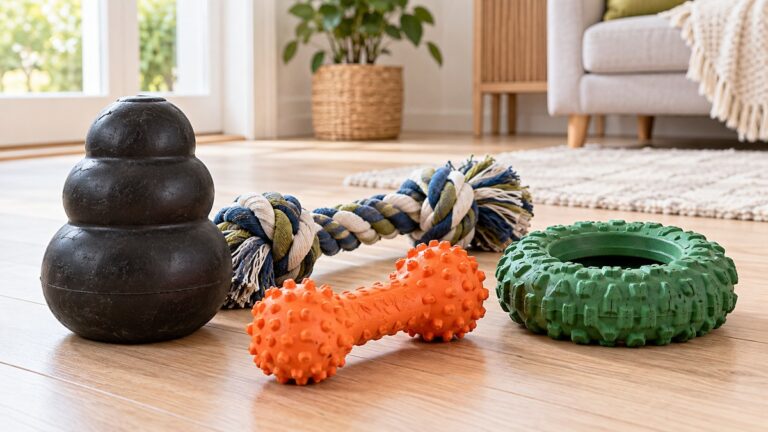
- Toys that break apart are the core risk. The AKC toy page (updated Mar 4, 2026) says heavy chewers need a toy that is durable and “won’t break into small pieces,” and warns that small pieces can be harmful if swallowed.
- Soft toys. The AKC toy shopping guide (published May 13, 2015) says that if a plush toy is ripped and the stuffing is coming out, throw it away. It also says that if your dog consistently destroys stuffed toys, you may want to opt not to give them.
- Squeakers. The same AKC guide says not to let a dog remove and chew a squeaker, because it may be swallowed and cause choking or an intestinal blockage.
- Inspect first. The AKC guide says to inspect toys and disregard those that look less durable or more easily destroyed and ingested.
- Balls. The AKC toy page says rubber balls are more durable than standard tennis balls, and that a ball for a large breed should be big enough that the dog cannot choke on it or swallow it by accident.
- Supervision. The Vetstreet column by Dr. Patty Khuly (published June 12, 2013) says homemade toys tend to be safe when used under supervision, not every toy is for every dog, and you should keep a sharp eye on your pet whenever any toy is in use, especially the first time. If a dog chews off smaller pieces, dispose of them before they can be swallowed.
- Bones. The ASPCA destructive chewing page says not to give cooked bones, like leftover t-bones or chicken wings, because they can splinter.
The common DIY ideas, checked against those sources
| Idea | Where it comes from | Verdict for a hard chewer |
|---|---|---|
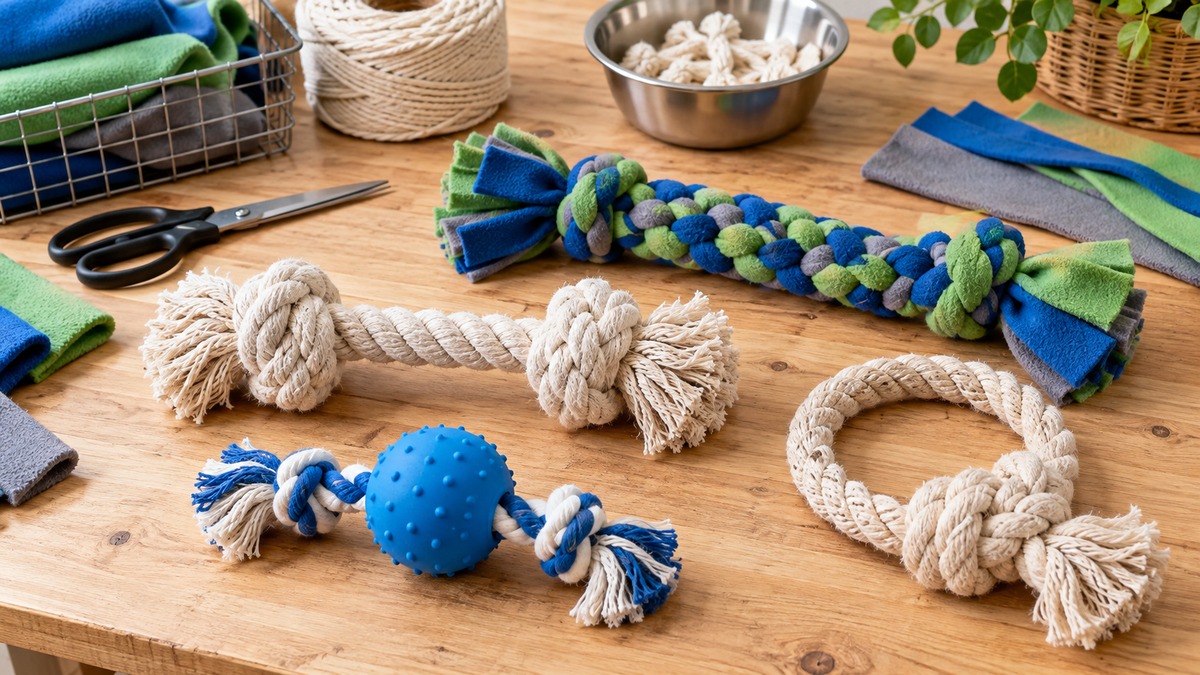
| Knotted towel or jeans strips | Vetstreet describes strips of towel or jeans tied with “a series of simple square knots” and a “very sturdy knot.” | Tug with you holding the other end only. A chewer can shred fabric, and the sources say to remove loose pieces. Do not leave it with the dog. |
| Sock around a treat bottle | Vetstreet describes an orphan sock around a used plastic bottle, with “no cap!”, filled with treats. | Skip it for a chewer. We found no source that clears plastic for a dog that chews hard, and the column itself says to dispose of chewed-off pieces. |
| Tennis ball toy | Vetstreet describes a “Tennis Ball Buddy” built on a tennis ball, with variations that use fabric strips. | Supervised play only. The AKC says rubber balls are more durable than standard tennis balls, so a dog-rated rubber ball is the better base. |
| Rope and PVC “Wolf Stick” | Vetstreet describes PVC pipe, rope, a carabiner and burlap. | Skip it for a chewer. The sources do not cover how PVC or burlap behaves under heavy chewing, and the AKC rule is to avoid anything that breaks into small pieces. |
| Frozen low-sodium broth on a lick mat | AKC lick mat page (updated Aug 3, 2026). | This is a licking activity, not a chew. It suits chewers who need something to do. Use a food-grade mat and supervise. |
| Homemade stuffed plush | AKC toy shopping guide. | Not for a dog that destroys plush. Ripped stuffing means the toy goes in the bin. |
How to decide: a checklist
- Does the material break into small pieces? If the dog can rip, crumble or splinter it, do not use it.
- Can the dog swallow the finished toy? Size it up for a large dog using the AKC ball rule.
- Does it have loose parts, such as stuffing, squeakers, caps or ties?
- Will you be watching? If not, put the toy away and use a tougher purchased chew.
- Is it intact after each session? Throw it away at the first rip, tear or puncture.
Worked example: two chewers, one afternoon
Our planning example, not a standard. Dog A is a 60 lb mix who tears a stuffed toy open in about 10 minutes. By the AKC rule, plush is out, and a towel braid is unlikely to last either. Dog A gets a frozen-broth lick mat for 15 minutes with you in the room, and a durable rubber toy for solo time. Dog B is a 30 lb dog who carries toys but rarely tears them. A towel-strip tug toy is fine for a 5 minute game of tug with you holding the other end, then you take it away and check it. Dog C is a 90 lb dog that tugs hard: cap tug sessions at 20 minutes in this example, and stop to check the toy for loose threads each time you pause. The only difference between the three is how the dog uses the material, and that decides the choice.
Alone time, rotation and crates
The ASPCA page says to supervise during all waking hours until you feel confident chewing is under control, and to rotate your dog’s chew toys every couple of days. It adds that if you must confine a dog, you should not crate for lengthy periods, with more than 6 hours given as the warning point. It also suggests a puzzle toy filled with something delicious for the times your dog is most likely to chew. A homemade toy is not the thing to leave behind for those hours.
Which store-bought toys to compare instead
If the dog destroys your DIY toys, move on to purchased chew toys made for the job. Our durable dog toys for heavy chewers roundup and the guide to Kong toys for heavy chewers compare those. For a different take on homemade ideas, read our DIY dog toys for aggressive chewers post. No toy is indestructible, so supervision still applies to all of them.
FAQ
What is the safest homemade toy for a dog that chews everything?
The sources we opened do not name a homemade toy that is safe for a hard chewer. The AKC rule is to pick toys that do not break into small pieces, so licking activities like a frozen broth lick mat are the lowest-risk DIY choice, with supervision.
Are old socks and towels safe for dogs to chew?
Fabric toys can be shredded and swallowed, so use them for supervised tug only. The Vetstreet column says to dispose of chewed-off pieces before they can be swallowed.
Are tennis balls okay as a homemade toy base?
The AKC says rubber balls are more durable than standard tennis balls, and that a ball must be large enough that a large dog cannot swallow it by accident. Supervise, and throw out any ball that is coming apart.
Can I use a plastic bottle as a dog toy?
Vetstreet describes a bottle toy with no cap, but also says to remove chewed-off pieces. We found no source that clears plastic for a hard chewer, so we recommend skipping it for that dog.
Should I give a chewer a cooked bone?
No. The ASPCA says not to give cooked bones, because they can splinter.
How often should I rotate chew toys?
The ASPCA suggests introducing something new or rotating your dog’s chew toys every couple of days.
When should I throw a homemade toy away?
At the first rip, tear, deep puncture or loose piece. The AKC advises throwing out a plush toy as soon as stuffing shows.
Bottom line
For a hard chewer, a homemade toy is a supervised activity, not a chew. Use it with you in the room, inspect it before and after, and bin it at the first sign of wear. If it does not survive a session, buy a purpose-made durable toy and keep supervising.
Sources
- AKC, Which Dog Toys Are Right for Your Dog? (updated Mar 4, 2026): durability, ball size, rubber versus tennis balls
- AKC, A Guide to Toy Shopping for Your Pup (May 13, 2015): plush, squeakers, inspecting toys
- Vetstreet, Making Safe and Effective Pet Toys At Home (Dr. Patty Khuly, June 12, 2013): the DIY toy designs and supervision advice
- ASPCA, Destructive Chewing: supervision, rotation, cooked bones, crating limits
- AKC, Lick Mats for Dogs (updated Aug 3, 2026): freezing broth on a mat. All sources were opened on 2026-10-18.