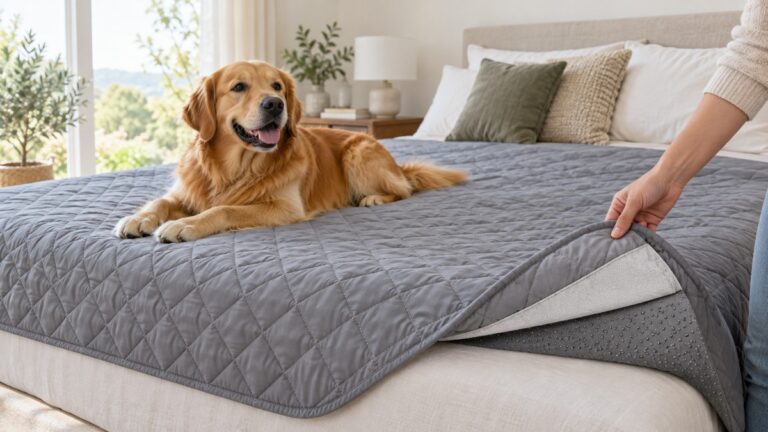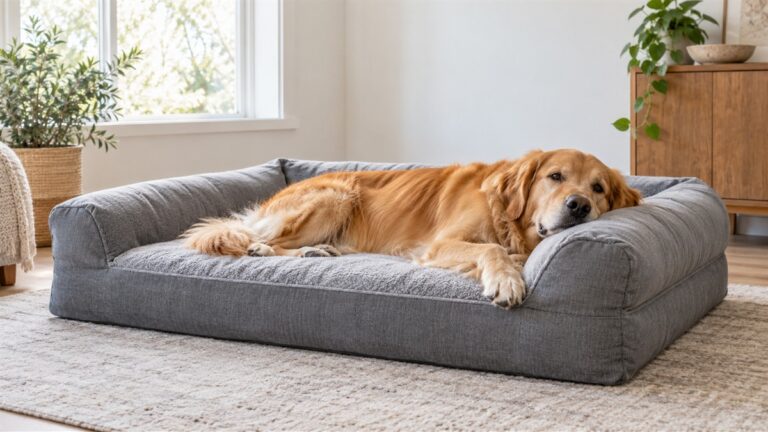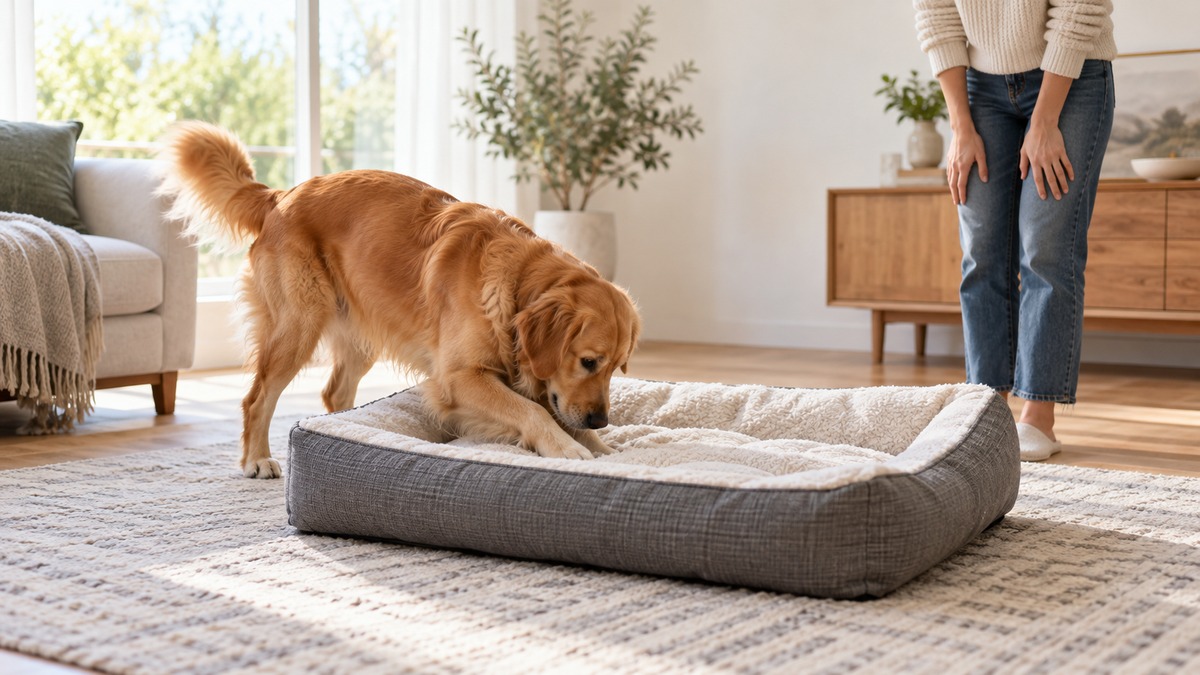
Female Dog Digging in Bed: Causes and Bed Choices
As an Amazon Associate we earn from qualifying purchases. Details
Female dog digging in bed can leave you wondering whether the bed is wrong, the routine needs attention, or the behavior warrants professional help. This guide helps you sort it out without guessing at a diagnosis. Start by noting exactly when she digs, what material she targets, and whether the pattern is new. Then inspect the bed for movement, bunching, wear, and a poor size match. A different bed may help when the current surface slides, traps mess, or gives her too little room, but buying one is not automatically the answer. You will learn how to separate a gear problem from a question for your vet or a certified trainer, and how to compare six listing-backed beds.
Quick answer
Watch what happens before, during, and after the digging. If your dog circles, paws for a moment, then lies down, check whether the bed stays flat and gives her enough room in her chosen position. If she repeatedly catches fabric, shifts the whole bed, or soils it, prioritize a non-skid base, a simpler surface, or a washable cover. You may not need a new bed if the current one remains intact, fits her, and is easy to clean.
At a glance
| Item | Figure stated in this post |
|---|---|
| Beds in this guide | 30 x 24 in up to 44 x 32 in |
| Sample dog outline | 30 in long by 22 in wide |
| Sleeping area with 2 in margins | 34 x 26 in |
| Example 42 x 30 in bed | 34 x 26 in sleeping area; 4 in clearance in each direction |
A sudden change, physical discomfort, damaged paws, or any other health concern belongs with your vet. Persistent behavior you cannot safely manage belongs with a certified trainer. Being female does not, by itself, tell you the cause; the observations around the behavior are what guide the next step.
Why a female dog may dig at her bed
No source used for this guide establishes one cause that applies to female dogs. That means sex alone should not drive a bed purchase or a behavioral conclusion. Treat “digging” as a description of what you see, then record the surrounding details.
First, separate a short settling sequence from repeated disruption. Write down whether she paws once, circles, lies down, gets up, or returns to dig again. Note whether the entire bed slides or only the top fabric bunches. Those details point to different shopping needs. A sliding bed makes a non-skid bottom relevant. Loose or damaged fabric makes construction and inspection more important. Repeated wet messes make a removable, machine-washable cover more useful.
Next, compare locations. Does she dig only in her own bed, only on your bedding, or on every soft surface available to her? This is an observation, not a diagnosis. It helps you decide whether the physical bed is the common factor. For nighttime-only scratching, the guide to a dog scratching the bed at night covers that narrower problem separately.
Also record when the pattern began. If the change is sudden or arrives with signs that concern you, ask your vet rather than assuming a new mattress will resolve it. For a persistent management question, ask a certified trainer.
Finally, inspect the result. Look for torn seams, exposed filling, pulled fibers, and a base that walks across the floor. No bed is indestructible. Stop using a damaged bed if your dog can reach loose material, and follow the maker’s care instructions. If the bed remains sound and she settles after a short pawing sequence, replacement may add no practical benefit.
How bed fit changes the choice
Bed labels such as medium, large, and extra large are not interchangeable measurements. The six listings here range from a 30-by-24-inch rectangle to a 44-by-32-inch model. Their stated weight guidance also varies. Measure the space your dog actually occupies in her normal resting position, then compare that observation with the listed outer dimensions and any stated sleeping area.
Do not infer usable space from the outside dimensions when bolsters take up part of the bed. One listed 42-by-30-inch bed gives a 34-by-26-inch sleeping area. That difference matters to a dog that stretches flat. A curled sleeper may instead use the raised sides, but the listing cannot tell you which posture your dog prefers.
Weight guidance deserves the same care. One 35-by-25-inch bed states a maximum recommendation of 30 pounds even though its breed recommendation says large. Another 35-by-22-inch mat states a 90-pound maximum while calling the breed size medium. Those fields do not align neatly, so compare your dog with the exact dimensions and weight statement instead of trusting a size word.
The 35-by-23-inch plush mat has another conflict: its specification says a 65-pound maximum, while its bullet says it is for dogs up to 60 pounds. Rely on neither number without checking the current listing. Use the narrower stated range for an initial screen and confirm the current size chart.
For beds, use your dog’s resting outline. If you also size wearable gear, the American Kennel Club says most gear relies on back length, chest girth, and neck girth. Measure her standing, keep the tape snug, and allow two fingers beneath it. The guide to orthopedic beds for large breeds can continue a size-led search.
A sample sizing calculation
Take a dog whose relaxed floor outline is 30 inches long and 22 inches wide. This is an illustration, not a universal fitting rule. Suppose her owner wants a 2-inch margin at each end and each side so the sleeping surface does not merely match her outline.
First calculation: length needed = 30 inches + 2 inches + 2 inches = 34 inches. Width needed = 22 inches + 2 inches + 2 inches = 26 inches. Recheck the additions in a different order: 2 inches + 30 inches + 2 inches still equals 34 inches, and 2 inches + 22 inches + 2 inches still equals 26 inches.
Now compare that estimate with the listing that states a 34-by-26-inch sleeping area inside a 42-by-30-inch outer bed. Estimated length clearance = 34 inches − 30 inches = 4 inches. Estimated width clearance = 26 inches − 22 inches = 4 inches. Verify from the margins: two 2-inch end margins total 4 inches, and two 2-inch side margins also total 4 inches. Both checks agree.
This calculation changes what you buy because it uses the stated sleeping area rather than the larger outer size. Repeat the process using your dog’s resting outline and the current listing. Do not apply these sample measurements to another dog.
What to check before buying another bed
Surface and movement
If the whole bed shifts during pawing, a listed non-skid bottom addresses that mechanical problem. It does not promise to stop digging. Five of the six choices state a non-skid or anti-slip base.
If claws catch the top, avoid assuming that “durable” means damage-proof. Inspect fabric and seams regularly. The medium crate mat expressly lists scratch resistance, while other choices describe polyester, fleece, flannel, velvet, or blended covers. Those are material descriptions, not guarantees against repeated clawing.
Cleaning method
Decide whether you want to wash the whole bed or remove a cover. Two fiber-filled choices state that the full bed can be machine washed. The foam beds direct you to remove a cover or the foam first. The EHEYCIGA bed expressly forbids machine washing or drying its foam core.
“Waterproof” also needs a closer read. The EHEYCIGA bed places a waterproof film between its fleece surface and bottom fabric, but its sides are not waterproof. Other foam beds state a laminated layer, inner liner, or TPU barrier. Water protection may reduce liquid reaching the foam, but it does not remove the need to follow care directions.
Shape and entry
Raised sides reduce the flat area available for stretching. They may suit a dog that chooses to rest against an edge, while a plain mat leaves a simpler open rectangle. One four-sided model states that it has a lowered entrance. Another raised-side bed also describes a low leading edge. Those details are worth checking if your dog’s normal entry pattern makes a tall border inconvenient, but ask your vet about any mobility concern.
Recovery after unpacking
Compressed beds need time to regain shape. Directions range from 24–48 hours to 1–2 days. Follow the exact listing and wait before judging loft.
Dog beds that fit the practical problem
These six beds do not treat a behavioral or medical cause. They offer different answers to slipping, exposed sleeping area, washability, and size. Choose only after the observation and measurement steps above.
1. EHEYCIGA Orthopedic Extra Large Dog Bed, Waterproof Washable XL Pet Bed 44″ (Best overall)
Specs from the listing (checked 2026-10-10):
- Product Dimensions: 44″L x 32″W x 6.5″Th
- Maximum Weight Recommendation: 45.36 kg
- Product Care Instructions: Machine Wash
- Cover Material: Fleece with Faux Linen sides
Pros
- Three-sided bolsters leave one side open
- The removable cover is machine washable
- The listing specifies memory foam and egg-crate foam
Cons
- The sides are not waterproof
Best for: Large or extra-large dogs within the stated dimensions and 45.36 kg maximum whose owners want a removable washable cover
Skip if: You need waterproof protection on the sides or a fully machine-washable foam core
View on Amazon (affiliate link)
2. Bedsure Orthopedic Dog Beds Large Sized Dog Washable Original Design (Best lowered entry)
Specs from the listing (checked 2026-10-10):
- Product Dimensions: 35″L x 25″W x 6.5″Th
- Maximum Weight Recommendation: 30 pounds
- Fill Material: Polyurethane Foam
- Product Care Instructions: Machine Wash
Pros
- Four bolsters include a lowered entrance
- The cover has a laminated waterproof layer
- The listing states a non-skid bottom
Cons
- The 30-pound maximum conflicts with the large size wording
Best for: Dogs within the stated 30-pound maximum that use a lowered bolster entrance
Skip if: Your dog exceeds the listed maximum or targets raised bolster seams
View on Amazon (affiliate link)
3. KSIIA Washable Dog Bed Medium Size Dog Crate Bed Plush Pet Mat 35″x23″ Gray (Best fully washable mat)
Specs from the listing (checked 2026-10-10):
- Product Dimensions: 35″L x 23″W x 3.5″Th
- Maximum Weight Recommendation: 65 pounds
- Item Weight: 4 pounds
- Cover Material: Heavy weight deluxe plush
Pros
- The whole mat can be machine washed
- Six keyhole fixation points secure the fill
- The listed features include scratch resistance
Cons
- The specifications and bullet disagree between 65 pounds and 60 pounds
Best for: Medium dogs whose owners want a plush, fully washable crate-style mat after confirming the weight guidance
Skip if: You require a waterproof layer, removable cover, or unambiguous weight limit
View on Amazon (affiliate link)
4. Comfort Expression Waterproof Orthopedic Dog Bed for Extra Large Dogs (Best measured sleeping area)
Specs from the listing (checked 2026-10-10):
- Product Dimensions: 42″L x 30″W x 8.5″Th
- Maximum Weight Recommendation: 90 pounds
- Included Components: Egg Crate Foam, Removable Washable Cover, Supportive Bolsters
- Product Care Instructions: Machine Wash
Pros
- The listing states a 34-inch by 26-inch sleeping area
- A waterproof inner liner protects the foam
Cons
- The bolsters and foam must be removed before washing the cover
Best for: Dogs up to the stated 90-pound maximum that fit the listed 34-inch by 26-inch sleeping area
Skip if: Your dog needs more open sleeping space or a borderless surface
View on Amazon (affiliate link)
5. Sunheir Washable Orthopedic Large Dog Bed with Removable Cover, Pet Bed Mat (Best flat foam mat)
Specs from the listing (checked 2026-10-10):
- Product Dimensions: 35″L x 22″W x 3″Th
- Maximum Weight Recommendation: 90 pounds
- Fill Material: Polyurethane Foam
- Cover Material: Waterproof Leathaire
Pros
- The borderless rectangle supports open stretching
- The removable cover includes a TPU waterproof barrier
- The listing states a slip-resistant bottom
Cons
- It provides no head-support bolster
Best for: Dogs within the 35-inch by 22-inch surface and stated 90-pound maximum that prefer a flat mat
Skip if: You want raised sides or a base deeper than 3 inches
View on Amazon (affiliate link)
6. INVENHO Medium Dog Beds for Medium Dogs Washable, Rectangle Dog Bed Medium Size Dog, Orthopedic Dog (Best small-medium bolster bed)
Specs from the listing (checked 2026-10-10):
- Product Dimensions: 30″L x 24″W x 9″Th
- Maximum Weight Recommendation: 35 pounds
- Material: Outer cover : 92% Polyester 8% Nylon, Inner Cover: 100 % Polyester, Bottom Cover 100% Polyester
- Fill Material: Cotton
Pros
- A low leading edge interrupts the raised sides
- The whole bed is described as machine washable
- The bottom is listed as non-slip
Cons
- The 35-pound specification conflicts with the 40-pound bullet
Best for: Small or medium dogs that fit the 30-inch by 24-inch footprint after the owner confirms the weight limit
Skip if: Your dog is near the disputed maximum or needs a waterproof removable cover
View on Amazon (affiliate link)
EHEYCIGA: waterproof film but open sides, for an extra-large dog
The EHEYCIGA is a 44-by-32-by-6.5-inch rectangular bolster bed with a 45.36 kg maximum. Its extra-large recommendation and large breed-size field differ, so confirm the current chart. Memory foam and egg-crate foam are listed inside.
Three-sided bolsters create an open side and a fleece sleeping surface. A waterproof film sits between the fleece and bottom fabric, but the listing explicitly says the sides are not waterproof. That is the meaningful limit for a dog that wets or digs at an edge. The cover can be removed and machine washed separately in cold water on a delicate cycle; the foam core cannot go in the washer or dryer. Allow 24–48 hours for expansion. Skip this bed if you need protected sides or want to wash the whole bed as one piece.
Bedsure: lower-entry bolster bed with a light weight limit
The Bedsure measures 35 by 25 by 6.5 inches and lists a 30-pound maximum. Its “large” wording conflicts with that maximum, so do not select by label alone. It uses egg-crate polyurethane foam, a washable cover, four bolsters, and a lowered entrance.
The removable cover includes a laminated waterproof layer and is described as machine washable. A non-skid bottom is also listed. Those details make it worth a look when the current bed slides and cover removal is acceptable. The certifications named in the listing apply to its stated materials, but they do not establish that the bed will withstand digging. Skip it if your dog exceeds the listed maximum, needs an unbordered stretching surface, or regularly targets bolster seams.
KSIIA: fully washable medium crate mat
The KSIIA is a 35-by-23-by-3.5-inch, 4-pound plush mat. It uses polypropylene fiber fill and six keyhole fixation points. Listed features include scratch resistance and a non-skid bottom. The whole mat can be machine washed on a gentle cold cycle and tumble dried on low.
Sizing needs confirmation. The specifications state a 65-pound maximum, while the bullet says dogs up to 60 pounds. Do not rely on either conflicting limit until the current listing resolves it. The medium breed recommendation is only another label, not a substitute for measuring. This mat has no stated removable cover or waterproof layer. Skip it if liquid protection is essential, if you want foam, or if unresolved weight guidance makes fit uncertain.
Comfort Expression: bolstered bed with a stated inner sleeping area
The Comfort Expression bed has 42-by-30-by-8.5-inch outer dimensions and a stated 34-by-26-inch sleeping area. That inner measurement makes it the clearest bed here for comparing a dog’s resting outline with usable space. The listing gives a 90-pound maximum and names several breeds, including German Shepherd Dog, Golden Retriever, Labrador Retriever, Siberian Husky, and American Pit Bull Terrier.
Its egg-crate foam base has three-sided bolsters, a waterproof inner liner, and a non-skid bottom. The cover is machine washable after the foam and bolsters are removed. Allow 48 hours after unpacking. Skip it if your dog needs more than the stated inner area or prefers a borderless mat.
Sunheir: flat foam mat for open stretching
The Sunheir measures 35 by 22 by 3 inches. The listing states a 90-pound maximum, calls the dog breed size medium, and recommends several named breeds. Because the size label and maximum tell different stories, judge fit by your dog’s resting outline, the bed dimensions, and the current chart.
This rectangular mat uses 3-inch high-density egg foam. The description and the cover-material field (Waterproof Leathaire) do not clearly agree on the top surface, so check the current listing. Its machine-washable removable cover has a TPU waterproof barrier. A slip-resistant bottom is listed. With no bolsters, the rectangle is simpler to assess for a stretching dog, and every edge stays open. Skip it if you want bolsters or a deeper base.
INVENHO: small-to-medium raised-side washable bed
The INVENHO measures 30 by 24 by 9 inches and lists a 35-pound maximum, while its bullet says 40 pounds. Verify the active listing. The raised sides contain cotton fill; the outer material is 92% polyester and 8% nylon.
The whole bed is described as washable by hand or machine. Wide side bolsters and a low leading edge distinguish it from the flat mats. A non-slip bottom is listed. After washing or unpacking, the listing says to allow 1–2 days for it to become fluffy. Skip this one if your dog falls near either disputed limit, needs a removable waterproof cover, or benefits from an unbordered sleeping area.
Common misunderstandings about bed digging
“A female dog needs a female-specific bed”
None of the bed listings identifies a sex-specific fit. Dimensions, weight guidance, sleeping posture, floor grip, and cleaning needs are the useful checks here. Do not substitute a marketing label or color for those checks.
“Orthopedic means the behavior will stop”
Several listings call their foam orthopedic, but that word is not evidence that a bed changes digging. Treat it as the maker’s product description, then examine the actual foam type, dimensions, entry shape, and care method. Ask your vet if you are choosing a bed around pain, arthritis, or another medical concern.
“Waterproof means every surface is protected”
Construction varies. One listing excludes the sides from waterproof protection. Others describe a liner, laminated layer, or TPU barrier. Read where the barrier sits and how the cover must be removed. A waterproof component is not a reason to ignore torn fabric or cleaning directions.
“The largest outside dimensions provide the largest sleeping area”
Bolsters can occupy part of the footprint. Only one bed here states both its outer dimensions and its 34-by-26-inch sleeping area. When another listing gives only outer measurements, do not invent the usable area. Check the current product page or choose a flat mat whose shape is easier to compare.
“Replacing the bed is always the next step”
Keep the current bed when it fits, stays intact, remains manageable to clean, and does not create a floor-grip problem. Replace it when an observed mismatch maps to a listed feature you can verify. If your real question is about repeated destruction, use the guide for a dog that keeps digging at its bed before buying. If your dog targets your mattress instead, a protective blanket for a human bed solves a different cleanup problem, not the cause.
FAQ
Is female dog digging in bed automatically a problem?
Not automatically. Observe duration, frequency, damage, and what happens afterward. If the bed remains intact and she settles, a purchase may be unnecessary. Ask your vet about a sudden change or health concern, and a certified trainer about persistent behavior you cannot manage safely.
Does being female explain why my dog digs?
The listings do not establish a female-specific cause. Base your choice on timing, location, bed movement, damage, cleanup needs, and fit rather than sex alone.
Should I choose a flat mat or a bolster bed?
Choose a flat mat when you want an open rectangle and your dog stretches or targets raised seams. Consider bolsters when she already chooses to rest against an edge. Compare her resting outline with the sleeping area, not just the outer footprint.
What if the product’s size fields conflict?
Do not average them or choose the more convenient figure. Several listings here conflict on weight or breed-size labels. Measure your dog’s resting outline, check the current maker chart, and skip the product if the discrepancy prevents a confident fit.
Will a non-skid bottom stop digging?
It addresses bed movement, not the underlying behavior. It is relevant when you actually see the whole bed slide during entry or pawing. Continue to inspect the top and seams for damage.
Is a waterproof bed also fully washable?
Not necessarily. Some choices have removable machine-washable covers and foam that must stay out of the washer. Others allow washing the whole fiber-filled bed but do not list waterproof protection. Follow the exact care instructions for the selected model.
How should I handle nails that catch the fabric?
Nail trimming is an essential grooming task. The AKC recommends gradual introduction to clippers or a grinder over several days and dog-friendly tools. Its sequence moves from sniffing and touching the tool to hearing or feeling it, then trimming only the tiniest nail tip. If you are unsure how to do this safely, ask a professional groomer or your vet.
When should I stop shopping and call someone?
Call your vet when the digging is a sudden change or accompanies a health concern. Ask a certified trainer when the repeated behavior is difficult to manage. A bed can change grip, shape, space, and cleaning convenience; it cannot establish or treat a diagnosis.
Bottom line
Keep the current bed if it fits, stays intact, and remains easy to manage. Choose a replacement only when you can name the mismatch: sliding, insufficient measured space, exposed borders, or unsuitable cleaning. Match that problem to a verified feature, confirm conflicting size fields on the current listing, and route medical concerns to your vet or persistent management questions to a certified trainer.
Sources
- American Kennel Club dog gear measuring guide: supports the three core gear measurements, chest-girth location, standing measurement, and two-finger method.
- American Kennel Club nail trimming guide: supports nail care and the gradual introduction sequence for clippers or grinders.