Best Dog Tie Out: Five Cables Compared by Length, Weight Limit and Clip
As an Amazon Associate we earn from qualifying purchases. Details
The best dog tie out is the one whose cable length, listed weight limit and clip match your dog and your yard, and that you can keep from tangling. This guide compares the five tie-out cables in our research file by what their listings state. It also sets out what the sources we opened say about tethering a dog outdoors, because those rules matter as much as any product feature. The Humane World for Animals page accepts a restraint for a short period or under supervision, and rejects long tethering.
Quick answer
- Choose the length by the yard first. The five cables run from 25 feet to 50 feet, and reachable area grows with the square of the length, so a 50 foot cable covers four times the ground of a 25 foot cable (our planning estimate).
- Match the weight limit to your dog’s actual weight. The listings state limits of 90, 125 and 250 pounds. The 500 pound figure for Tresbro comes from its bullets, and its specification fields are not used, so confirm it before you rely on it.
- Keep the dog supervised and the cable clear of other objects. Humane World for Animals says a restraint “can be acceptable if it is done for a short period or while supervised”, and only when the tether “cannot become entangled with other objects”.
- Do not leave a dog tied out alone. The Amazon Basics listing says “do not leave pet unattended when connected to cable”, and the sources we opened reject long-term tethering.
What a tie-out is
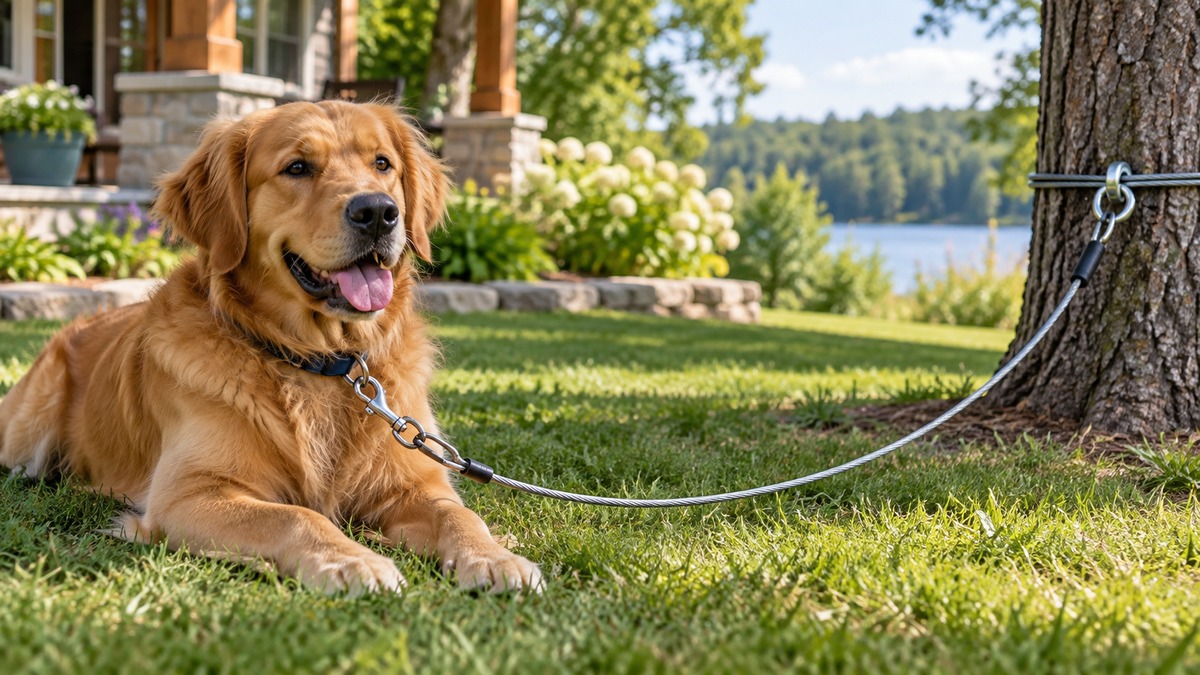
A dog tie-out is usually a length of coated steel cable with a clip at each end, and many include a swivel. One clip fastens to the dog’s collar or harness, and the other fastens to a stake, post, tree or fence. The Tuff Pupper listing says to “Attach to a tree, fence, post” and that the stake is “sold separately.” The research file does not say that any of the five listings includes a stake, so this guide does not rate stakes.
The sources use several words for the same idea. Humane World for Animals, formerly the Humane Society of the United States, says that “chaining” and “tethering” both refer to “the practice of fastening a dog to a stationary object and leaving them unattended.” The same page adds that “These terms are not meant to refer to an animal being walked on a leash or cases of supervised, temporary tethering while an owner is present.” A tie-out fits the first definition when the dog is left on it alone. It does not fit when you hold the leash or stay with the dog. Most of the safety points below depend on that line.
Safety first: tethering outdoors
What the sources say about tethering
The ASPCA treats tethering as a safety problem as well as a welfare one. In a press release about a grant to replace tethered chains, an ASPCA anti-cruelty grants officer said: “Tethering is an inhumane practice that poses a threat to the safety of the tethered dog, other animals and humans.”
Humane World for Animals lists the physical costs for dogs that are tethered for long stretches. “Their necks can become raw and sore, and their collars can painfully grow into their skin.” Continuously tethered dogs, the page says, “are at high risk of entanglement, strangulation and harassment or attacks by other dogs or people.”
The same page describes the bite risk. It says tethering “is a high-risk factor in serious dog bites and attacks,” and that a tied dog, “unable to take flight, resorts to fight.” These are general findings about tethered dogs. None of the sources we opened describes a specific tie-out cable, its clip or its stake.
Time, supervision and weather
The most useful rule for a tie-out comes from the Humane World page: “Placing an animal on a restraint can be acceptable if it is done for a short period or while supervised and if the tether is secured in such a way that it cannot become entangled with other objects.” The same page also says that “Keeping an animal tethered for long periods or during extreme weather and disasters is never acceptable.”
The page gives no number of minutes or hours, so this guide does not set one. Phrases such as “short period” describe a principle, not a measured limit, and a reader should not treat them as one.
Weather belongs to the same rule. Humane World notes that for tethered dogs, “During periods of extreme heat, they may not receive adequate water or protection from the sun.” The Veterinary Emergency Team page from Texas A&M’s veterinary medicine site says that “Pets left outdoors are at risk for diseases,” and warns of “storm-related injuries, and, possibly, death.” Its disaster rule is direct: “In the event of a natural disaster, never leave your pets behind in vehicles, tethered, or crated without you or a member of your family.” The Amazon Basics listing gives the same warning in shorter form: “do not leave pet unattended when connected to cable.”
Collars, lines and entanglement
Humane World’s collar rule is short: “Collars should be comfortable and fitted properly; choke chains should never be used.” A heavy chain or a choke-style collar is not a safe choice for a tie-out.
The AKC’s advice is about long lines rather than tie-outs, but it makes the same neck point. It says to “Attach a long line to a well-fitted back-clip harness to prevent your dog from pulling and straining their neck.” The same page says that “long lines can range in length from 10 to 50 feet,” which overlaps the 25 to 50 foot range of the cables in this set.
Moving from a fixed stake to a pulley or a longer line does not remove the main risks, and for everyday harness choices our everyday dog harness guide compares fit and wear. Humane World says that “many of the same risks associated with tethering still apply, including hanging, attacks on or by other animals, lack of socialization and safety.”
Humane World recommends that dogs living outdoors have “a safe, escape-proof enclosure with proper shelter.” A tie-out is not an enclosure. The Tresbro bullets say its lock “prevents the latch from opening and the dog getting loose.” That is a listing claim, and this guide does not treat it as proof that a dog cannot get loose.
Rules where you live
Humane World advises readers to “Find out if your community (city, county, township and even some states) has laws regulating tethering.” The ASPCA notes that “Since 2006, it has been illegal in the state of California to keep dogs tethered on chains, as stated by California Health & Safety Code 122335.” The AKC adds that local rules can also limit leash length, and says to “check local ordinances, as some locations do not permit leashes longer than six feet.”
Length and the ground a cable covers
The listed length sets the outer edge of a dog’s run, if nothing blocks the line. A cable of length L, anchored at one point, lets a dog reach roughly a circle with radius L. Our planning estimate uses the circle formula, 3.1416 x L x L, and it ignores the dog’s body, the collar position and any obstacle. Real reach is smaller wherever an object is in the way.
| Cable length | Radius used | Reachable area (our planning estimate) | Share of the 50 foot circle |
|---|---|---|---|
| 25 ft | 25 ft | 3.1416 x 25 x 25 = 1,963.5 sq ft | 25 percent |
| 30 ft | 30 ft | 3.1416 x 30 x 30 = 2,827.4 sq ft | 36 percent |
| 40 ft | 40 ft | 3.1416 x 40 x 40 = 5,026.6 sq ft | 64 percent |
| 50 ft | 50 ft | 3.1416 x 50 x 50 = 7,854.0 sq ft | 100 percent |
Because area grows with the square of the length, a 25 foot cable covers one quarter of the ground that a 50 foot cable covers. A longer run gives more ground, and it also gives the line more room to reach a fence, a tree or another animal. The Humane World page says the tether must be secured so that it cannot become entangled with other objects, so more length is not a safety gain on its own. The sources we opened do not give a maximum safe length, so this guide does not name one.
Comparison table
Table 1 lists only what each listing states in its title, its first bullets or its specification fields. Tresbro’s specification fields are not used, for the reason given in the section on what we could not verify.
| Listing (from the research file) | Stated length | Stated dog size or weight limit | Clip or lock | Coating or material |
|---|---|---|---|---|
| Amazon Basics, 25 ft | 25 feet | Medium to large dogs, up to 90 pounds | Metal clips; snap closure | Steel and PVC |
| Petest, 30 ft | 30 feet | Dogs up to 125 pounds | Swivel clips; snap closure | Steel cable with vinyl covers |
| Petest, 40 ft | 40 feet | Dogs up to 250 pounds | Swivel clips and snaps | Steel cable with vinyl and crimp covers |
| Tuff Pupper, 50 ft | 50 feet | Dogs up to 250 pounds | 360-degree no-tangle clips; hook closure | Galvanized steel with waterproof PVC coating |
| Tresbro, 50 ft (title and bullets only) | 50 feet | Medium to large dogs in the title; up to 500 pounds in a bullet | Locking clip, with a lock described in the bullets | Stainless steel core with vinyl coating, per the bullets |
Four of the five titles name a weight limit. The Tresbro title does not, and its 500 pound figure appears only in a bullet.
How we chose
The research file holds five listings for this keyword, recorded as checked on 21 October 2026 from Amazon.com. This guide keeps all five and adds none. Two of the five come from the same brand: Petest has a 30 foot listing and a 40 foot listing. Both are kept, because each states its own length and weight limit.
The criteria are the ones a buyer can check on the page: the stated length, the stated dog size or weight limit, the clip or lock, and the coating or material. We used the title and the first bullets first, and the specification fields second. For the Tresbro listing we used only the title and bullets, because its specification fields include a garbled manufacturer name and a “Target Species” entry of Basset Hound.
We do not rank the five by quality. The listings give features, and the sources we opened give rules for use, so the picks below describe fit and limits rather than a winner. Where a listing does not state a value, this guide says so.
Product picks
The set has five listings, and this guide keeps all five. Petest appears twice, once as a 30 foot listing and once as a 40 foot listing. Each product below gives who the cable suits, one strength the listing states, one limit, and a skip-if line. Strengths and limits come from the listing text unless a sentence names an opened source.
Amazon Basics 25 ft steel wire tie-out
This cable suits an owner of a large dog up to the 90 pound limit the listing states, who needs a 25 foot run for a yard or campsite. The listing says the steel and PVC build has rust-resistant performance, and that the metal clips make connections quick and easy. The limit is that the listing gives a weight of 13.8 ounces and no cable strength figure, and 25 feet is the shortest run in this set. Skip if your dog weighs more than 90 pounds or you need a run longer than 25 feet.
Petest 30 ft reflective tie-out for dogs up to 125 lb
This cable suits an owner of a large dog up to 125 pounds who wants a 30 foot run with reflective covers. The listing says its vinyl covers are reflective and give “extra safety at night.” The limit is that the listing states a 125 pound limit and a 30 foot length, but no cable strength figure. Skip if your dog is heavier than 125 pounds, or if you want the 40 foot model from the same brand.
Petest 40 ft tie-out for dogs up to 250 lb
This is the second Petest listing, and it is a separate listing with a different length and limit. It suits a giant or very strong dog that needs the longest Petest run, which the title rates for dogs up to 250 pounds. The bullets say the rotation “protects your pet from tangling,” and that the crimp covers help protect the cable ends. The limit is weight: at 2.77 pounds, this cable is heavier than the 30 foot Petest listing at 1.39 pounds, and the listing gives no cable strength figure. Skip if you want a lighter cable or a run shorter than 40 feet.
Tuff Pupper 50 ft tie-out for dogs up to 250 lb
This cable suits an owner with a large yard, campsite or picnic area who wants a 50 foot galvanized cable. The bullets say the cable is “sealed in waterproof PVC coating,” and that the clips rotate 360 degrees to reduce tangles. The bullets suggest use in “a fenceless yard, campsite, or picnic,” and the time and supervision rules in the safety section apply to that use. The listing states a weight of 4.66 pounds, the heaviest weight in this comparison. The limit is that the bullets give strength figures, “withstand 480 pounds of pulling force” and “rating of 8KN of tensile force,” which this guide could not verify. Skip if you need a stake in the box, since the listing says the stake is “sold separately.”
Tresbro 50 ft tie-out with shock spring
This cable suits an owner of a medium to large dog who wants a spring in the line. The title names a shock spring, and the bullets say the spring helps with sudden movements. The bullets also describe a lock that “prevents the latch from opening and the dog getting loose.” That is a listing claim, and this guide could not verify it. The limit is in the listing data itself: the manufacturer name is garbled, and the specification list gives a “Target Species” of Basset Hound, so this guide uses only the title and bullets for this cable. Skip if you want the manufacturer and model confirmed on the listing before you buy.
1. Amazon Basics Rust-Free Steel Wire Tie-Out Cable for Large Dogs up to 90 lbs, Dog Leash Run Tether (Plain 25 foot steel cable for large dogs)
Specs from the listing (checked ):
- Item Weight: 13.8 ounces
- Material Type: Alloy Steel, Polyvinyl Chloride
- Closure Type: Snap
Pros
- The listing describes a rust-resistant steel and PVC build
- The metal clips are described as quick and easy to connect
- The title names a limit of 90 pounds for large dogs
Cons
- The listing gives no cable strength figure
- At 25 feet it is the shortest run in this set
Best for: An owner of a large dog who needs a 25 foot run for a yard or campsite
Skip if: Your dog weighs more than 90 pounds or you need a run longer than 25 feet
View on Amazon (affiliate link)
2. 30ft Reflective Tie-Out Cable for Heavy Dogs Up to 125 Pounds (Reflective 30 foot cable for dogs up to 125 pounds)
Specs from the listing (checked ):
- Item Length: 30 feet
- Material Type: Alloy Steel, Vinyl
- Closure Type: Snap
Pros
- The bullets say the vinyl covers are reflective for use at night
- The title states a 125 pound limit for heavy dogs
- The swivel clips and snaps are listed in the bullets
Cons
- The listing states no cable strength figure, only the 125 pound limit
- At 1.39 pounds it is heavier than the Amazon Basics cable but lighter than the 40 foot Petest model
Best for: An owner of a large dog who wants a 30 foot run with reflective covers
Skip if: Your dog is heavier than 125 pounds or you want the 40 foot model from the same brand
View on Amazon (affiliate link)
3. Reflective Tie Out Cable with Crimp Cover for Super Dogs Up to 250 Pounds, 40 Feet (40 foot cable rated in the title for dogs up to 250 pounds)
Specs from the listing (checked ):
- Item Length: 40 feet
- Item Weight: 2.77 pounds
- Closure Type: Snap
Pros
- The bullets say the smooth rotation protects the dog from tangling
- The bullets say the crimp covers protect the cable ends
- The title names a limit of 250 pounds for giant dogs
Cons
- At 2.77 pounds it is heavier than the 30 foot Petest listing
- The bullets say ultra strong but give no figure for it
Best for: An owner of a giant or very strong dog who needs the longest Petest run
Skip if: You want a lighter cable or a run shorter than 40 feet
View on Amazon (affiliate link)
4. Tuff Pupper Dog Tie Out Cable, 50 ft Heavy Duty Lead for up to 250 lb Dogs (Galvanized 50 foot cable with waterproof coating)
Specs from the listing (checked ):
- Item Length: 50 feet
- Material Type: Galvanized Steel
- Closure Type: Hook
Pros
- The bullets describe a waterproof PVC coating over the steel
- The bullets describe clips that rotate 360 degrees to reduce tangles
- The bullets suggest use in a fenceless yard, campsite or picnic
Cons
- The strength figures in the bullets could not be verified
- The stake is sold separately, according to the listing
Best for: An owner with a large yard, campsite or picnic area who wants a 50 foot galvanized cable
Skip if: You need a stake included in the box
View on Amazon (affiliate link)
5. 50FT Dog Tie Out Cable Lead with Shock Spring for Medium Large Dogs (50 foot shock-spring cable for medium to large dogs)
Pros
- The title names a shock spring and the bullets say it helps with sudden movements
- The bullets describe a lock that prevents the dog from getting loose
- The bullets describe a 360-degree swivel that keeps the line from tangling
Cons
- The manufacturer name in the listing data is garbled, so this pick uses only the title and bullets
- The lock and chew-proof claims in the bullets could not be verified
Best for: An owner of a medium to large dog who wants a spring in the line
Skip if: You want the manufacturer and model confirmed on the listing before you buy
View on Amazon (affiliate link)
Buying checklist
- Weigh the dog, then choose the limit. Use the dog’s actual weight, not its breed. The listings state limits of 90, 125 and 250 pounds, and the Tresbro bullets state 500 pounds.
- Measure the yard before you choose the length. Look for fences, trees, steps and other animals, then pick a run that keeps the cable clear of them.
- Check the clip against the ring on your dog’s collar or harness before you buy. For harness options for a large dog, see our large-dog harness guide.
- Use a collar or harness that is comfortable and fitted properly. Do not use a choke chain on a tie-out.
- Plan for weather and disasters before you tie a dog out. Humane World says that tethering “during extreme weather and disasters is never acceptable,” and the Texas A&M page says never to leave a pet tethered in a natural disaster without you or a family member.
- Plan for a stake separately if the listing does not include one.
- Check the dog’s neck often. Humane World says raw, sore necks and collars that grow into the skin are among the costs of long-term tethering.
Mistakes to avoid
- Leaving the dog on the cable alone. The Amazon Basics listing says not to leave the pet unattended while it is connected, and Humane World defines tethering as leaving a dog unattended on a fixed object.
- Using a choke chain or a heavy chain on the line. Humane World says choke chains should never be used.
- Treating a lock or a stated weight limit as proof of escape-proof or safe use. The Tresbro lock claim and the 480 pound pulling figure are listing claims, not checked facts.
- Picking the longest run for the most ground. Area grows with the square of the length, and a longer run gives the line more room to reach a fence or a tree.
- Forgetting the disaster rule. The Texas A&M page says never to leave pets tethered in a natural disaster without you or a family member.
- Assuming the stake comes with the cable. The Tuff Pupper listing says the stake is sold separately, and the research file does not show a stake for any of the five.
What we could not verify
- Tresbro’s listing data. The manufacturer name is garbled, the specification list gives a “Target Species” of Basset Hound, and the model and part number fields read “dog tie out cable” and “dog cable” rather than model identifiers. This guide uses only the title and bullets for this cable and leaves its specification table out.
- Petest’s two listings. Both come from one brand. We did not confirm whether they share a cable, clip or coating beyond what each listing’s bullets say.
- Tuff Pupper’s color field. It reads “250 lbs Max Weight,” so the listing does not state a color, and this guide does not use that field.
- Strength figures. The 480 pound pulling figure and the 8KN rating for Tuff Pupper, the 500 pound figure for Tresbro, and the weight limits in every listing are listing claims. None of the sources we opened gives a strength rating for these cables.
- Escape-proofing. None of the sources we opened says that any of these cables is escape-proof. Humane World describes an escape-proof enclosure, which a cable is not.
- Chew resistance. The Tresbro bullets say the outer skin is “chew proof vinyl coating.” We could not verify that claim, and the other listings do not make it.
- Warranty. The Amazon Basics bullets say it is “backed by an Amazon Basics limited one-year warranty.” That is a listing statement that this guide did not check.
- Stakes and swivels. No listing in the research file describes a stake, and none of the sources we opened describes swivel quality for these cables.
- Safe maximum length and time limits. The sources we opened give no maximum length and no number of minutes or hours for tethering.
- Local rules. We did not check the tethering or leash rules of any city, county or state. The sources say those rules vary.
- AKC guidance on tie-outs. We did not find AKC guidance on tie-outs. The AKC pages we opened cover long lines and off-leash use.
- Listing dates. The research file is dated 21 October 2026, and listings can change after that date.
FAQ
Is a dog tie out safe to use outdoors?
None of the five listings can be called safe on the strength of the sources we opened. Humane World for Animals accepts a restraint “if it is done for a short period or while supervised,” and only when it “cannot become entangled with other objects.” The ASPCA calls tethering a threat to “the safety of the tethered dog, other animals and humans.” Ask a veterinarian about your dog’s temperament and your yard before you use a tie-out outdoors.
How long can a dog stay on a tie out?
The sources we opened do not give a number of minutes or hours, so this guide does not give one. Humane World says a restraint can be acceptable “for a short period or while supervised,” and says that long tethering “is never acceptable.” If your dog is on a cable, the Amazon Basics listing says not to leave the pet unattended while it is connected.
Can I leave my dog tied out while I am at work?
The sources do not support it. Humane World defines tethering as “the practice of fastening a dog to a stationary object and leaving them unattended,” and the Amazon Basics listing says “do not leave pet unattended when connected to cable.” The same Humane World page treats supervised, temporary restraint as a different case, but a dog left alone for a working day falls outside that case.
How long should the cable be?
Choose the length that fits your yard and the space you need, and remember that reachable area grows with the square of the length. The sources we opened do not name a safe maximum length. The AKC says that “long lines can range in length from 10 to 50 feet,” which overlaps the 25 to 50 foot range in this set, and it notes that some locations do not permit leashes longer than six feet.
Should I use a collar or a harness?
Humane World says “Collars should be comfortable and fitted properly; choke chains should never be used.” The AKC’s long-line guidance recommends “a well-fitted back-clip harness to prevent your dog from pulling and straining their neck.” The listings in this set do not say which attachment they assume, so check the clip against whichever one you use. For a fuller comparison of the two, see our harness or collar guide.
Does a longer tie out give my dog more freedom?
It gives more ground, as the length table shows, but the sources we opened do not say that more ground is safer. Humane World says that moving from a fixed tether to a pulley or a longer line still leaves “many of the same risks associated with tethering,” including “hanging, attacks on or by other animals, lack of socialization and safety.”
Bottom line
Choose the length and weight limit that your yard and your dog need, and treat a tie-out as short, supervised time outside. Check the clip and the swivel before each use, keep the cable clear of other objects, and never tie out a dog during extreme weather or a disaster. The listings describe features, and the sources we opened set the limits on use.
Disclosure: this page contains affiliate links, and the site may earn a commission on qualifying purchases.
Sources
- Humane World for Animals (formerly the Humane Society of the United States), “Is it Okay to Chain or Tether Dogs? Find Out Here!”, opened 2026-10-22: https://www.humanesociety.org/resources/chaining-and-tethering-dogs-faq
- ASPCA, press release on a grant to replace tethered chains in Santa Cruz County, California, opened 2026-10-22: https://www.aspca.org/about-us/press-releases/aspca-grants-22500-help-santa-cruz-county-replace-dangerous-tethered-chains
- Texas A&M University, Veterinary Medicine and Biomedical Sciences, “Be Prepared – Veterinary Emergency Team”, opened 2026-10-22: https://vetmed.tamu.edu/vet/be-prepared/
- American Kennel Club, “Is My Dog Ready to Be Off-Leash?”, opened 2026-10-22: https://www.akc.org/expert-advice/training/dog-ready-to-be-off-leash/