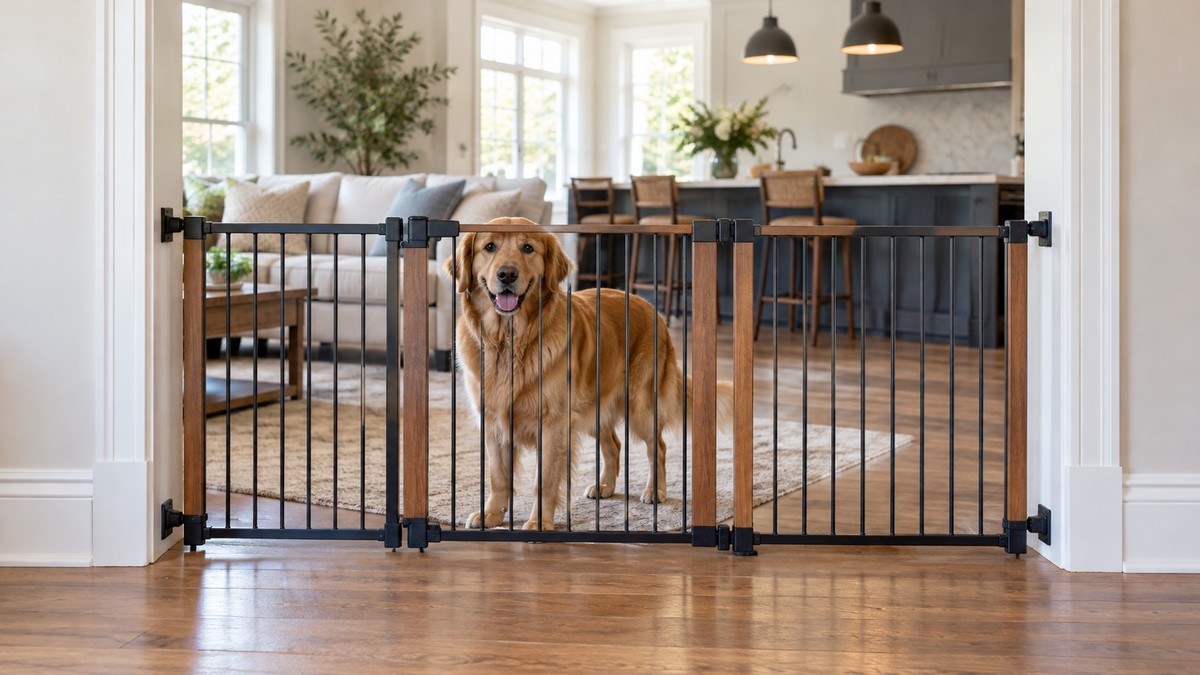
Best Extra Wide Dog Gate: Five Options Compared by Width, Height and Mounting
As an Amazon Associate we earn from qualifying purchases. Details
The best extra wide dog gate is the one whose listed width covers your narrowest opening with room to spare, whose listed height suits how high your dog can jump, and whose mounting type suits the spot where it will stand. This guide compares the five extra wide dog gate listings in our research file, using only the figures those listings state and the sources we opened on 2026-10-22. No gate here is ranked first, because the right choice depends on your opening and your dog.
Quick answer
- For openings wider than 78 inches, the listings that state a width that large are LAUNX (142 inches fully open), Mumeasy (150 inches) and No Pawblems (156 inches).
- AKC’s guidance starts at 30 inches for bigger breeds or jumpers. Four of the five listings state 28 to 30 inches. The LAUNX listing states 24 inches.
- For the top of stairs, AKC says hardware-mounted gates are generally considered the safest option. Of the five listings, only cideny and LAUNX mention stairs, and both advise against using the gate there.
- Measure the narrowest point of your opening first, then check the width margin with the formula in the width section.
Comparison at a glance
| Gate (listing title, shortened) | Listed width | Listed height | Mounting (as listed) | Listed weight | Stair note in listing |
|---|---|---|---|---|---|
| No Pawblems freestanding gate with door | 156 in (product dimensions) | 30 in | Pressure mount, wall mount | Not stated | Not stated |
| cideny extra wide baby gate | 29.4 to 78 in (opening range) | 28 in | Hardware-mounted installation with suction cups at the base | 6.85 kg (about 15.1 lb) | Advises against installing at the top of stairs |
| Mumeasy extra wide baby gate | 30 to 150 in (opening range) | 30 in | Wall mounting with screws included | 13.22 kg (about 29.1 lb) | Not stated |
| Amibud extra wide baby gate | 30 to 63 in (opening range) | 30 in | Pressure mounted | 15.1 lb | Not stated |
| LAUNX acacia wood freestanding gate | 142 in fully open | 24 in | Freestanding, no tools or mounting | 24.5 lb | Not for use at the top of stairs |
Weights given in kilograms are converted at 2.20462 lb per kg, for example 13.22 kg x 2.20462 = 29.1 lb. Every width, height and weight in the table is the figure the listing states. Where a listing gives an opening range, the range is shown as written.
How the width math works
For each gate, use this formula:
Width margin = listed maximum width – measured opening width
A positive margin means the stated range covers your opening. A small positive margin leaves little room for the hardware, the bottom of the panels and any baseboard along the wall. One buying guide we opened, Christ Hold Fast, says careful measuring is essential because some products exclude several width ranges, so the listed maximum is not always the usable maximum.
Worked example at a 60-inch opening:
- No Pawblems: 156 – 60 = 96 inches of margin
- Mumeasy: 150 – 60 = 90 inches of margin
- LAUNX: 142 – 60 = 82 inches of margin
- cideny: 78 – 60 = 18 inches of margin
- Amibud: 63 – 60 = 3 inches of margin
Worked example at a 96-inch opening:
- No Pawblems: 156 – 96 = 60 inches of margin
- Mumeasy: 150 – 96 = 54 inches of margin
- LAUNX: 142 – 96 = 46 inches of margin
- cideny: 78 – 96 = -18 inches, so the stated range does not reach this opening
- Amibud: 63 – 96 = -33 inches, so the stated range does not reach this opening
Two cautions apply to these numbers. The LAUNX width of 142 inches applies to the eight-panel gate fully open, so a narrower setup gives a narrower span. The cideny and Amibud figures are opening ranges, so a 30-inch doorway sits at the bottom of their stated range, not the middle.
Height and jumping
AKC says a gate should be tall enough that the dog cannot jump over it, and for bigger breeds or jumpers it gives 30 inches as a starting point. Measured against that starting point, three listings match it: No Pawblems, Mumeasy and Amibud, each stating 30 inches. The cideny listing states 28 inches, and the LAUNX listing states 24 inches, so both sit below the level AKC names for bigger breeds or jumpers.
Height is not the only thing that matters for a jumper. AKC also advises that when a dog paws at or jumps on a gate, you should redirect the dog and reward calm behavior near the gate with praise or treats. A taller gate does not replace that training.
The listings do not state a jump height for any dog, and no opened source gives one. The height figures above are the ones each listing states, and the 30-inch figure is AKC’s general guidance for bigger breeds or jumpers, not a test result.
Mounting and the top of stairs
AKC describes three types of dog gate: pressure-mounted, hardware-mounted and freestanding. It says pressure-mounted gates suit people who are renting or who do not want permanent changes, while hardware-mounted gates are more secure. Its exact words on the stairs point the same way: “They’re better for the top of stairs or if you have an energetic or larger dog.”
Safety 1st, a baby gate maker, is more direct about pressure mounting. Its safety tips say pressure-mounted gates “should not be used at the top of the stairs, as they can fall over if not properly installed.” The same page says the pressure that holds a gate in place can decrease over time and needs to be regularly tightened to keep the gate secure. Safety 1st is a manufacturer, so this post treats it as general mounting advice only, and does not use it to rate any product on this list.
Applied to the five listings:
- No Pawblems lists pressure mount and wall mount. The listing says its wall-mounting hardware excludes screws and wall anchors, so a wall-mounted setup needs parts that are not in the box.
- cideny lists hardware-mounted installation with suction cups at the base. Its listing says the gate should not be installed at the top of stairs.
- Mumeasy lists wall mounting with screws and tools included. Its listing gives no stair note.
- Amibud lists pressure mounting and says it needs no drilling. The listing gives no stair note for it, and the Safety 1st guidance above applies to any pressure-mounted gate.
- LAUNX is freestanding and needs no tools or wall mounting. Its listing says it is not for use at the top of stairs.
Product picks
Each section below lists one gate, who it suits, one strength and one limit, all taken from its listing or from the sources in this post. Read the “Skip if” line before you buy.
1. Freestanding Dog Gate with Door for Indoor & Outdoor, 30'' Tall (No Pawblems Freestanding Dog Gate with Door, 30 in tall)
Pros
- Listing states 156 inches wide and 30 inches tall
- 4 and 6 panel sets include a walk-through door that opens both ways
Cons
- Wall-mounting hardware excludes screws and wall anchors
- Listing does not state a weight
Best for: Very wide openings, freestanding or pressure-mounted setups
Skip if: Your opening is under 100 inches
View on Amazon (affiliate link)
2. 29.4-78" Extra Wide Baby Gate, Long Dog Gates Indoor for Stairs (cideny Extra Wide Baby Gate, 29.4 to 78 in)
Pros
- Listing states an opening range of 29.4 to 78 inches
- 16.5-inch walk-through door with dual-lock system
Cons
- Listing states 28 inches tall
- Listing recommends not installing at the top of stairs
Best for: Openings between about 29 and 78 inches with hardware mounting
Skip if: Your dog is a jumper or you need a gate at the top of stairs
View on Amazon (affiliate link)
3. Mumeasy 150" Extra Wide Baby Gate, Play Yard Long Dog Gate for Doorways (Mumeasy Extra Wide Baby Gate, 150 in)
Pros
- Listing states 150 inches wide and 30 inches tall
- Six panels including a door that swings both ways
Cons
- 13.22 kg (about 29.1 lb), the heaviest listed weight of the five
- Listing does not state a folded size
Best for: Large open spaces, hallways, room dividers and yard boundaries
Skip if: You need a light gate you move often
View on Amazon (affiliate link)
4. Extra Wide Baby Gate Fits 30-63 Inch Wide Opening, Toddler Pet Gate for Stairs Doorways Hallways (Amibud Extra Wide Baby Gate, 30 to 63 in)
Pros
- Pressure mounted, listing says no drilling needed
- Four extension pieces and wall protection pads included
Cons
- Listing maximum is 63 inches, the lowest width ceiling of the five with a stated range
- Listing states 15.1 lb
Best for: Openings between 30 and 63 inches where pressure mounting is preferred
Skip if: Your opening is wider than 63 inches or the gate is for the top of stairs
View on Amazon (affiliate link)
5. Extra Wide Freestanding Dog Gate with Door, 142" W x 24" H Solid Acacia Wood 8-Panel Foldable Pet (LAUNX Extra Wide Freestanding Dog Gate with Door, 142 in)
Pros
- Freestanding with no tools or wall mounting
- Lockable walk-through door and folds to 17.75 x 6.5 x 24 inches
Cons
- Listing states 24 inches tall, below the 30-inch level AKC names for bigger breeds or jumpers
- Listing says not for use at the top of stairs
Best for: Small dogs and cats in a room, doorway or playpen setup
Skip if: You have a large dog or a jumper
View on Amazon (affiliate link)
No Pawblems Freestanding Dog Gate with Door, 30 in tall
This gate suits a very wide opening where a freestanding or pressure-mounted setup is the goal. Its listing states a width of 156 inches and a height of 30 inches. The 4-panel and 6-panel sets include a walk-through door that the listing says opens in both directions. The listing says the sets can be joined to extend the width, in 2, 3, 4, 6 and 8-piece configurations, and that the panels inside each set are riveted and hinged together.
The limit is the mounting hardware. The listing says the wall-mounting hardware excludes screws and wall anchors, so a wall-mounted setup needs parts you supply. The listing does not state a weight.
Skip if your opening is under 100 inches, because the extra width and extension parts add little for a standard doorway.
cideny Extra Wide Baby Gate, 29.4 to 78 in
This gate suits people who want a hardware-mounted option for an opening between about 29 and 78 inches. Its listing describes a 16.5-inch walk-through door and a dual-lock system, and says the door does not close on its own, so the user decides when it opens and closes. It also states 1, 2 or 3 panels for fitting different spaces.
The limit is height and stairs. The listing states 28 inches tall, below the 30-inch level AKC gives for bigger breeds or jumpers, and it recommends not installing this gate at the top of stairs.
Skip if your dog is a jumper, if you need a gate at the top of stairs, or if your opening is wider than 78 inches.
Mumeasy Extra Wide Baby Gate, 150 in
This gate suits large open spaces where a long, six-panel gate is the need, such as a wide hallway, a room divider or a yard boundary. The listing states a width of 150 inches, a height of 30 inches and six panels including a door. It says the door swings both ways, and that the double-lock system is easy for adults to open with one hand while being harder for kids and pets. The listing also says the gate auto-closes at less than a 90-degree opening.
The limit is weight. At 13.22 kg, or about 29.1 lb, it is the heaviest gate in the table by listed weight. That matters if you move it often or carry it up stairs. The listing says the design folds for storage but does not state a folded size.
Skip if you need a light gate you can move by hand every day, or if you need a gate that a listing approves for the top of stairs. The listing does not state a stair note.
Amibud Extra Wide Baby Gate, 30 to 63 in
This gate suits openings between 30 and 63 inches where pressure mounting is the preference. Its listing says it requires no drilling and includes wall protection pads. It includes four extension pieces, which the listing says let you adjust the width, and it states a double-lock mechanism that auto-closes when the gate is under 90 degrees.
The limit is the width ceiling. A 63-inch maximum is the lowest of the five listings that state a range, so a measured opening close to 63 inches leaves almost no margin, as the width example above shows. The listing also states 30 inches tall and 15.1 lb.
Skip if your opening is wider than 63 inches, or if the gate is for the top of stairs, since pressure-mounted gates are not advised there.
LAUNX Extra Wide Freestanding Dog Gate with Door, 142 in
This gate suits small dogs and cats in a room, a doorway or a playpen setup. Its listing says it is best for small dogs and cats, and that the eight panels can close into an octagon for about 11 square feet of space. The listing describes solid acacia wood and brass-finish hinges, a lockable walk-through door, and a fold-down size of 17.75 by 6.5 by 24 inches for storage. It needs no tools or wall mounting.
The limit is height. At 24 inches tall, it is the shortest of the five listings, below the 30-inch level AKC gives for bigger breeds or jumpers. The listing also says it is not for use at the top of stairs.
Skip if you have a large dog or a jumper, or if you need a gate for the top of stairs.
How we chose
The research file for this keyword contains five listings read on 2026-10-22, and we kept all five. We did not add products from outside that file, so this is a comparison of those five gates, not a ranking of every extra wide gate on the market. We compared each listing on the same points: the stated width or opening range, the stated height, the mounting type, the stated weight, and any stair note the listing gives. Where a listing did not state a point, the table says so.
Buying checklist
- Measure the narrowest point of the opening, at the top, middle and bottom, and use the smallest number.
- Subtract that number from the listed maximum width. Keep a positive margin, and allow for the hardware and any baseboard.
- Check the height against your dog. AKC’s 30-inch starting point is for bigger breeds or jumpers.
- Decide the mounting type first. Use pressure mounting only where the listing and the stair guidance allow it.
- If the gate will stand at the top of stairs, look for a hardware-mounted option and check that the listing does not advise against it. Of the five listings here, none is recommended for the top of stairs.
- Check the door. Note whether it opens both ways, whether it locks, and whether it closes on its own.
- Check the weight if you will move the gate often.
- Confirm what the package includes. Wall-mounting hardware is not always supplied, as the No Pawblems listing shows.
- If you are buying for a puppy as well, read our best gates for puppies post before you choose a height.
Mistakes to avoid
- Buying by the largest number on the page. A 150-inch maximum does not help a 60-inch opening that already has a baseboard, and a 63-inch maximum leaves almost no margin at a 60-inch opening.
- Using a pressure-mounted gate at the top of stairs. Safety 1st says pressure-mounted gates should not be used there, and the cideny and LAUNX listings advise against it too.
- Choosing a 24-inch or 28-inch gate for a jumping dog without a plan. AKC’s 30-inch starting point is for bigger breeds or jumpers, and a short gate invites a climb.
- Assuming a gate is chew-resistant because it is metal. AKC says metal gates are typically more durable and chew-resistant, but the listings do not give chew test results, and the LAUNX gate is made of wood.
- Forgetting the hardware. The No Pawblems listing says its wall-mounting hardware excludes screws and wall anchors.
- Trusting pressure alone to hold a gate. Safety 1st says the pressure needs to be tightened regularly.
What we could not verify
- No opened source gives a load rating, a force figure or a test result for any of the five gates, so this post makes no claim about how much force a dog can apply to any of them.
- No opened source gives a jump height for any dog. The 30-inch figure is AKC’s general guidance, not a measured limit.
- The No Pawblems listing does not state a weight, and the Mumeasy and No Pawblems listings do not state a stair note.
- The Mumeasy listing says it won an award. No opened source confirms that, so this post does not repeat the claim.
- The Mumeasy listing does not state a folded size.
- The listing figures are the figures each seller states on 2026-10-22. Where a number is not in the listing, this post does not supply one.
- The sources we opened do not cover the five products in detail. Christ Hold Fast and Fairybaby are retail-style guides, and we used them only for the sentences quoted in the sources list.
FAQ
What width do I need for an extra wide dog gate?
Measure the narrowest point of the opening and subtract it from the listed maximum width. The result is your margin. A margin of 0 or less means the gate does not cover the opening. The worked examples above show how this works at 60 and 96 inches. Keep some margin for the hardware and any baseboard, because the listings do not state how much room the hardware needs.
Which type of dog gate is best for the top of stairs?
AKC says hardware-mounted gates are generally considered the safest option for the top of staircases, because they are securely attached and less likely to fail under pressure. Safety 1st says pressure-mounted gates should not be used at the top of stairs. Of the five gates here, only cideny and LAUNX mention stairs at all, and both advise against using the gate there.
How tall should a dog gate be for a jumping dog?
AKC says bigger breeds or jumpers will probably need a gate at least 30 inches high. Three gates in this comparison state 30 inches, cideny states 28 inches and LAUNX states 24 inches. The height that works for your dog depends on how it jumps, so treat 30 inches as a starting point, not a guarantee.
Are extra wide dog gates chew-proof?
No source we opened calls any of these gates chew-proof, and this post does not say that. AKC says metal gates are typically more durable and chew-resistant. Of the five gates, the LAUNX listing describes acacia wood, and the other four are listed as metal or alloy steel.
Can a pressure-mounted gate be used in a wide opening?
Pressure-mounted gates can be used in wide openings, and the Amibud and No Pawblems listings both state pressure mounting. Safety 1st says the pressure needs to be tightened regularly, and the gate should not go at the top of stairs. Check the stated width range before you buy, because the width ceiling sets the limit for any pressure-mounted gate.
Should I buy a baby gate or a dog gate?
Several listings in this comparison are titled as baby gates, but they are used for pets as well. AKC says baby gates are often lighter, shorter and less resistant to chewing, scratching and pushing. If your dog is a large or persistent chewer, check the height, weight and material on the listing before you decide the title is enough.
Bottom line
Choose the gate by your narrowest opening first, then by height for your dog, then by mounting for the spot. Of the five gates here, No Pawblems covers the widest opening, Mumeasy is the heaviest, Amibud and cideny cover the narrower openings, and LAUNX is the shortest and the only freestanding gate in the set. For the top of stairs, look beyond this list and check the stair note in each listing. If your dog will also rest near the gate, our elevated XL dog bed guide covers that separate need.
We earn from qualifying Amazon purchases as an Amazon Associate.
Sources
- AKC, “Dog Gates”, opened 2026-10-22: https://www.akc.org/expert-advice/training/dog-gates/
- Safety 1st, “Baby and Pet Gate Safety Tips”, opened 2026-10-22: https://safety1st.com/blogs/safety-1st-blog/baby-and-pet-gate-safety-tips
- Christ Hold Fast, “10 Best Baby Gates for Wide Doorways in 2026”, opened 2026-10-22: https://christholdfast.org/buying-guides/best-baby-gates-for-wide-doorways/
- Fairybaby, “Pet Gate Installation Guide: Contain Pets Safely at Home”, opened 2026-10-22: https://fairybaby.com/blogs/petsafe-indoor/pet-gate-installation-guide-tips