How to Wash Dog Toys: Step-by-Step Guide
As an Amazon Associate we earn from qualifying purchases. Details
Knowing how to wash dog toys starts with one question: is the toy fabric or hard material? Fabric toys, including stuffed toys, can be laundered in hot water, as the Maddie’s Fund cleaning handout describes. Hard rubber and plastic toys are washed by hand or in the sink with a dishwashing detergent, rinsed, and dried. This guide covers both routes, the order to follow, how often to wash, and the parts of the process that our sources do not settle, such as whether a particular toy can go in the dishwasher.
Quick answer
- Sort toys by material. Fabric toys go in the laundry on a hot setting, separately from other laundry. Hard rubber and plastic toys are scrubbed with a dishwashing detergent, rinsed, and dried.
- Always remove debris before washing. The handout says cleaning comes first, and food, fur, and saliva need to be removed before anything else.
- Dry every toy fully. Sunlight and drying are part of the routine the handout describes.
- Throw away items that cannot be cleaned. The handout names cardboard toys as an item that cannot be cleaned or disinfected.
Why toys need more thought than a bowl
Dog toys are harder to clean than most bowls. The Maddie’s Fund handout we opened says toys are great, but some are difficult to clean and disinfect. It names stuffed toys and any toys with feathers, fabric, rope, or similar material as the hard cases, and it lists rubber or plastic toys among the supplies that are not as easy to clean and disinfect as stainless steel. Cardboard toys cannot be cleaned or disinfected at all.
Those differences shape the routine. A fabric toy has to be laundered because it holds moisture and hair. A hard toy can be scrubbed, but it may have grooves, seams, or a hollow chamber that a brush does not reach. The handout also says that toys should not be shared between pets, which is a useful habit if more than one dog plays with the same toys.
The handout lists toys with fabric alongside bedding and stuffed animals in its laundry section, so the laundry route is the one to use for soft toys.
How we chose
This guide draws only on four sources we opened and read on 2026-10-23: the Maddie’s Fund cleaning and disinfection handout for foster homes, the AKC article on cleaning a dog bed, a UC Davis handwashing handout, and an EPA-registered bleach label. We used the steps, cautions, and frequency guidance those pages state. We did not rank toys, and this guide does not recommend any product. Where the sources are silent, we say so under “What we could not verify” rather than filling the gap from memory.
Step-by-step: washing fabric toys
Step 1: Remove debris and loose parts
Start by shaking out the toy and removing any food, fur, dirt, or stuck-on debris. The handout’s first step for any object is to remove all debris before washing. For fabric toys, this also means checking seams and stitching for loose threads, because the sources say to be careful with toys that contain feathers, fabric, or rope.
Step 2: Put the toy in the laundry on a hot setting
The Maddie’s handout says bedding, towels, stuffed animals, and toys with fabric should be laundered in hot water, separately from other laundry. Wash fabric toys in their own load so they do not mix with clothing, and use a hot cycle. The AKC article on bed cleaning notes that high-temperature programs can kill germs and parasites and provide a deep clean, and it recommends a fragrance-free, pet-friendly detergent for washable soft items. Use the same detergent for toys.
Step 3: Follow the bleach and detergent order
The handout describes a two-step approach for fabric items. It says the best option is to use separate bleach and detergent cycles, with a rinse before bleach is added and a final rinse afterward. If you run only one cycle, the handout’s other option is to run the laundry twice, first with detergent and then with bleach. Follow the label directions for measuring detergent and bleach per load, and do not add more than the label says.
Step 4: Dry the toys completely
The handout says laundry should be dried by machine or in sunlight, and it calls sunlight a great additional disinfectant. Lay fabric toys out until they are fully dry, especially any thick stuffing or hollow sections. The AKC article’s point about damp bedding applies here too: a damp item can encourage mold and mildew, so do not return a toy to play until it is dry.
Step-by-step: washing hard rubber and plastic toys
Step 1: Scrub away the residue
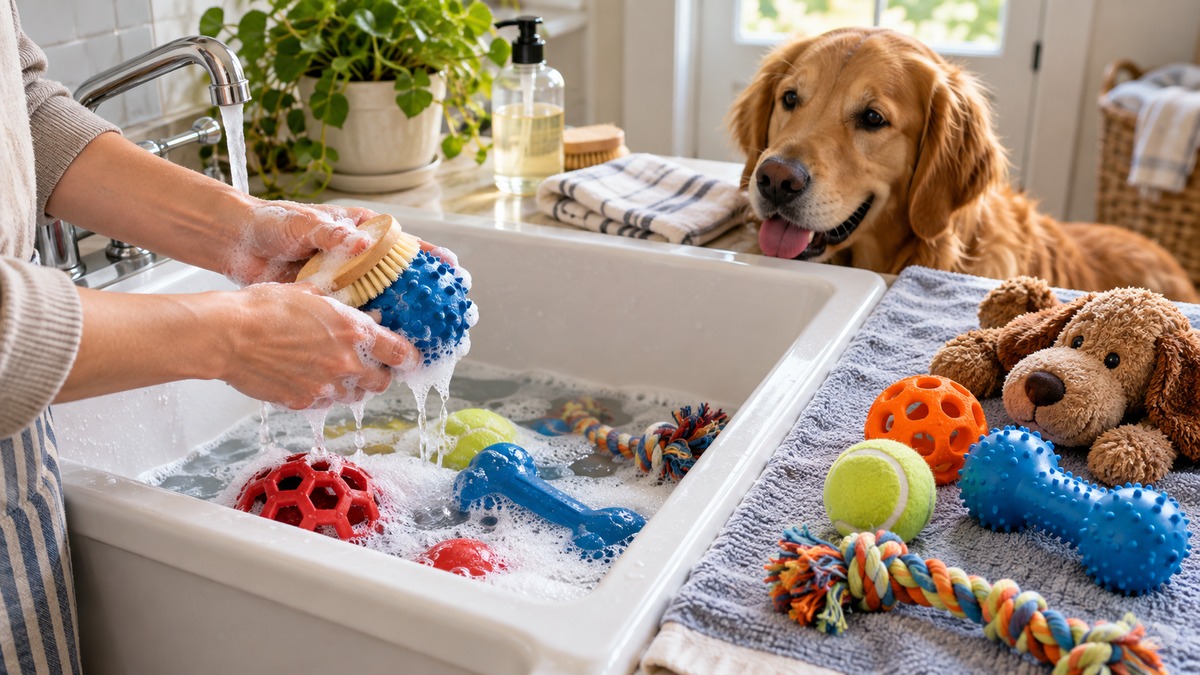
Rinse off large debris, then wash the toy in warm water with a dishwashing detergent. The handout names a dishwashing detergent such as Dawn as a good choice for cleaning, and it describes detergent as the agent that removes dirt and grease from surfaces. Use a brush for grooves, ridges, and the inside of any hollow toy. Scrub the whole toy, not only the outside, because the handout stresses that cleaning mechanically removes germs only when the surface is actually scrubbed.
Step 2: Rinse until the soap is gone
Rinse until no soap remains. The handout’s sequence for hard objects is to scrub, rinse, and dry before any disinfecting step. A toy left with soap residue may not be fully clean, so rinse each side of the toy and check any grooves by hand.
Step 3: Dry before the next play session
Dry the toy completely before giving it back to your dog. The handout’s rinse-and-dry step applies to any hard item. Dry the toy on a rack or with a clean towel.
Step 4: Disinfect only if the sources allow it
The handout lists bleach-safe items as surfaces such as bathtubs, tile, and stainless-steel bowls. It does not say whether rubber or plastic toys are bleach-safe. For those toys, the sources we opened do not give a disinfecting method, so the cleaning steps above are the only steps we can support. If you want to disinfect a hard toy, check the toy’s own care label before you use any bleach solution.
Where bleach is used, the handout’s details apply: a 1:32 dilution kills most infectious diseases except ringworm, which needs a 1:10 dilution, and bleach needs a full 10 minutes of contact time before the rinse. The handout also says bleach can burn, so wear gloves and make sure the room is ventilated. The EPA-registered bleach label we opened says to always dilute strictly in accordance with the directions and not to use the product at full strength for cleaning surfaces.
Washing toys in the dishwasher
Dishwashers are often suggested for hard toys, but the sources we opened do not say whether a dishwasher is a suitable way to wash dog toys. This guide therefore does not recommend it. If you consider a dishwasher, check the toy’s care label first, and treat the dishwasher as a question for the manufacturer rather than something this guide can confirm.
How often to wash dog toys
The Maddie’s handout gives the most direct frequency guidance in our sources. It advises cleaning and disinfecting at least weekly when all pets in the home are healthy, at least daily when a pet has an infectious disease, and as needed to clean up messes such as vomit, diarrhea, and nasal discharge. These figures are written for foster homes. For a dog’s favorite toys, a practical plan is to wash them on the weekly schedule and wash any toy sooner after a mess, as the handout’s “as needed” guidance suggests.
Toys that have been shared between pets deserve a separate wash. The handout says not to share hard-to-clean toys between pets, so keep a toy with one dog or wash it thoroughly before another dog uses it.
Keeping toys safe to chew
If your dog chews its toys, some of the wear will make cleaning harder. The sources do not say how cracked or softened toys should be handled, so inspect toys regularly and replace any toy that has worn into small pieces. A toy that has been chewed to bits cannot be cleaned and disinfected as a whole piece, and the handout’s rule for items that cannot be cleaned applies.
If you are looking for the right chewing toys for a puppy or small dog, our guides to safe chew toys for teething puppies, dog chew toys for dental health, and durable chew toys for small dogs cover the choices. This guide covers how to clean the toys once your dog has them.
Hand washing after you handle toys
Toys are part of your dog’s living area, and the UC Davis handwashing handout says to wash hands after touching animals or their living area. It asks people to wet their hands with clean running water, apply soap, rub and scrub well including the backs of hands and under the fingernails, rub hands together for at least 20 seconds, rinse, and dry with a clean paper towel or air dry them. The handout names young children, older adults, and people with weakened immune systems as the groups to be especially careful.
Common mistakes
- Washing fabric toys with clothing. The handout says to launder toys with fabric separately from other laundry.
- Skipping debris removal. The handout says cleaning comes first.
- Returning a damp toy to play. Damp items can hold moisture, and the AKC article links damp bedding to mold and mildew.
- Assuming a bleach solution is safe for every toy. The handout’s bleach-safe list does not include rubber or plastic toys.
- Trying to wash a cardboard toy. The handout says cardboard toys cannot be cleaned or disinfected.
- Sharing hard-to-clean toys between pets. The handout advises against this.
What we could not verify
- Whether rubber, plastic, or squeaky toys can take a bleach solution. The handout does not name these toys as bleach-safe or bleach-unsafe.
- Whether a dishwasher is a safe way to wash hard toys. The sources we opened do not say.
- How to remove a squeaker or other internal part safely, or whether a squeaker can go through a hot wash. The sources do not cover this.
- Whether a mesh laundry bag helps or hurts toy washing. The sources do not say.
- Whether vinegar or baking soda works better than detergent for stains or odors on toys. The sources we opened do not compare them.
- How often a toy needs washing in a home with no pets ill. The handout’s frequency guidance is for foster homes, and the sources do not give a separate figure for dog toys.
- Whether a specific chew toy is safe to put in a washing machine. Check the toy’s own label, because the sources we opened do not cover individual products.
FAQ
Can I put dog toys in the washing machine?
Fabric toys, including stuffed toys, can be laundered in hot water, separately from other laundry, according to the Maddie’s Fund handout. The AKC article recommends a fragrance-free, pet-friendly detergent for washable dog bedding, and the same detergent choice is a reasonable starting point for soft toys. Follow the label directions for detergent and bleach per load. The sources do not say whether a hard toy should go in the machine.
How do I clean a hard rubber dog toy?
Scrub it with a dishwashing detergent such as Dawn in warm water, using a brush for grooves and hollow areas. Rinse until no soap remains, and dry it completely. The sources we opened do not give a bleach-based disinfecting method for rubber or plastic toys, so check the toy’s care label before disinfecting.
Is bleach safe for dog toys?
The handout does not list rubber or plastic toys as bleach-safe, and it says that bedding and similar fabric items would be damaged by diluted bleach used as a surface disinfectant. Bleach is used in the laundry for fabric items, following the label directions. For a hard toy, check the toy’s care label before you use any bleach solution.
How often should I wash my dog’s toys?
The Maddie’s handout advises at least weekly when all pets are healthy, at least daily when a pet has an infectious disease, and as needed after messes. Those figures are written for foster homes, so use them as a guide and wash sooner after any mess or any contact with another dog’s waste.
Should I dry toys in the sun?
The handout says sunlight is a great additional disinfectant when laundry is dried outdoors. Make sure toys are completely dry before your dog plays with them again, because damp items can hold moisture and encourage mold.
Should I wash my hands after handling dog toys?
Yes, according to the UC Davis handwashing handout, which says to wash hands after touching animals or their living area. Wash for at least 20 seconds with soap, then rinse and dry.
Bottom line
Sort toys by material, remove debris, and wash fabric toys in hot water in their own laundry load with a pet-friendly detergent. Scrub hard rubber and plastic toys with a dishwashing detergent, rinse, and dry. Check the care label before any bleach or dishwasher use, wash toys sooner after messes, and throw away cardboard or chewed-apart toys that cannot be cleaned.
Sources
- https://www.maddiesfund.org/cleaning-and-disinfection-in-foster-homes/presentation_content/external_files/Educational%20Handout-%20Cleaning%20and%20Disinfection%20in%20Foster%20Homes.pdf
- https://www.akc.org/expert-advice/lifestyle/how-to-clean-a-dog-bed/
- https://ucfoodsafety.ucdavis.edu/sites/g/files/dgvnsk7366/files/inline-files/200948.pdf
- https://www3.epa.gov/pesticides/chem_search/ppls/005813-00001-20060925.pdf