Best Dog Food Container
As an Amazon Associate we earn from qualifying purchases.
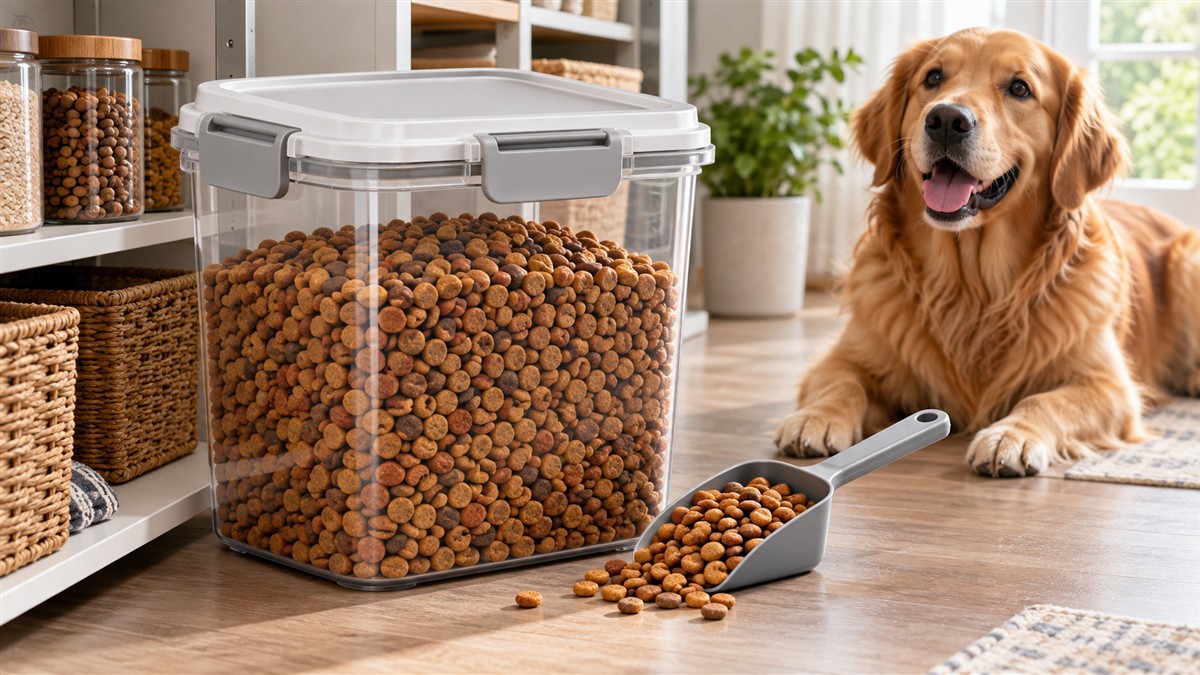
The best dog food container is sized for the specific kibble volume, seals in a way you will close correctly every time, and fits the storage space with room to open. The IRIS USA 33-quart rolling bin is the most transparent everyday choice because its listing explains that most dry kibble loads are about 22 to 26 pounds even though the size name says 30 pounds. For bulk storage, Vittles Vault offers a twist-lock lid and up-to-40-pound rating. The Amazon Basics two-bin set works when main food and a smaller supply need separate containers.
Quick answer
- Best rolling everyday bin: IRIS USA holds 33 quarts and states that typical kibble capacity is approximately 22–26 pounds.
- Best stackable bulk container: Vittles Vault lists up to 40 pounds, a threaded Gamma Seal lid, and a 144.97-cup volume.
- Best two-bin system: Amazon Basics combines 33- and 11-quart containers rated at 30 and 10 pounds.
- Best small stackable set: EQI supplies two 4-liter containers with one-touch lids and a 130 ml scoop.
Pounds of kibble and container volume are not interchangeable
Food-container listings often put a pound figure in the product title, but pounds measure mass while quarts, liters, cups, and gallons measure volume. Kibble shape and density determine how many pounds fit into a fixed space. Large airy pieces occupy more volume per pound than small dense pieces. A bin called “30 lb” may therefore fail to accept every 30-pound bag.
IRIS USA addresses this directly: its 33-quart container holds approximately 22 to 26 pounds of most dry kibble, and the listing warns that not every 30-pound bag fits. Vittles Vault also tells buyers to account for kibble shape and density and to select a larger size for bulky pieces. ZOMISIA says its maximum varies with food density. These cautions are more useful than a single large number.
The safest sizing method is to use the food’s actual volume, including enough headspace to close the lid without touching or crushing food. If replacing the original bag is part of the routine, measure how much space a full new bag occupies before choosing. If keeping food inside its bag, include the bag’s folds and seams in the required dimensions.
| Container | Published capacity | External dimensions | Closure | Mobility/stacking |
|---|---|---|---|---|
| IRIS USA | 33 qt; approx. 22–26 lb typical kibble | 16.38 × 10.88 × 18.44 in | Latch with foam-lined seal | Attachable wheels |
| Vittles Vault | Up to 40 lb; 144.97 cups | 12 × 16.85 × 20.13 in | Threaded twist lock | Stackable |
| Amazon Basics set | 33 + 11 qt; listed 30 + 10 lb | 16.2 × 12.4 × 27.4 in assembled listing | Lid seals | Four wheels on large bin |
| Iriisy steel bin | 35 lb field; bullet says 35–40 lb | 13.7-in diameter × 17.7 in high | Four clasps and silicone seal | Side handles; stacking claim |
| ZOMISIA | 45 L; bullet says 7–50 lb by configuration | 16.97 × 13.07 × 23.78 in | Four buckles and magnetic access lid | Collapsible with four wheels |
| EQI pair | 2 × 4 L / 4.22 qt | Each listed at 6.1 × 6.1 × 10.27 in | One-touch pop lid | Stackable |
Convert units before comparing the small containers
EQI gives four liters and 4.22 quarts per container, which are consistent after rounding. The pair totals eight liters or 8.44 quarts. The formula is liters × 1.05669 = US quarts, so 4 × 1.05669 is approximately 4.23 quarts. Two containers therefore supply roughly 8.45 quarts by conversion.
The Amazon Basics set lists 11 and 33 quarts, totaling 44 quarts. Its structured capacity field says 44 gallons, which conflicts dramatically with the dimensions and bullet information. The coherent total is 44 quarts, not gallons. The set’s weight ratings are 10 and 30 pounds, but they remain dependent on kibble density.
ZOMISIA states 45 liters, which converts to approximately 47.55 quarts. Its bullet says the collapsible body can hold from seven to 50 pounds depending on its expanded state and food density. Without dimensions for each collapsed height or a volume-to-mass test, that broad pound range should be treated as approximate.
The lid determines whether the container is convenient in daily use
IRIS USA uses a snap-lock lid and foam-lined seal. Vittles Vault uses a threaded Gamma Seal lid. Iriisy uses four locking clasps around a stainless lid with silicone gasket. ZOMISIA combines four buckles with a smaller clear magnetic access cover. EQI uses a push-operated pop lid. Amazon Basics identifies lid-seal technology without detailing the gasket construction in the supplied fields.
Each system has a different failure mode. A latch can appear closed when the opposite edge is not seated. Threads can collect crumbs that prevent smooth engagement. A multi-clasp lid takes more steps and requires even gasket contact. A small access door may reduce the number of times the full lid opens, but it creates another boundary that must close correctly.
“Airtight” is a listing claim, not a shared performance measurement here. No product provides a pressure-decay test, leak rate, humidity challenge, or seal-cycle result. Inspect the gasket and mating surfaces, remove crumbs, and close the lid as designed. Replace damaged seals or containers rather than assuming the label remains true indefinitely.
External dimensions decide whether the lid can open
A container can fit the floor of a pantry and still fail to function because a shelf blocks the lid. Measure width, depth, height, and opening clearance. IRIS USA stands 18.44 inches high with wheels and 16.9 inches without them. That 1.54-inch difference matters beneath a shelf. Its footprint is approximately 16.38 by 10.88 inches.
Vittles Vault is 20.13 inches high and 16.85 inches deep, with a 12-inch width. Its front or angled lid geometry should be compared with the planned stack. Iriisy is cylindrical at 13.7 inches in diameter and 17.7 inches high. EQI’s smaller footprint is 6.1 inches square per container, with a 10.27-inch height.
Amazon Basics gives slightly inconsistent complete dimensions: 16.2 by 12.4 by 27.4 inches in one field and 16.34 by 12.8 by 26.38 inches in another. That appears to describe the stacked two-container configuration, but the listing does not supply separate external dimensions for each bin. Use the larger values when planning a tight space until the exact configuration is confirmed.
Wheels help only on a suitable route
IRIS USA includes attachable wheels. Amazon Basics includes four wheels for the large container, two with brakes and two without. ZOMISIA also provides four wheels. Rolling can reduce lifting when a large bin is full, but wheels add height and require a smooth path wide enough for the container.
Check thresholds, grout lines, rugs, pantry lips, and turns between storage and feeding areas. A narrow tall container can tip if pulled abruptly or if a wheel catches. Use handles or body surfaces only as intended, and do not move a full bin by its lid. Lock the braked wheels when the container is parked.
Iriisy supplies side handles on its steel cylinder but no wheels. At a 6.6-pound empty weight plus food, lifting can become substantial. Vittles Vault has no wheel feature in the selected listing. Stackability saves floor area but can make access and lifting harder, especially when a full container sits above another.
Plastic, steel, and collapsible silicone all involve tradeoffs
IRIS USA uses polypropylene. Vittles Vault uses food-grade HDPE/polyethylene. EQI uses clear PET. Amazon Basics uses plastic, and ZOMISIA combines plastic with silicone. Iriisy is the only stainless-steel option, identified as 304 stainless steel with a stainless lid and silicone seal.
Clear plastic lets the user see the remaining level, while opaque material shields the view and may suit a tidy pantry aesthetic. Steel creates a rigid wall and adds weight. A collapsible body changes height as contents diminish but introduces folds that must remain clean and properly extended. The listings do not provide shared odor, stain, scratch, impact, or migration tests.
Iriisy describes a nonporous surface and makes broad hygiene claims, but the listing still specifies hand washing. IRIS USA and Vittles Vault also specify hand washing. EQI and Amazon Basics do not provide complete care instructions in the structured fields. Follow the received product’s instructions and dry the container and seal completely before refilling.
Scoops are measuring tools only when their volume is known
EQI includes a 130 ml scoop. Vittles Vault includes a one-cup scoop. Amazon Basics includes a detachable scoop with a storage slot. ZOMISIA includes a matching scoop without a stated volume. Iriisy includes no scoop.
A scoop volume does not set a feeding amount. A cup measures volume, while feeding guidance and nutritional energy depend on the specific food and dog. Follow the food label and veterinarian guidance rather than using the container’s scoop count as a universal ration. Level and repeat the measurement consistently if a volume-based plan has been selected.
Store the scoop so its handle does not disappear into the kibble and its food-contact surface stays clean. A built-in slot can help, but it also needs cleaning. Do not return a wet scoop to dry food. If multiple foods are stored, keep the scoop associated with the correct container to avoid mixing.
Plan what happens when a new bag arrives
A container should accept the normal purchase size without forcing old and new food together indefinitely. Before refilling, use the remaining food according to the household’s rotation plan, inspect the bin, and clean it as directed. Avoid topping up a dirty container where crumbs and residue remain at the bottom.
If the original packaging fits inside the bin, it preserves the product label and lot information while the outer container provides physical organization. The selected listings do not state whether their interior dimensions accept a particular bag intact. External dimensions cannot answer that question because walls, taper, lids, and wheel wells reduce usable space.
Keep the container in the indoor or covered conditions specified. Vittles Vault permits indoor, covered outdoor, or climate-controlled use. Amazon Basics says indoor. IRIS USA lists indoor and outdoor in a broad field, but its food should still be protected from unsuitable environmental exposure. Storage location affects temperature, moisture, pests, and access.
Choose storage separately from automatic dispensing
A sealed bin organizes a supply of dry food but does not release meals on a schedule. If timed or gravity-fed delivery is the actual requirement, compare a dog food dispenser rather than assuming a storage lid can perform that job. A dispenser introduces portion mechanisms, openings, and cleaning surfaces that are absent from a simple bin.
Likewise, a model-specific assessment can expose details that disappear in a broad capacity table. Our article on the IRIS USA 30-pound rolling container focuses on that product’s footprint, wheels, and realistic kibble capacity. Use the roundup to choose a storage format, then use the narrower article when that exact bin reaches the shortlist.
Do not set an opened container beside a feeding station where the dog can push into the lid or operate a light pop mechanism. Store it in a stable location and close it immediately after scooping. For stacked containers, keep the base level and follow the manufacturer’s stacking arrangement. A scoop, bag, or lid left on the floor can also become a trip or chewing object.
Finally, label multiple bins with the food identity and opening information needed by the household. A transparent wall shows quantity, not which recipe is inside or when it was opened. Labels should remain readable without covering latch engagement, seals, date trackers, or the view needed to monitor the remaining food.
Update those labels whenever the household changes foods so an obsolete name never remains on a refilled container.
How we chose
We compared the six supplied containers using their ASINs, titles, bullets, and specifications. All are intended for dry pet food. We prioritized honest usable capacity, unit consistency, external dimensions, closure mechanism, material, mobility, stacking, included scoops, and care instructions.
Volume received more weight than a pound label because kibble density varies. Listings that acknowledged this limitation were favored. Airtight, pest, freshness, and durability statements were treated as seller claims without a shared test. Conflicting capacities were disclosed rather than corrected by assumption.
All six products remain because they represent genuinely different storage patterns: rolling single bin, threaded stackable vault, two-bin wheeled system, small pop-lid pair, rigid steel cylinder, and collapsible wheeled bin. These are household-storage formats, so dog-weight ranges are not stated or relevant; the food bag and storage space determine fit.
What we could not verify
The listings do not provide shared airtightness tests, humidity data, pest-resistance tests, seal-cycle counts, impact tests, odor-retention results, usable internal dimensions, or capacity results using the same kibble. Pound ratings cannot be compared as exact volumes across foods.
Amazon Basics has a conflicting 44-gallon field versus coherent 33-plus-11-quart bullets. Iriisy lists 35 pounds in specifications but 35 to 40 pounds in a bullet. ZOMISIA spans seven to 50 pounds without publishing each configuration’s dimensions. No dog-weight range applies to these containers; storage needs depend on food volume and purchase pattern.
Best dog food containers by storage setup
IRIS USA 33-quart rolling bin: best transparent capacity guidance
IRIS USA says its 33-quart bin holds approximately 22 to 26 pounds of most dry kibble and warns that not every 30-pound bag fits. It uses a latch, foam-lined seal, polypropylene body, and removable wheels. At 16.38 by 10.88 by 18.44 inches, it offers a relatively narrow footprint and weighs 2.64 pounds empty.
Skip if: the normal food bag exceeds the stated typical kibble range or the lid lacks opening clearance.
Limitation: usable capacity varies by kibble, and no shared airtightness result is supplied.
Vittles Vault up-to-40-pound bin: best stackable bulk candidate
Vittles Vault combines a threaded Gamma Seal lid, food-grade HDPE construction, one-cup scoop, and stackable shape. It lists 144.97 cups and up to 40 pounds at 12 by 16.85 by 20.13 inches. The maker explicitly tells buyers to account for kibble shape and density.
Skip if: lifting or accessing a stacked full bin would be awkward.
Limitation: no typical-pound interval or standardized seal result is stated.
Amazon Basics 33- and 11-quart set: best two-container system
This set separates a listed 30-pound/33-quart main bin from a 10-pound/11-quart smaller bin. It includes a scoop and four wheels for the large container, with two braked wheels. The pair is useful when main food and treats or a second food need separate storage.
Skip if: you need verified separate external dimensions for each bin.
Limitation: the 44-gallon structured field conflicts with the 44-quart total supported by the bullets.
EQI two-container set: best small pop-lid option
EQI supplies two clear PET containers, each holding four liters or about 4.22 quarts, plus a 130 ml scoop. Each measures 6.1 inches square by 10.27 inches high. One-touch lids and a stackable form suit treats, supplements, or smaller food quantities.
Skip if: a full-size kibble bag needs to fit in one container.
Limitation: the approximate 3.5-pound dog-food claim depends on kibble density, and full care instructions are not stated.
Iriisy 304 stainless container: best rigid metal candidate
Iriisy uses a 13.7-inch-diameter stainless cylinder with a 17.7-inch height, four lid clasps, and silicone seal. The specification says 35 pounds and 14.13 liters, while the bullet extends the claim to 40 pounds. It weighs 6.6 pounds empty and includes side handles but no scoop.
Skip if: you need wheels, a transparent body, or a supplied scoop.
Limitation: the pound figures conflict with each other and appear difficult to reconcile with the 14.13-liter field.
ZOMISIA 45-liter collapsible bin: best adjustable-volume candidate
ZOMISIA combines a 45-liter plastic/silicone body with four wheels, four buckles, clear magnetic access cover, date tracker, and scoop. It measures 16.97 by 13.07 by 23.78 inches in the listed configuration and weighs 5.19 pounds empty. The collapsible body is intended to reduce storage height as contents decline.
Skip if: you prefer a rigid wall or need dimensions for every collapsed position.
Limitation: the seven-to-50-pound statement varies with configuration and food density without a published conversion table.
FAQ
Will a 30-pound container hold any 30-pound bag?
No. Kibble density and shape vary. IRIS USA says its 33-quart bin usually holds about 22 to 26 pounds and warns that not every 30-pound bag fits. Use food volume and allow headspace instead of relying only on the size name.
Is an airtight container permanently airtight?
The claim depends on a clean, intact seal and fully engaged closure. Crumbs, warped lids, damaged gaskets, or incomplete latching can change performance. The supplied listings do not share a standardized leak test. Inspect and clean closure surfaces and replace damaged components.
Are wheels useful on a dog food bin?
They help move a heavy container across a smooth, level route. They also add height and can catch on thresholds or rugs. IRIS USA, Amazon Basics, and ZOMISIA include wheels. Measure the route, use brakes where supplied, and never pull a full bin by its lid.
Can I use the included scoop as a feeding guide?
A known scoop volume creates a repeatable measure, not a universal feeding recommendation. EQI supplies 130 ml and Vittles Vault supplies one cup. Follow the specific food label and veterinarian guidance for the dog, then measure that selected amount consistently.
Should kibble stay in its original bag inside the bin?
Keeping the bag can preserve label and lot information, but it must fit without preventing closure. The listings do not give usable internal dimensions for intact bags. Compare the bag’s filled shape with the opening and interior rather than relying on external dimensions alone.
How should I clean a dog food container?
Follow the maker’s care instructions, remove all residue, and dry the body, lid, gasket, scoop, and folds completely before adding food. IRIS USA, Vittles Vault, and Iriisy specify hand washing. Do not mix old crumbs into a freshly opened bag.
Bottom line
Size by volume and space, then choose the closure you will operate correctly. IRIS USA gives the most honest everyday capacity guidance, Vittles Vault suits stackable bulk storage, and Amazon Basics separates two food quantities. Choose EQI for small supplies, steel only when its conflicting capacity works for your measured food volume, and a collapsible bin only when adjustable height is truly useful.
Sources
- ASPCA dog care — opened October 25, 2026
- American Kennel Club training advice — opened October 25, 2026
- American Kennel Club health advice — opened October 25, 2026