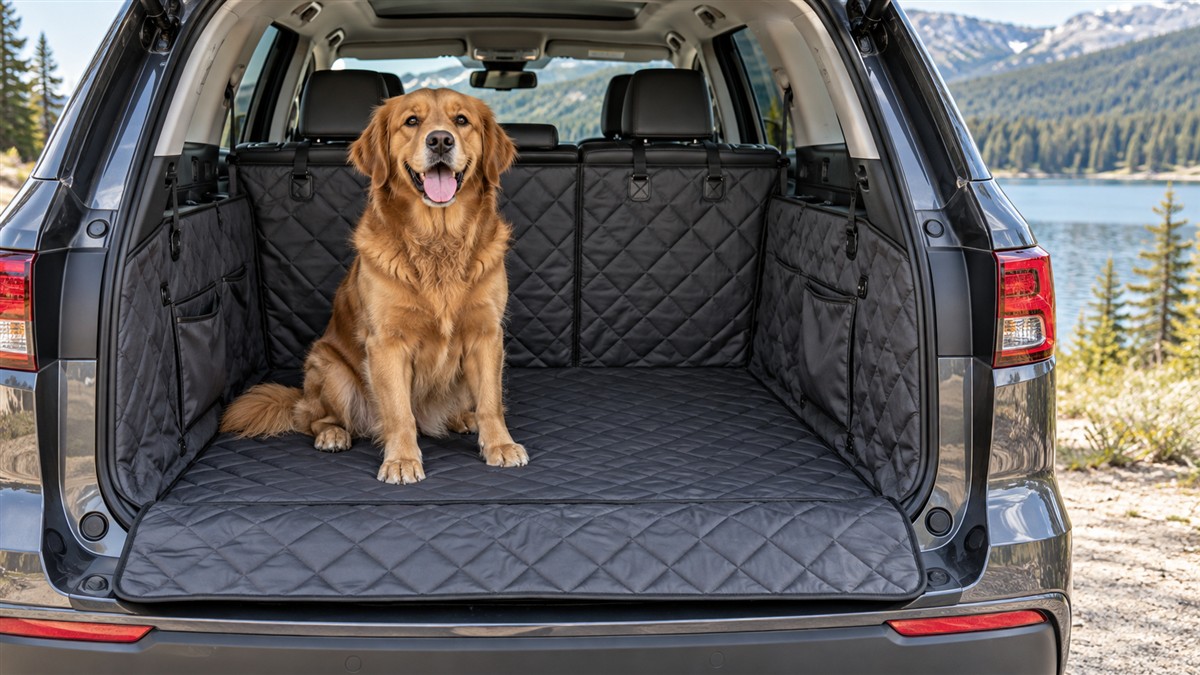
Best Dog Cargo Liner
As an Amazon Associate we earn from qualifying purchases.
The best dog cargo liner starts with a tape measure, not a “universal fit” label. Among the products with usable dimensions, the F-color 55-by-91-inch liner is the clearest all-around choice for midsize and standard-wheelbase three-row SUVs with the third row folded. The 4Knines 52-by-86-inch liner is better suited to split rear seats because its design supports 60/40 and 50/50 configurations. For smaller cargo areas, RYNVALE publishes a 39-inch width and 73-inch total length, plus padded side panels. A liner protects interior surfaces; it is not a substitute for appropriate travel restraint.
Quick answer
- Best measured full-coverage candidate: F-color measures 55 inches wide by approximately 91 inches long, including its seatback, floor, and bumper sections.
- Best for split-fold seats: 4Knines measures 52 by 86 inches and is designed around 60/40 and 50/50 rear-seat layouts.
- Best measured option for a narrower cargo bay: RYNVALE is 39 inches wide with a 73-inch combined panel length.
- Measure width, seatback height, floor depth, and bumper-drop distance with the seats in the position you will actually use.
Measure the vehicle before comparing fabric
Cargo liners fail most obviously when they are too narrow, too short, or shaped for the wrong seat configuration. A waterproof surface cannot protect trim it never reaches. Start with the cargo opening width at its narrowest usable point, the floor width between wheel housings, the depth from the seatbacks to the threshold, and the height of the exposed seatbacks. If the bumper flap matters, measure from the cargo threshold down across the painted surface you want covered.
Take those measurements with the second and third rows positioned for the intended trip. A liner that works behind an upright second row may not extend far enough when that row is folded. Conversely, a very long liner can bunch near the hatch in a short cargo bay. Bunching can create ridges, interfere with the hatch seal, or leave the non-slip layer folded against itself.
The word “universal” appears repeatedly in the specifications, but it does not erase geometry. PETICON says its 53.15-by-78.74-inch model is for large and full-size SUVs and specifically excludes several smaller vehicle categories. F-color identifies its 55-by-91-inch model for midsize and standard-wheelbase full-size three-row SUVs with the third row down. 4Knines calls out split-fold layouts. REEVAA asks buyers to verify the vehicle against a compatibility list. Those limitations are more useful than the universal-fit field.
| Liner | Published coverage dimensions | Vehicle/layout cue | Side protection | Listed weight |
|---|---|---|---|---|
| F-color | 55 × approx. 91 in | Midsize and standard-wheelbase 3-row SUV; third row folded | Not numerically stated | 3.83 lb |
| 4Knines | 52 × 86 in, including 22-in bumper flap | 60/40 or 50/50 split seats and pass-throughs | No side-wall height stated | 4.09 lb |
| PETICON | 53.15 × 78.74 in | Large/full-size SUVs | 40 × 12.6-in side flap | 3.39 lb |
| Reliadura | 53.15 × 78.74 in | SUV, sedan, or van claim; measure first | Hammock-style flaps | 2.97 lb |
| RYNVALE | 39-in width; 73-in total panel length | Small/medium SUV claim | 17.7-in side flaps with 1-in foam | 8.5 lb |
| ALLANSING large | Not stated | Midsize/large SUVs and minivans | Zippered three-sided enclosure | 4.22 lb |
Break the total length into functional panels
A single overall length can hide where the material goes. F-color is unusually specific: its approximately 91-inch length comprises a 22-inch seatback section, 53-inch cargo-floor section, and 16-inch bumper flap. The formula is seatback + floor + flap = total length, so 22 + 53 + 16 = 91 inches. That lets a buyer compare each vehicle measurement with the relevant panel rather than assuming all 91 inches lie flat on the floor.
4Knines includes a 22-inch bumper flap in its 86-inch length but does not divide the remaining 64 inches between seatback and cargo floor. RYNVALE gives a 39-by-18-inch backrest panel, 39-by-35-inch floor panel, and 39-by-20-inch front flap. Its sections total 18 + 35 + 20 = 73 inches. PETICON lists the complete 78.74-inch length and gives separate side-flap and non-slip-area measurements, but it does not publish a full longitudinal panel breakdown.
Use the panel figures literally. A 16-inch bumper flap covers a different drop than a 20- or 22-inch flap. More flap length may protect more paint during entry, but excess material can touch the ground or need folding on a low threshold. Measure the specific vehicle instead of ranking flap length in isolation.
Water-resistant and waterproof are not interchangeable
F-color makes the clearest limited claim. Its four-layer 600D Oxford construction is described as water-resistant, not fully waterproof, and the listing warns that standing or deeply pooled water may pass through. That wording is useful because a cargo liner has stitched edges, attachment openings, and seams that can become routes for liquid.
4Knines calls its K9-Shield material waterproof but explicitly says the seams and zippers are not watertight. The surface may block a spill while construction points remain vulnerable. PETICON’s bullet uses both water-resistant language and a four-layer/waterproof description, while its structured field says waterproof. Reliadura, RYNVALE, ALLANSING, and REEVAA also make waterproof claims, but the listings do not provide a common hydrostatic test or seam-sealing specification.
For muddy paws and damp coats, surface protection may be sufficient even when a liner cannot contain pooled liquid. Remove standing moisture rather than leaving it against the seams. If the dog is wet after a bath or swim, a cargo liner manages the vehicle surface; a separate drying routine is still needed. Treat every product’s strongest water language as a seller claim unless the exact construction details support a narrower conclusion.
Side walls change coverage and installation
Flat liners protect the seatback, floor, and bumper. Raised or suspended side panels extend protection toward the cargo trim. PETICON lists side flaps measuring 40 by 12.6 inches and uses suction cups plus hook-and-loop attachment. Reliadura uses hammock-style side flaps with four suction cups and six hook-and-loop strips. ALLANSING’s large model creates a three-sided enclosure with zippered side flaps and TPU suction cups.
Padded-wall designs add structure. RYNVALE lists 17.7-inch side flaps with one-inch foam, while REEVAA describes 18-inch walls with three-centimeter foam. The listings attach large impact-reduction numbers to these designs, but no shared protocol is supplied, so those percentages cannot be compared. Foam panels may separate a dog from hard trim during ordinary movement, yet they do not turn the liner into a crash restraint.
High side walls also reduce flexibility. They must clear window trim, hatch openings, vents, controls, and the actual contours of the vehicle. A rigid or foam-supported wall that bends sharply may not sit as intended. Suction cups require compatible smooth surfaces, while metal side clamps need a suitable attachment edge. Verify where every support component will go before choosing the more enclosed design.
Non-slip backing helps the cover stay arranged
PETICON gives the most useful non-slip area: 53.15 by 40 inches of textured rubber. F-color lists a 53-by-55-inch anti-slip section inside its 55-by-91-inch liner. Reliadura lists a 53.15-by-40-inch section. RYNVALE, ALLANSING, and REEVAA describe non-slip layers without comparable surface dimensions.
The presence of rubber dots or a textured base does not prove that a dog cannot slide. Grip depends on the cargo surface, liner orientation, contamination, moisture, folds, dog movement, and driving forces. The backing primarily helps the liner resist migration. Keep the material flat, attach every intended anchor, and clean both the cargo floor and backing when dirt reduces contact.
A liner also does not secure a dog to the vehicle. Some packages include a belt component, but the listings do not establish crash performance, attachment compatibility, or restraint certification. Use appropriate travel equipment independently of the protective cover, and do not attach a dog to suction cups, side flaps, storage pockets, or liner straps.
Split seats and cargo pass-throughs require deliberate design
4Knines is distinct because its liner is designed for 60/40 and 50/50 fold-down seats and center pass-throughs. That matters if one seat section must move while protection remains on the other. A single unbroken panel can block the split or bunch when only one side is folded.
ALLANSING’s large version uses zippered sides, and its listing says those sides can open when seats are folded. That addresses enclosure geometry, not necessarily a split down the middle of the seatback. The extra-long ALLANSING model is zipper-free and intended for extended spaces with rows folded. Neither entry provides numerical coverage dimensions in the supplied fields, so vehicle measurement cannot be matched to the product as precisely as with F-color, 4Knines, PETICON, or RYNVALE.
Decide which seats need to operate during normal use. If the configuration changes frequently, attachment speed and panel flexibility matter. If the third row stays folded for months, a longer one-piece design may be easier to keep aligned. Do not cover seat-latch mechanisms, ventilation openings, or vehicle controls.
Cleaning method is part of ownership
F-color recommends wiping or vacuuming and identifies hand washing as the preferred deeper method. PETICON likewise emphasizes wiping, vacuuming, and hand washing. 4Knines allows hosing, wiping, or machine washing. ALLANSING and Reliadura describe machine washing in addition to surface cleaning. RYNVALE does not give a complete care instruction in the structured fields, and REEVAA’s highlight says machine washable without a detailed cycle.
A large wet liner can be heavy and awkward. Remove loose hair and grit before washing, close zippers or fasteners as directed, and allow every layer and foam section to dry fully. Do not assume padded walls can be treated like a flat fabric panel. Follow the label on the received item where it is more specific than the listing.
Storage pockets are useful only if they do not interfere with folding or trap wet equipment. Reliadura includes two external pockets; PETICON identifies a one-pocket color variant. Keep sharp tools and heavy objects separate from the dog area, and remove damp leashes or towels rather than sealing moisture against the liner.
Separate interior protection from the travel enclosure
A cargo liner is fitted to the vehicle, not to the dog. It catches hair and mud and can shield upholstery from routine contact, but it has no published interior height, door, ventilation pattern, or animal containment function. A dog that needs an enclosure still needs a correctly sized carrier or crate positioned and secured for the trip. For trips involving flight rules, our guide to airline-oriented dog crate limits addresses a completely different set of dimensions and restrictions.
Keep the cargo area free from loose objects that can move when the vehicle changes speed or direction. Pockets help organize light items, but a liner does not anchor luggage, tools, water containers, or a crate. Its headrest straps, suction cups, hook-and-loop tabs, and side clamps are intended to hold fabric in position. They should not be assigned a load-bearing role that the listing does not document.
Entry height also sits outside the liner’s function. A bumper flap protects paint while paws cross the threshold, but it does not reduce the vertical step into an SUV. If a dog cannot enter comfortably, address access separately rather than pulling on the liner or using its side wall as a step. Fold the bumper section back inside before closing the hatch so it does not interfere with latches, seals, lights, sensors, or exhaust-adjacent areas.
After installation, perform a dry layout check without the dog. Fold and raise every seat you expect to move, close the hatch, confirm access to cargo hooks, and make sure no panel obscures controls. Then load the dog only after the protective layer, restraint or enclosure, and loose cargo have each been handled as separate parts of the travel setup.
How we chose
We compared the eight supplied cargo-liner listings using their ASINs, titles, bullets, and structured specifications. Every selected product is intended for a rear cargo area and includes broader protection than a small crate pad. We emphasized products with usable width and length figures, defined vehicle layouts, bumper coverage, side-panel information, and honest water limitations.
Fit evidence received the greatest weight. Construction followed: 600D or 900D Oxford, polyester, non-slip areas, suction cups, zippers, anchors, and foam panels. We distinguished surface protection from animal restraint and treated safety, impact, grip, and waterproof percentages as seller statements when no common test was supplied.
The shortlist retains six meaningful configurations and omits two products from the cards. The ALLANSING extra-long liner lacks numerical dimensions, making the “extra long” claim difficult to match to a vehicle. REEVAA adds tall padded walls but supplies no trustworthy installed length and width in the structured information; the item-dimension field appears to describe a packaged form.
What we could not verify
The listings do not provide a shared abrasion test, liquid-pressure test, seam-leak test, non-slip coefficient, color-transfer method, claw-resistance test, or crash-performance result. “Universal fit” cannot be verified without the vehicle’s measured geometry. Several products omit installed dimensions even while naming broad vehicle classes.
We could not independently validate RYNVALE’s force and impact statements, REEVAA’s grip and impact percentages, or the complete-water-blocking language used elsewhere. Product weights do not establish padding quality or durability. None of the selected listings provides a dog-weight range; cargo fit is determined primarily by the vehicle, while safe animal transport requires separate equipment and individualized planning.
Best dog cargo liners by vehicle setup
F-color 55-by-91-inch liner: best measured full-coverage candidate
F-color publishes the most useful layout: 22 inches for the seatback, 53 inches for the cargo floor, and 16 inches for the bumper, at 55 inches wide. Its 600D Oxford construction is explicitly water-resistant rather than fully waterproof, and it includes anti-slip backing, adjustable straps, seat anchors, and a bumper flap. The stated use is midsize and standard-wheelbase full-size three-row SUVs with the third row folded.
Skip if: any of the three panel lengths or the 55-inch width conflicts with your measured cargo area.
Limitation: no dog-weight range is stated, and pooled liquid may pass through the material or construction.
4Knines 52-by-86-inch liner: best for split-fold rear seats
The 4Knines liner measures 52 by 86 inches including a 22-inch bumper flap. Its defining feature is compatibility with 60/40 and 50/50 fold-down seats and center cargo pass-throughs. The polyester construction has non-slip backing and quick-release clips, and the listing allows wiping, hosing, or machine washing.
Skip if: the 52-inch width or remaining 64-inch seatback/floor span does not cover the intended configuration.
Limitation: seams and zippers are not watertight, and no dog-weight range is stated.
PETICON 53.15-by-78.74-inch liner: best large-SUV side-flap candidate
PETICON publishes overall dimensions, a 40-by-12.6-inch side flap, and a 53.15-by-40-inch non-slip section. The 600D Oxford liner weighs 3.39 pounds and uses suction cups plus hook-and-loop tabs to support the sides. Its listing specifically says the model is for large and full-size SUVs rather than compact or midsize vehicles.
Skip if: you drive a vehicle category the listing excludes or the measured footprint does not fit.
Limitation: water wording is inconsistent between fields, and no dog-weight range is stated.
Reliadura 53.15-by-78.74-inch liner: best storage-pocket option
Reliadura matches PETICON’s stated overall footprint and 53.15-by-40-inch anti-slip area while adding two external storage pockets. It has side and bumper flaps, four suction cups, six hook-and-loop strips, anchors, and adjustable straps. The Oxford liner weighs 2.97 pounds and is described as machine washable.
Skip if: you do not need pockets or cannot verify the broad SUV/sedan/van fit claim against actual measurements.
Limitation: panel lengths and side-flap height are not stated, and no dog-weight range is provided.
RYNVALE 39-inch padded liner: best measured narrow-cargo option
RYNVALE is 39 inches wide and divides its 73-inch length into an 18-inch backrest panel, 35-inch floor, and 20-inch front flap. It adds 17.7-inch side flaps with one-inch foam, metal clips, suction cups, and a supplied belt component. The 900D Oxford, cotton, sponge, and webbing assembly weighs 8.5 pounds.
Skip if: a 39-inch width is insufficient or the tall foam sides conflict with the vehicle interior.
Limitation: the large force and impact claims lack a comparable test description, and no dog-weight range is stated.
ALLANSING large zippered liner: best three-sided enclosure candidate
The large ALLANSING model uses 900D Oxford, zippered side panels, TPU suction cups, non-slip backing, and a cotton middle layer. The sides can open when the seats need to fold, and the stated vehicle target is midsize/large SUVs and minivans. It weighs 4.22 pounds and supports wiping, vacuuming, rinsing, or machine washing.
Skip if: you need published installed width and length before ordering.
Limitation: no numerical coverage dimensions or dog-weight range is stated.
FAQ
How do I measure an SUV for a dog cargo liner?
Measure the narrowest usable cargo width, floor depth, exposed seatback height, and desired bumper drop with the seats arranged for travel. Compare each number with the corresponding panel rather than only the overall length. Also note wheel housings, hatch latches, vents, and attachment surfaces.
Does a waterproof cargo liner contain every spill?
Not necessarily. 4Knines says its surface is waterproof while seams and zippers are not watertight. F-color explicitly calls its liner water-resistant and warns about pooled water. Remove liquid promptly and do not assume a surface claim applies to stitched boundaries, zipper tracks, or attachment openings.
Will non-slip backing keep my dog secure in the car?
Non-slip backing helps the cover remain arranged on the cargo floor. It does not restrain the dog and is not evidence of crash protection. Use suitable travel restraint separately and never connect it to suction cups, pockets, decorative flaps, or cover-retention straps.
Are padded side walls worth having?
They can separate the dog from hard trim and extend interior coverage, but they add bulk and may not match every cargo shape. RYNVALE states one-inch foam and a 17.7-inch side height; REEVAA states three-centimeter foam and 18-inch walls. Verify clearances and treat impact percentages as seller claims.
Can a cargo liner replace a dog crate liner?
No. A cargo cover is shaped for vehicle surfaces, while a crate liner is sized to a crate base and intended to remain within that enclosure. See our dog crate liner guide for that separate fit problem.
How should I clean a dog cargo liner?
Remove loose dirt and hair first, then follow the exact label. F-color and PETICON favor surface cleaning and hand washing; 4Knines permits hosing, wiping, or machine washing; several others mention machine washing. Dry every layer completely, particularly foam, seams, pockets, and folded edges.
Bottom line
Match every panel to the vehicle before ranking materials. F-color is the most transparent full-coverage option because its 91-inch length is divided into seatback, floor, and bumper sections. Choose 4Knines for a compatible split-seat layout, PETICON for a measured large-SUV liner with side flaps, or RYNVALE for a narrower measured bay with padded sides. Treat protection and restraint as two separate systems.
Sources
- VCA dog care library — opened October 25, 2026
- ASPCA dog care — opened October 25, 2026
- American Kennel Club training advice — opened October 25, 2026