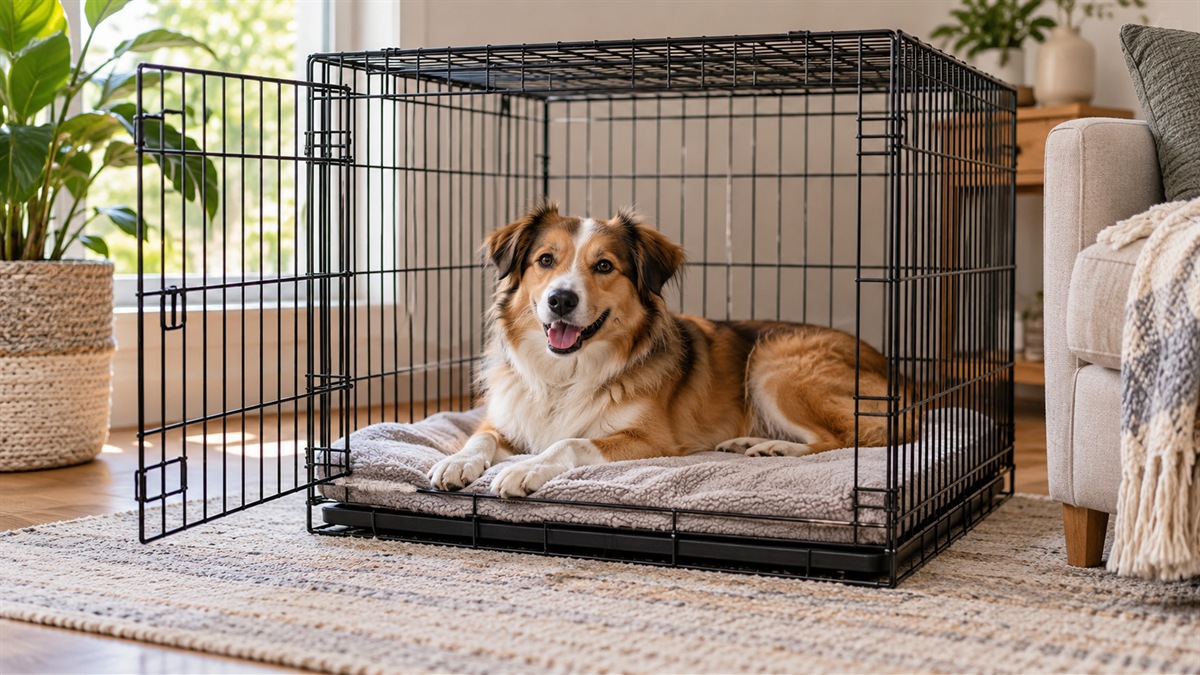
Best Dog Crates and Kennels: Size, Doors and Wheels
As an Amazon Associate we earn from qualifying purchases. Details
By Ken
This guide to the best dog crates carrier kennel options starts with one question: does the dog have room to sit, stand and lie down, and does the crate hold it safely while you are away? Size decides most of the choice, followed by the door and latch design, whether the floor tray comes out, and whether the crate can be moved. Our listing file holds twelve crate and kennel listings with titles, bullets and specifications. Five are carded below. The rest are mats, pads, or title-only items that we did not build cards from.
Quick answer
- For a large or medium dog that needs a steel kennel with two locking doors and lockable wheels, the LUCKUP 38 inch crate lists those features in its bullets and specifications.
- For a small to medium dog that needs a mesh front and four lockable wheels, the Aurapaws 30 inch diamond mesh crate gives a 15 to 70 pound range in its bullets.
- For a crate that also works as a side table, the DWANTON furniture crate has a wide top, a cushion and a wooden plate at the base, though its door count is unclear.
- Before you buy, measure your dog standing. AKC says the crate should let the dog “sit, stand, and lie down comfortably,” and that a crate that is too large is a problem too.
Size first: the room the dog needs
The most common crate mistake is buying a size by weight alone. AKC’s crate guide starts with room: “Your dog needs enough room to sit, stand, and lie down comfortably within the crate.” It also warns against going too far the other way: “While you want a roomy crate, you don’t want one that’s too large.” The size rule runs in both directions, so a crate that is far bigger than the dog is not a safe default.
AKC’s method for measuring is simple. “With your dog standing, measure them from the top of the head to the bottom of the feet to determine height.” Take that height, then add enough headroom for the dog to stand without its head touching the roof, and compare the figure with the crate’s interior height, not its outside dimensions. AKC’s guide gives this height method but no length method, so for length compare the interior figure the listing states with your dog’s body length, and treat any gap as a question for the seller. The listings in this set give outside dimensions for most crates, and only one gives an interior size in its bullets. That difference matters, and it is covered below.
For a puppy, AKC suggests a different approach: “For puppies, consider an expandable crate that’s as large as the typical adult size of your dog’s breed.” An expandable divider lets a young dog use a smaller space at first and more space as it grows. None of the five carded listings describes a divider, so a puppy owner would need a crate with a divider or a plan to buy a second crate later.
How much time a dog can spend in a crate
A crate is a tool for resting and house training, not a place for a whole working day. AKC’s time guidance is age-based. Its page on how long a dog can be left alone says: “As a guideline, new puppies up to 10 weeks old typically can’t hold their bladder for more than an hour.” It also says: “After 6 months, dogs can usually hold it for up to six hours.” And for adults: “However, even adult dogs shouldn’t be home alone for much longer than six to eight hours without a chance for a bathroom break.”
A crate that fits the dog is only half the answer. The other half is the schedule. A crate for a puppy in a daytime routine needs breaks built into the plan, not a long stretch of closed door. For an adult, the same guidance applies: a bathroom break within the six to eight hour window. None of the crates in this set changes that rule, and no listing claims otherwise.
AKC’s step-by-step crate training guide adds the reason many owners use a crate in the first place: “Crates are valuable tools for puppies, especially when it comes to potty training and preventing your pup from chewing the furniture.” It also says that crates “make for safe traveling with your dog.” Those are AKC’s words for the use case. The listings in this set do not say whether any crate is approved for a specific type of travel, so check the vehicle or transport rule before you rely on any crate for a trip.
Wire, mesh, steel, wood or fabric
The material decides the look, the weight and how the crate handles a chewer. The carded crates use four different materials.
- Steel tube or alloy steel. The LUCKUP listing describes a rust and corrosion resistant steel frame, with a slide-out plastic tray. Steel is heavy but firm, which suits a strong or large dog that pushes against the door.
- Diamond mesh and metal. The Aurapaws 30 inch crate has a diamond mesh front that its bullets call patented. The listing says the diamond shape prevents pinching of jaws and paws. The bullets also say the crate is not suitable for energetic or destructive dogs.
- Engineered wood and metal. The DWANTON and Hzuaneri crates are furniture-style pieces with wood-look boards and metal fittings. They look like a side table, and their interiors are smaller than the outside dimensions suggest.
- Steel frame with wire and a removable tray. The HOOBRO crate lists a removable tray and a grass mat, and its specifications list engineered wood and metal.
A chewer needs a different plan. The Hzuaneri specifications list “Chewproof” as a feature, and its bullets say the boards are not exposed to chewing. No crate is indestructible, and our site rule is that a crate can be chew-resistant at best. A dog that chews wire, wood or a tray needs supervision and a plan for what it can reach.
Doors, latches and trays
Door design decides how quickly you can get a dog in and out, and how well the crate holds a determined dog. Three of the five carded crates describe a locking system in their bullets. The LUCKUP listing describes two locks with safety buckles designed to stop a dog opening the door. The HOOBRO listing describes four front-door latch locks. The Aurapaws crate describes double secure latches.
The door count is not always clear. The HOOBRO and LUCKUP specifications both give two doors. The DWANTON specifications give one door, but its bullets describe double doors, so the count is unclear from the listing. The Hzuaneri crate has a sliding barn-style door on its side, which the bullets say saves space.
Trays matter for cleaning. The LUCKUP, Aurapaws and HOOBRO listings all describe a removable tray. The tray is the part you pull out and wipe, so check whether it slides out from the front or the side before you buy. A tray that cannot be removed makes cleaning a chore.
Wheels, weight and moving the crate
Wheels matter for a crate that needs to move between rooms. The LUCKUP specifications list lockable caster wheels, and the Aurapaws bullets describe four smooth-rolling lockable wheels. Lockable wheels are important because a crate that rolls while the dog is inside can frighten the dog and tip the crate. The other three carded crates do not describe wheels in their bullets or specifications, so you cannot count on them.
Weight is the opposite problem. The specifications give a weight of 19.6 pounds for the Aurapaws crate, 30.1 pounds for the Hzuaneri and 37.4 pounds for the HOOBRO. The HOOBRO is the heaviest of the group with a weight given. Heavy crates stay where you put them, which can be a benefit, but they are hard to move. Our planning estimate for the difference between the heaviest and the lightest crate with a stated weight is 37.4 minus 19.6 equals 17.8 pounds.
Weight limits and what the listings say
Weight limits are the figure most owners look for, and the listings differ on it. The Aurapaws bullets say the crate “comfortably accommodates dogs 15-70 lbs.” The HOOBRO bullets give a “100-lb weight capacity.” The LUCKUP, DWANTON and Hzuaneri listings give no weight limit that we can read in their bullets or specifications.
Where a limit is stated, compare it with your dog’s weight and its frame. A 70 pound limit and a 100 pound limit are different claims. The difference between them is 100 minus 70 equals 30 pounds, which is a real margin, but the limit is still the maker’s claim, not a test result. If a listing gives no limit, ask the seller before you buy for a large dog.
Furniture crates and wire kennels
A furniture crate hides in the room. It has a top surface that can take a lamp or a plant, and it is built to match a living room. A wire kennel is more open, easier to see through, and usually easier to clean. Choose the furniture style if the crate will sit in a living area all day, and the wire style if the dog needs to see out or you want a crate you can fold or move often.
The DWANTON and Hzuaneri listings sit in the furniture group. The DWANTON bullets describe a wide top that can hold small decorations and a cushion inside the crate. The Hzuaneri bullets describe use as a TV stand or bedside table. The LUCKUP, Aurapaws and HOOBRO listings are closer to a wire or steel kennel, and their bullets focus on locks, trays and wheels rather than furniture uses.
A furniture crate needs a closer check for a strong chewer, because its boards are the part a chewer will test. The Hzuaneri listing’s “Chewproof” feature is a claim we did not check. A wire kennel suits a dog that needs to see out. Neither choice removes the need for supervision.
Puppies and growing dogs
A puppy grows fast, and a crate that fits today may be too small in three months. AKC’s advice is to consider an expandable crate sized to the adult breed. If you buy a fixed-size crate, buy one that fits the adult and use a blanket or a bed insert to reduce the space at first. Our guide to blankets that go over a dog crate at night covers that approach.
Watch the puppy’s bladder before the crate schedule. AKC’s age figures are the limit: a very young puppy typically holds its bladder for about an hour. AKC’s size advice and its schedule advice therefore point the same way: the crate should fit the dog now, and the day should still include breaks.
Five crates and kennels from our file
The cards below follow the criteria above: size, door and latch design, tray, wheels, weight limits and the room the dog needs. Each card gives the listing’s own specification details and a short note on the trade-off.
1. LUCKUP 38 Inch Heavy Duty Dog Cage Metal Kennel and Crate for Large Dogs,Easy to Assemble Pet (Best for a large dog in a steel kennel with two locks)
Specs from the listing (checked ):
- Product Dimensions: 37.5″L x 25.5″W x 32″H
- Material: Alloy Steel
- Number of Doors: 2
- Dog Breed Size: Large
Pros
- The bullets describe two locks with safety buckles that the listing says stop dogs opening the door from inside
- The bullets describe a removable slide-out plastic tray that the listing says makes wiping and cleaning easy
- The specifications list lockable caster wheels, so the kennel can be moved and then fixed in place
Cons
- The listing gives no weight limit in its bullets or specifications, so the frame's load is not stated
- The specifications name a large breed size, so a small or medium dog is outside the listing's own guidance
Best for: A large or medium dog that needs a fixed steel kennel for indoor use with lockable wheels
Skip if: Your dog is small, since the specifications name a large breed size, or you need a fold-away crate
View on Amazon (affiliate link)
2. 30 Inch Diamond Mesh Dog Crate for Small Dogs, Durable Metal Dog Kennel Indoor with Lockable (Best for a mesh front and lockable wheels)
Specs from the listing (checked ):
- Product Dimensions: 30″L x 19″W x 20″H
- Material: Metal, Wire
- Dog Breed Size: Small
- Item Weight: 19.6 pounds
Pros
- The bullets describe diamond-shaped mesh panels that the listing says keep jaws and paws from pinching
- The bullets describe four smooth-rolling lockable wheels, which let you move the crate and lock it in place
- The bullets say assembly is tool-free, with a hex wrench included, and can be done in under ten minutes
Cons
- The bullets say the crate is not suitable for energetic or destructive dogs, so it is not a fit for every dog
- The bullets give a 15 to 70 pound range while the specifications list the dog breed size as small, so the two do not match
Best for: A small to medium dog that needs a see-through mesh front, a removable tray and wheels that lock
Skip if: Your dog is energetic or chews the mesh, since the listing says the crate is not suitable for destructive dogs
View on Amazon (affiliate link)
3. DWANTON 27″ Dog Crate Furniture, Dog Kennel Indoor, with Waterproof Cushion (Best for a crate that doubles as a side table)
Specs from the listing (checked ):
- Product Dimensions: 27.2″L x 20.1″W x 23.6″H
- Material: Alloy Steel, Engineered Wood
- Number of Doors: 1
- Breed Recommendation: Medium,Small
Pros
- The bullets describe a wide top that can hold small decorations, a lamp or a plant, so the crate suits a living room
- The bullets describe a wooden plate at the base, which the listing says stops feet catching in the gap
- The bullets say a matching cushion is included inside the crate
Cons
- The specifications give one door, while the bullets describe double doors, so check the doors before you order
- The specifications give a large dog breed size, while the breed recommendation says medium and small breeds
Best for: A small or medium dog that needs an indoor crate that also works as a side table or end table
Skip if: You need a large crate or a crate with a stated weight limit, since neither is given in the listing
View on Amazon (affiliate link)
4. Hzuaneri 27.2 in S Dog Crate Furniture Indoor Dog Kennel with Barn Door (Best for a small dog with a barn-style side door)
Specs from the listing (checked ):
- Gap Size: 0.4 inches
- Material: Engineered Wood, Metal
- Dog Breed Size: Medium, Small
- Item Weight: 30.1 pounds
Pros
- The bullets give an interior of 24.6 by 16.9 by 21.3 inches, which you can check against your dog's measurements
- The bullets describe a sliding barn-style door that saves space, with two locks on the side door
- The specifications give a 0.4 inch gap size, and the bullets say it makes the crate escape-proof for a small dog
Cons
- The bullets describe engineered wood, and the listing does not say whether the crate is waterproof or sealed
- The item weighs 30.1 pounds and the listing names no wheels, so moving it between rooms takes effort
Best for: A small dog such as a poodle, pug or Chihuahua, in a crate that also works as an end table
Skip if: Your dog is taller than the 21.3 inch interior height, or you need a crate that rolls
View on Amazon (affiliate link)
5. HOOBRO Dog Crate Furniture, 31.5″ Dog Kennel with Dog Grass Pad and Tray (Best for a stated weight capacity and a removable tray)
Specs from the listing (checked ):
- Item Dimensions L x W x H: 31.5″L x 21.9″W x 28.5″H
- Item Weight: 37.4 pounds
- Number of Doors: 2
- Breed Recommendation: Small and Medium Breeds
Pros
- The bullets give a 100 pound weight capacity, which is the highest stated limit in this group of five
- The bullets include a removable tray and a grass mat for indoor training or a spot outside
- The bullets describe four front-door latch locks, and the specifications list two doors
Cons
- The listing gives outside dimensions only, so you cannot check the interior headroom from the page
- The breed recommendation says small and medium breeds while the bullets give a 100 pound capacity, so the guidance is inconsistent
Best for: An owner who wants a crate with a stated weight capacity, a removable tray and two doors for indoor training
Skip if: You need an interior measurement before you buy, since the listing gives only outside dimensions
View on Amazon (affiliate link)
How we chose
We started from the twelve crate and kennel listings in our research file, dated 2026-10-20. The file holds titles, bullets and specifications only. It does not hold purchase data, and none is used here. We set four rules for a card. The item had to be a dog crate, kennel or furniture crate, not a mat, pad or cover. The listing had to give at least a bullet or a specification line that is more than the title. It had to give a size, a door or latch detail, or a weight limit. And it had to be usable for a dog at home rather than only for a vehicle or a specific trip.
Five items met the rules. We chose a steel kennel, a mesh crate with wheels, a furniture crate with a wide top, a furniture crate with a barn door, and a steel kennel with a stated weight capacity. None of the choices ranks performance, because the listings give no test data.
Listings without a card. The JIUZHEN crate mat, the Bartuke silicone crate mat, the zisiueel crate mat, the EHEYCIGA crate mat and the APPKER self-warming crate pad are mats and pads for the floor of a crate, not crates, so they are outside this question. The SportPet X-LARGE and LARGE travel kennels are listed by title only, with no bullets and no specifications in our file, so we did not build a card from a title alone. Their titles name an airline and a size, and the file does not confirm either point. Those seven items are listed here so you can see what was left out and why.
What we could not verify
- Whether any crate suits a particular dog’s weight or temper. The Aurapaws bullets say the crate is not suitable for energetic or destructive dogs, and the other listings give no temperament guidance, so the file cannot match a crate to a specific dog.
- The LUCKUP weight limit and frame strength. The listing describes corrosion-resistant steel and repeats the frame phrase several times, but gives no weight limit and no load test.
- The DWANTON door count and frame material. The specifications list one door and alloy steel with engineered wood, while the bullets describe double doors and particleboard with wire. We cannot tell which is correct from the listing.
- The DWANTON size. Its specifications give a large dog breed size, while its breed recommendation says medium and small breeds.
- The Hzuaneri interior fit. Its bullets give an interior of 24.6 by 16.9 by 21.3 inches, but its specifications give only outside dimensions. We cannot confirm the inside figures against the outside ones.
- The Hzuaneri waterproofing. The bullets describe engineered wood and a wear-resistant surface, but the listing does not say whether the crate is waterproof or whether the wood is sealed.
- The Aurapaws size claim against the breed field. The bullets give a 15 to 70 pound range, while the specifications list the dog breed size as small. The two do not match.
- The HOOBRO size guidance. Its breed recommendation says small and medium breeds, while its bullets give a 100 pound capacity. The listing does not explain the difference.
- The safety of any crate for a dog left alone. AKC gives time guidance by age, which we cite above, but the crate listings do not state how a particular crate handles a dog’s escape or injury.
FAQ
How big should a dog crate be?
Measure your dog standing, from the top of the head to the bottom of the feet, and compare that figure with the crate’s interior height and length. AKC says the dog needs room to “sit, stand, and lie down comfortably within the crate.” A crate that is too large can make house training harder, so do not buy the biggest one out of caution.
Can I use a crate for a whole working day?
No. A very young puppy typically cannot hold its bladder for more than an hour, and even adult dogs should not be home alone for much longer than six to eight hours without a bathroom break. Build a break into the day, whatever crate you buy.
What is the difference between a crate and a kennel?
The words are used loosely. In these listings, a crate is usually a wire or steel box with a tray, while a kennel can be a larger enclosure or a furniture-style piece. Judge each product by its size, door, tray and weight rather than by the name.
Are crate mats worth buying with a crate?
A mat can protect the floor and add comfort, but it is an accessory, not a crate. The mats in our file are listed for crate use, and none of them is a stated safety feature. Check any mat for damage after each wash, since a chewed or torn mat is no longer the product the listing describes.
Does a crate help with travel?
AKC says crates “make for safe traveling with your dog,” but the listings do not say whether a crate is approved for a particular type of trip, including air travel. Check the transport rule for your trip and the crate’s stated size before you rely on it.
Bottom line
Choose a dog crate by size first: the dog should have room to sit, stand and lie down, but not so much room that it can use one corner as a toilet. Then check the door and latch design, whether the tray comes out, whether the wheels lock, and whether the listing gives a weight limit you can compare with your dog. Schedule breaks whatever crate you buy. For a bed to use beside the crate, see our guide to large dog beds with a blanket.
Sources
- AKC, What to Look for When Choosing a Dog Crate: room to sit, stand and lie down; avoid a crate that is too large; measure the dog standing; expandable crates for puppies
- AKC, Step-by-Step Crate Training: crates help potty training and stop chewing; crates make for safe traveling
- AKC, How Long Can a Dog Be Left Alone: puppies up to 10 weeks about one hour; up to six hours after 6 months; adults six to eight hours at most
- SOURCES:
- AKC, What to Look for When Choosing a Dog Crate: room to sit, stand and lie down; avoid a crate that is too large; measure the dog standing; expandable crates for puppies
- AKC, Step-by-Step Crate Training: crates help potty training and stop chewing; crates make for safe traveling
- AKC, How Long Can a Dog Be Left Alone: puppies up to 10 weeks about one hour; up to six hours after 6 months; adults six to eight hours at most