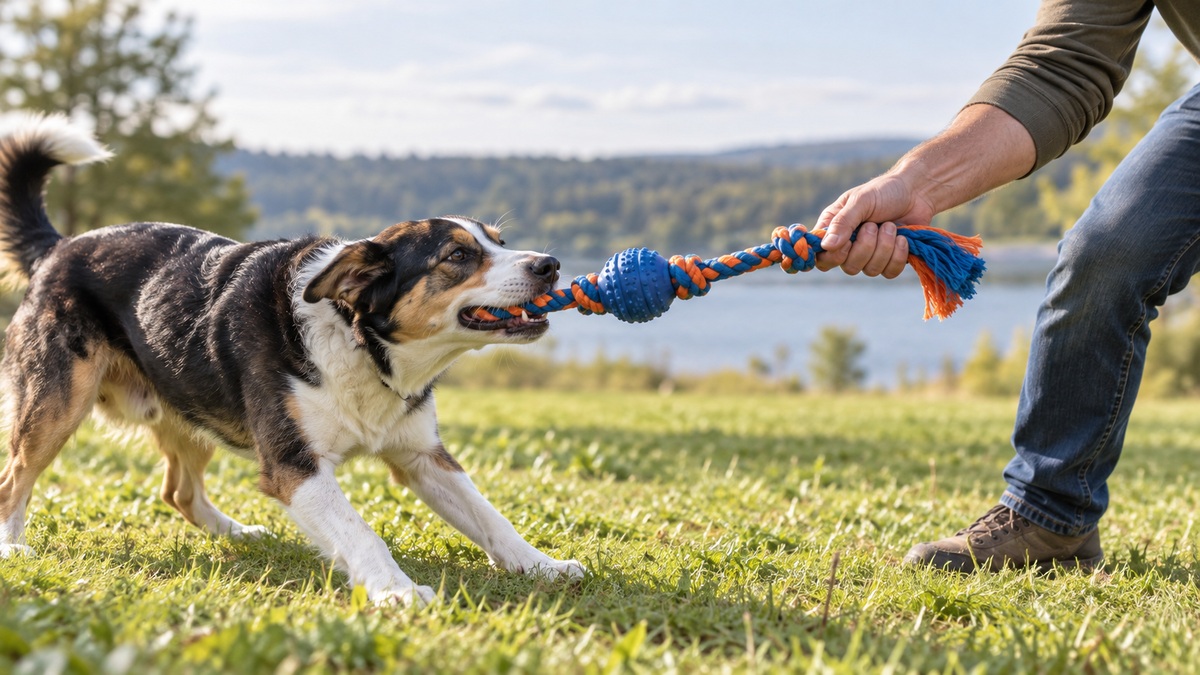
Best Dog Tug Toy
As an Amazon Associate we earn from qualifying purchases. Details
The best dog tug toy is a handled toy that you control during play and put away afterward, because the veterinary sources we opened tie tooth damage to hard objects and to rough play. This roundup compares six tug toys from six brands, covering rubber, rope, linen and webbing designs. For each one we read the title, the feature bullets and the specification table on its Amazon listing, and compared the materials, handles, size ranges and training uses the listings state. Where a listing is silent on a point, we say so.
Quick answer
- Medium or large dog, rubber preferred: the KONG listing describes a natural rubber tug that springs back into shape, and its title names medium and large dogs.
- Fetch and tug in one toy: the Chuckit! Ultra Tug pairs a 2.5 inch ball with a nylon cord, and its listing gives a medium size for dogs of 20 to 60 pounds.
- Training rewards: the Coachi Tuggi Tug listing says it can help with recall and agility, and says to use it only as part of interactive play.
- Squeaky fabric option: the wodoca listing describes a squeaker inside a chenille body, with a handle for the owner and a bite section for the dog.
- Trainer bite work: the Bull Fit K9 listing describes two handles for the handler and a bite pillow, and says the handles are not for the dog to bite.
Tug play and teeth: what the sources say
Tug is a sensible game to share, but the sources we opened describe real tooth risks, and they point to the object more than to the game. Cornell’s canine health center says that “fractured teeth are commonly caused by chewing very hard objects,” and adds that “even chew toys can be a cause.” Cornell’s page also describes the pain that follows a fracture: “a tooth fracture that exposes the pulp, the sensitive tissue that contains nerves and blood supply, will be painful.”
The Merck Veterinary Manual’s dog owner page lists the causes more widely. It says, “Teeth can be fractured from external trauma (eg, aggressive play or automobile accident) or from biting inappropriate objects (eg, real bones, hooves, antlers, hard nylon toys, rocks, fences, or cages).” Two things in that sentence matter for a tug toy. Aggressive play is named as a cause, and hard nylon toys are named as an object to avoid. A rope or nylon tug is not the same as a hard nylon chew, but the manual does not separate the two, so the play style matters as much as the material.
A research paper from the University of Pennsylvania’s veterinary school is the most detailed source we opened. It is a cadaveric study of maxillary fourth premolar teeth, and it reports the force at fracture. In the abstract, “the mean maximum force (± SD) sustained by the tested teeth at the point of fracture was 1,281 N (± 403 N).” The paper also says that “tooth fracture in dogs is a commonly observed clinical condition, with a reported prevalence of 20–27%, although the literature quantifying this number is limited.” Taking one standard deviation either side of the mean, the range runs from 878 N to 1,684 N (1,281 minus 403 is 878, and 1,281 plus 403 is 1,684). Those are forces on teeth in a lab, not ratings for a toy, and the paper does not test any toy in this roundup.
The same paper notes “increasingly latent concern about the potential role of chewing on treats and toys in the fracture of large cheek teeth.” One co-author is listed with Mars Petcare Care and Treats, Europe, which is a commercial affiliation, so we weigh the paper’s conclusions as a research finding rather than as a product endorsement.
Cornell also gives a practical test that owners can use on any item. It says that “most veterinary dentists go by the ‘thumbnail test’ for chewing items,” and suggests that “you should be able to make a dent in the item with your fingernail.” A tug toy is not a chew, but the same idea applies: a toy that is too hard to dent is more likely to strike a tooth. The fingernail test does not tell you whether a toy is safe for tug, and the listings give no hardness figure for any tug toy in this set.
Materials: rubber, rope, linen and webbing
The six listings use four materials. KONG and Outward Hound describe natural rubber. Chuckit! Ultra Tug describes a two-ply nylon cord with a ball at the end. wodoca describes a chenille body with an elastic band and a squeaker inside. Bull Fit describes French linen with double stitching on the edges, and Coachi describes a soft, stretchy toy with “extra strength webbing.”
Rubber is the most elastic of the four. The Outward Hound bullets say its rubber “bends and stretches for long-lasting strength” and that the toy is “floppy and flexible yet holds its shape during rough play.” The KONG bullets say its rubber “springs back into shape during a game of tug.” A rubber tug gives the dog a firm grip that does not tear, but the listings do not say how a rubber bite section reacts to the teeth of a strong chewer.
Rope and fabric toys give a softer bite. The wodoca bullets describe chenille and an elastic band, and the Bull Fit bullets describe linen with stuffing held in by double stitching. A fabric body can be pulled apart over time, and the stitching is the first thing to check after each session. None of the fabric listings gives a tear strength or a stitching standard.
Handles, grip and who holds the toy
Handles matter because tug is a two-person game. The KONG bullets describe a “comfortable grip design” for the owner, and the Outward Hound bullets describe an “ergonomic handle” that makes tug “more comfortable for you and your dog.” The wodoca bullets say “the handle is for you, the bite tug is for dog,” which describes the same split between the owner’s grip and the dog’s bite. The Bull Fit listing is the most explicit. It says the handles on the bite pillow “are not designed for the dog to bite but are for handler use only,” and it says to “always supervise.”
Chuckit! Ultra Tug uses a nylon strap instead of a handle. The bullets say the strap “makes the Ultra Tug dog toy easy to toss,” so it is a fetch and tug toy first. Coachi’s bullets describe it as a strap-style toy for tug and play, and they do not give a handle design.
Size, weight and the dog
Size decides who can play safely with a tug. The specification tables give weights that differ widely. Outward Hound is the heaviest at 12.63 ounces, and KONG is 9.17 ounces. The gap is 3.46 ounces (12.63 minus 9.17 is 3.46). Coachi is 5.86 ounces, which is 3.04 ounces more than wodoca at 2.82 ounces (5.86 minus 2.82 is 3.04). A heavier toy is harder for a small dog to carry, but it also gives a larger grip for an owner.
Size range is stated in several titles. KONG says “for Medium/Large Dogs.” Bull Fit says “Ideal for Medium to Large Breeds.” Chuckit! Ultra Tug says it is for dogs weighing 20 to 60 pounds. Outward Hound says “for All Breeds,” and wodoca says it is “suitable for all dogs of all ages, from tiny tuggers to large dog breeds.” Coachi’s bullets say its toys are “perfect for puppies.” These statements are the maker’s, and the sources we opened do not give a size rule for tug toys.
Training uses: recall, agility and the reward rule
Several listings describe training rather than play alone. The Coachi bullets say the toy is “great for playing tug and also as a fun and enticing toy for games and rewarding recall,” and they add that it “can also help interrupt play biting and chewing.” The wodoca bullets say the toy helps with “agility, practicing recall, boosting motivation.” The Coachi bullets also set a rule: “only using these toys as part of interactive play,” which keeps the toy as a reward “the same as a food treat.”
That rule is useful for any tug toy. A toy used only during play, and put away after, gives the dog less time to chew on it between sessions. The listings do not say how long a tug session should last, so set a short session and stop before the dog’s grip or mouth looks strained.
Durability and tooth claims in the listings
Most of the durability claims in these listings are maker statements. The KONG bullets say “no dog toy is truly indestructible, so always remove the toy from playtime if damaged,” which is the most cautious line in the set. The Bull Fit bullets say “tug toys are meant for interactive tugging between you and your dog only, not chew toys.” Chuckit! says its Ultra Tug is “not a chew toy; always supervise your dog when playing with this toy.”
The wodoca bullets make a tooth claim that we did not verify. They say the rope “will get teeth cleaning” and that it “is also great for teeth puppies,” which the bullets say will keep them “healthy and happy.” The sources we opened do not confirm that a rope tug cleans teeth, so we do not repeat that claim as a benefit.
How to choose: five steps
- Match the toy to the dog’s size. Use the stated ranges: medium and large for KONG and Bull Fit, 20 to 60 pounds for Chuckit!, and all breeds for Outward Hound and wodoca.
- Decide between rubber, rope and fabric. Rubber springs back, rope gives a soft grip and fabric is light. Choose the one your dog grips best without wearing its teeth on a hard edge.
- Put the toy away after each session. Coachi says to use its toys only as part of play, and Bull Fit says the toy is not a chew toy. Both rules apply to every tug toy.
- Check the toy after each session. Look for loose stitching on fabric toys and for cracks or thin spots on rubber. Replace a toy that has a torn seam or a split.
- Plan the play. Keep sessions short and let the dog release the toy on command, so no one is pulled off their feet.
1. KONG Tug Toy, Natural Rubber Dog Toy for Tug of War, for Medium/Large Dogs (Natural rubber tug for medium and large dogs)
Pros
- The bullets describe natural rubber that springs back into shape during a game of tug
- The bullets describe a comfortable grip for the owner during tug games
- The bullets say KONG has made pet toys since 1976 and covers the toy with a satisfaction guarantee
Cons
- The bullets say no dog toy is truly indestructible and advise removing it when damaged
- The title limits the toy to medium and large dogs
Best for: An owner of a medium or large dog who wants rubber rather than rope
Skip if: Your dog is small, since the title names medium and large dogs
View on Amazon (affiliate link)
2. Chuckit! Ultra Tug Dog Toy, Medium, Fetch & Tug Ball for Dogs 20-60 Pounds (Fetch and tug ball on a nylon cord)
Pros
- The bullets describe a Chuckit! ball on a two-ply nylon cord for tug of war
- The bullets say the nylon strap makes the toy easy to toss and works with some Chuckit! launchers
- The bullets give a medium size of 2.5 inches in diameter for dogs of 20 to 60 pounds
Cons
- The bullets say the toy is not a chew toy and must be supervised
- The specification table lists Canine Hardware as the manufacturer, not Chuckit!
Best for: An owner who wants one toy for fetch and tug with a dog of 20 to 60 pounds
Skip if: Your dog chews toys rather than plays tug, since the bullets say it is not a chew toy
View on Amazon (affiliate link)
3. wodoca Dog Tug Toy, Dog Toys for Aggressive Chewers, Strong Squeak Rope Toy (Squeaky fabric tug for training games)
Pros
- The bullets describe a squeaker inside the chenille body
- The bullets say the toy can be used for tug, racing, rewards and recall training
- The bullets describe a handle for the owner and a bite section for the dog
Cons
- The bullets call the toy a rope chew toy in one place and a tug toy in the title, so its intended use is unclear
- The bullets give no tear strength or durability figure for the fabric
Best for: An owner who wants a squeaky tug for training games with a small or medium dog
Skip if: Your dog tears fabric quickly, since the listing gives no durability figure
View on Amazon (affiliate link)
4. Coachi Tuggi Tug – Interactive Dog Toy for Tug of War & Play (Stretchy training tug for recall and agility)
Pros
- The bullets describe a soft, stretchy toy with extra strength webbing
- The bullets say the toy can help interrupt play biting and chewing
- The bullets say the toy is useful for recall and agility training
Cons
- The bullets say to use the toy only during interactive play, so it is not a toy to leave out
- The bullets compare the toy to a food treat, which means it needs to be rationed
Best for: A trainer who uses tug as a reward for recall and agility
Skip if: You want a toy your dog can carry around alone, since the bullets say it is for interactive play
View on Amazon (affiliate link)
5. Outward Hound FlyFetch Durable Rubber Tug Dog Toy for All Breeds, 10.9″ (Heavy natural rubber tug with an ergonomic handle)
Pros
- The bullets describe 100 percent natural rubber that bends and stretches
- The bullets describe an ergonomic handle that makes tug more comfortable for the owner
- The bullets say the smooth surface wipes clean
Cons
- The bullets describe the toy as floppy and flexible, so it may not suit a dog that wants a stiff bite
- At 12.63 ounces, it is the heaviest toy in this set by the specification table
Best for: An owner of a dog that tugs hard and wants a rubber handle
Skip if: You want a light fabric toy, since this one weighs 12.63 ounces
View on Amazon (affiliate link)
6. Bull Fit K9 Dog Bite Tug Toy with 2 Strong Handles – Made of Durable & Tear-Resistant French Linen (Linen bite tug with two handles for trainers)
Pros
- The bullets describe French linen with double stitching on the edges
- The bullets describe two handles and a bite pillow for handler use
- The bullets say the toy suits medium to large breeds and big puppies
Cons
- The bullets say the handles are for the handler, not for the dog to bite
- The bullets name police, military and ring sport use, which we did not verify
Best for: A trainer doing bite-tug or obedience work with a medium or large dog
Skip if: Your dog is a chewer, since the bullets say the toy is not a chew toy
View on Amazon (affiliate link)
Mistakes to avoid
- Letting the dog keep the toy. The Coachi and Bull Fit listings both say to use the toy during play only, and Merck names aggressive play as a cause of tooth fracture.
- Choosing by the dog’s enthusiasm alone. A dog that grips hard may need a larger toy or a rubber design, not a smaller one.
- Using a fabric toy on a dog that shreds fabric. The listings give no tear strength, so a dog that tears fabric quickly will tear these too.
- Assuming a claim about teeth. The wodoca claim about cleaning teeth is a maker statement, and the sources do not back it.
How we chose
We searched Amazon.com in Chrome on 21 October 2026 for “best dog tug toy” and read the first results page. A listing counted only if its title or first bullets named a tug toy or tug-of-war toy for dogs. We left out chew toys with no tug use, rope sets sold as packs for chewing, and flirt poles, because those are different products. We opened six listings from six brands and read each title, the feature bullets and the specification table where one was shown.
We did not use a second listing from a brand already in the set, and we did not open the other tug-of-war listings on the page, because the set keeps one listing per brand. Sponsored placements were not used to choose the set.
Each bullet was captured in pieces of up to 300 characters, so a few bullets end mid-sentence in the listing data. Figures in this post come from a title, a bullet or a specification table on a listing, or from the veterinary sources named in the post.
What we could not verify
- The tear strength, hardness or stitching standard of any toy in this set. None of the listings gives a figure, and the sources we opened do not rate tug toys.
- Whether any toy in this set is safe for a dog’s teeth or jaw. The sources describe fractures from hard objects and aggressive play, and they do not test these toys.
- The wodoca claim that the rope “will get teeth cleaning.”
- The Bull Fit claims about use by police, military and ring sport teams, which the listing states without a source.
- The KONG claim of satisfaction and of product quality since 1976, which is a maker statement.
- The Coachi specification table’s length of 31.89 inches, which the table gives as a product dimension and which may not be the toy’s length in use.
- The fit of each toy to a particular dog’s mouth, which the listings do not describe.
- The cadaveric study’s findings for any tug toy, since the paper tested teeth and not toys.
- Anything beyond the first bullets we captured.
- Prices and availability, which were not recorded for this post.
FAQ
Is tug bad for my dog’s teeth?
The sources we opened do not say tug is always harmful. They do say that teeth can be fractured by “aggressive play” and by hard objects, and that a fracture can be painful. A gentle, short game with a toy you control is a lower-risk use than a long, rough session. Ask your vet if your dog has existing tooth problems before you start.
How hard should a tug toy be?
Cornell describes the fingernail test: a dentist’s rule of thumb is that “you should be able to make a dent in the item with your fingernail.” It is a rule for chews, but the same idea applies to tug. The listings give no hardness figure for any tug toy in this set.
Can I leave the tug toy with my dog?
The Coachi listing says to use its toys “only as part of interactive play,” and the Bull Fit listing says its tug toy is “not a chew toy.” Chuckit! says its Ultra Tug is not a chew toy and needs supervision. Store the toy out of reach between sessions.
Is a rope tug good for cleaning teeth?
The wodoca listing says it will get teeth cleaning, but we did not verify that. The sources we opened describe tooth fractures and dental disease, and they do not show that a rope tug cleans teeth. Ask your vet about dental care for your dog.
Can tug play hurt my dog’s neck?
The sources we opened do not address neck injury from tug, so we cannot give a number or a rule. Keep the game gentle, let the dog release the toy on command and ask your vet if your dog has a neck or back problem.
Should a puppy play tug?
The Coachi and wodoca listings describe their toys for puppies and all ages, but the sources we opened do not address tug for puppies. Ask your vet before you start, and keep sessions short and gentle.
Bottom line
Choose the toy by size and by how your dog grips. Medium and large dogs fit the KONG or Bull Fit listings, a 20 to 60 pound dog that also fetches fits Chuckit! Ultra Tug, a trainer who uses tug as a reward fits Coachi, and a dog that likes a squeaky fabric toy fits wodoca. Whatever you buy, keep play short, put the toy away after each session and replace a toy with a torn seam or a split. For more chew and fetch options, see our Chew King premium treat toy guide, our durable chew toys for pit bulls guide and our balls for dogs that chew guide.
Sources
- Cornell University Riney Canine Health Center, Risks from a fractured tooth: https://www.vet.cornell.edu/departments/riney-canine-health-center/canine-health-information/risks-fractured-tooth
- Soltero-Rivera et al., Fracture Limits of Maxillary Fourth Premolar Teeth in Domestic Dogs Under Applied Forces (PMC full text): https://pmc.ncbi.nlm.nih.gov/articles/PMC6364561
- Merck Veterinary Manual, Dental Disorders of Dogs (dog owner version): https://www.merckvetmanual.com/dog-owners/digestive-disorders-of-dogs/dental-disorders-of-dogs