Stop a Dog Jumping the Fence: Why a Harness Is Not the Fix
As an Amazon Associate we earn from qualifying purchases. Details
Updated 19 October 2026 | Author: Editorial team, bestdogsstuff.com
The person typing stop dog from jumping fence harness wants to keep a dog in the yard when it clears the fence, and they are hoping a harness will do the job. The sources we opened do not support that expectation. A harness can keep a dog safer on a leash and can prevent throat damage when a dog pulls, but none of the sources we opened say a harness stops a dog from jumping. The Sacramento SPCA’s guidance on escape artists points to the fence itself, the things near it, and the reason the dog wants out. This guide explains those steps and where a harness fits in.
Quick answer
- A harness is for walking on a leash. The sources we opened do not say it stops jumping over a fence.
- Block the jump first. The Sacramento SPCA says that if a dog jumps the fence, you can make it higher, and that an extension slanting inward at about a 45-degree angle is the best way to do that.
- Remove anything the dog can use to climb or push off, and keep an eye on digging spots as well.
- Address the reason the dog wants out, such as boredom, lack of company or too little exercise.
- Never use a tether or run line as a substitute for a fence, and never punish a dog after it has escaped.
What a harness can and cannot change
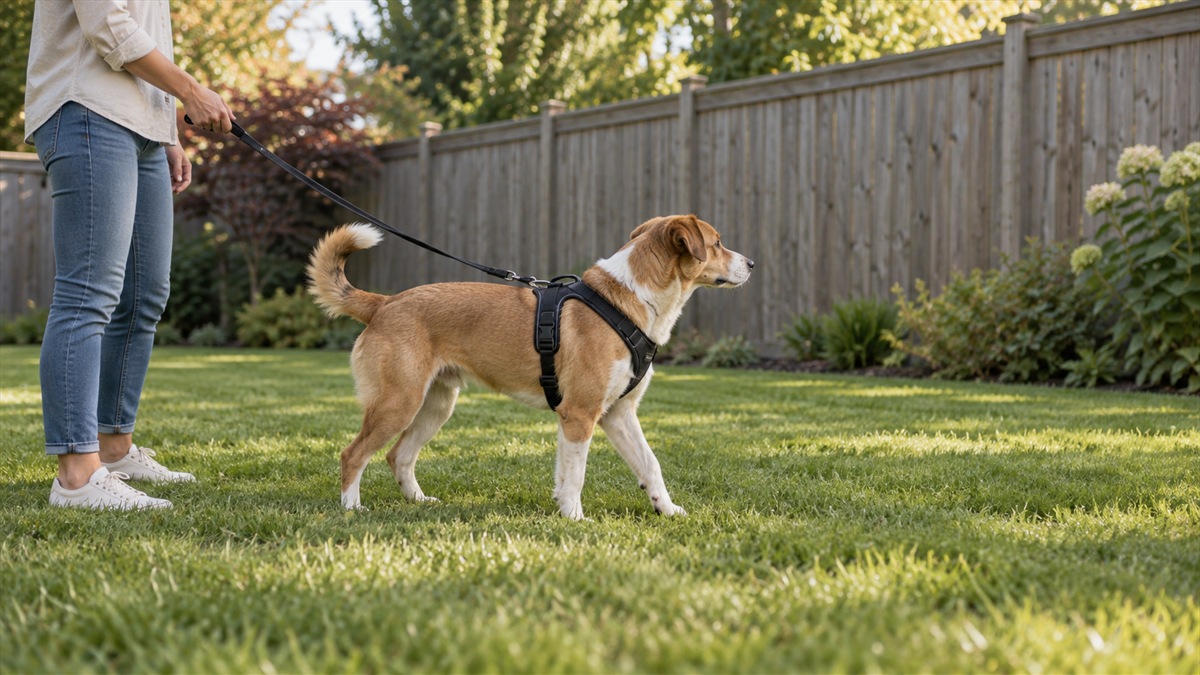
A harness is a piece of equipment that goes on the dog’s body rather than the neck. The AKC says a harness can prevent potential throat damage if a dog pulls, and it can make it less likely that the leash gets caught under the dog’s legs. Those are real benefits on a walk. They say nothing about a dog’s ability to clear a fence, and the sources we opened do not connect harness design to fence jumping.
The sources do name a harness-related risk. The AKC notes that as with collars, if a harness is too big, a dog may be able to wiggle out and escape. That is an escape problem on a walk, which is a different problem from jumping a backyard fence. A dog that slips out of a loose harness can end up loose, so a well-fitted harness is one part of a larger containment plan rather than the plan itself.
This distinction matters because a harness purchase can feel like action, while the fence and the dog’s motives are the things that change the outcome. Keep the harness for walks, and treat the fence as the thing to fix.
Find out how the dog gets over
The Sacramento SPCA says a lot of dogs get over fences by climbing, pushing off something on or near the fence, or by hitching themselves over with their paws. It also says that for a dog who digs under a fence, you can make digging difficult by securing chicken wire or chain link on the ground or burying it along the base of the fence, or by placing large rocks or bricks there.
Spend a few minutes watching or checking before you change anything. Look for the spot where the dog goes over. Look for a pile of leaves, a bench, a planter, a dog house or a stack of firewood near the line of the fence. Look for scuffed marks on the boards or bent mesh at the top. Look for digging holes at the bottom edge. Each clue tells you which fix matters most, and the sources suggest that one fix alone often misses the real route.
Fix the fence in a sensible order
The table below lists the fixes the Sacramento SPCA describes, in the order that usually makes sense. It is a sorting aid built from the source’s wording. It does not predict whether any particular fence will work for any particular dog.
| Step | What it addresses | What the source says |
|---|---|---|
| Raise the barrier | Dogs that clear the fence | Make it higher, with an extension that slants inward at about a 45-degree angle |
| Remove climbing aids | Dogs that climb or push off | Make sure there is nothing near the fence the dog can use to get over |
| Add a rolling bar | Dogs that grip the top | A rolling bar at the top of the fence can be helpful |
| Block digging | Dogs that dig under | Secure wire on the ground, bury it along the base, or place large rocks or bricks |
| Fix latches | Dogs that open gates | Replace or secure any latch or lock the dog has figured out |
| Provide a covered run | Times you are not home | Sometimes the only way to prevent fence escapes is a secure, covered dog run |
A simple way to plan the work is to count the gaps. If a dog has used two routes, such as jumping and digging, you need two fixes, not one. A taller fence does nothing about a hole under the boards, and a rolling bar does nothing about a dog that goes under a gate.
Check the fence after each change. Walk the line, look for new marks, and watch the dog in the yard for at least a few days. A fix that works for a week can fail when the dog finds a new route, which is why the source frames this as blocking escape routes rather than a single purchase.
Reduce the reason the dog wants out
Blocking the route only helps as long as the dog does not keep trying. The Sacramento SPCA lists boredom or social isolation as a common reason a dog seeks entertainment or companionship elsewhere. It advises making sure the dog gets enough exercise and enough company. In the source’s words, you should get your dog tired out every day, and time that a dog spends alone in the yard does not count toward that exercise.
Some escapes come from a different cause. The Sacramento SPCA notes that dogs with fears and phobias, such as thunderstorm or noise phobias, often react by escaping. It advises putting such a dog somewhere it cannot escape and where it feels safe when a frightening event is likely. It also says that separation anxiety can cause a dog to try to get out. In those cases the fence is not the root problem, and more fence work alone will not stop the behavior.
Sex drive can also drive roaming. The Sacramento SPCA says sexually motivated roaming is mainly an issue for unneutered male dogs, and that if a dog is neutered when young, the issue may be avoided entirely. It adds that if a dog has established a long pattern of escaping, the behavior may take longer to stop, but neutering makes changing it much easier. Discuss that option with your veterinarian rather than deciding on your own.
Do not punish the dog for escaping
Many owners respond to an escape with anger. The Sacramento SPCA warns against it. Its position is that punishment for escaping will not help, and that it can make the problem much worse. If a dog is punished after it has escaped, it may become afraid to come back to you, which is the opposite of what you want.
The source adds a point about in-the-moment correction. If you catch a dog in the act of digging under the fence, you can interrupt it so it knows you do not like the behavior. That interruption will not teach the dog to stop when you are away, so the lasting fix is to manage the problem with the fence and the routine.
Harness fit: what to check on the leash
Once the fence work is underway, the harness still matters on walks, especially if a dog pulls or has tried to slip out of a loose collar. The AKC says that you can slip one finger between the dog’s skin and the harness for a small dog, or two fingers for a large-breed dog. It also says that dog harnesses that are too tight can be painful or uncomfortable, especially in hot weather.
The AKC’s measuring guide gives the method. It says chest girth is typically the most important measurement for clothing and harnesses, because it reflects the widest part of the dog’s body. Measure the dog while it is standing, keep the tape snug but not tight, and follow the two-finger rule. Then compare your measurement with the sizing chart of the specific product, because the AKC says to always compare your dog’s measurements with individual product sizing charts before purchasing. If a measurement falls between sizes, the same guide suggests looking for adjustable options.
A fit check can be written as a simple comparison. For any harness you consider, subtract the top chest value on that brand’s chart from your dog’s chest measurement. A negative result means the dog’s chest is smaller than the top of the chart, so check the bottom value as well. A positive result means the dog is larger than the top of that chart, and that harness is not sized for it. This is arithmetic on the chart, not a rule about how a harness will behave on a fence.
Tethers and run lines are not a fence
Some owners try to keep a dog from leaving the yard with a tether or a run line instead of fixing the fence. The sources we opened advise against that approach. The Humane Society of the United States defines chaining and tethering as fastening a dog to a stationary object and leaving it unattended. It says tethered dogs are at high risk of entanglement, strangulation and harassment or attacks by other dogs or people.
The Sacramento SPCA also says a tied-out dog can easily get hurt or become so frustrated that it acts aggressively or destructively. It describes one safer arrangement for short periods: a trolley on a line between two points, with the dog connected by a leash to a body harness, and a leash short enough that it will not tangle but long enough for the dog to lie down. That is a short-term setup under supervision, not a way to keep a jumping dog contained while you are away. Keep the dog inside or in a secure run when you cannot watch it.
A four-step plan for the next week
- Identify the route. Look for the spot the dog uses, any object near it, and any digging.
- Block that route first, starting with the height and the climbing aids the Sacramento SPCA describes.
- Give the dog more exercise and company, and check whether it is bored when left alone outside.
- Measure the dog for a harness only after the fence work is in place, so the leash gear is ready for walks. Use the chest measurement and the two-finger rule before you buy.
If the dog keeps going over the fence after two weeks of fence work and more exercise, speak with your veterinarian or a qualified trainer about behavior. The sources we opened do not offer a method for behavior that continues despite good fence work, so do not treat this plan as a guarantee.
How we chose
We started from the question a dog owner would type: how to keep a dog from getting over the fence, with a harness in mind. We read the Sacramento SPCA’s guidance on escape artists, the AKC pages on harness fit and on measuring dogs for gear, and the Humane Society of the United States page on chaining and tethering. We kept only sentences that matched the saved text word for word.
Our research records for this keyword hold no harness listings, so this guide names no product and makes no product claim. We chose the sources by the problem, not by a brand: fence design and behavior first, harness fit second, and tether safety last.
What we could not verify
- Whether any harness on the market stops a dog from jumping a fence. None of the sources we opened study harnesses for that purpose.
- How high a fence must be for a particular dog. The Sacramento SPCA gives an extension angle, not a height for each breed.
- Whether a rolling bar or a slanted extension will work for a given dog and yard. The source says these can help but does not promise a result.
- Local rules on fence height or tethering. Some places regulate tethering, and the rules differ, so check with your local authority.
- The cause of any one dog’s escapes. Boredom, fear, separation, sex drive and digging can overlap, and the sources do not say how to sort them for a single dog.
FAQ
Will a harness stop my dog from jumping the fence?
The sources we opened do not say so. A harness is designed for walks and fit, and the AKC describes its benefits on a leash. Block the jump with a taller or slanted extension, remove climbing aids, and address why the dog wants out.
How high should a fence be to stop a jumping dog?
The Sacramento SPCA says to make the fence higher, and suggests an extension that slants inward at about a 45-degree angle. It does not give a height for every dog, so measure your fence and watch the dog’s jump before you choose the change.
What if my dog digs under the fence instead?
The Sacramento SPCA says you can secure chicken wire or chain link on the ground, bury it along the base of the fence, or place large rocks or bricks there. Check the bottom edge regularly, since a dig that is not blocked is still a route out.
Is it safe to tie my dog to a tree while I am gone?
No. The Humane Society of the United States describes tethering a dog to a stationary object and leaving it unattended as a practice with high risk of entanglement and strangulation. Keep the dog inside or in a secure run instead.
Should I punish my dog for jumping out?
No. The Sacramento SPCA says punishment for escaping will not help and can make the problem much worse, because a dog may become afraid to come back to you. Interrupt the behavior in the moment if you catch it, and manage the fence and the routine for the rest of the time.
Bottom line
A harness keeps a dog safer on a walk when it fits, but it does not stop a dog from clearing a fence. Block the jump, remove the things the dog uses to get over, fix any digging, and address the boredom or fear that drives the escape. Never rely on a tether to replace a fence.
For related reading, see our roundup of dog harnesses to wear all the time and our roundup of harnesses for small dogs that escape.
Sources
- Sacramento SPCA, Behavior and Training Department, Escape Artists (PDF): fence height and angle, climbing aids, digging, boredom, punishment, tethering with a trolley and body harness
- AKC, Dog Harnesses and Dog Collars: Which Is Right For Your Dog?: harness benefits on walks, escape risk from loose or large harnesses, two-finger fit, tight harness discomfort
- AKC, How to Measure Your Dog for Clothes and Gear: chest girth, standing measurement, two-finger rule, product chart comparison
- Humane Society of the United States, Is it Okay to Chain or Tether Dogs?: definition of tethering, entanglement and strangulation risk