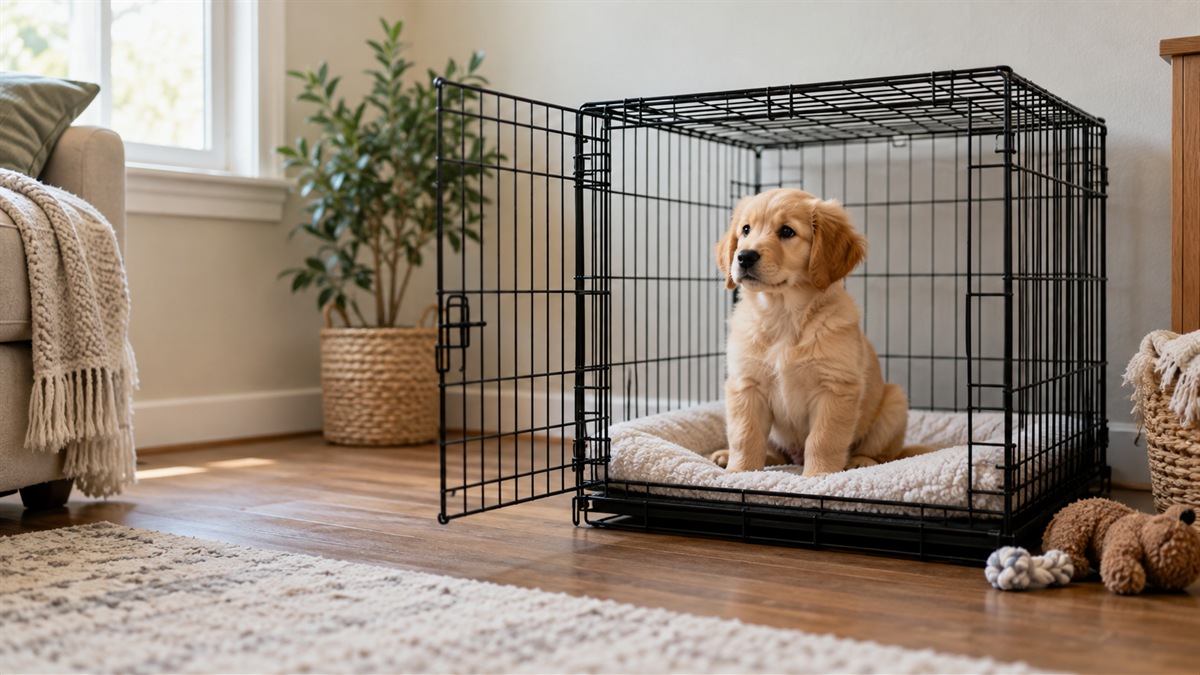
Best Crates for Puppies: Size, Divider and Material Guide
As an Amazon Associate we earn from qualifying purchases. Details
Updated 19 October 2026 | Author: Editorial team, bestdogsstuff.com
The best crates for puppies are sized for the adult dog the puppy will become, with a divider that shrinks the space until the puppy is older. Shoppers searching for best crates for puppies usually want three answers: which size to buy, which material holds up to a young dog’s chewing, and how to keep a puppy from using one corner as a toilet. The AKC and two veterinary college pages we opened agree on the core rule: a crate should let the dog stand, turn around and lie down comfortably, and no more.
Quick answer
- Size the crate for the adult dog’s expected height and length, then use a divider to make the space fit the puppy now.
- Keep the space just large enough to stand, turn around and lie down. Extra room lets a puppy use one end as a toilet.
- Wire crates are durable and often come with dividers. Choose a metal crate if the puppy is a serious chewer, because AKC says metal crates are best for dogs who chew through other materials.
- Plan crate time by age: Texas A&M gives a monthly rule of thumb for puppies, and it is a limit, not a target.
Why a puppy crate has to fit two sizes
A puppy crate has to work for two dogs at once: the small puppy that needs containing now, and the adult it will become. A crate chosen only for the current size means buying again as the puppy grows. Cornell’s Riney Canine Health Center says it directly: “If you are acquiring a crate for your puppy, then you will want a kennel that will be big enough to fit them as an adult to avoid buying multiple crates of different sizes.” That is why this guide starts with adult size instead of puppy size.
AKC describes the same approach. For puppies, it suggests an expandable crate sized to the typical adult size of the dog’s breed, with a divider that you adjust as the puppy grows. The divider is what makes a large crate usable for a small puppy.
Size is a trade-off, not a single number. A crate that is too large creates its own problem. AKC warns that a large crate can encourage a dog to go to the bathroom inside it: “This could encourage your dog to eliminate within the crate because they can sit away from the mess.” The aim is a crate that is roomy enough to stand, turn and lie down, and no roomier.
How to size the crate for an adult dog
AKC’s sizing method starts with the dog standing. Measure from the top of the head to the bottom of the feet to get height. Measure from the tip of the nose to the tip of the tail to get length. Then add 3 to 4 inches to each measurement. AKC gives this method for the crate you will need, so it is the right starting point when the adult size is not yet known.
For a puppy, use the typical adult size of the breed or the mix you expect. A puppy’s current measurements tell you very little about the crate it will need as an adult. The table below shows the arithmetic with an example adult dog. The numbers are illustrations of the method, not breed data.
| Measurement | Example adult dog | Crate target (add 3 to 4 inches) |
|---|---|---|
| Height: top of head to bottom of feet | 16 inches | 19 to 20 inches |
| Length: nose to tip of tail | 20 inches | 23 to 24 inches |
In the example, 16 inches plus 3 is 19 inches, and 16 plus 4 is 20 inches. For length, 20 inches plus 3 is 23 inches, and 20 plus 4 is 24 inches. Use your own dog’s or the breed’s real measurements in the same way. The sources we opened give height and length only. They do not give a width or floor area for puppy crates, so measure the space in the room too.
How the divider works
A divider turns one large crate into a crate that fits the puppy now. Cornell’s veterinary page describes the mechanism: “A divider can be used to make the larger crate fit the size of your growing puppy and help to accommodate them while they are potty-training.” The same page describes the layout that follows: if the crate is too large, the puppy can use one side as a bed and the other as a toilet.
Cornell also notes that wire crates often come with dividers. AKC adds that the divider can be adjusted to expand the space as the puppy grows. The sources we opened do not give a timetable for moving the divider, so the signal to move it is the puppy outgrowing the space, which is the reason AKC gives for expanding the crate.
Materials: wire, plastic, metal, wood and soft
Wire crates
Cornell describes wire crates as durable and easy to fold for storage. Its guidance also covers the look of the crate. “Many dogs feel comforted by being in a den, so we recommend covering a wire kennel with a sheet or another kind of custom crate cover that still leaves one or two sides open.” Cornell’s advice is to leave one or two sides of the cover open.
Plastic crates
AKC says plastic dog crates “work in the house and can also serve as travel carriers for dogs.” AKC also says, “Best of all, plastic crates are easy to clean,” which matters for a puppy that will have accidents during house training. The pages we opened do not compare plastic and wire for chewing strength.
Metal crates
AKC says “Metal dog crates are best for dogs who tend to chew through other materials.” AKC also says these crates “are the sturdiest you can buy and provide good air circulation and visibility.” Of the types AKC describes, metal is the one it names for dogs that chew.
Wood crates
AKC describes wood crates as usually the most attractive option, and notes that they “are heavier than other types of dog crates, and are harder to clean.” They also need assembly. A wood crate can look like furniture, but for a puppy that is still learning the house, the cleaning and weight points matter more than the look.
Soft crates
AKC calls fabric crates an economical choice for a small breed dog that does not chew on the crate. AKC also notes that fabric crates are harder to clean after an accident, so the description fits a small dog that does not chew, not a puppy that is still having accidents.
Every type needs airflow. AKC says that “All dog crates require proper ventilation holes or mesh fabric on the sides for your dog to breathe properly.” Check the sides and the door before buying, not just the floor size.
Crate time and the house-training stage
Crate time is a separate question from crate size. Texas A&M’s crate-training guidance advises “limiting crate time for puppies to one hour for each month of age,” and it recommends letting the dog outside to exercise and go to the bathroom before it goes into the crate. The same guidance says crate training “should not be used for excessive amounts of time or to punish the dog.”
Here is the arithmetic. A puppy that is 4 months old gets 4 months x 1 hour = 4 hours as the crate-time limit under that guidance. A 2-month-old gets 2 months x 1 hour = 2 hours. The rule does not replace the outdoor break before the crate, and it is a limit on crate time, not a target. A puppy that needs a break sooner should get one sooner.
Where the crate goes and what goes inside
AKC’s crate-training page says, “Making sure you choose the right crate size for your dog is also an important part of successful crate training.” Placement and bedding come after size. AKC suggests adding a cozy, machine-washable bed or mat inside the crate for dogs that do not regularly chew fabric, and notes that many crates come with coordinating beds that you can remove and wash. A washable bed is easier to keep clean during house training than a bed that cannot be washed.
If you want to compare padded options once the size is settled, see our padded crates guide and our memory foam crate pad guide. This guide covers size, divider, material and time.
Common mistakes
- Buying for the puppy’s current size only. Cornell’s point is that the adult size is the one to plan for, because a second crate means a second purchase.
- Leaving too much room. AKC’s warning about a crate that is too large applies to puppies as much as to adults.
- Choosing soft fabric for a chewer. AKC’s soft-crate description assumes a small dog that does not chew. A puppy that chews needs a sturdier type.
- Using the crate all day. Texas A&M says crate training should not be used for excessive amounts of time.
- Ignoring the sides and the door. AKC’s ventilation rule covers every type of crate, including the ones that look solid.
How we chose
This post covers the four questions a buyer of a puppy crate asks: size, divider, material and time. We looked for pages that answer those four questions with specific claims. We opened AKC pages and two university veterinary college pages (Cornell’s Riney Canine Health Center and Texas A&M’s College of Veterinary Medicine). We gave priority to university and AKC material and did not use Wikipedia for any safety or procedure claim.
We did not rank brands, and this post has no product cards, so every claim here comes from the pages we opened, not from a listing. Each quoted sentence was matched against the saved text of the page before it was used.
What we could not verify
- Breed-by-breed adult sizes. The sources give the method for measuring an adult dog, not a size chart for each breed or mix.
- Width and floor area for a puppy crate. The pages we opened give height and length, not width.
- A specific chew-proof crate model. The pages name material types and what they suit, not models, and they do not rank products.
- A timetable for moving the divider. AKC says to expand the space as the puppy grows but gives no schedule.
- How long a particular puppy can hold its bladder. The one-hour-per-month figure is a guideline from Texas A&M, not a measure of any one dog.
- Any product’s stated size, weight limit or warranty. This guide does not check listings and does not repeat listing claims.
FAQ
Should I buy a crate for my puppy’s current size or its adult size?
Buy for the adult size and use a divider to make the space fit the puppy now. Cornell says a crate big enough for the adult dog avoids buying multiple crates of different sizes, and AKC recommends an expandable crate sized to the typical adult size of the breed.
Is a wire crate or a plastic crate better for a puppy?
The pages we opened do not name a single winner. Cornell describes wire crates as durable and easy to fold, and AKC describes plastic crates as easy to clean and useful as travel carriers. If the puppy chews through things, AKC says metal crates are best for dogs who chew through other materials.
How long can a puppy stay in a crate?
Texas A&M advises limiting crate time for puppies to one hour for each month of age. A 4-month-old puppy works out to 4 hours under that guideline. Let the puppy outside to exercise and go to the bathroom before the crate, and do not treat the limit as a target.
Can a puppy use a soft-sided crate?
AKC describes fabric crates as an economical choice for a small breed dog that does not chew on the crate. A puppy that chews, or one that is still having accidents, is better served by a sturdier type that is easier to clean.
What does the divider actually do?
The divider reduces the space to the puppy’s current size. Cornell describes the result: one side can serve as a bed and the other as a toilet. As the puppy grows, the divider moves so the space keeps pace with the puppy.
Bottom line
Measure the adult dog or the breed’s typical adult size, add 3 to 4 inches, and buy a crate that fits that adult size. Use the divider to keep the space right for the puppy now, move it as the puppy grows, and choose the material by how hard the puppy chews.
Sources
- AKC, How to Choose the Best Crate for Your Dog: room to sit, stand and lie down; a crate that is too large can encourage elimination; expandable puppy crates with dividers; measuring method plus 3 to 4 inches; plastic, metal, wood and soft types; ventilation; machine-washable bed
- AKC, crate training guide: choosing the right crate size is an important part of crate training
- Cornell University, Riney Canine Health Center, dog crates guidance: adult-sized kennel to avoid multiple crates; divider for a growing puppy during potty training; wire crates are durable and fold; covering a wire kennel
- Texas A&M College of Veterinary Medicine, The Benefits of Crate Training: crate just large enough to stand, turn and lie down; one hour per month of age; go outside before the crate; not for excessive time