Best Dog Ramp for Dachshunds: Ten Listings Compared by Height, Slope and Fit
As an Amazon Associate we earn from qualifying purchases. Details
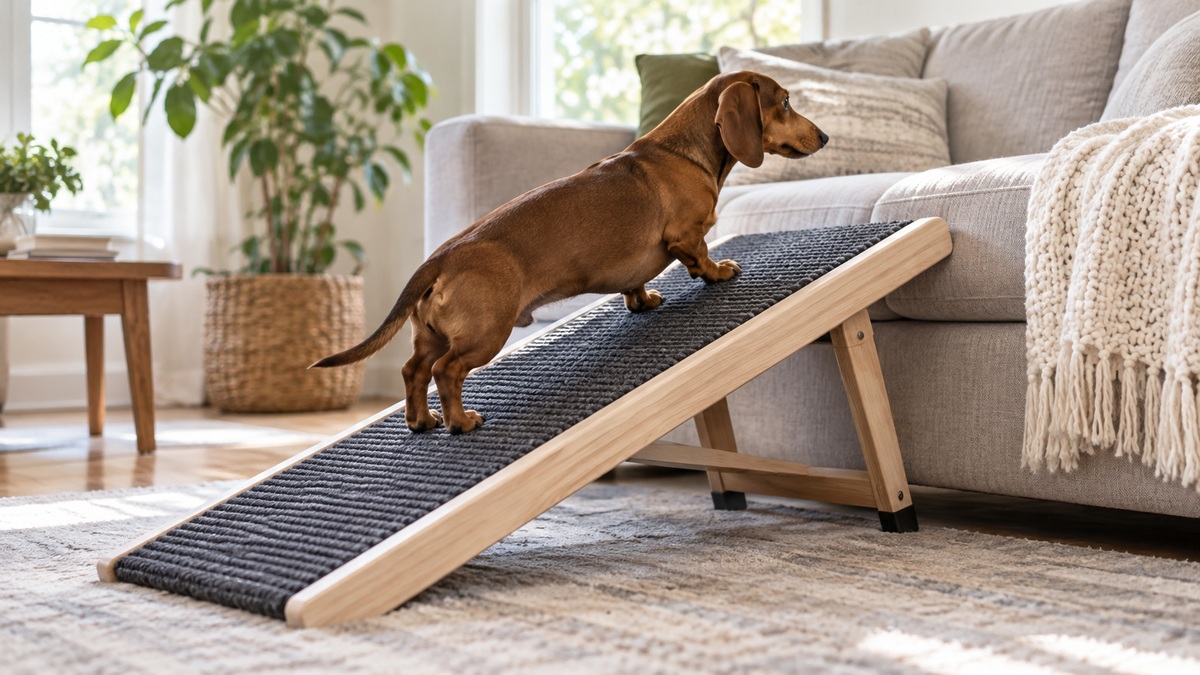
The best dog ramp for dachshunds is the one that matches your furniture height and lets your dog climb with a gentle slope instead of a jump. The veterinary sources we opened say dogs at risk of disc problems should not be allowed to jump from furniture, and that steps or ramps help them get on and off furniture safely. Below are ten ramp listings from the first page of Amazon results that name dachshunds, short-legged dogs or low body types. We compare them by the heights, inclines and weight figures printed in each listing, and we explain what the sources do and do not support.
Quick answer
- Measure the height from the floor to the top of your couch or bed before you shop. Most of these listings offer only a few fixed height settings, so the closest setting matters more than the maximum.
- Look for a gentle incline and a non-slip surface. The Vet Neurology Chesapeake post says pet stairs next to the bed or sofa will help limit jumping, which is the goal the sources describe.
- Prefer a listing whose own bullets name dachshunds, corgis or short-legged dogs. The ten picks below meet that rule, and their bullets are the basis for each card.
- Do not treat a ramp as protection against disc disease. None of the sources we opened shows that ramps prevent it, and the Dachshund Health UK survey reports an association, not cause and effect.
What the sources say about dachshunds and jumping
The Animal Medical Center page covers intervertebral disc disease, or IVDD, and says it is most common in certain breeds. It says IVDD can occur in any type of dog, but it is most common in a list of breeds that includes Corgis and Dachshunds. It also explains the body type behind that risk: the disease occurs mainly in chondrodystrophic breeds, which are the dogs with the long back and short legs. For a dachshund owner, that describes the dog in front of you, which is why the access question matters.
The same page gives the most direct guidance for furniture. It says that because discs are the shock absorbers of the spine, at-risk dogs should not be allowed to run on stairs or jump from furniture or high places. It then says doggie steps or ramps are recommended to help these dogs get on and off furniture safely. That sentence is the reason this article focuses on ramps for furniture access rather than on stairs. It also lists reluctance to jump up or go down stairs among the signs of IVDD, so a dog that starts hesitating at the couch deserves a veterinary visit.
The Vet Neurology Chesapeake post is written for owners of dogs already diagnosed with IVDD, and it is blunter. It says not to allow your dog to jump, especially on or off furniture or into or out of cars. It adds that placing pet stairs next to the bed or sofa will help limit jumping, as will a ramp or step into the car. It also advises avoiding stairs apart from pet steps and says baby gates can block stairs. Those are instructions for dogs with a diagnosis, so a healthy dachshund may not need the same restrictions, and the post does not say so.
The Dachshund Health UK page gives the most complicated evidence. Its survey found that dachshunds over age 3 that were allowed to jump on and off furniture every day had lower odds of IVDD than those not allowed to do this. The same survey found lower odds for dachshunds allowed to use a flight of stairs every day. The authors add that this should not be taken as a cause and effect association. The page also says dogs already diagnosed with disc degeneration or an IVDD episode face a higher risk of further injury if they jump off furniture, and that sudden shocks from jumping down put extra stress on a dog’s spine.
What this means in practice is narrower than a headline. The sources agree that jumping from furniture is the risk to manage, and that ramps or steps are the recommended way to reach a bed or sofa. They do not agree on whether a healthy adult dachshund needs to avoid furniture altogether. For a dachshund with any back history, the safest step is to ask your veterinarian which access method fits your dog before you buy.
Height, slope and surface in the listings
A dachshund ramp has three numbers that matter: the height settings, the incline, and the width of the walking surface. The listings print the first two in different ways, so it helps to read them side by side. The Careov bullets give three settings of 4.53, 5.51 and 5.91 inches, and they say the incline changes with each one, from 22 degrees at the lowest setting to 30 degrees at the highest. Those are the listing’s own figures, and they show that a higher setting makes a steeper climb.
The Znnam listing takes a different approach. Its title gives a 40-inch length and its bullets describe four height settings of 14, 16, 18 and 20 inches for low furniture, with a slope of 19 to 27 degrees across its adjustable range. The same bullets describe a 16-inch wide surface and a 4-inch top platform, which gives a dachshund a place to pause before stepping onto the bed. The bullets mention both 40 and 39 inches for the length, so we report the figure as about 40 inches and leave the exact number to the product page.
The Gdsshuhung listing has six settings, and they make a useful spacing example. Its bullets list 9, 11.4, 13.4, 15.4, 16.9 and 18.5 inches. The range from the lowest to the highest setting is 9.5 inches, and the steps between neighboring settings run from about 1.5 to 2.4 inches. If your couch sits between two settings, a closer step is usually easier to match. That is arithmetic on the printed figures, not a claim about how any dog will handle the slope.
The Ulyfaxy two-pack uses lower heights, 4.5, 5.5 and 5.9 inches. Its bullets are mainly about stairs and steps, and they say the tread depth must be over 10 inches for the ramp to sit securely. That matters for placement. A ramp that has to rest on a stair edge needs a deep enough tread, and a listing that spells out the tread depth is giving you a fit check before you buy.
The surface details are similar across the group. Several listings describe a non-slip carpet, a felt or fabric covering, or a textured silicone layer, and some mention anti-slip pads on the base. The bullets say these details help paws grip. We did not verify grip in any source, so treat the surface wording as the listing’s description rather than a measured result.
Stairs and ramps are different products
Many of the listings call themselves dog stairs or pet steps and use the word ramp in the title as well. In a dachshund context, the difference matters. The AMC page says at-risk dogs should not be allowed to run on stairs, so the stair climbing that a home staircase asks for is the part to avoid. A pet step set beside a bed is a different use: it reduces a jump. That is why the listings we picked are described as furniture ramps, and why the stair-style products appear only where their bullets say they help a dog reach a bed or sofa.
Several listings in this group describe a stair or step set with multiple levels. Those can suit a dog that needs a platform to climb in stages, but the sources we opened do not show that stepping is better than a continuous incline. The Dachshund Health UK survey itself treats stairs and furniture jumps as separate exposures. We do not claim that a stepped set reduces disc risk, and we do not claim that it increases it.
Dachshund-named ramps and the dogs each listing names
The table below lists the figures that appear in each listing’s title or bullets, and the dogs the listing names. A dash means the listing did not state that figure in the copy we read.
| Listing | Height settings in the listing | Weight figure in the listing | Dogs the listing names |
|---|---|---|---|
| Artpet | 10, 13.7, 16.3 and 18 inches | Up to 35 lbs in the bullets | Dachshunds, French Bulldogs, Corgis and Beagles |
| Ulyfaxy two-pack | 4.5, 5.5 and 5.9 inches | 100 lb capacity in the title only | Dachshunds, short-legged and aging dogs |
| Znnam | 14, 16, 18 and 20 inches | Load 200 lbs in the title | Dachshunds, Corgis, small senior dogs |
| Careov two-pack | 4.53, 5.51 and 5.91 inches | Up to 50 kg, about 110 lbs, in the bullets | Short-legged pets; the title names Corgis and Dachshunds |
| Pawaboo | 9.8, 13.8, 16.5, 18.5 and 20.5 inches | None stated | Short-legged and small breed dogs |
| SweetBin | 12, 15, 17.6 and 20 inches | Up to 60 lbs in the title only | Small dogs with short legs |
| Cipherwest | None stated | None stated | Small dogs, puppies, short-legged breeds |
| iPetba | 13.6 to 21 inches, four settings | None stated as a dog limit | Dachshunds, French Bulldogs, Shih Tzus |
| Oueand | Continuous 25 degree incline; 16 inches high in the title | None stated | Small, senior, short-legged and limited-mobility dogs |
| Gdsshuhung | 9, 11.4, 13.4, 15.4, 16.9 and 18.5 inches | None stated | Dachshund ramp for short-legged or smaller breeds |
The table shows where the figures are thin. Five listings give a weight figure, and three of those figures sit in the title rather than the bullets. If your dog is near a weight limit, check the product page before you order, because the bullets we read do not confirm one for most of these listings.
Our picks
1. Dog Ramp for Small Dogs, Adjustable Wooden Dachshund Ramp for Couch (Dachshund-named ramp with four height settings)
Pros
- Title and bullets name Dachshunds, French Bulldogs, Corgis and Beagles as intended dogs
- Bullets list four height settings from 10 to 18 inches
Cons
- The bullets set a 35 lb figure, so check your dog's weight against it
Best for: Owners who want a dachshund-named ramp for a couch, bed or windowsill.
Skip if: Your dog weighs more than the 35 lb figure in the bullets.
View on Amazon (affiliate link)
2. 2 Pack Dog Ramp for Stairs – Adjustable Foldable Wooden Small Dog Ramp & Dachshund Ramp,Pet Ramp (Two-pack with a dachshund ramp label)
Pros
- Title and bullets name dachshunds and short-legged dogs
- Bullets place the two ramps at a couch, a bed and a back door
Cons
- The bullets say the tread depth must be over 10 inches for a stable fit
Best for: Owners who want two ramps for steps or a couch in different rooms.
Skip if: Your stair or furniture edge is shallower than the 10-inch tread depth in the listing.
View on Amazon (affiliate link)
3. 40″ Dog Ramp for Couch & Low Bed – Extra Wide 16” Non-Slip Walking Surface, Load 200 lbs (Long low-incline ramp with a 4-inch platform)
Pros
- Bullets name dachshunds, wiener dogs and corgis and describe a 4-inch top platform
- Bullets describe four height settings for low sofas and beds
Cons
- Bullets give 40 inches in one place and 39 inches in another, so confirm the length before you buy
Best for: Owners of long-backed dogs who want a wide, gentle incline onto a bed or sofa.
Skip if: You need the exact length for a tight space, because the listing gives two figures.
View on Amazon (affiliate link)
4. 2 Pack Adjustable Dog Ramp for Stairs for Small Dogs, Senior Dogs, Short-Legged Breeds, Non-Slip (Stair-ramp pair with three heights)
Pros
- Title names Corgis and Dachshunds and bullets describe short-legged pets
- Bullets give a weight capacity of up to 50 kg, or about 110 lbs
Cons
- Bullets say the incline rises with height, reaching 30 degrees at the top setting
Best for: Short-legged dogs that need a low setting on steps or a sofa.
Skip if: You want a platform top or a wider surface, since the bullets describe a stair wedge.
View on Amazon (affiliate link)
5. Pawaboo 2026 Upgraded Small Dog Ramp for Couch Foldable, 5 Ajustable Height (Foldable couch ramp with five heights)
Pros
- Bullets name short-legged and small breed dogs as the intended users
- Five heights from 9.8 to 20.5 inches are listed for couches and beds
Cons
- The bullets do not state a weight limit, so check the product page for a larger dachshund
Best for: Short-legged dogs using a sofa or a low bed.
Skip if: Your dog needs a stated weight rating, since none appears in the bullets we read.
View on Amazon (affiliate link)
6. 2026 Upgraded Dog Ramp for Couch – Foldable Small Dog Ramp for Bed – 4 Adjustable Height from 12″ (Four-height ramp that folds for car trunks)
Pros
- Bullets name small dogs with short legs and injured or senior dogs
- Four heights from 12 to 20 inches and a folded size of 12.5 by 16.54 inches
Cons
- The up to 60 lb figure appears in the title only, not in the bullets we read
Best for: Owners who want a low-bed or couch ramp that folds small for storage.
Skip if: You need the 60 lb limit confirmed in the bullets before buying, since only the title states it.
View on Amazon (affiliate link)
7. Small Dog Ramp for Couch & Low Bed, Wooden Pet Ramp with Non-Slip Carpet Surface, Portable Indoor (Low-profile ramp for a couch and low bed)
Pros
- Bullets name short-legged breeds and recovering dogs as intended users
- Carry handle and carpet surface are described in the bullets
Cons
- The bullets give no height settings or weight limit, so measure the furniture carefully
Best for: Indoor use on low couches and low beds for small dogs.
Skip if: Your dog is a large breed, because the bullets say the ramp is not intended for large breed dogs.
View on Amazon (affiliate link)
8. Small Dog Ramp for Couch, Joint & Spine Support, Anti-Slip, Foldable (Four-height ramp that names Dachshunds)
Pros
- Bullets list Dachshunds, French Bulldogs and Shih Tzus as ideal users
- Four settings from 13.6 to 21 inches, with lower settings for shorter-leg breeds
Cons
- The bullets describe joint and spine support, which our sources do not verify for this ramp
Best for: Dachshund owners who want a lower setting for a short-legged dog.
Skip if: You need joint or spine wording backed by a source, since that part is the listing's own description.
View on Amazon (affiliate link)
9. Dog Ramp for Couch and Bed, 16″ High Foldable 2-in-1 Dog Ramp Ottoman, Solid Wood Frame (Ramp that folds into an ottoman)
Pros
- Bullets describe a continuous 25 degree incline for small, senior and short-legged dogs
- Bullets say it folds back into an ottoman or footrest when not in use
Cons
- The bullets describe one fixed height, which the title gives as 16 inches
Best for: Owners who want a ramp that doubles as living room furniture.
Skip if: Your couch or bed is far from 16 inches high, since the title gives one height only.
View on Amazon (affiliate link)
10. Dog Ramps for Small Dogs, 6-Level Adjustable Wooden Pet Ramp (Six-height wooden ramp with a dachshund label)
Pros
- Bullets call it a dachshund ramp and puppy ramp for short-legged or smaller breeds
- Six heights from 9 to 18.5 inches and a carrying handle
Cons
- Bullets give no weight rating, so check the product page for your dog's weight
Best for: Owners who need several height settings for different pieces of furniture.
Skip if: Your dog's weight is a major factor, because no weight rating appears in the bullets.
View on Amazon (affiliate link)
How we chose
We started from the first page of Amazon results for the keyword. We skipped sponsored copies when a non-sponsored copy of the same product was also on the page. We then kept listings whose bullets or titles name a body type the sources describe as the reason for a ramp: dachshunds, corgis, short-legged dogs, or low-profile use for a small dog. Ten listings met that rule on page one, so we did not load page two, and we kept no more than ten.
We did not keep every listing that says small dog. Some titles say small dog ramp but their bullets describe only size, senior use or general mobility. One listing names corgis and French bulldogs as examples in one bullet, while its title and other bullets describe small and medium dogs. We left that listing out because the body-type match is weaker than in the ten picks. We also did not open the car and truck ramp listings, because their titles describe vehicle use rather than a dachshund’s body type.
Where a title and the bullets disagreed, we used the bullets, as this article’s rules require, and we said so in the card or in the section above. Prices, ratings, review counts, sales and sales rank were not recorded for any listing. The only data stored for each product is its ASIN, title, brand, bullets and link.
What we could not verify
- Whether a ramp lowers IVDD risk. No source we opened tests ramps against disc disease. The Dachshund Health UK survey reports lower odds for dachshunds that jump on and off furniture, and it says that is not a cause and effect association.
- The 28 degree figure. The Znnam bullets say the incline stays below a 28 degree threshold recommended by vets. Our sources do not state that figure, so we do not use it.
- The Znnam length. The title says 40 inches, and one bullet says a 39-inch length. We report both and do not choose one.
- The Ulyfaxy weight rating. The 100 lb capacity appears in the title only. The bullets we read do not repeat it.
- The SweetBin and Oueand dimensions. The 60 lb figure and the 16-inch height come from the titles, and we did not find them repeated in the bullets.
- The Careov naming. The title names Corgis and Dachshunds, while the bullets describe small dogs and short-legged pets. The bullets also say the ramp helps prevent stair-related injuries, which we do not verify.
- The Artpet safety statement. The bullets say the ramp is independently safety tested to a 35 lb figure. We did not verify that testing.
- Joint and spine claims. The Pawaboo, Cipherwest, iPetba and SweetBin bullets describe joint or spine benefits. Our sources do not show that any ramp supports joints.
- Your dog’s own history. The survey covers dachshunds over age 3, and the veterinary pages address dogs at risk or already diagnosed. Your dog’s age, weight and back history are not in any listing, and they matter most.
Mistakes to avoid
The most documented mistake is letting an at-risk dog run on stairs. The AMC page says at-risk dogs should not be allowed to run on stairs, and it recommends steps or ramps for furniture access instead. A dachshund that climbs a full staircase every day is in a different situation from one that uses a short ramp to reach a sofa.
The second mistake is jumping down. The Dachshund Health UK page says sudden shocks from jumping down put extra stress on a dog’s spine. A ramp gives a way down, and it can prevent that jump, but it only works if the dog uses it.
The third mistake is buying by the label instead of the furniture. Measure the top of the bed or couch, then compare that figure to the listed settings. A setting that is too low leaves the dog climbing a steep edge, and a setting that is too high takes away the gentle incline the listings describe.
The fourth mistake is ignoring the fit note. The Ulyfaxy bullets say the tread depth must be over 10 inches for that ramp to sit securely on stairs. Skipping that check can leave a ramp that slides or rocks, and the listing’s own warning is the place to start.
Choosing for your dachshund
Start with the question the veterinary pages answer: is your dog at risk, or has it had a back problem? If the answer is yes, ask your veterinarian which access method to use, and treat any ramp as a way to avoid jumping rather than a treatment. If the answer is no, measure your furniture, pick the closest height setting, and choose a listing whose bullets name dachshunds, corgis or short-legged dogs.
The rest of your setup matters too. If you also need a harness for the walk to the ramp, our guide to plush no choke air mesh dachshund harnesses covers that choice. If you want a resting spot at floor height rather than on the couch, our guide to an orthopedic memory foam dog bed covers that option.
FAQ
Will a ramp prevent back problems in my dachshund?
None of the sources we opened shows that a ramp prevents disc disease. The veterinary pages recommend steps or ramps for getting on and off furniture, and they advise keeping at-risk dogs from jumping. The Dachshund Health UK survey reports lower odds of IVDD for dachshunds that jump on furniture daily, but it says that is not a cause and effect association. A ramp is a way to reduce jumping, not a treatment.
Is it okay for my dachshund to use stairs?
The Animal Medical Center page says at-risk dogs should not be allowed to run on stairs. The Dachshund Health UK survey also reports lower odds of IVDD for dachshunds that use stairs every day, with the same caveat about cause and effect. The sources do not give a single answer for every dog, so ask your veterinarian before you allow stair use, especially for a dog with a back history.
How high should a dachshund ramp be?
Match the ramp to the top of the surface you want your dog to reach. The listings give settings from about 4.5 inches on the stair ramps to about 21 inches on the couch ramps. Measure your bed or sofa from the floor, then choose the closest listed setting. If you are between two settings, the lower one is usually the gentler climb, and the listing’s own incline figures show how much slope each setting adds.
Should I buy a ramp labeled for small dogs or one labeled for dachshunds?
Read the bullets rather than the title. A dachshund label in a title is useful only if the bullets also describe low or long-bodied dogs. Several small dog ramps describe size, senior use or general mobility, and they do not name a body type. The ten picks here name dachshunds, corgis, short-legged dogs or small dogs with short legs in their bullets.
What if my dachshund will not use the ramp?
The sources we opened do not cover training. The Animal Medical Center page does list reluctance to jump up or go down stairs among the signs of IVDD, so a dog that suddenly avoids the ramp or the couch should be checked by a veterinarian rather than encouraged with force. Try a lower setting first, and stop if your dog shows pain or weakness, then call a veterinarian.
Do these ramps support joints?
Some bullets say they do. Pawaboo, Cipherwest, iPetba and SweetBin describe joint or spine benefits in their listings. The sources we opened do not show that any ramp supports joints, so treat those phrases as the listing’s wording and ask your veterinarian about joint support for your dog.
Bottom line
Choose the ramp whose listed height settings match your furniture and whose bullets name dachshunds, corgis or short-legged dogs. For a dog with any back history, ask your veterinarian before you rely on a ramp, and do not let an at-risk dog run on stairs or jump from furniture.
Sources
- Animal Medical Center, Intervertebral Disc Disease (IVDD) in Dogs: https://amcny.org/pet_health_library/intervertebral-disc-disease-ivdd-in-dogs (opened 2026-10-20)
- Vet Neurology Chesapeake, 10 Things to Know After Your Dog’s IVDD Diagnosis: https://www.vetneurochesapeake.com/vnioc-blog/10-things-to-know-after-your-dogs-ivdd-diagnosis (opened 2026-10-20)
- Dachshund Health UK, Jumping and Stairs: https://www.dachshund-ivdd.uk/lifestyle-advice/jumping-stairs/ (opened 2026-10-20)