Dog Boots That Stay On: How to Fit Them and What the Listings Claim
As an Amazon Associate we earn from qualifying purchases. Details
Updated 19 October 2026 | Author: Editorial team, bestdogsstuff.com
The person typing dog boots that stay on usually wants a boot that does not slide off a dog partway through a walk. Fit decides most of that outcome. A boot that is too loose slips, and a boot that is too tight rubs and can trap moisture between the toes. This guide sets out what AKC, the ASPCA and a veterinary hospital say about why boots are used and how to fit them, then shows what eight Amazon listings state in their titles, and where those titles stop.
Quick answer
- Fit does most of the work. AKC says to “Assess whether your dog’s paws stay in the boot or if they slip out,” and to try a different size if the paws do not fit securely.
- Measure the paw and compare it with the maker’s sizing guide. The Veterinary hospital guide says to get properly fitting boots “by using the manufacturer’s sizing guidelines.”
- None of the eight titles names a closure type. Four titles use a grip or stay word, such as Anti-Slip or Stay-On. Those words are the seller’s wording, not a test result.
- Do a test run indoors before a walk, then check the paws after the first outing. The sources we opened describe that routine, and the product pages were not checked for any listing.
What boots protect against
AKC’s guide to boots lists the main reasons a dog might wear one. It says that “A pair of proper-fitting dog boots can” help prevent “weather-related conditions, such as frostbite and heat blisters”. It also lists salt and chemicals, saying boots can “Shield your dog’s paws from potentially toxic substances, including deicers and road salts”. These are the two most common reasons people buy boots: cold, and the chemicals on winter streets.
Heat is the other main reason. The ASPCA hot weather page says that “Being so close to the ground, your pooch’s body can heat up quickly, and sensitive paw pads can burn.” It also advises owners to “let dogs linger on hot asphalt when the temperature is very high.” A boot can help on hot pavement, but the page does not say a boot is a replacement for timing walks in cooler hours or for walking on grass.
Salt is the third reason, and it is easy to underestimate. The veterinary hospital guide on ice melt says that “Not only are rock salt and other salt-based deicers toxic if eaten directly off the ground or licked off paws once inside, but these deicers are also very drying to your dog’s paw pads and delicate skin between their toes.” That line supports both boots and a paw wipe after a walk.
Why boots slip off
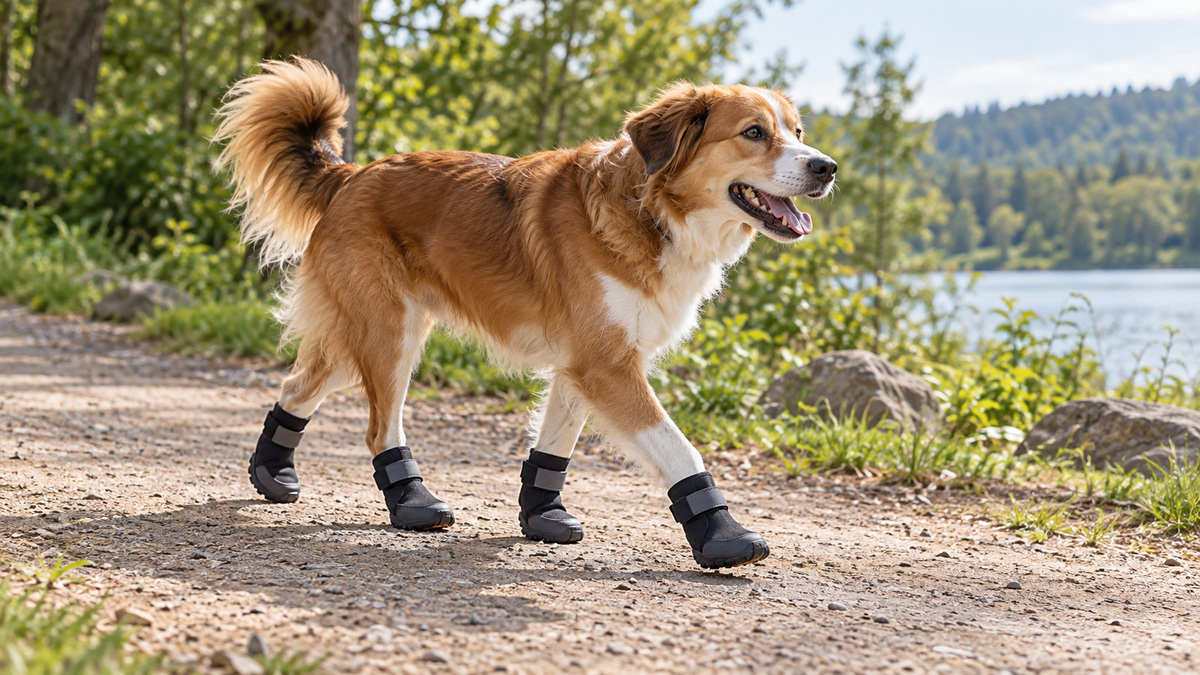
A boot slips when it is too big for the paw, when the closure is loose, or when the boot does not match the shape of the foot. The AKC guide on boots gives an indoor test for that. Once the boots arrive, the test is a short trial indoors before any walk. During that test, watch the paw. The guide says to “Assess whether your dog’s paws stay in the boot or if they slip out.”
If the paw slips, the fit is wrong, even if the closure is fastened tight. AKC is direct on that point: “If your dog’s paws don’t securely fit the boots, you may need to consider purchasing a different size.” The fix is usually a different size, not a tighter strap, because a strap pulled too tight creates a different problem.
The closure matters as well. The AKC guide explains that “Velcro helps you quickly secure the boot on your dog’s foot, while also ensuring that the item fits snugly.” A Velcro strap can be adjusted in small steps, which is useful when a paw sits between two sizes. None of the eight titles in this set names a closure type, so the closure has to be confirmed on the product page.
Measuring the paw
Measuring is the step most owners skip. AKC describes a paper method that needs only a sheet and a pen. It says, “Take a piece of paper and press your dog’s paw into the sheet.” Then comes the measurement itself: “Draw a line across the widest part of the paw tracing and measure it.” The number you get is the width of the paw at its widest point, which you compare with the maker’s sizing chart.
That method gives a width, not a size. Sizing charts are different from brand to brand, so the same paw can land on different sizes in two listings. The VCA guide says to get properly fitting boots “by using the manufacturer’s sizing guidelines,” and it adds that many stores let you try the boots on in the store or at home. If a store lets you try a pair, use that chance before buying online.
Measure both front paws if your dog’s paws are not the same. Use the larger measurement for the size you order, and check that the boot still fits the other paw. Keep the paper tracing with the order details, so the size can be compared with the chart later.
Too loose, too tight, or just right
The VCA guide describes a balance that many owners find hard. It says, “Make sure they’re easy to get on and off, but not too easy”. A boot that is too easy to get on and off may come off in a few steps. A boot that is hard to put on may be too small or the closure may be wrong. Test the boot until it goes on with a little effort and stays on through a short walk.
Tight boots create their own problems. AKC warns about moisture: “Not only is the sensation uncomfortable, but excess moisture between your dog’s toe pads can increase the likelihood of yeast infections.” That is one reason to look at the paw after every walk, not only the first one.
AKC also says the owner should watch the dog during the test. It advises to “Monitor your dog for signs of discomfort or stress when wearing boots, allowing you to intervene or make adjustments when necessary.” Signs can include limping, a dog trying to pull the boot off, or a dog that stops walking. Any of those is a reason to stop and change the fit.
Traction and the sole
A boot that stays on can still slip on the ground if the sole is smooth. AKC’s guide on boots notes that “As noted, soles with grooves offer greater traction on uneven pavement and rocky terrain.” The sole matters most on wet paving, on packed snow and on ice, where a smooth sole can slide out from under the dog.
Moisture inside a boot is a separate problem. The AKC guide says, “You don’t want a boot that traps water.” A waterproof boot keeps the outside wet out, but if it also holds sweat or melted snow inside, the paw stays wet. Look for a boot that lets moisture out, or check the paw more often in wet weather.
A sole with grooves is a feature the product page should confirm. The eight titles in this set name some grip words, but they do not describe the tread pattern, so a traction claim in a title is not the same as a tested sole.
Getting a dog used to boots
Many dogs do not like a boot on the first try. AKC says, “It may take a little time for your dog to get used to wearing dog booties”. The advice is to start indoors, keep the first sessions short, and reward calm behavior. Some owners start with one boot, then add the second when the dog walks normally.
The VCA guide frames the choice as a question of tolerance, not a rule. It says, “Use booties if your dog will tolerate them.” If a dog will not wear a boot after a fair try, the same guide points owners to other forms of protection, such as a protective balm applied before a walk.
Keep the first outings short and on a route you know. A dog that walks a short loop in a boot can show whether the fit is right before a long walk in snow or on pavement. For walking gear that works alongside boots, see our dog harness guide for everyday wear and our no-pull harness roundup, which cover the leash side of the walk.
Salt, ice and hot pavement
Salt and deicers need care whatever the boot. The VCA guide advises, “Avoid using rock salt and other salt-based deicers on walkways around your home.” It also lists pet-safe options and warns about ingredients that are not safe: “Examples of pet-safe deicers include potassium chloride or magnesium chloride (slow but the safest) or calcium magnesium acetate (CMA).” It also warns that “Sometimes deicers even include ethylene glycol (antifreeze), which is poisonous to pets.”
The same guide suggests limiting time on ice and snow: “Limit the amount of time your dog spends in ice or snow.” A boot does not change that advice. It reduces contact with the surface, but a dog that spends a long time on salted ground still takes in more chemical than one that does not.
Heat calls for the same kind of planning. The ASPCA warns that “sensitive paw pads can burn” and that owners should not “let dogs linger on hot asphalt when the temperature is very high.” Two listings in this set name hot pavement in the title. Those titles state the use, but they do not state a temperature range, so the owner has to judge the surface.
Paw checks after every walk
A boot is one part of paw care. AKC’s guide on cleaning paws says, “Cleaning your dog’s paws is a great opportunity to check for cuts, scrapes, or dry and cracking pads.” It also says that “salt and dirt can accumulate between your dog’s toes”. The VCA guide adds that owners should, “After walking your dog in the winter, clean their paws.” It describes protective balms as a way to get “a protective barrier between the paw pads and the salt-covered sidewalks.”
Use the paw check as the last step of every walk. Look between the toes, along the pads and under the nail. If the boot leaves a red line, a patch of moisture or a mark on the skin, adjust the fit before the next outing.
What the eight titles state
The eight listings come from one Amazon search. The table below shows only the words in each title. It does not add any claim the title does not make. The listing names are short forms, and the product page was not checked for any of them.
| Listing (short name) | Dog size in title | Weather or surface in title | Grip or stay word | Design word in title |
|---|---|---|---|---|
| Dimicoo winter boots | Small, medium and large | Winter | Anti-Slip | Reflective |
| Suspender boots, anti lost | Small, medium and large | None | Anti Lost | Suspender |
| Hardwood and hot pavement boots | Large and medium | Hardwood floors and hot pavement | None | Paw protectors |
| Stay-On waterproof boots | Small and medium | Waterproof | Stay-On | Paw protectors |
| Canada Pooch suspender boots | Size 4 only | None | None | Suspender |
| Hot pavement and snow booties | Medium to large | Hot pavement and snow | None | Booties |
| Winter snow waterproof boots | Not stated | Winter, snow and waterproof | None | Fleece lining |
| Non-slip suspender boots | Small and medium | Waterproof | Non-Slip | Suspender |
Several patterns show up in the table, and the arithmetic below uses only the titles.
Four of the eight titles use a grip or stay word, namely Anti-Slip, Anti Lost, Stay-On and Non-Slip. That is half of the set: 4 ÷ 8 = 0.5. A grip word is a claim, and the title does not explain how the boot achieves it.
Two of the eight titles name all three dog sizes, small, medium and large. Those are the Dimicoo winter boots and the suspender boots with anti lost. That is a quarter of the set: 2 ÷ 8 = 0.25. The other titles name one or two sizes, or give a single size number, or give none.
Three titles name snow or winter use. That is the Dimicoo winter boots, the hot pavement and snow booties, and the winter snow waterproof boots: 3 ÷ 8 = 0.375. Two titles name hot pavement, and both are for medium or larger dogs.
No title names a closure type, such as Velcro, a buckle or a strap. That is zero of eight: 0 ÷ 8 = 0. The closure is the single most important fit feature in the set, so it has to be confirmed on the product page before you buy.
1. Dimicoo Dog Shoes, Waterproof Dog Boots for Winter, Anti-Slip Dog Snow Booties for Large Small (Dimicoo winter boots, waterproof, anti-slip, reflective)
Pros
- The title names anti-slip booties and waterproof boots for winter in one listing.
- The title says reflective, which may help a walker see the dog in low light.
Cons
- The title lists large, small and medium dogs but gives no size chart or paw measure.
- The title does not name a closure, so the fastening must be checked before buying.
Best for: A winter walker who wants waterproof, reflective and anti-slip features in one set.
Skip if: You cannot measure your dog's paw against a size chart before ordering.
View on Amazon (affiliate link)
2. Dog Suspender Boots Waterproof for Small Medium Large Dogs, Anti Lost (Suspender waterproof boots, anti lost, all three sizes)
Pros
- The title names small, medium and large dogs, one of two listings that names all three.
- The title says waterproof, which suits wet walks and slushy streets.
Cons
- The title does not say how the boot closes or how it fastens to the leg.
- The title uses anti lost, which the title does not explain, so the claim needs the product page.
Best for: A buyer who wants a waterproof suspender-style boot for a dog of any size and will check the design first.
Skip if: You need the closure or a size chart stated before you order.
View on Amazon (affiliate link)
3. Dog Boots for Large Dogs, Medium Dog Boots and Paw Protectors for Hardwood Floors, Outdoor Dog (Hardwood floor and hot pavement boots for large and medium dogs)
Pros
- The title names two surfaces, hot pavement and hardwood floors, so its uses are stated.
- The title covers large and medium dogs, which is a clear size range.
Cons
- The title does not say which of the two surfaces the boot is built for.
- The title does not name a sole type, so traction on wet ground is unknown.
Best for: A buyer who wants one boot for hot pavement and for indoor use on hardwood.
Skip if: You need a boot built for snow, ice or road salt.
View on Amazon (affiliate link)
4. Waterproof Dog Boots for Small and Medium Dogs, Stay-On Paw Protectors (Stay-On waterproof paw protectors for small and medium dogs)
Pros
- The title uses the words stay-on paw protectors, the only listing in this set that does so.
- The title says waterproof and gives a small and medium size range.
Cons
- The stay-on claim is the seller's wording, and the title does not explain how the boot stays on.
- The title gives no size chart, so the paw fit must be checked before buying.
Best for: A small or medium dog owner who wants a waterproof boot with a stay-on claim in the title.
Skip if: Your dog is large, or you need the fastening method stated before ordering.
View on Amazon (affiliate link)
5. Canada Pooch Dog Suspender Boots and Paw Protectors, Black, Size 4 (Canada Pooch suspender boots, black, size 4)
Pros
- The title gives a size, Size 4, and a color, black, which the other listings do not state.
- The title names a brand, Canada Pooch, so the maker can be looked up.
Cons
- The title does not say which dog weight or paw length Size 4 fits.
- The title says suspender but does not explain the strap design.
Best for: A buyer who wants a named brand and a stated size in one listing.
Skip if: Your dog's paw measure does not match Size 4 on the maker's chart, which the title does not show.
View on Amazon (affiliate link)
6. XSY and G Dog Shoes for Hot Pavement, Dog Snow Booties for Medium to Large Dogs (Hot pavement and snow booties for medium to large dogs)
Pros
- The title covers both hot pavement and snow in one listing.
- The title names a medium to large size range.
Cons
- The title does not give a sole type, so the grip on wet ground is not stated.
- The title does not name a fastening method for the boot.
Best for: A medium or large dog owner who wants one boot for summer pavement and winter snow.
Skip if: Your dog is small, or you need the fastening described before buying.
View on Amazon (affiliate link)
7. Dog Shoes for Winter Snow Waterproof Dog Boots with Fleece Lining (Winter snow waterproof boots with fleece lining)
Pros
- The title names a fleece lining, a warmth feature, and waterproof boots for snow.
- The title names winter snow use, which fits cold and wet walks.
Cons
- The title does not give a size range or a size chart.
- The title does not say how the boot closes.
Best for: A walker in cold, wet conditions who wants a lined boot.
Skip if: You need a boot for hot pavement or summer walks.
View on Amazon (affiliate link)
8. Waterproof Dog Suspender Boots Non-Slip for Small Medium Dogs (Non-slip waterproof suspender boots for small and medium dogs)
Pros
- The title names non-slip and waterproof, two traction and moisture features in one listing.
- The title gives a small and medium size range.
Cons
- The title uses suspender but does not describe the strap design.
- The title does not give a size chart, so fit must be checked before buying.
Best for: A small or medium dog owner who wants a non-slip, waterproof boot.
Skip if: Your dog is large or you need a stated closure before ordering.
View on Amazon (affiliate link)
How we chose
We started from the question a dog owner types, which is how to get boots that stay on. We put the fit and safety guidance first, because a boot that does not stay on fails whatever its title claims. We then turned to the eight listings that came up in one Amazon search and read only the words those titles state.
We opened four sources in this batch and kept only the sentences we could match word for word in the saved page text. Two are AKC pages, one on cleaning and caring for a dog’s paws and one on boots. The third is the ASPCA hot weather safety page. The fourth is a veterinary hospital guide on keeping a dog’s paws safe in winter and on ice melt. We did not use a retailer guide or a product blog as a source for any fit or safety claim.
We kept all eight listings as picks. Each pick has a use from its own title and a skip rule. We did not add or remove any listing from the set.
What we could not verify
- Whether any listing stays on a dog during a walk. The titles say anti-slip, anti lost, stay-on or non-slip, but the product page was not checked, and the sources we opened do not test any boot.
- The closure type for every listing. No title names one, so the fastening must be checked on the product page.
- The size chart for any listing. The titles give size ranges or one size number, but not a chart, and the product page was not checked.
- The sole pattern and traction on wet or icy ground. The titles name grip words but not the tread.
- How any boot performs in heat. The ASPCA page warns about hot asphalt, but it does not say how a boot affects paw temperature.
- Breed or paw-shape fit. The sources we opened do not cover breed-specific fit, so the paper measure is the only fit method described here.
- Whether a boot is safe for a dog with a skin condition, an injury or a medical history. Ask your veterinarian before using a boot on an injured or sensitive paw.
- Stock or current availability of any listing. This post uses only the title words and the brand names in the data we used.
FAQ
How do I know if dog boots fit well enough to stay on?
Do a test run indoors. AKC says to watch whether the paws “stay in the boot or if they slip out.” If a paw slips, try a different size. A good fit lets the dog walk normally, does not leave red marks when the boot comes off, and stays on through a short walk.
What size dog boot should I buy if my dog is between sizes?
Measure the paw with the paper method AKC describes, then compare the width with the maker’s sizing chart. If the paw sits between two sizes, the VCA guide’s advice to use the manufacturer’s sizing guidelines still applies, and a store try-on is the best check if one is available. Keep in mind that sizing differs by brand, so a size in one listing may not match another.
Are boots better than paw balm for salt?
The sources we opened do not rank them. AKC describes boots as a way to shield paws from road salt and deicers, and VCA lists protective balms as a way to create a barrier. VCA says to use boots “if your dog will tolerate them,” so the choice depends on the dog. In either case, wipe the paws after the walk, because the VCA guide says to clean the paws after a winter walk.
Can dog boots prevent burns on hot pavement?
Boots can help protect the paw from the surface, but the ASPCA page is clear about the risk. It says “sensitive paw pads can burn” and advises owners not to “let dogs linger on hot asphalt when the temperature is very high.” Walk in cooler hours, stay on grass when you can, and check the surface before the walk.
What should I check on a dog’s paws after a boot walk?
Check between the toes, the pads and under the nails. AKC lists cuts, scrapes, and dry or cracking pads as signs to look for, and it notes that “salt and dirt can accumulate between your dog’s toes.” If you see redness, moisture trapped between the toes, or a sore spot, change the fit or give the paws a rest, and ask your veterinarian if the skin does not recover.
Bottom line
Fit before the walk. Measure the paw, test the boot indoors, and check the paw after the first outing. A title that says stay-on or anti-slip is a claim to confirm, not a fact to rely on, so check the closure and size chart on the product page before you buy.
Sources
- AKC, How to Clean and Care for Your Dog’s Paws: dog booties as an easy way to protect paws; it may take time to get used to booties; cleaning the paws is a chance to check for cuts and dry pads; salt and dirt accumulate between toes
- AKC, Best Dog Boots for Any Weather: proper-fitting boots prevent frostbite and heat blisters and shield paws from deicers and road salts; paper measuring method; test run indoors; fit and slipping; closures; soles with grooves; moisture between toes; monitoring discomfort
- ASPCA, Hot Weather Safety Tips: sensitive paw pads can burn; avoid letting dogs linger on hot asphalt when it is very hot
- VCA Animal Hospitals, How To Keep Your Dog’s Paws Safe In Winter: avoid rock salt and salt-based deicers; pet-safe deicer examples; ethylene glycol warning; limit time in ice and snow; use booties if the dog will tolerate them; properly fitting boots and sizing guidelines; protective balms; clean paws after walks