Best Dog Leash Coupler: Four Listings Compared for Two Dogs
As an Amazon Associate we earn from qualifying purchases. Details
The best dog leash coupler for two dogs is the one whose listed size range and clip fit both dogs, and only if both dogs already walk well together. A coupler, also called a double dog leash, splits one handle into two lines so each dog has its own clip. This guide compares four listings from four brands. It uses only the sizes, lengths, weights and clips each listing states, plus the walking advice from the sources we opened, and it shows where the listings disagree.
Quick answer
- Use a coupler only with two dogs that know each other and keep a similar pace. AKC’s walking guide quotes trainer Kelly Citrin on this point.
- Be very careful with a dog that pulls. Avoid a coupler altogether if either dog barks, lunges, growls, stares or snarls on walks, or if the two dogs do not get along.
- Check the size before you order. Caldwell’s title names medium or large dogs, while its bullets describe small dogs, and Taglory’s bullets give a 10 to 50 pound range.
- Confirm the handle. The Taglory bullets say its main leash handle is not included, so you need your own everyday leash for it.
What a coupler does
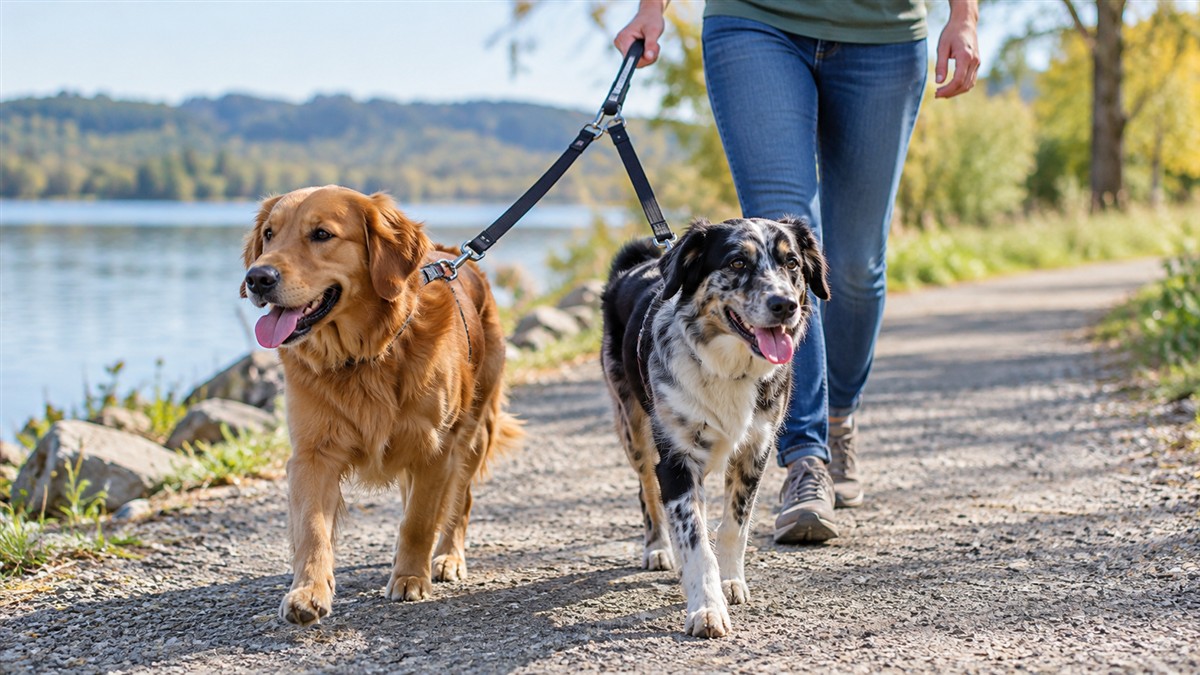
A coupler is a double dog leash. AKC describes it as a way to walk two dogs at once: you hold one handle, and the leash splits into two lines at the bottom so each dog has its own section. The appeal is that you hold one handle instead of two, and the dogs are not on two separate leashes that can cross and twist. AKC says a double leash can make walking two dogs more accessible for that reason.
The listings make a stronger version of the same claim. The STGOOD bullets say its heavy-duty swivel clips are good for avoiding tangles. The Caldwell’s bullets describe a zero tangle design, and the Taglory bullets say its swivel hardware adjusts to prevent crossing and tangling. These are listing claims. The sources we opened do not say that any of these four products prevents tangles, and they do not examine these products at all.
AKC’s guidance is about the dogs as much as the hardware. It says some owners use couplers to keep dogs of similar sizes and energy levels walking side by side. The trainer quoted in the walking guide ties their use to how well the dogs know each other and how closely their pace matches. If you want a hands-free set-up for a single dog instead, our bike-riding leash guide covers a different use.
When a coupler suits two dogs
AKC and the expert it quotes give several conditions. Treat each one as a check before you look at a listing.
They know each other. AKC’s walking guide quotes Kelly Citrin, a certified dog trainer, saying a single handler should never walk two dogs who do not know each other. The guide recommends letting the dogs meet, play off leash and have varied experiences together before you ask them to walk on leash side by side.
They keep a similar pace. The same guide says a coupler works only with dogs that know each other well and keep a similar pace. It also advises going only as fast as the slowest dog on the walk, and working up to your ideal pace gradually.
They are similar in size and energy. AKC says couplers are used to keep dogs of similar sizes and energy levels walking side by side. That is a narrower test than the size wording on most listings, and it is the test to apply first.
Each dog walks on a loose leash alone first. The double-leash article says that before you use one, you should teach each dog a strong foundation in loose leash walking. The expert quoted there, Lane, also recommends regular one-on-one walks even for dogs that enjoy a double leash, so you can notice changes in each dog’s posture, movement or behavior.
Their walking styles match. The same article gives an example: a dog that likes to zip around and another that meanders are not good candidates for a coupler. Lane recommends walking two dogs together only when they enjoy the same walking activities.
Size is where the listings and the AKC guidance differ. STGOOD’s bullets say its coupler is great for small, medium and large dogs, and even puppies. Taglory’s title says small and medium dogs, and its bullets give a 10 to 50 pound range. AKC’s guidance points to dogs of similar size. A pair whose sizes sit at the edges of one of these ranges needs a closer look, and the listing wording alone does not settle it. None of the four bullet sets says whether the two dogs must know each other or keep a similar pace, so those checks fall to you.
When a coupler does not suit two dogs
AKC lists situations where the sources advise against a double leash. Each one is a reason to skip a coupler, whatever the listing says.
A dog that pulls. AKC says double leashes should be used with extreme caution with dogs who pull on leash, even if they are small. It calls this a safety issue that could result in you getting hurt. The same article asks owners to consider a pair in which one dog pulls one way and the other pulls the other way. AKC’s walking guide adds that no-pull (front-hook) harnesses and headcollars are two options that can help a dog that pulls, especially when you walk more than one dog. If a pulling dog is your concern, our PetSafe no-pull harness guide covers that product type.
A reactive dog. If either dog barks, lunges, growls, stares or snarls on walks, AKC advises avoiding double leashes. A reactive dog can rile up the other dog, and the reaction can spread across the coupler.
Dogs that do not get along. AKC says to avoid double leashes with dogs who do not get along or only tolerate each other. It explains that on a double leash the two dogs cannot move away from each other, and that can make them fight when they would not otherwise.
Dogs that want to play. AKC notes that walking two dogs on a coupler gets difficult when they try to play with each other for the entire walk. One overexcited dog can draw the other into the same state.
Dogs without leash manners. AKC says double leashes are not appropriate for dogs who have not learned leash manners. Until the dogs understand polite walking behavior, walk them one at a time and treat each walk as a training session.
None of these cases depends only on the hardware. AKC’s expert says the level of training, the dog’s behavior and the handler’s skill level appear more important than the leash and attachment used. She still advises extra precautions for handler safety when two dogs are walked on a double leash.
Injury and tangle risks
This is where the sources matter most, so here is what each one says.
Tripping, tangling and pulling. AKC says dog walking injuries are not uncommon. They often involve the handler tripping on the dog, tripping on the leash or getting tangled in the leash. AKC cites a Journal of the American Veterinary Medical Association study that found dog-pulling behavior is the most common cause of those injuries.
How much force. The University of the District of Columbia reports a study of routine walks led by an assistant professor of mechanical engineering. A quarter of the participants experienced leash forces of 45 pounds or more, and half recorded at least 28 pounds of force during a typical walk. The UDC article does not mention couplers, so these figures describe leashes in general, not these four products.
Balance. The same study found that walking with a dog significantly increased stride-to-stride variability compared with walking alone. The article calls that variability a known risk factor for falls. The researchers stress that the goal is awareness, not alarm, and they note the sample was small. They also say no current guidelines define which dog pulling behaviors are safe, so the study does not give a safe pulling limit.
Handling. Rush University Medical Center’s hand and wrist surgeons describe severe finger and wrist fractures, dislocations and ruptured tendons from dog walking. Their advice has three parts. Do not loop the leash around your fingers or wrist, because a sudden lunge can cause a fracture before you can unwrap it. Do not put your fingers under the collar, because a jump or pull can cause twisting fractures. Do not grab for the collar to separate two dogs, because you risk fractures and bites. Rush also says a longer leash gives a dog more to pull and makes it easier to trip or get tangled.
Rush does not discuss couplers. A coupler still gives you one handle that takes the load when a dog lunges, so its handle deserves the same care as a single leash. That is our reading of the Rush advice, not a claim the surgeons make. None of these sources says a coupler prevents injuries, and none gives a limit for how much force a coupler can take.
Comparison table
Table 1 sets out what each listing states. Where a listing gives no figure, the cell says not stated. The listing data was read on 22 October 2026.
| Listing | Length or adjustment | Width | Weight (specifications) | Dog size (listing) | Clip or handle (bullets) |
|---|---|---|---|---|---|
| STGOOD No Tangle Dog Leash Coupler | 15 to 20 inches, adjustable | 1 inch | 3.88 ounces | Small, medium and large dogs, and puppies | Heavy-duty nickel-plated swivel clips; attaches to your everyday leash |
| Caldwell’s Pet Supply Co. Leash Coupler | Small 14.5 to 24.5 inches; large 15 to 24.5 inches | Not stated | 5.6 ounces | Title: medium or large dogs. Bullets: small dogs | Not stated |
| Taglory Double Dog Leash Coupler | 30 inches | 1/3 inch | 4.23 ounces | Title: small and medium dogs. Bullets: 10 to 50 pounds | Top O-ring to your leash; dual bottom clips to collars or harnesses; main leash handle not included; 360-degree swivel |
| Guardian Gear Nylon 2-Way Small Dog Coupler | Not stated in bullets; title gives 4 inches | Not stated | 1.12 ounces | Title: small dog. Bullets: not stated | Nickel-plated swivel clip |
How to read the figures. The adjustable span is the longest setting minus the shortest one. Using the figures the listings state, and labelled as our planning estimate:
- STGOOD: 20 inches minus 15 inches equals 5 inches of adjustment.
- Caldwell’s small setting: 24.5 inches minus 14.5 inches equals 10 inches of adjustment.
- Caldwell’s large setting: 24.5 inches minus 15 inches equals 9.5 inches of adjustment.
The weight figures come from the specifications, and they are close enough that weight alone will not decide the choice. Our planning estimate for the differences: 5.6 ounces minus 4.23 ounces equals 1.37 ounces between Caldwell’s and Taglory’s listings, and 4.23 ounces minus 3.88 ounces equals 0.35 ounces between Taglory’s and STGOOD’s. Taglory’s bullets cover a dog range of 50 pounds minus 10 pounds equals 40 pounds.
The table does not show how a coupler behaves when the two dogs differ in size, and it does not show how the adjustment is set on each listing. The listings do not state either point. Read the table as a list of what each page says, not as a ranking.
Product picks
Each section gives who the coupler suits, one stated strength, one limit and a Skip if line. Figures come from the listing or its specifications unless a source is named.
STGOOD No Tangle Dog Leash Coupler
Who it suits: two dogs of close size and pace, for an owner who wants nickel-plated swivel clips and 1-inch nylon straps. The bullets describe both.
Strength: the bullets give 15 to 20 inches of adjustment for each line, and they say the coupler attaches to your everyday walking leash.
Limit: the bullets say the nylon is strong enough that no dog can chew or break it. That is a listing claim. None of the sources we opened tests it, and the listing gives no weight limit.
Skip if: your two dogs differ a lot in size. The listing’s wording covers small, medium and large dogs, while AKC’s guidance points to dogs of similar size.
Caldwell’s Pet Supply Co. Leash Coupler
Who it suits: an owner who wants a stated small setting and a stated large setting, and who can confirm the dog size on the product page before buying.
Strength: the bullets give two settings, 14.5 to 24.5 inches for small dogs and 15 to 24.5 inches for large dogs. By our planning estimate, that is a 10-inch span for small dogs and a 9.5-inch span for large dogs.
Limit: the title says medium or large dogs, while the bullets describe a tangle free design for small dogs. The listing does not resolve that conflict, and the bullets name neither the clip nor the material.
Skip if: you need the clip or material named before you order, because the bullets leave both out.
Taglory Double Dog Leash Coupler
Who it suits: two dogs the title describes as small and medium, for an owner who wants a 1/3-inch braided rope with reflective threads and swivel hardware.
Strength: the bullets describe 360-degree swivel hardware, reflective threads for early morning and late evening walks, and a dog range of 10 to 50 pounds.
Limit: the main leash handle is not included, so you need your own everyday leash. The bullets say so directly.
Skip if: you want a coupler that comes with its own main handle, or your dogs fall outside the 10 to 50 pound range in the bullets.
Guardian Gear Nylon 2-Way Small Dog Coupler
Who it suits: owners of two small dogs who want a basic nylon coupler, and who are comfortable relying on the title for the size.
Strength: the specifications give 1.12 ounces, the lightest of the four, and the bullets name nickel-plated swivel clips for long-lasting use.
Limit: the listing has only three bullets. They give no size range, length or weight limit, and the 4-inch figure in the title is not explained by the specifications.
Skip if: you need an adjustment range or a dog size stated in the bullets before you buy.
1. No Tangle Dog Leash Coupler, Dual Double Dog Adjustable Splitter Lead Sturdy Walker Trainer Leash (Nickel-plated clips with a 15 to 20 inch adjustment)
Pros
- The bullets describe heavy-duty nickel-plated swivel clips
- The bullets give an adjustment from 15 to 20 inches for each line
- The bullets say the coupler attaches to your everyday walking leash
Cons
- The bullets say the nylon cannot be chewed or broken, a claim no source we opened tests
- The listing gives no weight limit and its size wording covers small, medium and large dogs
Best for: Owners of two dogs of similar size who want nickel-plated clips and 1-inch nylon straps
Skip if: Your two dogs differ a lot in size, since AKC's guidance points to similar sizes
View on Amazon (affiliate link)
2. Caldwell's Pet Supply Co. Leash Coupler, Two Dog Leash Splitter to Split Leashes for Walking 2 (Stated small and large settings with a size conflict)
Pros
- The bullets give a small setting of 14.5 to 24.5 inches
- The bullets describe a zero tangle design, which is a listing claim
- The title names a two dog leash splitter for walking two dogs
Cons
- The title says medium or large dogs while the bullets describe small dogs
- The bullets name neither the clip nor the material
Best for: An owner who wants stated settings for each size and can confirm the dog size first
Skip if: You need the clip or material named in the bullets before you order
View on Amazon (affiliate link)
3. Taglory Double Dog Leash Coupler for Two Dogs, 1/3" Lightweight Dual Leash Extension for Small (Swivel rope coupler with reflective threads)
Pros
- The bullets describe 360-degree swivel hardware on a 1/3-inch braided rope
- The bullets say the interwoven nylon has reflective threads for low-light walks
- The bullets give a dog range of 10 to 50 pounds
Cons
- The bullets say the main leash handle is not included
- The title says small and medium dogs, which does not match the 10 to 50 pound range
Best for: Owners of two small or medium dogs who want a swivel rope coupler with reflective threads
Skip if: You want a coupler that comes with its own main handle
View on Amazon (affiliate link)
4. Guardian Gear Nylon 2-Way Small Dog Coupler with Nickel-Plated Swivel Clip, 4", Black (Basic nylon coupler, lightest of the four by specifications)
Pros
- The specifications list a weight of 1.12 ounces, the lightest of the four
- The bullets name nickel-plated swivel clips for long-lasting use
- The bullets say the coupler is designed to make walking two dogs easier
Cons
- The listing has only three bullets with no size range, length or weight limit
- The specifications name PetEdge Dealer Services as the manufacturer, not Guardian Gear
Best for: Owners of two small dogs who want a basic nylon coupler and accept a short listing
Skip if: You need an adjustment range or a dog size stated in the bullets before buying
View on Amazon (affiliate link)
How we chose
The research file for this keyword holds four listings from four brands: STGOOD, Caldwell’s Pet Supply Co., Taglory and Guardian Gear. The listing data was read from Amazon.com on 22 October 2026. We kept all four listings and did not add any product. The picks follow the order of that file, not a score.
We did not rank the four by sales, reviews or ratings, because the listing data in this file holds none of those. The criteria are plain. We asked whether the listing names a split design for two dogs, what length or adjustment it states, which dog size it names, which clip and material its bullets describe, and whether a handle is included. All four listings name a coupler or splitter in the title or bullets, so all four passed that first test.
We used the sources to set the walking conditions: when a coupler suits two dogs and when it does not. The sources do not rank couplers and do not cover these four products. The statements in this post about pulling, tangling and injury draw on at least three non-Amazon pages that we opened on 22 October 2026, and those pages are listed at the end.
Buying checklist
- Confirm both dogs know each other and walk at a similar pace, as the AKC guidance sets.
- Walk each dog alone on a loose leash first, and keep some one-on-one walks after you start walking them together.
- Compare the dog size in the title with the one in the bullets. The Caldwell’s listing conflicts with itself, and Taglory states 10 to 50 pounds.
- Decide how far apart you want the dogs to walk, then compare that with the listed setting or length. The STGOOD range is 15 to 20 inches, and Caldwell’s small setting runs 14.5 to 24.5 inches.
- Check the handle. Taglory’s main leash handle is not included. STGOOD’s bullets describe attaching it to your everyday leash, while the Caldwell’s and Guardian Gear listings do not say whether a handle comes with the coupler.
- Check the clip and material named in the bullets. STGOOD and Guardian Gear name nickel-plated swivel clips, Taglory names braided rope and interwoven nylon, and the Caldwell’s bullets name neither a clip nor a material.
- Plan a stop rule for tangles. AKC advises stopping to fix a tangle before you move on, and waiting until everyone is together if the dogs pull or get distracted.
- Hold the handle in your palm, not wrapped around your fingers or wrist, as Rush advises.
Mistakes to avoid
- Treating the tangle claim as a guarantee. The listings say their designs avoid tangles. AKC explains that a double leash removes two separate leashes, and it still advises stopping to fix a tangle when one happens.
- Pairing a fast dog with a slow one. AKC says a dog that zips around and a dog that meanders are not good candidates for a coupler.
- Using a coupler with a puller. AKC advises extreme caution even with small dogs that pull, and the UDC study recorded leash forces of 28 pounds or more for half of its participants during a typical walk.
- Ignoring the Caldwell’s size conflict. The title and the bullets name different dog sizes. Settle that on the product page before you order.
- Wrapping the handle around your hand. Rush surgeons describe fractures from a sudden lunge when the leash is looped around the fingers or wrist.
- Taking “no dog can chew or break it” as a test result. The STGOOD bullets make that claim. No source we opened tests it.
- Skipping one-on-one walks. Even dogs that enjoy a double leash benefit from regular walks alone, according to the expert AKC quotes.
What we could not verify
- Whether any of the four couplers stops tangles in use. The listings make that claim, and the sources we opened do not cover these products.
- How much force a clip or strap can take before it fails. None of the four listings gives a break load, and the sources do not give one for couplers.
- Weight limits for STGOOD, Caldwell’s and Guardian Gear. The Taglory bullets give 10 to 50 pounds, and the other listings state no weight limit.
- Caldwell’s dog size. The title says medium or large dogs, the bullets say small dogs, and the listing does not resolve the difference.
- What the 4-inch figure in the Guardian Gear title measures. Its specifications give 6.5 x 1.3 x 0.5 inches, and the listing does not connect the two.
- The manufacturer of the Guardian Gear coupler. Its specifications name PetEdge Dealer Services, while the brand field names Guardian Gear, and the listing does not explain the difference.
- The full STGOOD title. The research file cuts it off, so this post uses only the opening words.
- How a coupler behaves when the two dogs differ in size. None of the bullets describes that case, and the sources set only the similar-size guidance.
- Anything outside the bullets and specification fields in the research file.
FAQ
What is a dog leash coupler?
It has one handle that splits at the bottom into two lines, each with a clip for one dog. It is a leash accessory rather than a harness or collar. Taglory’s bullets say its clips attach to collars or harnesses.
Can a coupler stop my dogs from tangling?
Several listings claim tangle-free designs. AKC makes a narrower point: a double leash can help because the dogs are not on two separate leashes that can cross. The sources we opened do not say any coupler stops tangles every time, and AKC’s guidance is to stop and sort out a tangle when one forms.
Can I use one coupler for two dogs of different sizes?
AKC describes couplers as a way to walk dogs of similar sizes and energy levels side by side, so its guidance points away from a large gap in size. Taglory’s bullets give a 10 to 50 pound range, and STGOOD’s bullets say small, medium and large dogs. Neither listing explains how a coupler works when the dogs differ a lot in size, so ask the seller or read the full product page before you decide.
Is a coupler a good choice for a dog that pulls?
AKC says to use extreme caution with pullers, even small ones, and it asks owners to consider a pair in which the dogs pull in opposite directions. The UDC study measured leash forces during routine walks, but its article does not mention couplers. If pulling is the problem, AKC names no-pull harnesses and headcollars as options that can help.
How fast should the walk go?
AKC advises working up to your ideal walking pace gradually and going only as fast as the slowest dog on the walk. If a leash gets tangled, stop and fix it before moving on.
Which listing should I check first?
Check the size first. The Caldwell’s title and bullets name different dog sizes, and Taglory’s bullets give a 10 to 50 pound range. Then check the handle. Taglory’s bullets say its main leash handle is not included. For the other three, the STGOOD bullets point to your everyday leash, and the Caldwell’s and Guardian Gear bullets are silent on a handle.
Bottom line
Choose a coupler only if your two dogs already know each other, keep a similar pace and walk well on a loose leash alone. Skip the coupler if either dog pulls hard, reacts to the other or does not get along with it. Among these four listings, read the size claim first, because the Caldwell’s title and bullets disagree and Taglory’s range is 10 to 50 pounds. Then confirm the handle before you buy.
Disclosure: this page contains Amazon affiliate links, and we earn from qualifying purchases.
Sources
- American Kennel Club, “Going for a Walk? How to Walk Multiple Dogs at Once”, opened 2026-10-22: https://www.akc.org/expert-advice/training/walk-multiple-dogs/
- American Kennel Club, “Are Double Dog Leashes Suitable for Your Dog? Choosing a Double Leash”, opened 2026-10-22: https://www.akc.org/expert-advice/lifestyle/double-dog-leashes/
- University of the District of Columbia, “New UDC Research Examines the Science of Dog Walking”, opened 2026-10-22: https://www.udc.edu/news/2026/02/new-udc-research-examines-the-science-of-dog-walking
- Rush University Medical Center, “Preventing Dog Walking Injuries”, opened 2026-10-22: https://www.rush.edu/news/preventing-dog-walking-injuries