Best Harness for Xsmall Dog: How to Fit a Tiny Dog
As an Amazon Associate we earn from qualifying purchases. Details
A harness for an xsmall dog has to fit a small chest and a slim body without rubbing, slipping or pinching. This guide explains how to measure a small dog, which features change the fit at the smallest sizes, and how to read the sizing on the listings here. It is written for owners of toy poodles, miniature poodles and other small breeds who want a harness that goes on without a fight. Breed names on listings are only recommendations, so the measurements decide the choice.
Quick answer
Measure your dog’s chest first, then choose the harness whose stated chest range covers that number. Few of the listings in this guide state a size that small, so do not assume an XS or extra small label means the fit is right. Only the Voyager in the cards below states a chest range that starts near the small end of the scale, and it says it is not for large dogs. The Annchwool names an XS strap width but labels its size L, so confirm the size with the maker before you order. If your dog’s chest falls outside the stated range, or the listing gives no chest range at all, skip that listing and check another size chart.
What an xsmall harness has to fit
Four features decide the fit for a small dog. Each one changes the answer, so check them in this order.
The first is chest girth. Chest girth is the measurement around the largest part of the dog’s rib cage, usually just behind the front legs. It is typically the most important measurement for clothing and harnesses, so it comes before the label on the package.
The second is the neck. Harnesses that wrap the neck need the neck figure as well as the chest figure. A neck strap that is too loose lets a small dog wiggle out, and one that is too tight is uncomfortable. Check that the neck and chest adjustments both reach the sizes you measured.
The third is the body shape. A small dog with a long body or deep chest may need a harness with more adjustment, even when the neck measurement looks right. Look for listings that give more than one adjustment point, and check whether the chest strap sits behind the front legs.
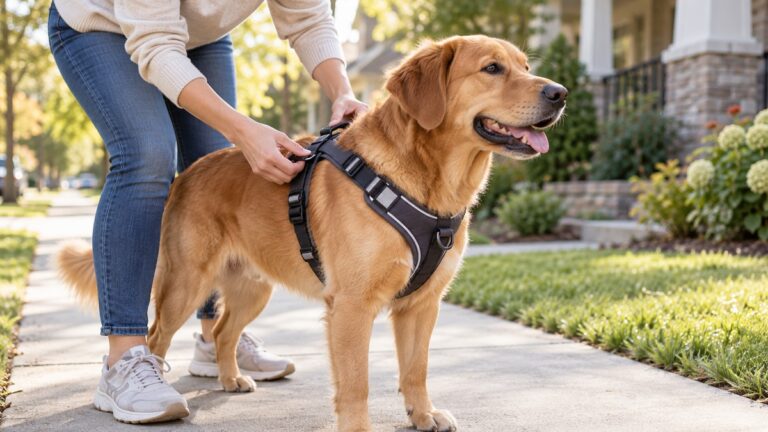
The fourth is the way the harness goes on. A step-in design asks the dog to put its front legs through openings, then the harness closes over the back. An over-the-head design goes over the head and needs the dog to hold still while you fasten it. Neither design is right for every dog. Choose the one that your dog accepts without a struggle, and practice the steps before a walk. For more step-in options, see the guide to step-in dog harnesses for small dogs.
Measuring a small dog’s chest
Measure while your dog stands on a flat floor. AKC says to keep the tape snug but not tight, and to slip two fingers between the tape and the dog. A string, ribbon or shoelace can replace a measuring tape. If you use string, mark the point where it meets itself, then lay it flat against a ruler and read the length.
Measure twice, and write down both readings. Small dogs move quickly, so a reading taken while the dog is turning or sitting will be wrong. If the two readings differ by a lot, measure again with the dog standing still and a helper holding the tape.
Compare the chest reading with the chest range on the listing, not with the breed label. A dog harness for a miniature poodle has the same measurement steps as a harness for a toy poodle, because the breed name does not set the size. The chest range sets the size.
Write down the neck reading too, if the listing asks for it. A neck figure that is close to the chest figure can be normal for some builds, but the listing’s own neck range decides the fit. Do not guess the neck from the chest.
Why a puppy or toy dog needs a closer look
AKC says a harness is generally a better option for puppies, so there is no pressure on the neck if the puppy pulls. The same guidance adds that the harness must fit so the puppy cannot slip out. That condition matters most for a small dog, because a small body can slide out of a harness that is too large in the chest.
AKC also says it is best to begin leash training as soon as you bring a puppy home. Puppies are not born knowing what a leash is, and leash walking is a trained skill. A harness that fits well makes the early steps easier, because the puppy can walk without a tight neck strap pulling at its throat.
If you are looking at a toy poodle dog harness, treat the breed name as a starting point. Use the chest and neck figures to decide. The listings here use general size words such as small breeds, not toy or miniature breeds, so the sizing figures are what you should compare before you order. For a puppy-specific guide, see the best harness for a toy poodle puppy.
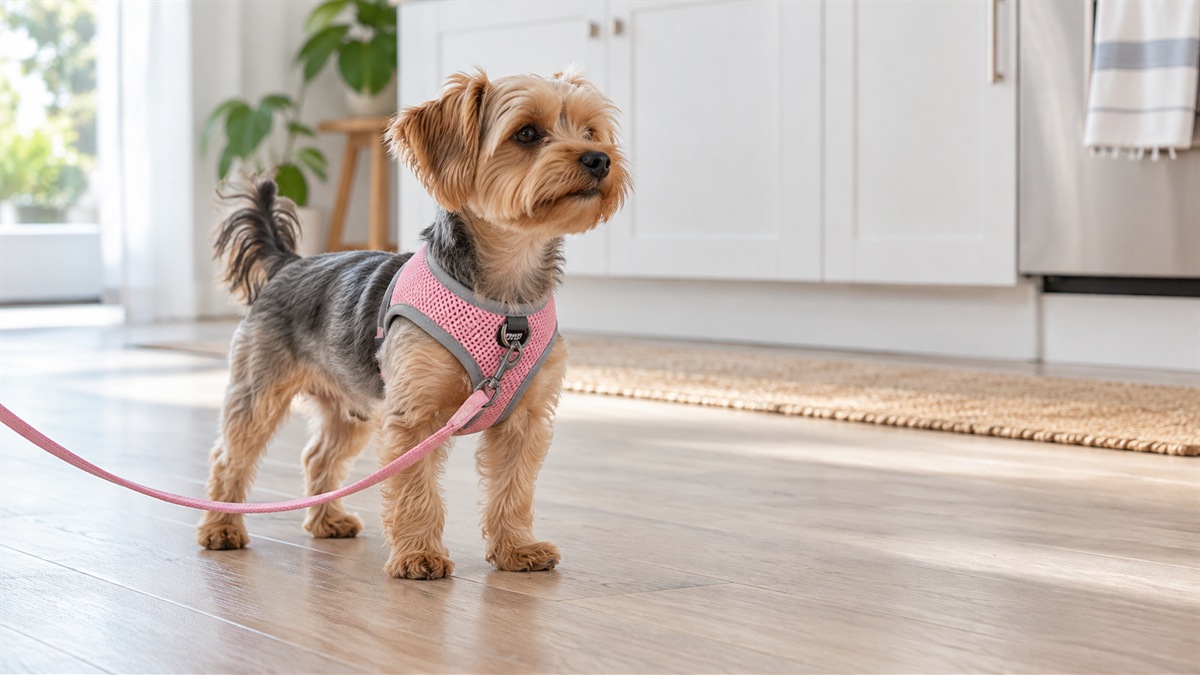
The Voyager in the cards below states a small chest range, and its specs name small and medium breeds. It is a step-in design with a mesh body, so it may suit a dog that dislikes the head going through a harness. The listing does not name toy poodles, so check the chest range against your dog before you buy.
Leashes, clips and walking
The harness is only part of the walk. AKC advises against retractable leashes and recommends a lightweight six-foot leash for loose-leash training. A small dog on a long retractable line can dart into the path of other dogs or people, and a light leash keeps the handle comfortable for your hand.
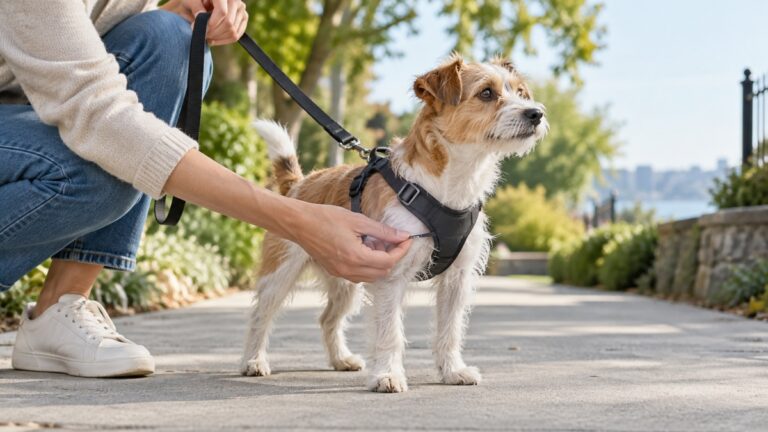
If your dog also slips out of its gear, the guide to harnesses for small dogs that escape covers escape-proof fit. Check the leash attachment point before you buy. A front chest ring helps guide a dog that pulls, and a back ring suits relaxed walks. Some small harnesses offer both. Choose the ring that matches how you walk your dog, then test the clip at home before the first walk.
Reflective trim helps you see a dog at dusk. It does not light the dog on its own.
How to choose: rules for a small dog
Choose a harness with a stated chest range if your dog’s measurement falls inside that range. A common rule of thumb is to avoid a size that leaves the dog at the very edge of the range, because a dog that grows or gains weight may need the next size soon.
Choose a harness with a stated weight range if your dog is near the bottom of the chart, and make sure the weight figure does not contradict the chest figure. If the two disagree, treat both as unconfirmed until the seller clears up the difference.
Choose a step-in design if your dog accepts having its legs placed through openings and dislikes things going over its head. Choose an over-the-head design if your dog is calm during fastening and you want a simple closure.
Choose a listing that clearly states its size, not only a label, when you want a clear fit. A label that says XS while the size field says L leaves you with a fit question you must answer yourself.
Skip any listing whose chest range stops short of your dog’s measurement. Skip a listing that says it is not for your dog’s size, even if its label sounds right. Skip a listing whose size field and bullets contradict each other until the maker confirms the size.
Use the product cards below to compare the two harnesses. Each card shows the specs the listing states, the pros and cons that come from those specs, and who should skip it.
1. Voyager Step-in Air Dog Vest Harness – Moss Green, Small (Smallest chest range here)
Specs from the listing (checked 2026-10-11):
- Size: S (Chest: 14.5 – 16″)
- Item Highlight: 14.5-16″ in Chest, Reflective Bands, All Weather Breathable Air Mesh, Cats Compatible, Lightweight, Fast Drying
- Weight Range: 10 lbs – 14 lbs
- Material Type: Air mesh
- Product Care Instructions: Machine Wash
Pros
- The Size field states a chest range of 14.5 – 16 inches, and the weight range reads 10 lbs – 14 lbs
- The bullets say to let the pet step in and then clip the harness, with no pulling over the head
- The listing names two reflective bands, air mesh and a machine wash care line
Cons
- The bullets say the harness is not for large dogs, so it covers only the small end of the range
- The bullets say sizing does not directly follow breed or weight, so the measurement must be taken before ordering
- The warranty field reads 31 day manufacturer, and the listing names no handle
Best for: Owners of a small dog whose chest measures inside 14.5 to 16 inches and who want a step-in fit.
Skip if: Your dog's chest measures outside that range, or you need a harness with a handle.
View on Amazon (affiliate link)
2. Annchwool No Pull Dog Harness with Soft Padded Handle,Reflective Strip Escape Proof and Quick Fit (XS strap width named, size field says L)
Specs from the listing (checked 2026-10-11):
- Size: L
- Dog Breed Size: Large
- Breed Recommendation: Small Breeds
- Material Type: Nylon
Pros
- The bullets say the harness comes in five sizes, with XS built 1 inch wide and S through XL 1.5 inches wide
- The listing names reflective stitching along polyester webbing, and the front strap is described as helping prevent rushing
- The listing names a velcro area with two patches, which adds a place for ID or a patch
Cons
- The Size field reads L and the breed recommendation reads Small Breeds, which conflicts with the XS line, so the listing does not confirm an XS size
- The listing states an item weight of 5.6 ounces and no weight range
- The closure type field reads n, so the listing does not state a closure type in its specs
Best for: Owners who want to check an XS strap width and will confirm the size with the maker before ordering.
Skip if: You need a confirmed XS size on the listing, because the Size field says L.
View on Amazon (affiliate link)
A 15 inch chest in the 14.5 to 16 inch range
Suppose your dog’s chest measures 15 inches, and the step-in listing’s chest range runs from 14.5 to 16 inches. The measurement sits inside the range: 15 minus 14.5 leaves 0.5 inch at the bottom, and 16 minus 15 leaves 1 inch at the top. A dog that gains weight or grows will move toward the top, so that 1 inch is the number to watch over time. A chest of 14 inches would fall below the range, and that listing would be the wrong size.
Common mistakes
- Buying from the label alone. An XS or extra small label does not tell you the chest range, and the size field on a listing may say something else.
- Measuring the dog after it has moved. A small dog that shifts while you measure gives a reading that is too large or too small.
- Assuming a harness for a small breed fits a puppy that will grow. Check whether the listing states a size for the dog as it is now, not for a future size.
- Skipping the neck check. A chest fit with a loose neck strap lets a small dog slip out.
- Using a retractable leash on a small dog. AKC advises against retractable leashes for leash training.
- Choosing a harness that the listing describes as not for your dog’s size. Read the sizing bullet before you add to cart.
Fit check at home
When the harness arrives, put it on a dry dog before the first walk. Fasten every buckle and check that you can slip two fingers under each strap. Check the chest strap and the neck strap separately, because a harness can fit one and not the other.
AKC notes that a harness that is too big can let a dog wiggle out, and a harness that is too tight can be painful, especially in hot weather. Look for rubbing at the armpits and behind the front legs. Watch your dog walk a few steps and sit down. If the harness moves toward the throat or slides back, adjust it or try a different size.
Repeat the check after the first walk and again after your dog has been wet or sweaty. Straps can stretch or loosen, and a harness that fit on a dry day may not fit the same way afterward.
FAQ
How do I know which size harness my xsmall dog needs?
Measure chest girth while the dog stands still, then compare that number with the chest range on the listing. The size label alone is not enough.
Is an XS harness the same as an xsmall harness?
The names mean the smallest size on a chart, but each maker sets its own range. Compare the chest figure on each listing, not the name.
Can a small dog wear a harness that is a little too big?
A harness that is too big can let a dog wiggle out, which AKC notes is a risk. Choose a size whose range covers the measurement, then check the fit at home.
Should I choose a step-in or an over-the-head design?
Choose the design your dog accepts without a struggle. A step-in design suits a dog that does not like the head going through the harness. An over-the-head design can be simpler if your dog stays calm during fastening.
Does reflective trim make a small dog visible at night?
Reflective trim helps when a light shines from near the viewer. It does not light the dog on its own, so add a separate light if you walk at night.
Is a harness better than a collar for a puppy?
AKC says a harness is generally a better option for puppies, as long as it fits so the puppy cannot slip out. Check the fit at the chest and neck before each walk.
Can I machine wash a small dog’s harness?
Check the care line on the listing. Follow it exactly. Some listings say hand wash only, and one of the harnesses in the cards says machine wash.
Bottom line
Measure your dog’s chest, choose a listing whose stated chest range covers that number, and check the neck strap and the design that suits your dog. Use the Voyager only if your dog’s measurement sits inside its chest range and the listing’s no-large-dogs note does not apply. Use the Annchwool only after the maker confirms the XS size, because its size field says L. If neither listing fits, keep looking for a harness whose sizing figures match your dog.
Sources
- AKC, measuring dog gear: chest girth is typically the most important measurement, with the two-finger rule and string method
- AKC, teach your puppy to walk on leash: a harness is generally better for puppies if it fits; avoid retractable leashes; begin leash training early
- AKC, dog harness vs collar: a harness that is too big can let a dog wiggle out, and one too tight can be painful
- Wikipedia, retroreflector: a retroreflector reflects light back toward its source with minimal scattering