Best Way to Store Dog Toys: Sort, Inspect, Clean, Then Contain
As an Amazon Associate we earn from qualifying purchases. Details
The best way to store dog toys is to inspect every toy before it goes into the bin, remove any that are torn or worn, clean the rest with the label directions, and then keep the whole collection in one container that sits away from cleaning products. The sources we opened, from the American Kennel Club and the ASPCA, agree on the inspection step. They tell owners to throw out toys with rips, tears, or deep punctures, and to discard chews before they become excessively worn. This guide sets out the steps in order and lists what the sources do not cover.
Quick answer
- Inspect before you store. Throw out any toy with rips, tears, or deep punctures, and any chew that is excessively worn.
- Check size. The AKC says balls should be big enough that a dog cannot choke on or swallow them.
- Clean with label directions. The ASPCA says a properly diluted bleach solution, followed by a thorough rinse and airing out, is not expected to cause harm for pet toys.
- Store the toys in one container, and keep it, along with the cleaning supplies, out of your pet’s reach.
Why inspection comes before storage
Storage only works if the toys are still safe to hand to a dog. A toy that has been chewed open may have pieces that come loose, and those pieces are the reason the sources give for retiring toys early. The AKC’s puppy toy guide puts it plainly: “If you notice rips, tears, or deep punctures, throw the toy out. You don’t want to risk your puppy ingesting any small parts.”
The same logic applies to chews. The ASPCA’s position statement on dog chews says that dogs who like these chews “will slowly wear down the ends of the chews, resulting in thin sections that can be broken off and swallowed.” The guidance that follows is direct: “Guardians should discard these chews before they become excessively worn.”
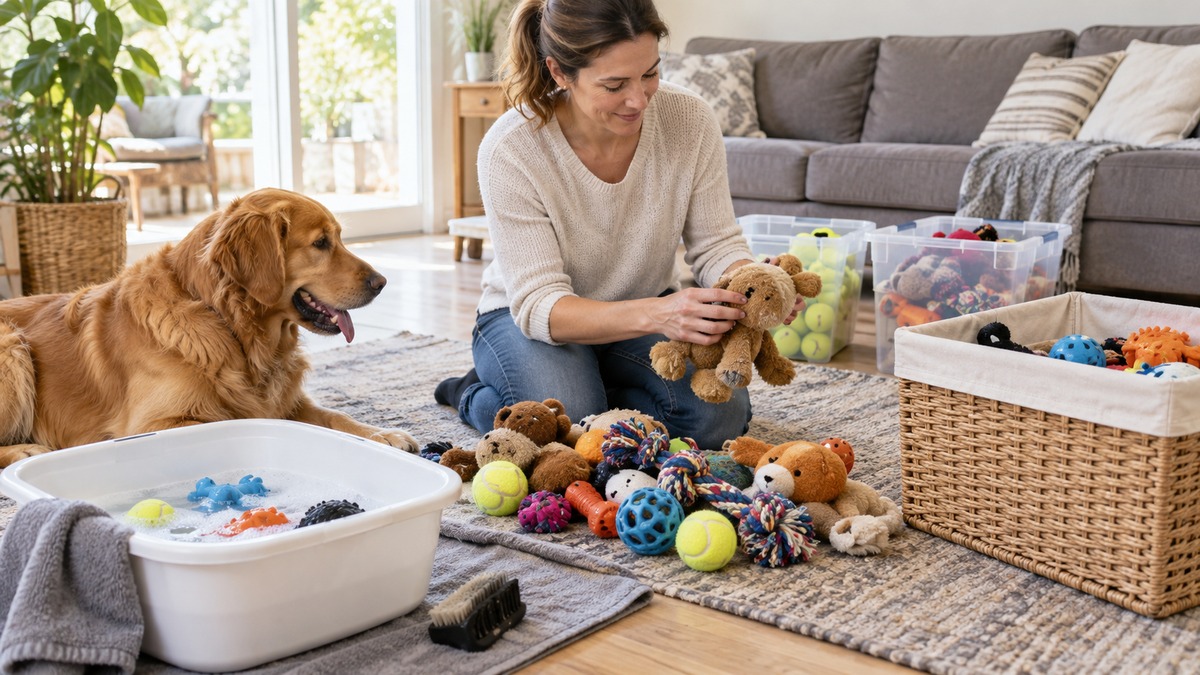
So the first job in storage is a sorting pass. Pick up every toy in the house, including the ones hidden under the couch and in the car, and sort them into three piles: keep, clean, and retire. Retire anything that fails the inspection, even if the dog still likes it. Storing a damaged toy only postpones the problem.
Step 1: Sort every toy into keep, clean, or retire
Work through the collection one toy at a time. Ask three questions for each toy. Is it torn, punctured, or split? Is any part loose or close to coming off? Is a chew worn down to thin sections at the ends? If the answer to any of these is yes, the toy goes to the retire pile.
Toys that are intact but dirty go to the clean pile. Toys that are intact and clean go to the keep pile. Keep the retire pile separate and throw it out once the sort is finished, so the same damaged toy does not go back into the bin by mistake.
Step 2: Check the size against the dog
Size matters in two ways. A toy that is too small can be swallowed whole, and a toy that breaks into pieces can become a second problem. The AKC’s guidance on toys for dogs that chew notes that balls should be “big enough that your dog can’t choke on or swallow them by accident.” Check each ball against the dog that uses it, not against the size of the toy in the store.
The ASPCA’s position on chews points in the same direction. It says that “excessively small products or products that fragment should not be offered as pet toys to any dog, as intestinal blockage requiring surgical removal can occur.” If a toy looks like it could shrink or crumble in the dog’s mouth, keep it out of the keep pile.
Step 3: Clean the toys that are going back in
Cleaning comes after the sort, and only for the toys in the clean pile. The ASPCA’s guide to household products addresses cleaning pet toys directly. It says that “cleaning your pet’s cage or toys with a properly diluted bleach solution, followed by a thorough rinsing and airing out, is not expected to cause harm.” The same page adds a condition that matters: “always follow label directions for usage.”
In practice, that means three things. First, read the label on the cleaner you use, and follow its dilution and contact instructions. Second, rinse the toy thoroughly after any disinfectant so no residue stays on the surface. Third, let the toy air out before it goes into a container. The ASPCA treats the rinse and air-out as part of the method, not an optional extra.
Soft toys with stuffing or squeakers need a different check. The AKC’s puppy guide says to throw the toy out if rips, tears, or deep punctures appear. A soft toy that has been cleaned and still shows an opening belongs in the retire pile.
Step 4: Choose one container for the keep pile
Once the toys are sorted and clean, put the keep pile into one container. A basket, bin, or box with a lid all work. The sources we opened do not compare container types, so the choice is a practical one. Pick a container that is easy to lift, easy to see into, and large enough that toys do not get crushed.
Keep the container in a dry room. The sources we opened do not say how humidity affects dog toys, so do not treat any container as a guarantee against mold or odor. A dry shelf is a reasonable default, and checking the bin for damp toys once in a while is a simple habit.
Place the container where the dog cannot reach into it on its own. This also helps keep the toys in one place when the dog is ready for play. The ASPCA’s household guidance says to keep common household dangers up and out of paws’ reach, so the toy bin should not share a shelf with cleaning supplies.
Step 5: Keep the cleaning supplies apart from the toys
The ASPCA advises that owners “clean and put away cleaning implements like mops in areas your pets won’t have access to.” The ASPCA’s household list of common dangers also asks owners to keep those items up and out of paws’ reach. For toy storage, this means the toy bin and the cleaning supplies should be in different places, and the cleaning supplies should go back where the dog cannot reach them after every use.
Owners often keep a spray bottle or a bleach jug near the toy bin because that is where the cleaning happens. Move the supplies back to a closed cabinet once the toys are dry, and keep the toy bin on a shelf the dog cannot reach.
Step 6: Inspect the bin again before handing out a toy
Storing toys is not a one-time task. Before a toy comes out of the bin for play, look at it again. The AKC’s guidance on dog toys notes that toys should be durable enough not to break apart with normal play, so a quick check before each session catches damage that appeared since the last sort.
The sources we opened do not give a schedule for these checks, such as weekly or monthly. The practical rule is to check each toy when it comes out of the bin, and to re-sort the whole collection whenever a new toy arrives or a dog begins chewing more aggressively.
Common mistakes to avoid
Storing a damaged toy. A toy with a split seam or a loose part still goes back into the bin if it is not sorted out first. Retire it at the sort, not later.
Ignoring worn chews. The ASPCA says to discard chews “before they become excessively worn.” Thin ends are the signal, so do not wait until the chew breaks.
Keeping toys that are too small. The AKC warns that balls too small for a dog can cause choking. A toy that is safe for one dog may not be safe for another, so check each toy against the dog that plays with it.
Cleaning without reading the label. The ASPCA ties its cleaning guidance to label directions. Diluting a disinfectant more than the label says, or skipping the rinse, is a mistake the sources do not endorse.
Storing cleaning supplies next to the toy bin. The ASPCA’s guidance on household products says to keep them where pets cannot reach them. A toy bin on the same shelf as a cleaner defeats that rule.
What we could not verify
The sources we opened do not say which storage container material is best for dog toys, and they do not say whether one type of bin prevents damage better than another.
The sources do not give a cleaning schedule for dog toys, and they do not say how often a toy should be washed during regular use.
The sources we opened do not address squeaker removal or stuffing replacement in soft toys. This guide does not give a method for either.
The sources do not say how long a toy stays safe after it shows wear. They describe the signs to look for, but not a number of days or weeks.
Information about the best toy rotation schedule is not in the sources we opened, so this guide does not recommend one.
How we chose
This guide answers one question: what is the best way to store dog toys, using steps the sources support. We based the steps on four pages we opened on 2026-10-23: the AKC’s puppy toy guide, the AKC’s guide to choosing dog toys, the ASPCA’s position statement on dog chews, and the ASPCA’s household product guide. Each step either repeats a point those pages make or describes a practical arrangement that the pages do not forbid. Where a page is silent, the guide says so. The guide does not recommend a product, list a price, or quote a rating.
FAQ
How often should I check dog toys for damage?
The sources we opened do not give a fixed schedule. The practical approach is to check each toy when it comes out of storage and to re-sort the whole collection when new toys arrive. The AKC says to throw out a toy with rips, tears, or deep punctures, and the ASPCA says to discard chews before they become excessively worn.
Can I wash dog toys in the dishwasher?
The sources we opened do not address dishwashers. The ASPCA’s household guidance describes a diluted bleach rinse for pet toys followed by a thorough rinse and airing out, and says to follow label directions. Use the method on the cleaner’s label.
What size ball is right for my dog?
The AKC says a ball should be big enough that your dog cannot choke on or swallow it by accident. The sources we opened do not give a size chart, so judge each ball against the dog that plays with it.
Should I keep chews in the same bin as other toys?
The sources we opened do not say whether chews and plush toys should be kept apart. Sort chews separately during inspection, because the ASPCA gives its own guidance on when to discard them.
Is it safe to store dog toys in the garage?
The sources we opened do not address garage storage of toys. Keep the toy bin away from cleaning supplies and other household chemicals, and apply the ASPCA’s advice to keep common household dangers up and out of paws’ reach.
Bottom line
Inspect each toy before it goes into storage, retire anything torn, punctured, or worn down, check ball size against the dog, and clean the keepers using the label directions. Keep the toys in one container, and keep that container apart from cleaning supplies. For the points the sources do not cover, such as schedules and container materials, the sources do not say, so this guide does not supply a number.
For more on chew choices, see our teething puppy chew guide. For durable chews for heavy chewers, see our heavy chewer toy roundup.
Sources
- https://www.akc.org/expert-advice/puppy-information/best-puppy-toys/
- https://www.akc.org/expert-advice/lifestyle/best-dog-toys/
- https://www.aspca.org/about-us/aspca-policy-and-position-statements/position-statement-dog-chewstreats
- https://www.aspca.org/news/pet-poisons-be-mindful-these-household-products-and-cleaning-agents