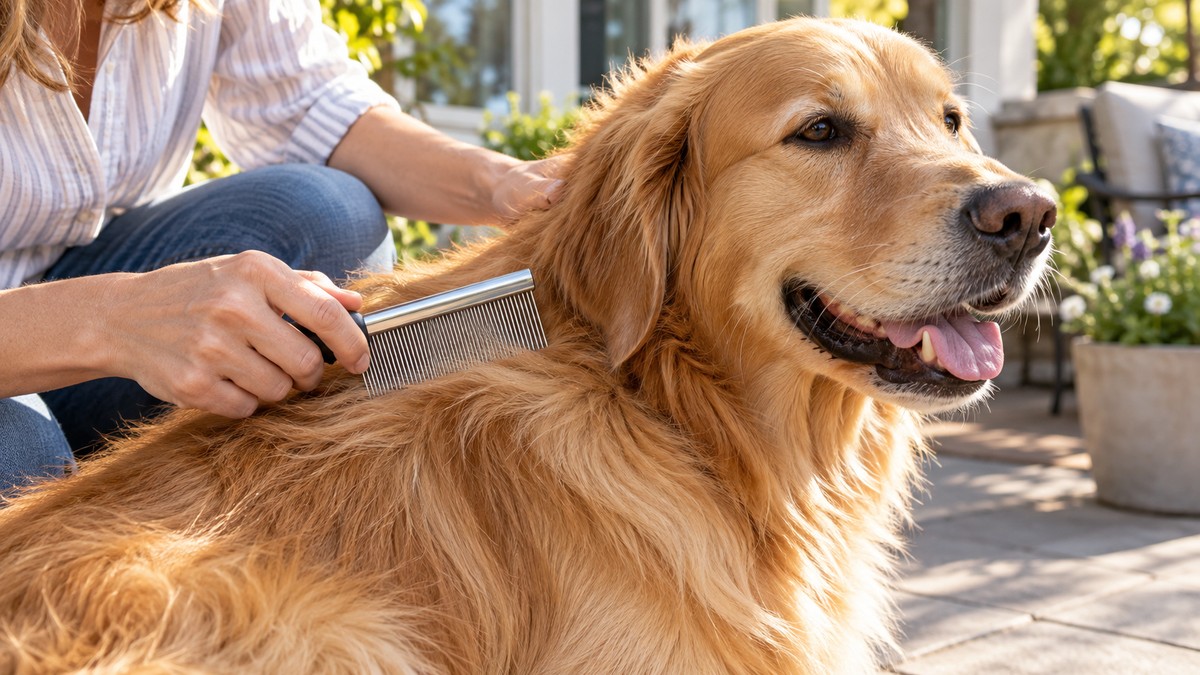
Dog Flea Comb
As an Amazon Associate we earn from qualifying purchases.
Best Dog Flea Comb: Six Useful Designs for Coat Checks and Manual Removal
A dog flea comb is a close-spaced grooming tool for finding and lifting small surface debris from a dog’s coat. The best choice is not automatically the comb with the most accessories: tooth spacing, usable width, handle control, and the dog’s coat are more important. This guide compares six manual options from compact single-row combs to multi-piece sets. It also explains how to prepare tangled fur, inspect what the comb collects, and recognize when grooming alone is not an adequate response.
Quick answer
- Best straightforward single comb: yumflan combines 1.0 mm precision teeth with a rubber-grip handle.
- Best set for different coat areas: Jigfew includes five tools with long, short, double-sided, and facial-comb formats.
- Best two-size metal set: We Love Doodles supplies a larger body comb and a smaller detail comb.
- Important limit: a comb can reveal or remove material caught in the coat, but it does not replace veterinarian-recommended parasite control.
Dog flea comb comparison
| Product | Pieces | Construction or design | Best fit |
|---|---|---|---|
| yumflan | 1 | Metal teeth, plastic body, rubber handle; 1.0 mm spacing | A controlled full-coat check with one familiar tool |
| Jigfew | 5 | Stainless-steel assortment with multiple tooth patterns | Homes needing separate body and detail formats |
| We Love Doodles | 2 | Large and small metal combs | Switching between broad areas and tight contours |
| Tweezerman | 1 | Plastic and stainless steel; wide and narrow bristle zones | Two spacing choices in one handheld comb |
| BRILLIRARE | 4 | Large, double-sided, long-needle, and short-needle tools | A multi-dog or multi-coat grooming station |
| PrimePets | 1 | Compact ABS and stainless-steel single row | Small-area checks and lightweight storage |
What a flea comb can and cannot tell you
A fine-tooth comb is primarily an inspection and mechanical-removal tool. Closely spaced teeth can catch loose coat material that wider grooming combs pass over. Working above a light-colored towel or paper makes dark particles easier to see. That observation can help you describe the situation to a veterinarian, but appearance alone does not establish what every speck is. Dirt, dried skin material, tiny scabs, and outdoor debris can look similar at a glance.
The tool also offers only a snapshot of the area you reached. A clean pass through one section does not prove that the whole dog or home environment is clear. Dense undercoat, mats, skin folds, and places the dog will not let you inspect can hide material. Conversely, one suspicious finding is a reason to investigate calmly, not to scrape the skin or repeatedly rake the same patch.
Manual combing does not address parasite life stages away from the dog, and it is not a substitute for an appropriate prevention or treatment plan. If you find live insects, see persistent scratching, notice skin damage or hair loss, or have a puppy or medically vulnerable dog, contact a veterinarian for advice appropriate to that animal. Do not apply household chemicals, concentrated essential oils, or a product intended for another species based only on what the comb collected.
Tooth spacing matters more than a dramatic product title
Flea-comb teeth sit closer together than the teeth on a typical detangling comb. Yumflan is the only selected listing that states a 1.0 mm precision-tooth measurement, giving shoppers one concrete spacing reference. The other listings describe their rows as fine, dense, or intended for flea grooming without supplying a comparable measurement. That absence prevents an exact rank by tooth gap.
Very close spacing can catch small material, yet it also increases resistance when loose undercoat or knots enter the row. Longer teeth may reach farther into a plush coat, while shorter teeth can feel easier to control around the face, ears, and other contours. Tooth length is not the same as tooth spacing. A long-needle comb may still have gaps that differ from another maker’s short row, so do not infer precision from length alone.
Rounded tips are useful where the listing confirms them; Tweezerman specifically describes rounded tips. Even rounded metal should glide through hair rather than press into skin. Hold the comb nearly parallel to the body, use short strokes, and keep the free hand between a knot and the skin when practical. If the row stops, back out instead of pulling harder.
Prepare the coat before the fine-tooth pass
A flea comb should not be the first tool pushed into a matted coat. Separate visible tangles with the appropriate everyday grooming method before using the close row. The yumflan listing explicitly advises clearing mats first, and that sequence makes sense for every fine comb in this group. Forcing narrow teeth through a knot can tug the skin, bend teeth, and cause the dog to avoid later inspections.
- Choose a bright, quiet area and place a pale towel beneath the dog.
- Part the coat with your fingers and look for irritated or broken skin before combing.
- Remove loose tangles with a suitable brush or wider comb, working gently.
- Run the flea comb in the direction of hair growth with short, controlled strokes.
- Check the teeth after each pass and clean the tool before moving to another dog.
Common inspection zones include the neck, back, base of the tail, and areas where coat density changes, but handling tolerance should determine how far a session goes. Avoid dragging a metal row across an open sore. Around eyes, lips, genitals, and ear openings, a smaller detail comb gives more control, yet it still stays on the hair and away from delicate tissue.
Handle design changes control
The yumflan has a rubber handle, which may help when hands are damp or when the user prefers a fuller grip. Tweezerman also presents a conventional handled profile with two bristle-spacing zones. PrimePets is much smaller and lighter according to its package figures; compactness may suit a travel kit, but shoppers with limited hand mobility may find a more substantial handle easier to stabilize.
All-metal combs such as the We Love Doodles pair reduce the number of joined materials and provide two physical sizes. They do not offer the cushioned hold of a rubber grip. The Jigfew and BRILLIRARE kits distribute several shapes across one purchase, making tool selection more flexible but creating more pieces to clean and store. Choose the design that makes gentle pressure repeatable; extra pieces have little value if only one feels safe in your hand.
Match tool width to the body area
A broad working edge covers the back or flank efficiently, while a narrow comb can navigate under the chin or around a leg with less accidental contact. The We Love Doodles two-pack makes this division clear by pairing large and small metal combs. Jigfew includes a designated tear-stain comb alongside longer handled formats, and BRILLIRARE combines large, double-sided, long-needle, and short-needle tools.
More coverage is not always faster. A wide row entering thick undercoat can load with hair quickly and require frequent clearing. A narrow row needs more passes but may keep each stroke manageable. For a dog that dislikes long grooming sessions, divide the coat into zones across several brief checks rather than rushing the entire body.
Use the listed measurements carefully
Some records provide item dimensions, while others provide package dimensions. These are not interchangeable. Yumflan is listed at 7 by 1.8 by 0.5 inches and 1.47 ounces. We Love Doodles is listed at 1.5 by 7 by 2.7 inches and 0.8 ounce. The remaining numerical measurements in this group are presented as package sizes or weights: Jigfew at 7.05 by 4.09 by 0.63 inches and 3.03 ounces, Tweezerman at 9.21 by 4.33 by 2.64 inches and 3.46 ounces, BRILLIRARE at 7.76 by 5.43 by 1.69 inches and 2.12 ounces, and PrimePets at 3.43 by 3.31 by 0.35 inches and 0.63 ounce.
Those figures are useful for drawer or travel planning, not for calculating the exact width of every tooth row. A large package can contain several small tools or protective materials. If working-edge width is decisive, confirm it on the current product page or request it from the manufacturer before ordering.
Calculate how much variety a set adds
A simple way to compare kits is tool count difference = larger set count − smaller set count. Jigfew contains five tools and BRILLIRARE contains four, so the difference is 5 − 4 = 1 tool. Compared with a single yumflan, Tweezerman, or PrimePets comb, Jigfew adds four pieces. That arithmetic describes quantity only; it does not show that five tools will work five times better.
Another practical calculation is allocation. A two-comb We Love Doodles set can reserve one tool for the body and one for detail work. A four-tool kit can theoretically dedicate one tool to each of four coat zones or dogs, but cross-dog use still requires cleaning between sessions. Do not assume separate tools eliminate hygiene steps. The useful question is how many distinct designs you will employ, not how many handles arrive in the package.
Clean and inspect the comb after use
Remove trapped hair and debris without sliding bare fingers forcefully along sharp metal edges. Follow the maker’s care instructions for washing or disinfecting because the listings summarized here do not specify one universal method. Dry metal components thoroughly before storage. Inspect for bent teeth, rough joints, cracked plastic, or corrosion; retire a damaged tool rather than using it close to the skin.
Store the comb where teeth cannot be crushed by heavier grooming equipment. Multi-piece kits benefit from labeled compartments so the short detail tool does not disappear beneath brushes. If several pets share the household, clean between animals and consider labeling dedicated tools when a veterinarian recommends separation for a skin issue.
Help the dog accept an inspection
Before attempting a full coat check, let the dog investigate the comb while it is stationary. Pair a brief touch to the shoulder with a reward, then gradually introduce one short stroke. Continue only while the body stays loose and the dog can choose a comfortable position. A non-slip surface provides steadier footing than a slick bathroom floor.
Watch for repeated turning, freezing, lip licking, pawing, or efforts to leave. These behaviors can signal that the session is too long, the pressure is uncomfortable, or an area is tender. Stop and reassess rather than holding the dog down. Sudden sensitivity in a location that was previously easy to groom deserves closer attention and, when persistent, professional guidance.
Read coat type as a workflow question
Short, smooth hair usually gives a clear view of the skin and lets a short row travel with fewer obstructions. A plush double coat creates a different task: the user has to part layers, manage shed undercoat, and clear the teeth more often. Long silky hair may wrap around a row, while curly hair can resist a close comb even when no obvious mat is visible. These differences do not make one coat “easy” and another “bad”; they change the preparation and stroke length required.
For dense coats, create narrow parts and inspect the skin line by line instead of driving the comb from the surface toward the body. Clear collected hair after each short pass so the tooth gaps remain visible. On a thin coat, use even lighter pressure because there is less hair between metal and skin. If the comb cannot pass through prepared fur without repeated catching, choose a different tooth length or ask a groomer to show a suitable technique.
Seasonal shedding also alters how the same comb feels. A design that moved freely a month earlier may fill rapidly when undercoat releases. That change does not necessarily mean the tool has failed. Separate ordinary shed hair from the fine inspection step, and check the row for damage before assuming the resistance comes from the coat.
Organize a full-body check without losing track
A consistent route makes it easier to know which areas were actually examined. Divide the dog into left and right sides, then work from neck toward tail before checking the chest and legs. Mark completed zones on a simple note if the dog needs several short sessions. Do not restart at the same comfortable shoulder patch every time while leaving sensitive locations unobserved.
Count passes only as a pacing device, not as a required dose. For example, six coat zones with five short strokes per zone equals 30 strokes: 6 zones × 5 strokes = 30. If the dog remains relaxed for only 10 strokes, split that outline across three sessions. The calculation helps prevent a rushed final section; it does not override the need to stop when the animal is uncomfortable.
Record what you found by location and date rather than relying on memory. A note such as “dark particles at tail base after outdoor walk” is more useful than a vague statement that the dog was dirty. If you save a sample for professional review, contain it securely and ask the clinic how they prefer it handled. Photographs should be taken in consistent lighting without delaying needed care.
Avoid common technique errors
The first error is using the fine comb as a rake. Long, forceful strokes increase tugging and give the user less time to stop at a snag. The second is pressing down to reach skin; parting the coat with fingers is safer than making the teeth do all the separating. The third is continuing over a red area to gather more evidence. Once the skin appears damaged or painful, observation and professional advice matter more than collecting another combful.
Another mistake is interpreting every black particle as the same finding. Observe shape, location, movement, and whether the material came from the coat or the floor, but avoid a home diagnosis based on a photo comparison. Likewise, a dog that scratches can have many possible reasons for doing so. The comb contributes one piece of information and should be paired with the dog’s history, environment, prevention plan, and veterinary assessment.
Finally, do not judge a set by the number of pieces left unused. A five-piece kit may be sensible when different designs have defined roles; a single well-controlled comb may be better when it moves through the dog’s coat without pulling. The right purchase minimizes friction in both meanings of the word: resistance in the hair and resistance from the dog.
How we chose
We retained manual combs that clearly matched the requested use and supplied enough product information to compare construction, quantity, or format. Selection emphasized fine-tooth designs, controllable handles, size variety, and options for both broad coat sections and smaller contours. We excluded unrelated electric devices, chemical treatments, and ordinary wide-tooth detangling tools.
Product statements below are limited to information in the supplied research records. The comparison gives preference to concrete details such as 1.0 mm spacing, stated materials, piece counts, and disclosed dimensions. We did not treat broad suitability language as proof that a comb will move equally well through every coat.
What we could not verify
Most listings did not disclose exact tooth spacing, working-edge width, tooth-tip radius, steel grade, or cleaning instructions. Package measurements do not confirm individual-tool dimensions. We also could not verify long-term resistance to bending, grip comfort for a particular user, performance in a specific coat, or whether every included piece will match the product-page images over time.
No dog weight or size range was supplied for these combs. Claims that they suit all sizes or coat types are manufacturer positioning, not a measured fit guarantee. Current packaging, included pieces, and instructions should be confirmed on the listing when those details affect your decision.
Six dog flea comb picks
1. yumflan Flea Comb
Why it stands out: The single comb has stated 1.0 mm precision teeth and a rubber-grip handle. Its listed item size is 7 by 1.8 by 0.5 inches, giving shoppers more usable sizing information than package-only dimensions.
Skip it if: You want separate sizes for the body and face or a complete multi-tool grooming kit.
Limitation: The research record does not state tooth length, working-edge width, or a dog size range. Mats need to be cleared before the fine row is used.
2. Jigfew Five-Piece Flea Comb Set
Why it stands out: Five stainless-steel tools provide long-handle, double-sided, long-needle, short-needle, and tear-stain-comb formats. That assortment supports a more deliberate switch between broad coat work and small facial areas.
Skip it if: You prefer one easily stored comb and do not expect to use several tooth configurations.
Limitation: The listing supplies package measurements but not exact dimensions or spacing for each comb. No dog weight or size range is given.
3. We Love Doodles Metal Flea Comb Two-Pack
Why it stands out: A larger and smaller all-metal comb let the user keep separate formats for main coat sections and tighter contours. The pair is listed at 0.8 ounce.
Skip it if: A cushioned or rubberized handle is important for your grip.
Limitation: Exact tooth spacing is absent, and the record does not specify which listed dimensions belong to each piece. No dog size range is provided.
4. Tweezerman Pet Flea Comb
Why it stands out: Wider- and narrower-spaced bristle sections sit on one plastic-and-stainless-steel tool, and the listing describes rounded tips. This avoids storing multiple combs while retaining two working zones.
Skip it if: You want an all-metal design or independently sized detail and body tools.
Limitation: The available dimensions are for the package, and no numerical tooth gap, working width, or dog size guidance is supplied.
5. BRILLIRARE Four-Piece Flea Comb Set
Why it stands out: The kit combines large, double-sided, long-needle, and short-needle combs. Its range may suit a household that routinely handles different coat depths or several grooming zones.
Skip it if: You need a compact travel tool or know that one familiar comb is enough.
Limitation: Individual measurements and tooth gaps are not stated. The listing’s all-coat positioning is not supported by a numerical dog size range.
6. PrimePets Flea Comb
Why it stands out: This compact single-row ABS-and-stainless-steel comb is listed at 0.63 ounce. Its simple format fits a small grooming pouch and can be reserved for controlled detail checks.
Skip it if: You prefer a long, full-size handle or need multiple tooth lengths for dense coat work.
Limitation: The figures supplied are package measurements, not confirmed working dimensions. Tooth spacing and dog size range are not disclosed.
FAQ
Can a flea comb replace a parasite-control product?
No. It can help inspect the coat and mechanically remove material it catches, but it does not manage every life stage on the dog or in the environment. Ask a veterinarian about prevention or treatment appropriate to the dog.
Should I comb wet or dry fur?
Follow the comb maker’s directions and use the condition that lets the teeth move without pulling. The supplied records do not provide one shared wet-or-dry instruction for all six products.
Why does the comb keep snagging?
Loose undercoat, knots, coat density, stroke angle, or damaged teeth may create resistance. Stop, inspect the area, and remove tangles with a suitable grooming tool before returning to the close-spaced row.
Can I use the same comb on multiple dogs?
A shared tool needs cleaning between animals according to its care directions. When one dog has a suspected skin or parasite problem, ask a veterinarian whether dedicated tools and additional household steps are appropriate.
How often should I check my dog?
There is no universal schedule in the available product records. Exposure, coat, season, local parasite patterns, current prevention, and veterinary advice all affect frequency. Keep checks brief enough that the dog remains comfortable.
What should I do if I find a live flea?
Contain what the comb collected, clean the tool, and contact a veterinarian for a complete plan suited to the dog and household. Avoid improvising with concentrated oils or products labeled for a different species.
Bottom line
Choose a dog flea comb by tooth information, handling control, coat access, and the number of formats you will genuinely use. yumflan offers the clearest spacing specification in a conventional handled design. Jigfew and BRILLIRARE provide greater variety, while We Love Doodles divides work between two metal sizes. Tweezerman puts two spacing zones on one tool, and PrimePets is the compact option. Whichever comb fits, clear tangles first, use light strokes, clean it after the session, and treat findings as information rather than a complete parasite solution.
For related buying guides, see Best Brush for Curly Hair Dogs: Slickers, Kits and Rakes and Best Deshedding Brush for Large Dogs: Reach, Head Size and Use.
Sources
- American Kennel Club: Training — opened October 26, 2026.
- American Kennel Club: Health — opened October 26, 2026.
- Merck Veterinary Manual: Dog Owners — opened October 26, 2026.