Best Deshedding Brush for Large Dogs: Reach, Head Size and Use
As an Amazon Associate we earn from qualifying purchases. Details
By Ken
The best deshedding brush for large dogs is the one that reaches the undercoat, has a head wide enough to cover a big back without a dozen passes, and fits the way you will actually brush. This guide compares twelve listings on tool type, head size, pin design and what each listing says it does. None of the listings names a weight range for a large dog in its title, so the picks depend on the coat and the reach you need. The American Kennel Club says that during heavy shedding periods, a coat rake or de-shedding tool can remove large amounts of loose undercoat hair.
Quick answer
- A large dog with a double coat needs a tool that gets through the topcoat to the undercoat. A slicker alone may only lift the top layer, so pick a rake or a de-shedding tool for the heavy season.
- Head size is the number to check. The listings give head sizes for a few tools and none for most, so measure the dog’s back and compare it with the head width in the listing before you order.
- Brush several times a week for short sessions, rather than once a month for a long one. Texas A&M’s veterinary team recommends three to four sessions a week of five to 10 minutes.
- Read the listing claims about shedding reduction as claims. No listing in this group gives a method for its percentage figures.
Why a large dog’s coat asks for a different tool
Large dogs often have thick coats, and many of them are double-coated. A double coat has a soft undercoat under a coarser topcoat, and the undercoat is where most loose hair collects before it falls onto the sofa. AKC’s brush guide makes the point in one line: “Remember to brush the undercoat, as well as the top coat, if your dog is double-coated.” A brush that only smooths the top layer leaves most of the loose hair in place, even when the coat looks clean afterward.
The size of the dog also changes the job. A tool that is comfortable on a small terrier takes many more strokes to cover a Labrador’s back, a German Shepherd’s side and the thick ruff on a husky. The number of strokes is the practical cost. Each stroke that misses the undercoat is a stroke you have to repeat, and a brushing session that takes forty minutes on a large dog quickly becomes one that gets skipped. That is why head width matters as much as bristle design for this keyword.
Large dogs also carry a lot of coat on the legs, chest and hindquarters. AKC notes that “Mats commonly develop behind the ears and under the legs,” and its managing shedding article says dogs with longer or double coats need tools that reach where loose hair collects. It also says that a steel comb or a mat-splitting tool should come first when there are tangles, so the brush does not drag the knots. The large-dog job is therefore two jobs in sequence: open the tangles, then take out the loose undercoat.
Matching the tool to the coat
AKC’s brush guide describes several tool types, and the differences between them matter for shedding. Slicker brushes have “short, tightly-packed wire pins angled to go through the coat and avoid the skin.” They are useful for lifting loose hair from a dense coat and for removing light mats. Undercoat rakes have “one or two rows of metal pins designed to penetrate through to the undercoat to remove loose fur, and remove and prevent mats.” For a large double-coated dog in shedding season, the rake usually does more of the removal work, and the slicker is the tool for finishing.
The listings in this group mix these categories. Several are slickers with a button that retracts the pins, which the listings describe as a self-cleaning feature. Two are dual-sided rakes with a wide side for dematting and a dense side for deshedding, and one of those is a set with a comb. One is a metal comb head that detaches from a handle. Kits are the most common form, and they mix a slicker, a comb, a flea comb and sometimes a bath brush in one bag. A kit gives you more tools, but it does not give you a bigger head, so check the size of the main tool in each kit, not the count of pieces.
The pin length matters as much as the tool type. AKC’s brush guide says: “However, you must choose the correct pin length for your dog’s coat length.” A pin that is too short does not reach the undercoat of a thick coat, and a pin that is too long can scratch the skin under the topcoat. Many listings in this group do not state pin length at all. Where a listing says the pins are longer and softer, the claim is a comparison with an unnamed standard brush, and the listing does not give the length in inches.
Brush size is the last matching step. AKC advises owners to “Choose an appropriate brush size for the size of your dog.” That sounds obvious, but many buyers pick a brush from the picture and not from the head. For a large dog, look for a head that covers at least a hand’s width of the back at each pass, and check the listing’s product dimension field for the head. If the listing gives only the product dimensions, which includes the handle, the head size is not stated, and you should say so in your buying decision.
How often and how long
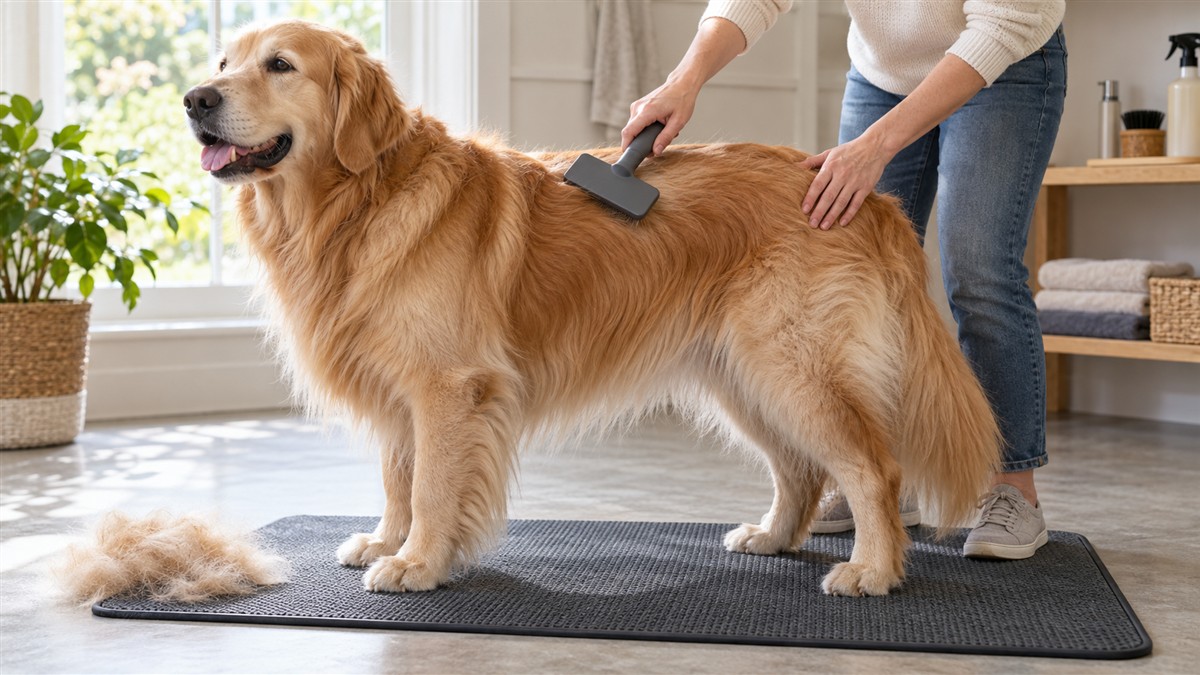
The brushing schedule is the part of the plan that changes the most. Texas A&M’s veterinary technician Harmony Diers is quoted by the university’s Pet Talk article as saying: “Ideally, brushing your dog at least three to four times a week for 5 to 10 minutes can help soften your dog’s coat and reduce the amount of hair that is shed.” That is a practical starting point for a large dog in a shedding season.
AKC’s managing shedding article says that dogs that shed heavily may need brushing several times a week, and that lighter shedders still benefit from consistent grooming. The two sources agree on the principle: short, regular sessions beat a single long session. The table below turns that principle into a weekly plan, using the Texas A&M range and the arithmetic of session length.
| Shedding load | Sessions per week | Minutes per session | Weekly minutes |
|---|---|---|---|
| Light, off-season | 2 | 10 | 20 |
| Steady, most of the year | 3 | 10 | 30 |
| Heavy, peak season | 4 | 10 | 40 |
| Heavy, long session | 3 | 15 | 45 |
The weekly minutes column is the product of the first two columns (2 x 10 = 20, 3 x 10 = 30, 4 x 10 = 40, 3 x 15 = 45). A large dog that needs 40 minutes a week in peak season is a manageable commitment, and it is more effective than one 90-minute session on a Sunday. A short midweek session can keep the coat from building up between longer sessions.
The AKC grooming guide says that “Consistent brushing helps control shedding and keeps your dog’s coat looking its best.” Consistency is the point here. A brush that lives on a hook by the door is more likely to be used than a kit that lives in a closet, and that is a reason to choose a tool with a comfortable handle for regular use.
Technique, skin and when to ask a vet
A heavy stroke does not necessarily remove more hair, and it can irritate the skin. AKC’s brush guide says to “Maintain a light touch when using slicker brushes, as pressing down hard could cause your dog discomfort.” That advice applies to rakes and de-shedding tools too. Let the pins do the work, and keep the head moving so that the same spot is not hit repeatedly.
Brushing is also a skin check. The ASPCA’s grooming tips say that regular grooming with a brush or comb helps keep the skin “clean and irritant-free,” and the AKC managing shedding article asks owners to watch for changes such as thinning fur, bald patches or irritated skin. If you see any of those changes, a brush is not the answer. The AKC article says that if you suspect a problem with the coat or skin, you should consult your veterinarian for guidance. Shedding that is heavier than usual, or that comes with a bald spot, is a question for the vet, not for a better brush.
Use the brush on the coat, not on sores or cuts. Check the skin while you brush, and pause if the dog flinches or if a spot looks red. A tool that catches on the skin is either the wrong pin length or the wrong tool, and the fix is to switch tools, not to press harder.
Kits, combos and the value of a second tool
Kits can make sense for a large dog because a single big-headed tool rarely does every job. A rake takes out the undercoat, a comb works through the knots before the rake, and a flea comb handles fleas. The MIU PET set, the Aiolpy nine-piece kit and the LYONGSMENT seven-piece bag all follow this idea, and each lists the tools it includes.
The downside is that a kit spreads the budget and the storage space across several small tools. A large dog may need only the rake and the comb in practice. The best value is the set whose main tool has the head you need, not the set with the largest number of pieces. A single rake with a wide head may do more for a large coat than a bag of small tools.
Combos that pair a brush with a metal comb, such as the Pat Your Pet combo and the Docrok combo, offer two tools in one order. The comb is useful for detail work on the face, paws and tail, where a wide rake can be too much. For a large dog, the comb is the second tool and the rake is the first.
How we chose
The research file for this keyword holds twelve listings, and none of them was left out. Listings without a card: none. We used all twelve, because each one is a deshedding, grooming or dematting tool sold for dogs, and none is a product of the wrong type for the question. Some are kits, some are self-cleaning slickers and some are dual-sided rakes. The cards say which type each one is, using the listing’s own words, and they state what each listing does not give, such as head width or pin length.
We did not add products from outside the file, and we did not change the listing data. Several listings have empty bullets or specification fields, so the card for each one relies on the title or on the fields that exist. The facts we used come from AKC’s brush, shedding and grooming pages, the ASPCA grooming tips and the Texas A&M Pet Talk article. We opened each page for this post and matched every quoted sentence to the saved page text.
We did not rank the tools by how well they remove hair. The listings give no test method for any shedding figure, and we do not have a source that compares one brush with another for shedding. The order of the cards follows the order of the listing file.
What we could not verify
- Head width for most listings. Only a few give a head size, and many give a product dimension that includes the handle, so the reach across a large back is often unstated.
- Pin length. Most listings do not say how long the pins are, and AKC’s point about choosing the right pin length cannot be checked against these listings.
- Shedding reduction figures. Several listings claim a percentage reduction in shedding. None gives a method, a dog size or a comparison with another brush.
- Weight and size ranges. No listing in this group names a weight range that covers a large dog, except as a general phrase, such as the claim that a slicker suits dogs of all sizes, in one bullet.
- Durability and warranty. Some listings claim a lifetime or two-year warranty, and the warranty terms are not reproduced in the listing data.
- Contents of several kits. The seventh item in the seven-piece bag is cut off in the text we read, and the three-piece MIU PET set has no bullets at all.
- Product dimensions that look inconsistent. One slicker’s product dimension field reads as a much longer tool than the rest of the group, so confirm the size on the product page.
- Safety cautions. The MIU PET listing includes a caution about the angle of the detangling comb, which this post repeats only as the listing states it.
The listings, one by one
Each card gives the listing’s stated tool type, size or count, and the points the listing makes. The “Skip if” line matters most for a large dog, because head width and reach decide whether a tool is worth a second look.
1. Aogeili Self-Clean Slicker Brush for Dogs Cats, Deshedding Grooming Tool (Self-cleaning slicker with fine bent bristles)
Specs from the listing (checked ):
- Hair Type: All
- Additional Features: Self Cleaning
- Product Dimensions: 7.8 x 3.9 x 1.7 inches; 3.53 ounces
Pros
- The bullets describe a button that retracts the bristles so collected hair falls off, which the listing says avoids picking hair out by hand
- The head measures 7.87 by 4.13 inches in the bullets, a compact size that the listing says reaches the back, belly and legs
Cons
- The head is compact for a large back, so covering a big dog takes more strokes than a wider rake would
Best for: An owner who wants a self-cleaning slicker for a mixed household of dogs and cats
Skip if: You want a rake for a thick undercoat, since this is a slicker with fine bent bristles
View on Amazon (affiliate link)
2. Swihauk Self Cleaning Slicker Brush – Skin Friendly Deshedding Grooming Tool for Dogs & Cats (Blue pin brush with a press-to-clean bottom)
Specs from the listing (checked ):
- Bristle Material: Plastic
- Product Dimensions: 16.14 x 9.45 x 0.79 inches; 8.82 ounces
- Additional Features: Easy Desheding, Effective to Remove Loose Fur, Ergonomic Grip, Skin Friendly, Sturdy & Durable
Pros
- The bullets describe soft, rounded plastic bristles and a press-to-clean bottom for emptying hair
- The handle is a lightweight TPR grip, and the bullets say it is easy to hold during a long session
Cons
- The listing's product dimension field reads 16.14 by 9.45 by 0.79 inches, which is much larger than a typical hand brush, so the head size must be confirmed
Best for: An owner who wants a plastic-tipped brush for a regular session on a short or medium coat
Skip if: You need a stated head width, since the listing gives only the product dimensions
View on Amazon (affiliate link)
3. Slicker Brush for Dogs – Long Pin for Poodles, Doodles & Long Haired Dogs, Deshedding & Dematting (Long-pin slicker in coral, flat small)
Specs from the listing (checked ):
- Bristle Material: Stainless Steel
- Handle Material: Wood
- Product Benefits: Detangling
Pros
- The bullets say the pins are about 50 percent longer and softer than a standard slicker, which suits a thick coat
- The wooden handle is described as slip-resistant, and the bullets say it gives better control during long sessions
Cons
- The title says flat small, and the listing does not say which dog sizes a small head suits
Best for: An owner grooming a poodle, doodle or other long-haired dog with a thick coat
Skip if: You want a head sized for a large dog's back, since the title says small
View on Amazon (affiliate link)
4. Professional 3PCS Self Cleaning Slicker Brush & Pet Grooming Rake & Flea Comb for Dogs,Cats (Three-tool set with a dematting rake and a slicker)
Specs from the listing (checked ):
- Number of Items: 3
- Special Feature: Adjustable
- Package Dimensions: 7.24 x 4.72 x 2.83 inches; 12.7 ounces
Pros
- The listing bundles a double-sided rake, a self-cleaning slicker and a flea comb, so one order covers three jobs
- The listing states a two-year warranty and support at any hour
Cons
- The deshedding job rests on one side of the rake, and the set's other tools do not add head width for a large dog
Best for: An owner who wants one set for mats, shedding and fleas in a single bag
Skip if: You want a single large deshedding tool for a big coat
View on Amazon (affiliate link)
5. GoPets 2-in-1 Deshedding & Dematting Comb & Grooming Brush for Dogs & Cats (Two-sided metal comb with a 23-blade deshedding side)
Specs from the listing (checked ):
- Material: Metal
- Size: 8.9 x 2.5 x 1.4 Inch
- Item Weight: 3.52 ounces
Pros
- The bullets describe a 12-blade dematting side and a 23-blade deshedding side on one metal tool
- The bullets say the handle is lightweight and non-slip, which the listing says reduces hand fatigue
Cons
- The listing gives a tool size of 8.9 by 2.5 by 1.4 inches and no head width, so reach across a large back is not stated
Best for: An owner who needs a compact tool for the legs, chest and tail as well as the back
Skip if: You need a soft brush for a sensitive coat, since the listing describes metal blades
View on Amazon (affiliate link)
6. Professional Deshedding Dog Brush Grooming Kits, for Long-Haired Dogs and Cats – Dog Deshedding (Three-piece gift box with a rake, deshedding brush and slicker)
Specs from the listing (checked ):
- Pack: 3 Pack
- Contents (description): detangling rake (9-tooth and 17-tooth sides), deshedding brush, self-cleaning slicker brush
- Caution (listing): To protect the pet's skin, do not place the detangling comb parallel to the pet's body when using it.
Pros
- The listing names three pieces in one box: a detangling rake with 9 and 17 teeth, a deshedding brush and a self-cleaning slicker
- The listing gives a caution about the detangling comb, which is useful for a first-time user
Cons
- The listing has no bullets, and its only use note is the caution about the detangling comb, so the rest of the use has to be checked elsewhere
Best for: A gift or a first set for a dog with a long coat
Skip if: You want size details for each tool, since the listing gives none
View on Amazon (affiliate link)
7. Complete Pet Grooming Solution – 9PCS Kit with Slicker Brush, Deshedding Tool, and Grooming Comb (Nine-piece kit with a deshedding comb and a slicker)
Specs from the listing (checked ):
- Pieces: 9 (listing text names: deshedding comb, dematting comb, massage brush, steel comb, slicker brush, rubber palm brush, fine grooming comb, plus an organizer)
Pros
- The listing names a deshedding comb with stainless steel blades and a slicker brush whose pins retract at the press of a button
- The kit includes a dematting comb, a massage brush and a fine grooming comb, so it covers detangling, massage and finishing in one set
Cons
- Nine pieces means the deshedding tool is one of several items, and the listing gives no piece sizes
Best for: An owner who wants a full grooming kit with an organizer for regular care
Skip if: You want one large deshedding tool with a wide head for a big coat
View on Amazon (affiliate link)
8. Pat Your Pet Deshedding Brush & Metal Comb Grooming Combo (Deshedding brush and metal comb combo)
Specs from the listing (checked ):
- Material: Stainless Steel ,Non-slip Rubber
- Item Highlight: Deshedding brush, metal detangling comb, long and short hair, cats and dogs, skin-friendly
- Color: Cyan
Pros
- The bullets describe a dual-sided brush with 9 teeth for mats and 17 teeth for thinning, plus a metal comb for the face, paws and tail
- The bullets say both tools have rounded, scratch-free teeth and a non-slip grip
Cons
- The bullets claim a large percentage reduction in shedding, a figure with no method and no outside source
Best for: An owner who wants a brush and a comb in one order for both shedding and detangling
Skip if: You want only one tool, since the combo includes a comb
View on Amazon (affiliate link)
9. MIU COLOR Pet Grooming Brush, Deshedding Tool for Dogs & Cats, Blue (Blue stainless comb head for surface hair)
Specs from the listing (checked ):
- Bristle Material: Stainless Steel
- Item Dimensions L x W x H: 4.92″L x 1.57″W x 7.87″H
- Additional Features: Flexible
Pros
- The listing describes a four-inch stainless steel comb head that detaches for cleaning and has a blade cover for safe storage
- The handle is a plastic and silicone grip, with an anti-slip design noted in the bullets
Cons
- The bullets say the comb suits the upper layer of pet hair, which limits its reach into a dense undercoat
Best for: An owner who needs a light tool for a quick brush between bigger sessions
Skip if: You need to reach a thick undercoat on a large dog
View on Amazon (affiliate link)
10. 7-in-1 Pet Deshedding Tool, Dog Grooming Brush Set, Dog Brush Combo (Seven-tool bag with a deshedding brush and slicker)
Specs from the listing (checked ):
- Bag weight with all tools: about 21 ounces
- Materials (listing): rubber, stainless steel, copper blade
Pros
- The listing names seven tools in one bag, including a deshedding brush, a self-cleaning slicker and a double-sided carpet brush
- The bullets suggest an order of use that starts with the deshedding brush, which gives a simple routine
Cons
- The listing says the bag weighs about 21 ounces with all tools, and it does not give the size of each piece
Best for: An owner who wants one bag for grooming and for pet hair on carpet
Skip if: You want a light set to carry, since the bag weighs about 21 ounces
View on Amazon (affiliate link)
11. Docrok Pet Grooming Combo – Blue Deshedding Brush with Metal Comb for Detangling and Dematting (Blue undercoat rake and metal comb combo)
Specs from the listing (checked ):
- Package Dimensions: 7.4 x 4.17 x 1.65 inches; 6.74 ounces
- Unit Count: 2 Count
- Material: Metal
Pros
- The listing describes a two-in-one rake with a wide side for dematting and a dense side for deshedding
- The metal comb has a wide side for smoothing and a dense side for loose hair, and the listing says it reaches the legs, head and tail
Cons
- The title says combo, and the count fields say two count in one package, so the number and type of pieces should be checked on the listing
Best for: A dog with a double coat that needs both a rake and a comb
Skip if: You want a single tool, since the listing describes two pieces
View on Amazon (affiliate link)
12. 3-in-1 Multifunctional Pet Grooming Brush, Dematting Comb + Deshedding Blade + Massage Pin Comb (Three-in-one comb with a foldable thinning blade)
Specs from the listing (checked ):
- Material: Abs Plastic, Stainless Steel
- Package Dimensions: 7.68 x 3.94 x 1.97 inches; 3.2 ounces
- Hair Type: All Hair Types Including Thick, Long, Short, Curly, And Straight Pet Fur
Pros
- The bullets describe three tools in one: a dematting comb, a foldable thinning blade and an air-cushion pin brush
- The listing says the tool suits thick, long, short, curly and straight pet fur
Cons
- The listing gives one size only, labeled Standard, so the head width for a large dog is not stated
Best for: An owner who wants one tool for mats, thinning and light brushing across several coat types
Skip if: You want a fixed large head, since the thinning blade folds
View on Amazon (affiliate link)
Mistakes that waste a good brush
- Brushing only the top layer. AKC’s advice is to brush the undercoat too on a double coat, so a tool that stops at the topcoat is a poor choice for shedding.
- Using a small tool on a large dog. A small head takes many more passes, and the session becomes long enough to skip.
- Pressing hard. AKC’s advice is a light touch, and pressing down hard can cause discomfort.
- Skipping the comb before the rake. Tangles should be opened first, using a steel comb or a mat-splitting tool, according to AKC.
- Waiting for peak season. Regular sessions through the year keep the amount of loose hair lower than a single heavy session in spring.
- Ignoring skin changes. Bald spots, thinning fur or irritated skin are a reason to call the veterinarian, not a reason to brush harder.
For hair that has already spread across the car, see our guide to car seat covers that repel dog hair. For a comparison of two brushes in the same price range, the Dexas and PrimeCat brush comparison puts the tools side by side.
FAQ
What is the best deshedding tool for a large dog with a double coat?
A rake or de-shedding tool with a wide head is the usual choice, because AKC describes undercoat rakes as designed to reach the undercoat and remove loose fur. Check the head width on the listing, since few of these listings state it. Use a slicker or a comb to finish after the rake has removed the loose undercoat.
How often should I brush a large dog that sheds a lot?
Texas A&M’s Pet Talk article recommends brushing three to four times a week for five to 10 minutes, and AKC notes that heavy shedders may need brushing several times a week or more during peak periods. Three to four sessions of five to 10 minutes add up to 15 to 40 minutes a week (3 x 5 = 15, and 4 x 10 = 40).
Is a deshedding tool safe for the skin?
A deshedding tool used with a light touch is a routine part of grooming, and AKC’s advice is to avoid pressing hard. Stop if the dog flinches or if the skin looks red, and speak with your veterinarian if you see bald patches, thinning fur or irritated skin. A tool does not treat a skin condition.
Do I need a kit or a single tool?
A single well-chosen rake with the right head width does most of the work on a large coat. A kit adds a comb for knots and a slicker for finishing, which can help. Choose a kit for its main tool, and treat the extra pieces as a bonus rather than the reason to buy.
What should I do if a brush pulls hair out?
Check the pin length against the coat length, as AKC advises. A pin that is too long or too stiff for the coat catches on the undercoat and pulls. Work through the tangles with a steel comb first, and use the brush after the knots are open.
Bottom line
For a large dog, choose the tool whose head and reach fit the coat, then brush in short sessions several times a week. Use a rake or de-shedding tool for the heavy season, a comb for knots and a slicker for finishing. Treat every shedding percentage on a listing as a claim, and check the head size yourself before you order.
Sources
- AKC, Types of Dog Brushes: slicker, rake and pin length; brush the undercoat on double coats; light touch
- AKC, Managing Dog Shedding: rake or de-shedding tool in heavy periods; steel comb before brushing; skin changes and the veterinarian
- AKC, How to Groom a Dog: consistent brushing helps control shedding; mats commonly form behind the ears and under the legs
- Texas A&M School of Veterinary Medicine, Pet Talk: Reduce dog shedding: three to four brushing sessions a week for five to 10 minutes; brushes for thicker coats
- ASPCA, Dog Grooming Tips: brushing keeps the skin clean and irritant-free; ask a vet or groomer about brush type