Best Air Purifiers for Dog Hair: Room Size, Filters and Dander
As an Amazon Associate we earn from qualifying purchases. Details
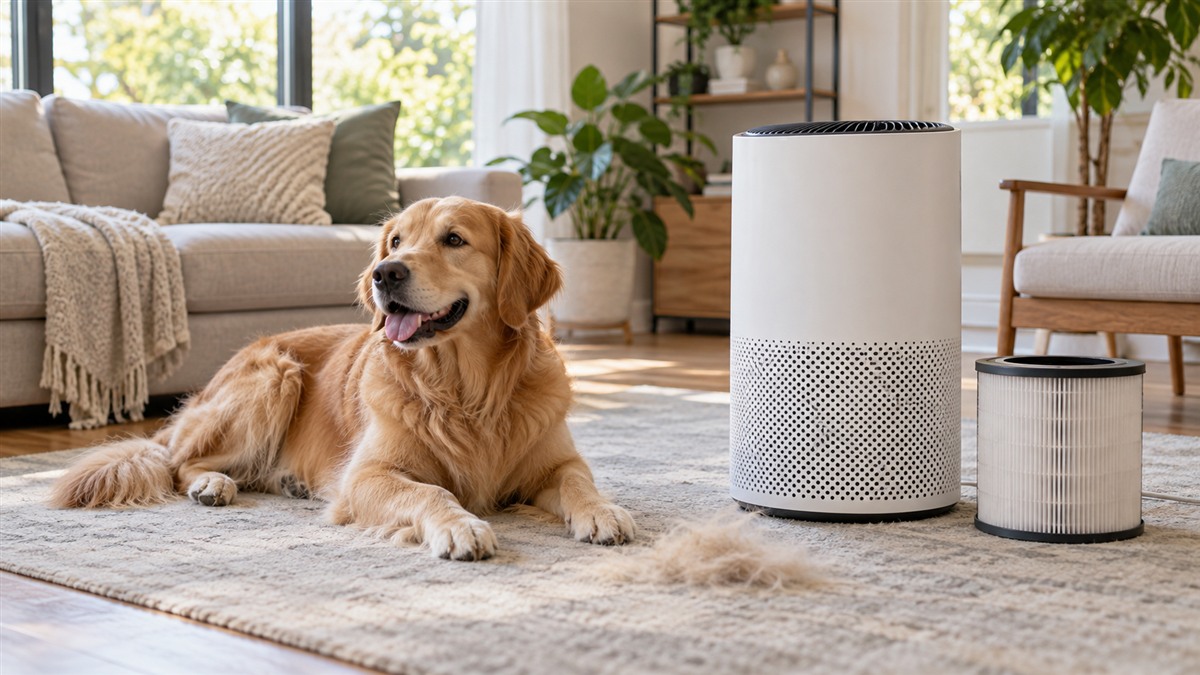
The person typing best air purifiers for dog hair usually wants fewer loose hairs in the air and on the floor, and often less pet odor. A purifier catches hair mostly at its intake and its pre-filter, but the substance that matters most for people with allergies is dander, which is a different thing. The ten listings in this set make many pet-hair claims and fewer room-size claims that can be checked. This post shows how to check the coverage numbers yourself and what the listings do and do not say about hair.
Quick answer
- Check coverage before you read any hair claim. A unit whose rated air delivery is too low for the room will not turn over the air in that room, whatever its intake looks like.
- Hair is caught at the intake and the pre-filter. A wide intake and a washable pre-filter matter more for hair than the HEPA label does.
- Dander is the allergen that the EPA and allergy-society pages focus on. HEPA air cleaners can help with allergy symptoms, but none of the pages we opened says a purifier clears a room of dander.
- Three listings give an air-delivery rating that fits their own room claim under the EPA rule of thumb. Two give a room claim their rating cannot support. The other five give no rating, so their coverage cannot be checked.
Hair is not the allergen
The allergy-society pet page draws the line that matters for a buyer. It says allergic dander in cats and dogs is not affected by the length of the hair or fur, or by how much the animal sheds. The proteins in dander, skin flakes, saliva and urine are what can set off an allergic reaction or aggravate asthma in some people. The same page notes that pet hair or fur can collect pollen, mold spores and other outdoor allergens, so hair and allergens do travel together, but they are not the same thing.
That means a listing that promises to catch pet hair is solving a visible problem. Loose hair on the sofa, the bed and the intake grille is real, and a purifier can reduce it. A hair claim does not, by itself, tell you what the unit does to dander. The same allergy-society page says HEPA air cleaners can be a big help in removing unwanted allergenic particles from the air. The EPA guide says multiple studies with portable HEPA air cleaners have found improvements in one or more allergy and asthma symptoms. Neither page says a single unit clears a room, and the symptom findings describe people, not hair counts on the floor.
The same allergy-society page also says removing carpeting and rugs can help, because they can trap pet dander and other allergens. That matters for the rug post in this set, and it is a reason to read the room-size numbers here as one part of a bigger picture.
What the listings say about hair
The table below gives each listing’s hair wording, the part of the unit that does the catching, and whether the spec field names pet hair as a contaminant.
| Listing | Hair wording in the bullets | Catching part | Spec field names pet hair? |
|---|---|---|---|
| Levoit Vital Pet Pro | Auto-clean pre-filter described as removing up to 95 percent of captured pet hair; wide U-shaped inlet described as capturing up to 99 percent of loose hair within 1.7 inches of the inlet | Auto-clean pre-filter and wide U-shaped inlet | Yes |
| MOOKA KJ190H | Larger front inlet and wider dual-side inlet described as pulling air from several sides and trapping airborne pet hairs | Washable pre-filter and dual-side inlet | Yes |
| Dhyala KJ03 | Multi-intake design, with a washable pre-filter described as catching impurities from pet hair to tiny particles | Washable pre-filter and multi-intake | No; pet dander is named instead |
| HEAPETS P358 | Dual-sided U-shaped inlets described as less prone to clogging with pet hair | U-shaped inlets and washable pre-filter | Yes |
| KNKA APH2500P | Six-way bottom intake described as capturing pet hair close to where it gathers | Six-way intake and reusable pre-filter | Yes |
| PuroAir 240 | Hair is not described on its own; pet dander and VOCs are named | Three-layer filter and 360-degree intake | Yes |
| DAYETTE AP308 | Washable pre-filters described as capturing pet hair before the H14 HEPA filters | Two washable pre-filters and dual intake | Yes |
| Winix 5520 | Washable fine mesh pre-filter described as the first line of defense for the largest particles; hair is not named | Mesh pre-filter | No; the spec field says only High |
| uahpet mate E204 | U-shaped clog-resistant intake described as engineered for floating cat and dog fur | U-shaped intake and washable pre-filter | Yes |
| DREO DR-HAP008 | Large intake and 360-degree spiral airflow; hair is not named | Pleated filter in the spec field; 3-in-1 filter in the bullets | No; pet dander is named instead |
The clearest hair claims come from Levoit, uahpet, HEAPETS and KNKA, and each one is an intake or pre-filter design rather than a filter rating. The Levoit wording needs care. The 95 percent figure for the pre-filter comes from a note in the listing that describes a test with 0.2 grams of cat fur, and the 99 percent intake figure applies only within 1.7 inches of the inlet. A dog’s hair load is different from that test, and the listing does not describe a dog-hair test. Read the figures as the seller’s own, and read the intake design as the thing a buyer can see and check.
Three listings in the set do not name pet hair in their spec field. Dhyala and DREO name pet dander there instead, and Winix’s field gives only the word High. A buyer whose main problem is loose hair should look for a listing whose spec field and bullets both name hair, as Levoit, MOOKA, HEAPETS, KNKA, DAYETTE, uahpet and PuroAir do.
Room size: the coverage math you can check
The EPA guide gives the rule that matters most. It says the clean air delivery rate, or CADR, should be large enough for the room, and that the higher the CADR, the more particles a unit can filter and the larger the area it can serve. It also says the CADRs are calculated based on an 8-foot ceiling, and that the CADR rating system is for particles only, so it says nothing about gases or odors.
The EPA chart is the most useful number in the guide. It lists a minimum CADR of 65 cubic feet per minute for a 100 square foot room, 130 for 200 square feet, 195 for 300, 260 for 400, 325 for 500 and 390 for 600. Each 100 square feet adds 65 cubic feet per minute, so the chart works out to 0.65 cubic feet per minute for each square foot of floor. Our planning estimate uses that rule in two directions. To check a rating against a room, divide the rating by 0.65 to get the room size it can serve. To check a room claim, compare the room with that figure.
A second check is the air-change rate. Air changes an hour equal the CADR, times 60 minutes, divided by the room’s floor area times the ceiling height. With the EPA’s 8-foot ceiling, the formula becomes the CADR times 60, divided by the floor area times 8. Here is how the three rated listings work out, using the figures each one states:
- Levoit: 148 times 60 is 8,880. 229 times 8 is 1,832. 8,880 divided by 1,832 is about 4.8 air changes an hour, which matches the listing’s claim for 229 square feet.
- DREO: 115 times 60 is 6,900. 178 times 8 is 1,424. 6,900 divided by 1,424 is about 4.8, which matches the listing’s claim for 178 square feet.
- KNKA: 119 times 60 is 7,140. 184 times 8 is 1,472. 7,140 divided by 1,472 is about 4.85, which matches the listing’s claim for 184 square feet. KNKA’s 893 square foot claim at one change an hour also works out, because 119 cubic feet per minute over 893 square feet at 8 feet works out to about one change an hour.
The table puts the whole set side by side. The last column uses our planning estimate, the rating divided by 0.65.
| Listing | Rating listed | Room claim in the listing | Room size by the EPA rule | Result |
|---|---|---|---|---|
| Levoit Vital Pet Pro | 148 cfm | 229 square feet at 4.8 changes an hour | about 228 square feet | Matches |
| DREO DR-HAP008 | 115 cfm | 178 square feet at 4.8 changes an hour | about 177 square feet | Matches |
| KNKA APH2500P | 119 cfm for smoke | 184 square feet at 4.8 changes an hour; 893 square feet at one change an hour | about 183 square feet | Matches |
| Dhyala KJ03 | Up to 265 cfm | Up to 3,000 square feet in one hour | about 408 square feet | Does not match |
| HEAPETS P358 | Up to 176 cfm | Up to 2,500 square feet once per hour | about 271 square feet | Does not match |
| MOOKA, PuroAir, DAYETTE, Winix, uahpet | Not stated | Coverage given without a rating | Cannot be checked | No rating to check |
The two listings that do not match are worth working through. For Dhyala, 265 times 60 is 15,900, and 3,000 times 8 is 24,000. 15,900 divided by 24,000 is about 0.66, so at its stated rating the unit gives about two thirds of one air change an hour in a 3,000 square foot room. One full change would take about 91 minutes, because 24,000 divided by 265 is about 91. The listing’s claim of one hour would need a rating near 400 cubic feet per minute, which is more than the 265 it states.
For HEAPETS, 176 times 60 is 10,560, and 2,500 times 8 is 20,000. 10,560 divided by 20,000 is about 0.53, so at its stated rating the unit gives about half an air change an hour in a 2,500 square foot room. The once-an-hour claim would need about 333 cubic feet per minute, because 20,000 divided by 60 is about 333.
One limit applies to both. The EPA chart stops at 600 square feet, so the rule of thumb is an extrapolation for any larger claim. Our planning estimate can say that the two listings’ room claims are far above what their stated ratings support under the same method the EPA uses. It cannot say what the seller’s own method is, because neither listing names one.
Pre-filters, washing and filter life
The pre-filter is the part that catches hair, and washable pre-filters appear across this set. DAYETTE, MOOKA, Dhyala, HEAPETS, Winix, uahpet and KNKA all describe a washable or reusable pre-filter, and Levoit describes an auto-clean pre-filter that the listing says reduces buildup. The listings describe the pre-filter as the layer that catches hair before it reaches the main filter, and a pre-filter that can be rinsed or cleaned is the feature they stress. We could not verify how much longer a main filter lasts because of a washable pre-filter.
Filter-life claims appear too, and each one is the listing’s own. DAYETTE gives a reminder after 3,000 hours of use. KNKA advises replacing its filters every three to six months. HEAPETS says its replaceable pre-filter pads can extend the life of the main HEPA filter from three to six months. uahpet says its washable pre-filter extends the life of its HEPA layer by more than 50 percent. None of these figures is backed by a test in the pages we opened.
HEAPETS also gives a usage note that is worth taking seriously. It says that placing the purifier near the pet, using Pet Mode and running it for at least four hours a day helps, and that pet-hair collection may become noticeably more effective after about 30 days. That is the listing’s guidance, and it means a new unit should not be judged on the first afternoon.
Odor and gas
The EPA guide draws a clear line here. It says that a portable air cleaner with a high CADR and an activated carbon filter can filter both particles and gases, and that the CADR rating covers particles only. So the odor claim is a separate question from the rating. Most of the ten listings name an activated carbon layer or a carbon filter, and the odor claims in those listings are general. Levoit names 140 grams of activated carbon. HEAPETS says its carbon layer helps adsorb some airborne litter box odors, and adds that actual odor improvement may vary. DAYETTE names activated carbon pellets. Winix names a high deodorization carbon filter in its title. None of these odor claims was tested in the pages we opened.
Read odor claims as a feature that can be present or absent, and do not treat them as a measure of how much the unit reduces pet smell in your home. HEAPETS says actual odor improvement depends on odor concentration, room size, ventilation and filter condition, so the filter schedule matters as much as the claim itself.
Noise and sleep
Several units in this set are described as quiet enough for a bedroom, and the listing figures are not all consistent. The table gives each figure as it appears.
| Listing | Noise as listed | Note |
|---|---|---|
| Levoit Vital Pet Pro | 21 dB in sleep mode | Bullet and spec agree |
| MOOKA KJ190H | 20 dB | Bullet and spec agree |
| Dhyala KJ03 | 15 dB in the title and bullet | Spec field says 20 dB |
| HEAPETS P358 | 25 dB in sleep mode | Pet Mode and Sleep Mode both named |
| KNKA APH2500P | 25 dB | Spec field only |
| PuroAir 240 | 22 dB | Spec field only |
| DAYETTE AP308 | 22 dB in sleep mode | Bullet and spec agree |
| Winix 5520 | 23.5 dB at the slowest speed | Spec field says 27 dB |
| uahpet mate E204 | 25 dB in sleep mode | Bullet and spec agree |
| DREO DR-HAP008 | 24 dB | Spec field only |
The Dhyala and Winix figures disagree with themselves. Neither listing says which figure applies to which speed, so the decibel number on the page is the seller’s word. For a bedroom, check the sleep-mode figure, and check whether the listing says the display lights go off, because several listings say they do.
Ozone and the certification names
Certification names appear in most of these listings, including CARB, ETL, UL, AHAM, EPA, FCC and CE. A certification name tells you that the seller claims one, and it is not a test result for this post. The EPA guide makes one point about air cleaners that matters more than the list of logos. It says to avoid portable air cleaners that intentionally produce ozone, and it says that ozone is a lung irritant. It also names electrostatic precipitators, ionizers, some UV lights and plasma units as designs that may emit ozone. Both the California Air Resources Board and the Association of Home Appliance Manufacturers keep lists of air cleaners tested and shown to emit little or no ozone.
Check the exact model number against one of those lists before you buy. MOOKA’s listing says “No ozone release”, which is the seller’s own claim. The CARB or AHAM list is the place to confirm any model’s ozone status.
Hair versus dander in a room with a dog
The distinction between hair and dander decides what a purifier can promise. The listings describe the intake and pre-filter as the parts that catch hair before it reaches the main filter. The allergy-society page says dander stays in the air and settles on furniture and clothing, which is why the HEPA description and the room-size math matter more for allergy than the intake design alone. A unit that handles hair well may still leave dander in the room if its rating does not match the room, and a unit with an excellent HEPA layer may still leave hair on the floor if the intake is not designed for it.
In practice, a buyer whose main problem is hair should look for a wide intake or a clog-resistant design, a washable pre-filter and a rating that matches the room. A buyer whose main problem is dander or allergy symptoms should read the HEPA description and the rating first, and treat hair capture as a bonus. Either buyer should talk to a doctor or an allergist before relying on any purifier for allergy or asthma. The allergy-society page and the EPA guide both point in that direction, and neither offers a product recommendation.
Two more things help. Cleaning up the hair where it starts, with brushing and bathing, reduces what reaches any filter. The AKC shedding guide says a dog that sheds heavily may need brushing several times a week, and that pet vacuums can help with loose hair during grooming. The Texas A&M shedding note says reducing shedding begins with grooming, and it recommends brushing three to four times a week for five to ten minutes. The two links below cover related problems.
The car seat covers that repel dog hair roundup looks at a different surface, and the blankets for dogs that shed roundup covers the bedding side of the same problem.
How we chose
We chose this roundup from the ten items listed for this keyword, and we did not add or drop any of them. Each item appears as a card below, with its own pros, cons and a skip-if line.
We ordered the emphasis of the post by four questions. Does the listing give an air-delivery rating that can be checked against the room? Does the listing describe a hair-catching part, such as a pre-filter or an intake, in its own words? Does the spec field agree with the bullets on the main details, such as noise and filter type? Does the listing describe a pre-filter that can be washed? A unit that answers yes to more of these questions gets more of the analysis above.
We did not rank by price, customer ratings or review counts, because the listings we read do not include them. We did not reward a listing for strong wording about allergies, sleep or odor, because those claims are the seller’s and the pages we opened do not test them for these models.
What we could not verify
- Dog-hair capture for any unit. The Levoit figures come from its own note on cat fur, and no listing in the set reports a dog-hair test.
- Room performance. We did not measure any room, and the room math is a planning estimate built on the EPA chart.
- Dander removal for any unit. No listing gives an independent dander result, and the pages we opened do not name a model.
- Odor reduction and carbon life. These are the listings’ claims.
- Filter-life and wash-interval figures, including 3,000 hours, three to six months and more than 50 percent. None was verified.
- Certification names. We did not look up any model in the CARB or AHAM lists during this work, so those names remain the listings’ claims.
- The Dhyala and Winix noise conflicts, and the uahpet weight conflict, where the bullet says 5.73 pounds and the spec says 5.3 pounds.
- Room claims above 600 square feet, where the EPA chart does not reach. For those claims, the rule of thumb is an extrapolation.
The ten purifiers in this set
1. LEVOIT Smart Pet Air Purifier for Home Pets Large Room, Vital Pet Pro,White (Pre-filter claim with a stated test note)
Pros
- Auto-clean pre-filter described as removing up to 95 percent of captured pet hair
- Wide U-shaped inlet described as capturing up to 99 percent of loose hair within 1.7 inches
- Stated rating of 148 cfm fits its 229 square foot room claim under the EPA rule
Cons
- The 95 percent figure comes from a listing note about a test with 0.2 grams of cat fur, not dog hair
- The listing points buyers to a separate genuine filter, so the replacement is a purchase to plan for
Best for: Owners with a room of about 229 square feet who want a pre-filter built for pet hair and app control
Skip if: Your room is larger than about 229 square feet, or you need a dander figure from an independent test
View on Amazon (affiliate link)
2. MOOKA Air Purifier for Home Bedroom Large Room 2200 Ft², HEPA Filter, White (Large-room claim with washable filters)
Pros
- Listing claims 2,200 square feet with a washable H13 HEPA filter
- Dual-side air inlet described as pulling air from several sides to trap pet hairs
- Child lock and a 20 dB sleep mode named in the listing
Cons
- No air-delivery rating is listed, so the 2,200 square foot claim cannot be checked
- The listing says to remove the protective plastic bag from the filter before use
Best for: Owners who want a washable pre-filter and a quiet sleep mode in a large bedroom
Skip if: You need a rating to check the room size before you buy
View on Amazon (affiliate link)
3. Air Purifier for Home Bedroom Large Room up to 3000Ft², HEPA Air Purifier with Washable (Wi-Fi unit whose room claim the rating does not support)
Pros
- Dual washable pre-filters and a three-stage filter described in the bullets
- A 1.83-meter power cord that the listing calls anti-chew
- Smart Wi-Fi and voice control with Alexa and Google Assistant
Cons
- Rating of up to 265 cfm does not support the 3,000 square foot one-hour claim under the EPA rule
- Noise is 15 dB in the title and bullet, but 20 dB in the spec field
Best for: Owners of a room of about 400 square feet or less who want Wi-Fi control, using the rating as the room limit
Skip if: You need the 3,000 square foot claim to hold, or you cannot reconcile the noise figures
View on Amazon (affiliate link)
4. Pet Air Purifier for Home Large Room 2500 Sq Ft, H13 HEPA Double-Sided Filter with Washable (Pet-mode unit with U-shaped intakes)
Pros
- Dual-sided U-shaped inlets described as less prone to clogging with pet hair
- Pet Mode for heavy shedding periods, plus a washable pre-filter
- Sleep mode at 25 dB and a 12-month warranty named in the listing
Cons
- Rating of up to 176 cfm does not support the 2,500 square foot once-an-hour claim under the EPA rule
- The listing says pet-hair collection may take about 30 days to become noticeably more effective
Best for: Owners whose room is about 270 square feet or less and who want a pet mode for heavy shedding
Skip if: You need the 2,500 square foot claim to be accurate, or you expect results on day one
View on Amazon (affiliate link)
5. KNKA Pet Air Purifier for Home Pets Large Room, PetAir, APH2500P, White (Rating that fits its room claims)
Pros
- Room claims use the lowest of its four ratings, 119 cfm for smoke, which is the conservative figure
- Six-way intake and reusable pre-filter described for pet hair near where it gathers
- Pet mode and a purple indicator light that the listing says turns off after an hour
Cons
- The listing gives no pet-hair rating, so hair capture cannot be checked
- Its replacement interval of three to six months is the listing's own figure
Best for: Owners of a room of about 180 square feet who want a pet mode and an intake built for hair
Skip if: Your room is larger than about 184 square feet and you need about 4.8 air changes an hour
View on Amazon (affiliate link)
6. PuroAir 240 HEPA Air Purifiers for Home Pets Bedroom 1000 Ft² – Black (Coverage claim with no air-delivery rating)
Pros
- Three-layer filtration of pre-filter, HEPA and carbon named in the bullets
- Automatic air-quality sensor and a quiet sleep mode with a 22 dB figure
- Two-year manufacturer warranty listed in the spec field
Cons
- No air-delivery rating is stated, so the one-hour claim for 1,000 square feet cannot be checked
- Allergy and sleep benefits are the listing's own claims, and the pages we opened do not test this model
Best for: Owners of a bedroom around 1,000 square feet or less who want a sensor and a carbon layer
Skip if: You need a figure you can check, or you want a unit whose bullets describe pet hair
View on Amazon (affiliate link)
7. DAYETTE Pet Air Purifier for Home Large Room 3400 Ft², TVOC & PM2.5 Sensors (Enhanced pet mode with a 3,000-hour reminder)
Pros
- Enhanced Pet Mode described for airborne pet hair, dander and odors
- Two washable pre-filters that catch pet hair before the H14 HEPA filters
- Filter reminder after 3,000 hours of use, according to the listing
Cons
- No air-delivery rating is stated, so the 3,400 square foot one-hour claim cannot be checked
- The listing gives no capture rate for pet hair, so Enhanced Pet Mode is the seller's own term
Best for: Owners who want washable pre-filters and a timed filter reminder for a large room
Skip if: You need an air-delivery rating before you buy, or you want the room claim checked against one
View on Amazon (affiliate link)
8. WINIX 5520 Air Purifier for Home Large Room Up to 1882 Ft² in 1 Hr With Air Quality Monitor, True (Heaviest unit with a listed weight)
Pros
- Washable fine mesh pre-filter described as the first line of defense for the largest particles
- AHAM verification and a real-time air-quality indicator, per the listing
- Nearly silent at the slowest speed, rated 23.5 dB in the bullet
Cons
- Spec field gives 27 dB, which conflicts with the 23.5 dB bullet
- At 13.3 pounds it is the heaviest unit with a listed weight in this set, and its pre-filter description does not name hair
Best for: Owners who want a fixed large-room unit with a mesh pre-filter and an air-quality light
Skip if: You want a pet-hair claim in the listing, or you need a unit you can move easily
View on Amazon (affiliate link)
9. uahpet Pet Air Purifier, H13 HEPA Filter for Pet Hair, Dander & Odors, 2100 Sq Ft Coverage, Plug (Plug-in unit with a clog-resistant fur intake)
Pros
- U-shaped clog-resistant intake that the listing says is engineered for floating cat and dog fur
- H13 HEPA and activated carbon, with a washable pre-filter
- Plug-in use with no app or Wi-Fi, and a 25 dB sleep figure
Cons
- Weight conflicts: 5.73 pounds in the bullet and 5.3 pounds in the spec field
- No air-delivery rating is stated, so the 2,100 square foot claim cannot be checked
Best for: Owners who want a simple plug-in unit with a fur-focused intake and no app
Skip if: You want app scheduling, or a rating you can use to check the room size
View on Amazon (affiliate link)
10. DREO Air Purifier for Home, HEPA Sleep Mode, AHAM VERIFIDE Air Purifiers for Bedroom, Pets, Smoke (Rated unit whose spec lists dander, not hair)
Pros
- AHAM verified 115 cfm rating, with a 178 square foot room at 4.8 air changes an hour
- PM2.5 monitor with a four-color indicator and an Auto mode
- Noise of 24 dB in the spec field, a Sleep mode in the bullets, and a scent pad option
Cons
- Spec field names pet dander in its contaminant list but not pet hair
- The bullets describe a 3-in-1 filter, while the spec field says pleated
Best for: Owners of a room of about 178 square feet or less who want a rated unit with a monitor
Skip if: Loose hair is your main problem, since neither the bullets nor the spec field names pet hair
View on Amazon (affiliate link)
FAQ
Does an air purifier remove dog hair from the air?
It catches hair that reaches the intake and the pre-filter. The listings describe that catch in different ways, and none gives a dog-hair capture rate that can be checked. Look for a washable pre-filter, an intake the listing describes as resisting clogs, and a rating that matches the room. Hair that has already settled on the floor needs vacuuming or brushing, not a purifier.
Is pet hair the same as pet dander?
No. The allergy-society page says allergic dander in cats and dogs is not affected by the length of the hair or fur, or by how much the animal sheds. Hair is what you see on the furniture, and dander is the allergen that can trigger symptoms in some people. A unit that handles hair well may not handle dander, so check the HEPA description and the room-size rating as well.
How big a unit do I need for my room?
Measure the floor area in square feet. Under the EPA rule of thumb, the rated air-delivery figure should be about 0.65 times the room’s square feet. A 200 square foot room, for example, lines up with about 130 cubic feet per minute on the EPA chart. The EPA also says the ratings assume an 8-foot ceiling, and it suggests a higher rating for higher ceilings.
Are ozone-producing purifiers a risk?
The EPA guide says to avoid air cleaners that intentionally produce ozone, because ozone is a lung irritant. It names ionizers, electrostatic precipitators, some UV designs and plasma units as types that may emit ozone, and it points buyers to the CARB and AHAM lists of units that emit little or no ozone. Check the exact model number on those lists before you buy.
Do washable pre-filters need replacing?
Listings describe rinsing the pre-filter and replacing the main filter on a longer schedule. DAYETTE gives a reminder after 3,000 hours, KNKA advises replacement every three to six months, and HEAPETS says its pre-filter pads can extend the main filter’s life. These are the listings’ figures and we did not verify them. Follow the reminder on your unit and the instructions that came with it.
Will a purifier help with allergies?
That is a finding about symptoms in studies, not a promise for any one home, and it does not name a model. If allergies or asthma are a concern, talk to a doctor or an allergist before you rely on a purifier.
Bottom line
Choose by room size first. If the rated air-delivery figure is at least 0.65 times the room’s square feet, the unit meets the EPA rule of thumb, and Levoit, DREO and KNKA do so on their own figures. Choose a unit with a washable pre-filter and an intake designed for hair if loose hair is the main problem, and a unit whose HEPA description is clear if dander and allergy symptoms matter more. If a listing gives a room size without a rating, or a rating too low for its own claim, treat the claim as the seller’s word until you check it. Do not buy for the word hair on its own.
Sources
- EPA, Guide to Air Cleaners in the Home: CADR, the 8-foot ceiling, the room-size chart, HEPA and allergy symptom studies, ozone
- American Academy of Allergy, Asthma and Immunology, Pet Allergy: dander versus hair, HEPA air cleaners, carpets and rugs
- AKC, Dog Shedding: What to Expect and How to Manage It: hair around the home, brushing frequency, pet vacuums
- Texas A&M College of Veterinary Medicine, Brushing Up For Shedding Season: grooming as the starting point for less shedding