Dog Grooming Vacuum
As an Amazon Associate we earn from qualifying purchases.
A dog grooming vacuum should collect loose coat and clipped hair without making the grooming routine harder for the dog or the person handling it. The oneisall LM2 is the most balanced starting point here because its record identifies seven functions, a 1.5-liter cup, three suction settings, 59-decibel operation, and tools for coat, paw, and nail work. HEAPETS is the capacity choice with a 3-liter bin, while FIXR and Kavano pair 2-liter cups with stated noise levels at or below 50 decibels. The best match still depends on coat workload, sound tolerance, and which attachments will actually be used.
Quick answer
- Best all-around starting point: oneisall LM2 combines a 1.5-liter cup, three suction settings, and a seven-function kit with clipper and nail grinder.
- Best for fewer emptying pauses: HEAPETS supplies a 3-liter cup, the largest documented capacity among these six.
- Best documented quieter options: FIXR and Kavano both list operation at no more than 50 decibels; these are seller figures, not standardized measurements.
- Choose by routine: compare the attachments, cup size, hose reach, guide-comb lengths, and whether a tool works only while connected to suction.
Six grooming vacuums compared
| Model | Stated suction | Stated noise | Dust cup | Documented cutting range or guards |
|---|---|---|---|---|
| oneisall LM2 | 11 kPa; 3 levels | 59 dB | 1.5 L | Maximum cut 23 mm; exact full guard set not specified |
| Buenkee MAS 505 | 15,000 Pa in the title; 3 levels | No numerical value supplied | 2 L | Maximum cut 4 mm in the specification field |
| AiRiOBO 5-in-1 | 12,000 Pa; 3 levels | 60 dB | 1.8 L | 3, 9, 16, and 24 mm guards |
| Kavano | 12,000 Pa; 3 levels | At or below 50 dB | 2 L | Guide combs included; lengths not supplied |
| FIXR PG100 | 12,000 Pa; 3 levels | At or below 50 dB | 2 L | Six positions across three combs; 1/8 to 1/2 inch stated |
| HEAPETS | 3 levels; numerical suction not supplied | No numerical value supplied | 3 L | 3, 6, 12, 18, and 24 mm guards |
Match the machine to the coat workload
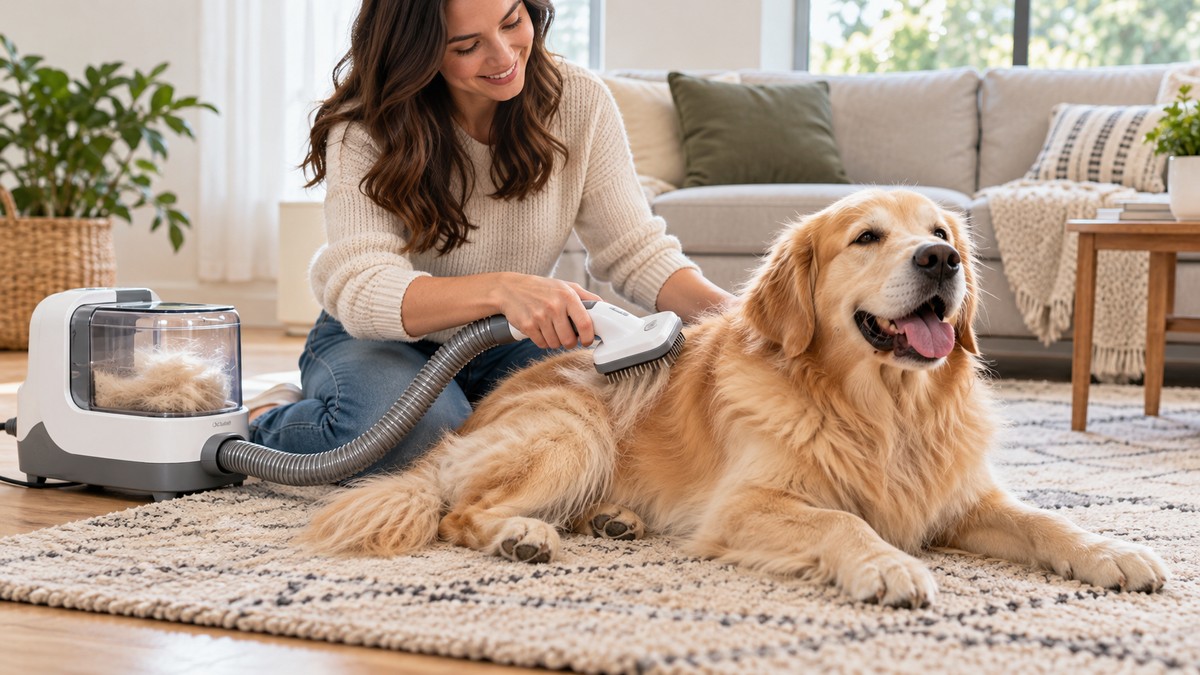
A grooming vacuum does two jobs at once: a brush or clipper loosens hair, and airflow moves some of that material through the hose into a container. The relative importance of those jobs changes by coat. A dog that sheds heavily may benefit most from a dedicated grooming brush and a larger cup. A dog receiving tidy paw, sanitary-area, or outline trims needs controllable cutting lengths and a clipper head that can reach the intended area. A short-coated dog may not need a long set of guards at all.
Start by listing the tasks performed during an ordinary month. If the list is brushing and deshedding only, a nail grinder adds no value to the coat workflow. If it includes body clipping, inspect the documented guide lengths rather than accepting “multiple combs” as sufficient. HEAPETS gives five numerical lengths from 3 to 24 millimeters. AiRiOBO provides four lengths over that same minimum-to-maximum interval. FIXR describes six size positions from one-eighth to one-half inch. Those ranges offer different spacing even when their attachment counts look similar.
Dense or tangled coat should be prepared before a clipper pass. A vacuum does not turn a clipper into a detangling tool, and pulling a guard through resistant coat can make the session uncomfortable. Brush out manageable knots and use an appropriate detangling method before trimming. Our dog grooming scissors set guide explains what those separate kits include when detail work is the actual need. Keep scissors and powered blades away from moving skin folds, and ask a professional groomer or veterinarian for help when coat condition, skin irritation, or handling behavior makes home work unsafe.
Dust-cup capacity: what the liters mean
The largest numerical difference in this group is container capacity. The supplied values are 1.5 liters for oneisall, 1.8 liters for AiRiOBO, 2 liters for Buenkee, Kavano, and FIXR, and 3 liters for HEAPETS. A larger cup can reduce interruptions, but liters do not state how tightly coat packs, how quickly the filter loads, or how much usable capacity remains before airflow falls. Fine coat, long clippings, and compacted fluff occupy the same container differently.
A simple comparison is capacity gain = larger cup − smaller cup. HEAPETS at 3 liters minus oneisall at 1.5 liters equals a 1.5-liter gain, or twice the nominal cup volume. Compared with a 2-liter model, the HEAPETS difference is 3 − 2 = 1 liter. This arithmetic describes container volume only. It does not prove that the larger unit can finish twice as many dogs or run twice as long between filter care.
Consider emptying access as well as volume. Hair can expand when the cup opens, so position the container deep inside a waste bag before releasing it. Check whether the filter must be removed first and whether the cup has corners that trap compacted material. Emptying before the fill line is reached may preserve airflow and make cleanup more controlled. Never rinse a filter, motor housing, or electrical connector unless the maker explicitly permits that method.
Suction numbers are not a complete performance scale
Four records publish suction figures: Buenkee states 15,000 Pa, while AiRiOBO, Kavano, and FIXR state 12,000 Pa. Oneisall identifies 11 kPa, which converts to 11,000 Pa because 1 kPa = 1,000 Pa. HEAPETS lists three levels without a numerical pressure value. On paper, Buenkee has the highest stated figure in this set.
Pressure alone does not tell how much hair reaches the cup. Hose diameter, hose length, attachment openings, seals, filter condition, and coat type all affect the path. The records do not describe a common measuring method, so a 15,000-Pa claim from one seller should not be treated as a laboratory comparison against another seller’s 12,000-Pa claim. A low setting may also be the correct starting point even when the machine offers more suction.
Look at tool dependence before choosing. Buenkee says its powered grooming arrangement works with the vacuum function; oneisall describes certain clipper, paw, and nail tools as part of the combined kit. The supplied information does not consistently explain whether every powered attachment can run separately from the hose. If cordless detail work away from the base unit matters, confirm that capability for the exact model rather than assuming it from the word “clipper.”
How to compare the noise claims
Kavano and FIXR state no more than 50 decibels, oneisall lists 59 decibels, and AiRiOBO lists 60 decibels. Buenkee and HEAPETS do not supply a numerical noise value in the provided fields. These numbers help identify what each seller is willing to specify, but they lack distance, room, attachment, suction setting, and measuring-method details. Without those conditions, a difference of several decibels cannot predict an individual dog’s response.
Motor pitch, airflow at the brush, hose movement, and vibration transmitted through a clipper can matter as much as the published number. Introduce the base unit before attaching a tool to the coat. Place it at a comfortable distance, switch it on briefly at the lowest setting, reward relaxed behavior, and stop before the dog becomes distressed. Over later sessions, move the inactive attachment near the body, then introduce airflow for a short pass. Do not restrain a frightened dog simply to complete the haircut.
A longer hose can create distance from the motor, but the six records do not all state hose length. That prevents a consistent reach comparison. Room layout still matters: the base should sit on a stable surface where the dog cannot step on the cord or pull the unit over. Route the hose with a broad curve, because a kink can restrict airflow and make tool movement less predictable.
Guide-comb range and clipping control
Guard count and cutting range answer different questions. Five guards may provide five lengths; three reversible or multi-position combs may provide six. The useful value is the set of documented finished lengths, not the number of plastic pieces. HEAPETS spans 3 to 24 millimeters, a difference of 24 − 3 = 21 millimeters. AiRiOBO also spans 21 millimeters but supplies four listed positions: 3, 9, 16, and 24. That leaves wider steps than a kit with more intermediate settings.
FIXR’s described interval of one-eighth to one-half inch converts approximately to 3.2 to 12.7 millimeters. Its upper cutting length elsewhere is listed as 1.5 inches, creating a conflict between fields. Because the supplied information does not resolve whether that larger figure refers to a different configuration, the comparison uses the clearly described comb interval and flags the inconsistency. Buenkee’s specification field gives a maximum cutting length of 4 millimeters, which is unusually short for a multi-comb kit and should be confirmed on the exact variant.
Never treat a guard as protection against every blade contact. Skin can fold, ears can move, and a comb can lift away from the body. Work with the coat growth, keep skin flat without stretching it harshly, and inspect blade temperature during a longer session. Product listings cannot determine the correct style or safe technique for a particular coat. A professional groomer is the better route for mats close to skin, unfamiliar breed patterns, or a dog that cannot remain comfortable and still.
Attachments that earn their storage space
The oneisall set is the broadest task bundle: grooming brush, deshedding tool, clipper, paw trimmer, nail grinder, nozzle, and cleaning brush. HEAPETS also lists seven tools, but its bundle emphasizes a massage comb and hair roller instead of a separate paw trimmer and nail grinder. That makes oneisall better suited to a household seeking several grooming functions from one base, while HEAPETS directs more of its accessory count toward coat care and cleanup.
AiRiOBO and Kavano are narrower five-function systems. Both include a clipper, grooming brush, and cleaning attachments. FIXR adds three guide combs with six positions, a crevice nozzle, and a storage bag. Buenkee identifies a clipper, shedding brush, guide combs, and storage bag, but its complete component count is less explicit in the structured specifications. Choose a short list of attachments you can name a job for. An unused massage tool or nozzle should not decide the purchase.
For a stable work surface and safer organization around cords, compare the setups in our dog grooming table guide. A vacuum and a table solve different problems: one manages loose coat, while the other changes working height and helps define the grooming area. Neither substitutes for calm handling or appropriate restraint.
Filters, hoses, and maintenance
Hair capture depends on a clear air path. Check the brush opening during use, because a dense wad at the attachment can reduce pickup before the cup appears full. After switching off and unplugging the unit, remove hair from the tool, inspect the hose, empty the cup, and service the filter according to the model instructions. Reassemble only after washable pieces are completely dry.
AiRiOBO describes HEPA filtration, while the structured fields for the other five do not consistently identify a filter grade. A filtration label does not establish capture performance for a complete system, because seals and maintenance also matter. Do not promise household air-quality outcomes from the filter name. The practical advantage that can be observed is containment: clipped and brushed material entering the cup is material that does not need to be swept from the immediate work area.
Cords deserve the same inspection as blades. Oneisall is specified for 110–130 volts, and these units are listed as corded electric machines. Keep plugs dry, do not operate a unit with damaged insulation, and position the cord away from paws and the handler’s walking path. The machines are not listed as waterproof. Coat should be dry unless the exact instructions state otherwise.
A low-stress first-week plan
On day one, unpack the machine away from the dog, identify each part, and operate the controls without an attachment. On a later short session, allow the dog to approach the switched-off hose. Next, run the base at a distance for only a few seconds. Progress to touching the coat with an inactive brush before combining contact and suction. This sequence isolates sound, touch, and airflow so the handler can see which element causes concern.
Keep early work limited to an easy body area rather than starting near feet, face, tail, or ears. Finish while the dog is still composed. If the dog repeatedly retreats, pants when the room is not warm, struggles, snaps, or cannot take a familiar reward, increase distance and shorten the task. Sudden sensitivity, painful skin, or marked coat changes warrant veterinary guidance instead of a more forceful grooming attempt.
A grooming dryer is a separate tool with different airflow and heat considerations. If drying after a bath is the larger problem, use the specifications in our dog grooming dryer comparison rather than expecting a debris vacuum to perform that job.
How we chose
All six products are vacuum-based grooming systems in the supplied research file. We compared the exact ASIN records for suction, numerical noise, cup capacity, power source, guide lengths, included tools, hose or cord information, filter description, and stated coat uses. We gave greater weight to fields tied to the selected model than to broad product-family language.
The shortlist keeps different priorities visible rather than turning one number into the winner. Oneisall has the broadest mixed grooming set with well-documented basic operation. HEAPETS has the largest stated cup. FIXR and Kavano publish the lowest noise ceilings. AiRiOBO supplies a clear four-step guard set, and Buenkee lists the highest suction figure. All performance statements remain seller claims unless they are straightforward physical specifications such as capacity or included parts.
Dog-weight ranges are not supplied for these machines because they are handheld grooming systems rather than wearable products. The records use coat or breed language instead. We therefore did not invent weight limits. We also excluded popularity signals, promotional savings language, and unsupported claims about professional-equivalent results.
What we could not verify
- The records do not provide a shared laboratory method for suction or noise, so those figures are not directly standardized.
- Actual usable cup capacity before airflow changes, filter replacement intervals, hose diameter, and long-term seal durability are not consistently stated.
- Buenkee’s 4-millimeter maximum cutting field and FIXR’s conflicting cutting-length fields could not be reconciled.
- The listings do not consistently say whether every powered hand tool works independently of the vacuum base.
- No selected record supplies a dog-weight range; suitability depends on coat, task, behavior, and attachment access rather than body weight alone.
- Claims about captured-hair percentages, calmer behavior, or salon-equivalent outcomes were not independently established.
Dog grooming vacuum picks
oneisall LM2 — best all-around attachment set
Why it stands out: The LM2 combines a 1.5-liter cup, three suction levels, a stated 59-decibel sound figure, and seven functions. Its clipper, paw trimmer, nail grinder, grooming brush, and deshedding tool cover more distinct grooming jobs than the narrower five-function kits. The specification record gives a maximum cutting length of 23 millimeters. No dog-weight range is stated.
Skip if: A cup larger than 1.5 liters or a seller-stated noise ceiling below 59 decibels is the priority.
Limitation: The complete numerical guard sequence and hose length are not supplied in the structured record.
Buenkee MAS 505 — best stated suction figure
Why it stands out: Buenkee lists 15,000 Pa, three suction levels, a 2-liter dustbin, stainless-steel blade material, and a storage bag. The exact unit measures 12.01 by 5.24 by 8.11 inches and is corded. Its description specifically tells handlers to introduce operating sound gradually. No dog-weight range is stated.
Skip if: You need a published decibel value or a clearly documented long cutting range.
Limitation: The 4-millimeter maximum cutting field is difficult to reconcile with the listing’s mention of multiple guide combs.
AiRiOBO 5-in-1 — best clearly spaced four-guard set
Why it stands out: The listing specifies 3, 9, 16, and 24-millimeter guards, 12,000-Pa suction, three levels, a 1.8-liter cup, and a 60-decibel figure. The kit includes a grooming brush, electric clipper, cleaning brush, and nozzle head. It is a more focused set than oneisall for shoppers who do not need nail tools. No dog-weight range is stated.
Skip if: You want closely spaced intermediate guard lengths or a cup of at least 2 liters.
Limitation: The supplied specifications identify package dimensions rather than clear assembled-unit dimensions.
Kavano — best low-noise five-tool option
Why it stands out: Kavano combines a seller-stated ceiling of 50 decibels with 12,000-Pa suction, three power levels, and a 2-liter container. Included components are an electric clipper, grooming brush, guide combs, crevice tool, and cleaning brush. Its listed machine dimensions are 7 by 2.5 by 6.5 inches. No dog-weight range is stated.
Skip if: Nail grinding, a paw trimmer, or numerical guide-comb lengths must be included.
Limitation: The exact comb sizes and hose reach are missing from the supplied fields.
FIXR PG100 — best six-position compact trimming set
Why it stands out: FIXR lists 12,000-Pa suction, operation at or below 50 decibels, a 2-liter detachable cup, three combs offering six sizes, a ceramic blade, crevice nozzle, cleaning brush, flexible hose, and storage bag. The description gives a one-eighth to one-half-inch comb interval. No dog-weight range is stated.
Skip if: You require a nail grinder, separate paw trimmer, or an unambiguous maximum cutting specification.
Limitation: The 1.5-inch maximum field conflicts with the smaller comb interval described elsewhere in the same record.
HEAPETS 3L — best capacity for heavy coat cleanup
Why it stands out: Its 3-liter cup is the largest documented container here. The seven-tool bundle includes grooming and deshedding brushes, a clipper with 3, 6, 12, 18, and 24-millimeter guards, massage comb, hair roller, cleaning brush, and nozzle. The unit offers three suction levels. No dog-weight range is stated.
Skip if: You need a numerical suction or decibel figure before comparing machines.
Limitation: The supplied package weight is 9.41 pounds, and the record does not provide assembled dimensions or hose length.
FAQ
Does a grooming vacuum replace brushing before clipping?
No. The vacuum collects material released by the attachment, but it does not make a tangled coat ready for a clipper. Remove manageable tangles with an appropriate brush or comb first. Mats close to skin can hide irritation and change blade clearance, so those cases are better handled by a professional groomer or veterinarian.
Is a lower decibel number always better?
It is useful documentation, not a guarantee of comfort. The listings do not give identical measurement conditions, and dogs can react to pitch, vibration, airflow, or the moving hose. Introduce any machine at its lowest setting and increase exposure gradually.
How large should the dust cup be?
Choose according to shedding volume and tolerance for emptying pauses. A 3-liter cup has twice the nominal volume of a 1.5-liter cup, but coat packs differently and filters may need attention before a container is full. A larger cup also creates a larger base to store.
Can the grooming vacuum be used on wet coat?
The selected machines are not listed as waterproof, and the records do not authorize wet-coat use. Keep the unit, plug, cord, hose connections, and powered tools dry. Follow the exact manual for the model rather than treating it as a bathing or drying appliance.
How often should the filter be cleaned?
No shared interval is supplied for these six models. Inspect airflow, the cup, and filter after each session, then follow the maker’s cleaning and replacement directions. Do not reinstall a washable filter while it is damp.
Which attachment should a beginner use first?
A grooming brush on an easy body area is usually a simpler introduction than a powered blade near paws or the face. Begin with the attachment inactive, then add low suction briefly. The correct progression is the one that keeps the dog calm and gives the handler controlled access.
Bottom line
Choose by the jobs you will perform, then use cup size, documented noise, and guard lengths as tie-breakers. oneisall LM2 is the broadest all-around starting point; HEAPETS offers the largest cup; FIXR and Kavano have the lowest stated noise ceilings. Confirm conflicting specifications before ordering, introduce the machine in stages, and stop if coat condition or behavior makes home grooming unsafe.
Sources
- Merck Veterinary Manual: Dog Owners — opened October 26, 2026.
- Cornell Riney Canine Health Center — opened October 26, 2026.
- VCA Animal Hospitals: Dogs — opened October 26, 2026.