How to Choose Dog Bowl Size: A Measuring and Feeding Guide
As an Amazon Associate we earn from qualifying purchases. Details
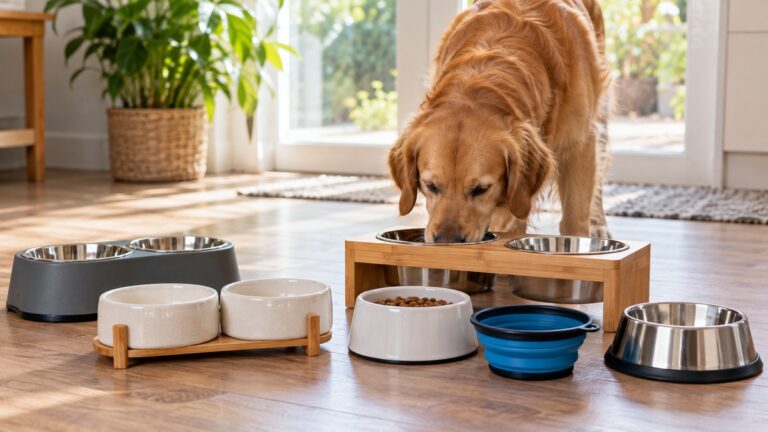
This guide explains how to choose dog bowl size by measuring your dog’s height at the shoulders and then comparing that number with the bowl’s own dimensions. Bowl size is a fit question, not a health prescription. The sources we opened do not agree on whether a raised bowl is safer or riskier than a floor bowl, so the choice of height should be discussed with your veterinarian. This guide covers the measuring steps, the feeding-speed evidence, and the points the sources leave open.
Quick answer
- Measure your dog’s height to the highest point where the shoulder blades and neck meet, according to PetMD.
- Compare that height with the bowl’s listed dimensions, and check whether the bowl lists the rim height, the inside depth or both.
- AKC says a solid recommendation cannot be made on whether elevated bowls are riskier than floor bowls for bloat, so talk to your veterinarian before you raise a bowl.
- AKC reports that fast eaters have five times the risk of bloat compared with slow eaters, so a slow-feed design deserves a look in addition to the size question.
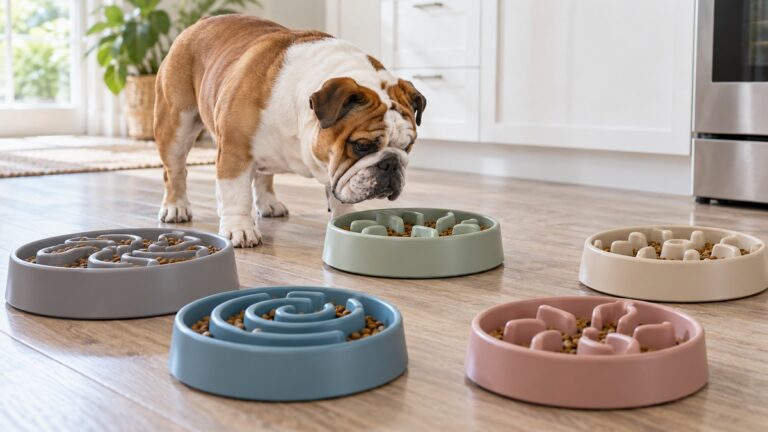
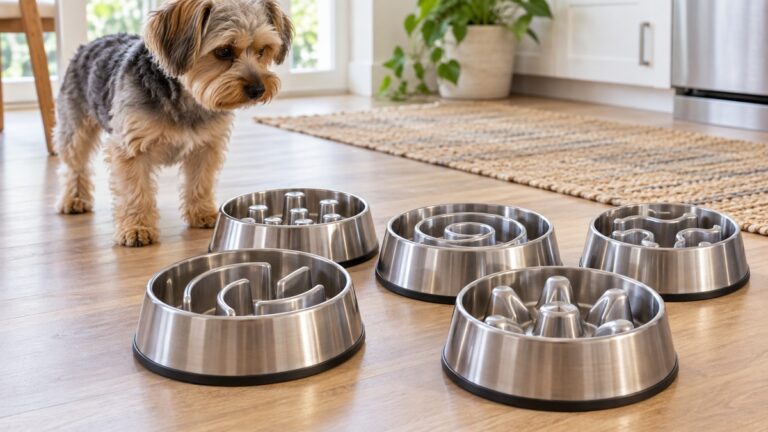
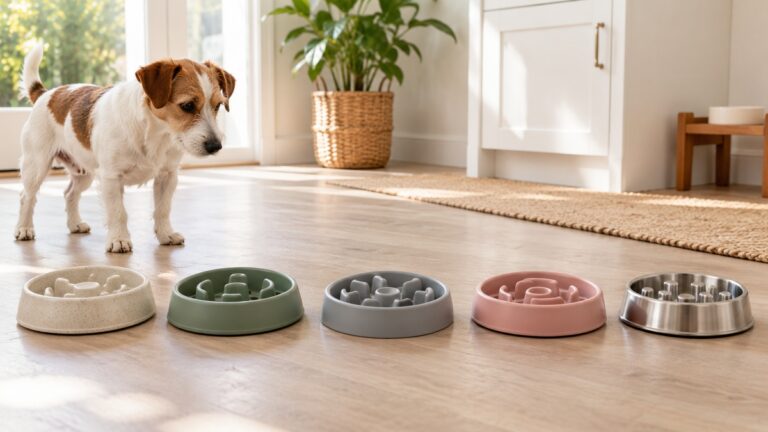
- AKC notes that slow feeder bowls with fingers or center posts can slow a dog down physically.
- The sources we opened do not give a bowl-size formula or a breed chart, so use the bowl’s own dimensions.
How we chose these steps
We opened three pages on October 23, 2026: the AKC guide on bloat in dogs, the PetMD guide to measuring a dog and the AKC guide to measuring a dog for gear. The measuring point and the feeding-speed points in this guide come from those pages. We did not add figures from memory. Where a page does not cover a point, we say so in “What we could not verify” at the end.
This is a how-to guide. It names no bowls, prices or ratings, and it does not rank bowls by brand.
What you need before you measure
- A soft fabric measuring tape or a flexible ruler. A rigid metal tape can be hard to read at the shoulder.
- A pen and a note with your dog’s name, the date and the height in inches.
- The bowl’s dimension chart, saved or printed. Check whether the chart lists the outside diameter, the inside diameter, the depth or the rim height, because the numbers are not interchangeable.
- A short list of questions for your veterinarian, if you plan to raise the bowl.
Step 1: Measure height at the shoulders
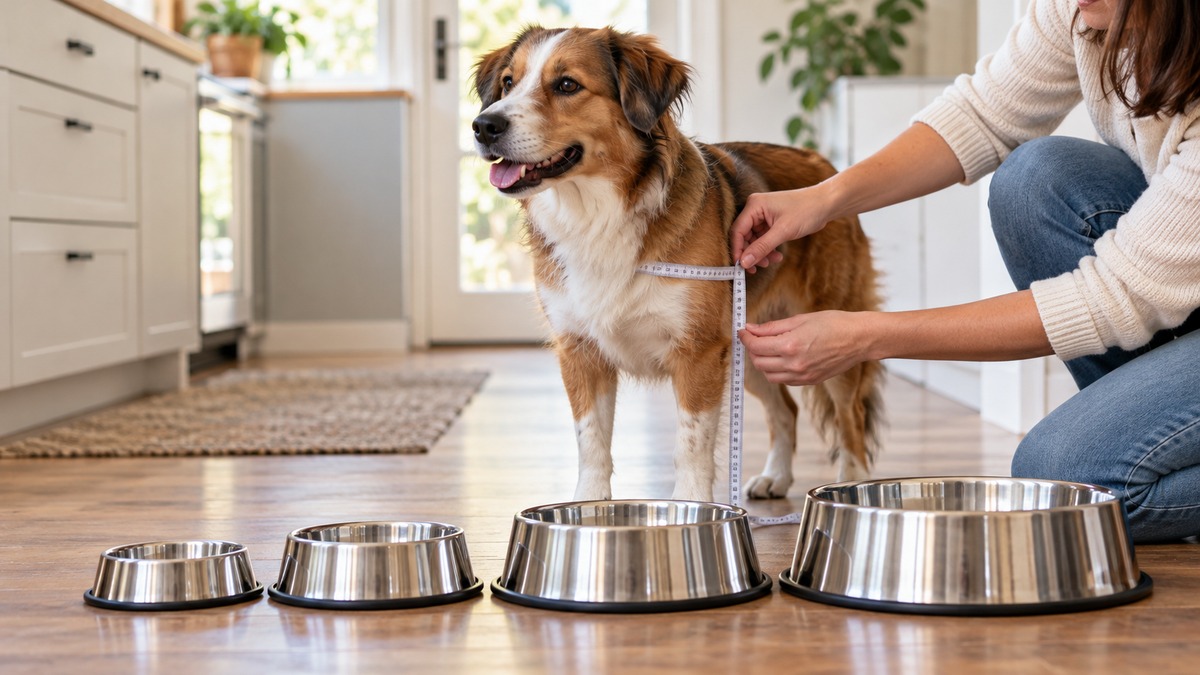
PetMD says that measuring height is particularly important when sizing a dog for a comfortable crate or harness. Its method is to measure to the highest point where the shoulder blades and neck meet. The same point is a useful reference for a bowl height check, and it is the number to bring to your veterinarian.
Use the same standing posture each time. Ask the dog to stand square on a flat floor with its weight even on all four legs. AKC notes that measuring while the dog stands gives the most accurate reading for gear, and says slouching should be avoided.
Hold the tape upright beside the dog. Read the number at the top of the shoulders. Do not measure to the top of the head, because that number is taller and does not match the bowl’s rim.
AKC describes the withers as the ridge between the shoulder blades. If the bowl chart uses the withers as its measuring point, measure to that ridge instead, and note which point you used.
Step 2: Check the bowl’s own dimensions
Bowl charts vary. Some list a diameter, some list a depth and some list only a rim height. Write down the labels exactly as the chart uses them. Do not compare the bowl’s outside diameter with your dog’s shoulder height, because those are different measurements.
Use this worksheet. Fill in your dog’s height first, then read the bowl’s chart and complete the last two columns.
| Measurement | Your dog (inches) | Bowl chart label | Bowl dimension |
|---|---|---|---|
| Shoulder height | Write your number | Check the chart | Check the chart |
| Rim height (if listed) | Not applicable | Check the chart | Check the chart |
| Inside depth (if listed) | Not applicable | Check the chart | Check the chart |
| Diameter (if listed) | Not applicable | Check the chart | Check the chart |
If the bowl chart does not list a height, the sources we opened do not give one, so you cannot compare the bowl’s height with your dog’s height from the chart alone. In that case, ask the maker for the rim height, or choose a bowl whose shape and depth suit your dog’s mouth and face.
Step 3: Think about the feeding speed first
Before the height question, consider how fast your dog eats. AKC reports that dogs fed one meal a day are twice as likely to bloat as those fed two meals a day. It also reports that fast eaters have five times the risk of bloat compared with dogs that are slow eaters.
These are risk figures from one source, so treat them as a reason to think about feeding habits rather than as a guarantee. Feeding speed, meal frequency and the bowl design are all points to discuss with your veterinarian, who knows your dog’s history.
AKC says that slow feeder bowls with fingers or center posts, or large rocks placed in a bowl, slow a dog down physically. It also says that anxiety around other dogs can be a risk factor for fast eating, so the feeding location matters too. If your dog eats quickly, a slow-feed design can be a practical starting point, while the height decision waits for your veterinarian.
If you are looking for a slow-feed design, best dog bowl to slow down feeding covers that type of bowl in more detail, and best slow feed bowl for wet food covers a different feeding situation.
Step 4: Decide on height with your veterinarian
AKC says that studies once suggested floor bowls caused more bloat, but that this was later debunked, and that elevated food bowls are now known to be just as much of a risk. It concludes that, with these conflicting results, a solid recommendation cannot be made.
That leaves the height decision open. For most owners, the practical step is to ask the veterinarian whether a raised bowl makes sense for the dog, given its size, age, medical history and eating habits. Bring your shoulder height measurement and the bowl’s rim height to that conversation.
If your veterinarian advises a particular height, follow that advice over the general steps in this guide. If the veterinarian has no preference, you can use the measured height as a starting point and check how the dog eats from the bowl over a few meals.
Do not raise or lower a bowl based on a chart alone. The sources we opened do not give a height rule that applies to every dog, and a height that fits one dog may not suit another.
Step 5: Check the fit with the dog
Once you have a bowl, watch the dog eat from it. Look at how the dog’s head and neck move, whether the dog has to stretch, and whether the dog can reach the food without the bowl tipping or sliding.
Look for these signs:
- The dog can reach the food without stretching its neck far forward or lifting its head up.
- The bowl stays steady on the floor, or on the stand, while the dog eats.
- The dog eats at a steady pace rather than gulping, if your dog is a fast eater.
- The dog can drink comfortably from the water bowl without the bowl being too deep or too high.
If the dog struggles to reach the food, the bowl may be the wrong height or depth. Discuss the change with your veterinarian before you make it, especially if the bowl is raised.
Mistakes to avoid
- Measuring to the top of the head instead of the shoulder point that PetMD describes.
- Comparing the bowl’s outside diameter with your dog’s height. Check the chart’s labels first.
- Raising the bowl without asking the veterinarian, when the evidence on raised bowls is mixed.
- Ignoring feeding speed. AKC links fast eating with a higher risk of bloat.
- Buying a bowl with no height information and guessing. Ask the maker, or choose another bowl.
- Assuming a breed chart is accurate for your dog. The sources we opened do not give breed sizes.
- Treating a slow-feed design as a substitute for a vet visit. AKC lists several factors, and the choice is best made with a veterinarian.
What we could not verify
- We could not verify a formula for bowl height, such as a set number of inches to subtract from shoulder height. The sources we opened do not give one.
- We could not verify whether raised bowls are safer or riskier than floor bowls. AKC says a solid recommendation cannot be made.
- We could not verify a general bowl diameter or depth for a given dog size. The sources we opened do not give bowl dimensions.
- We could not verify breed-based bowl sizes. The sources we opened do not list them.
- We could not verify how bowl material affects hygiene, safety or the dog’s comfort. The sources we opened do not cover that point, so this guide makes no claim about it.
- We could not verify the best bowl height for a dog with a medical condition. Ask your veterinarian.
- Where a bowl chart asks for a point this guide does not cover, the maker’s chart is the authority for that bowl.
FAQ
How do I measure my dog for a bowl height?
PetMD says to measure to the highest point where the shoulder blades and neck meet, with the dog standing. Compare that number with the bowl’s rim height, not the outside diameter.
Is a raised bowl better for dogs?
AKC says a solid recommendation cannot be made on whether elevated bowls are riskier than floor bowls for bloat. Ask your veterinarian before you raise a bowl.
Does feeding speed matter for bowl choice?
AKC reports that fast eaters have five times the risk of bloat compared with slow eaters. A slow-feed design, such as one with center posts or fingers, may be a practical step, and your veterinarian can advise on the rest.
What is the withers?
Some bowl charts use this point, so check the chart’s diagram before you measure.
What if the bowl chart does not list height?
Ask the maker for the rim height or choose a bowl with clear dimensions. The sources we opened do not give a height rule for bowls without that information.
How many meals a day matter for bloat?
Discuss your dog’s meal schedule with your veterinarian.
Bottom line
Measure your dog’s shoulder height, compare it with the bowl’s own rim height and dimensions, and think about feeding speed first. Because the sources do not give a settled answer on raised bowls, ask your veterinarian before you choose a height.
Sources
- https://www.akc.org/expert-advice/health/bloat-in-dogs/
- https://www.petmd.com/dog/general-health/how-to-measure-dog
- https://www.akc.org/expert-advice/lifestyle/measure-dog-gear/