How to Clean Metal Dog Bowls: Step-by-Step Guide
As an Amazon Associate we earn from qualifying purchases. Details
Knowing how to clean metal dog bowls comes down to a simple order: remove leftover food and debris, wash with a dishwashing detergent and warm water, rinse, and dry the bowl completely. When you need to disinfect, use a diluted household bleach solution, let it sit for a full 10 minutes, then rinse and dry again. The Maddie’s Fund cleaning handout we opened describes stainless-steel food and water bowls as very easy to clean and disinfect. This guide walks through each step, how often to repeat the routine, and the points the sources do not settle.
Quick answer
- Remove food and debris first. The handout states that cleaning always comes first, because a surface cannot be disinfected until it has been cleaned.
- Scrub with a dishwashing detergent such as Dawn, rinse well, and dry the bowl.
- For disinfection, spray a diluted household bleach solution on the bowl and let it sit for a full 10 minutes of contact time before the final rinse and dry.
- Make the bleach solution fresh, and store any leftover solution in an opaque container, because bleach breaks down in light and when mixed with water.
Why stainless steel is the easy case
Metal bowls are not all the same. The Maddie’s Fund handout lists stainless-steel food and water bowls among the supplies that are very easy to clean and disinfect. It also lists stainless-steel bowls among the bleach-safe objects, meaning a 1:10 or 1:32 dilution of household bleach would not damage them. Plastic food and water dishes sit on the other side of that line. The same handout puts plastic dishes in the group of supplies that are not as easy to clean and disinfect.
That difference matters for a routine. If your bowl is stainless steel, the full cleaning and disinfecting sequence can be used without worrying about the bowl itself. If your bowl is a different metal, or has a painted or coated finish, the sources we opened do not tell you whether bleach is safe for it, so check the maker’s care label before you disinfect.
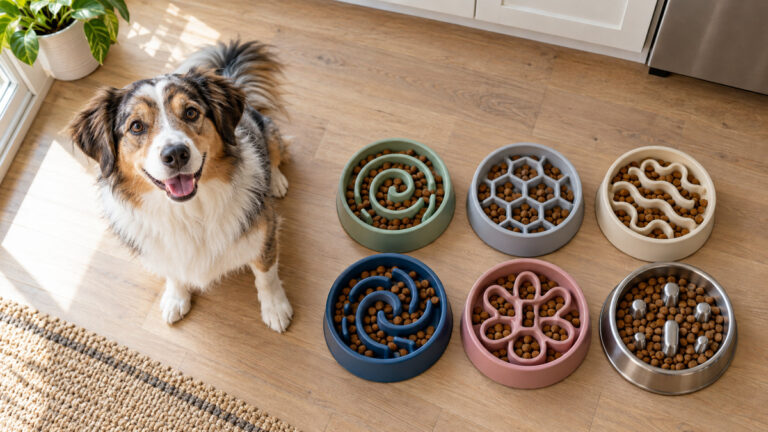
If you are comparing bowl designs as well as cleaning routines, our guide to a slow feed bowl for wet food covers a different question, and the non plastic slow feeder dog bowl guide looks at materials. Neither one replaces the cleaning steps below.
Step-by-step: the routine wash
Step 1: Clear away food and debris
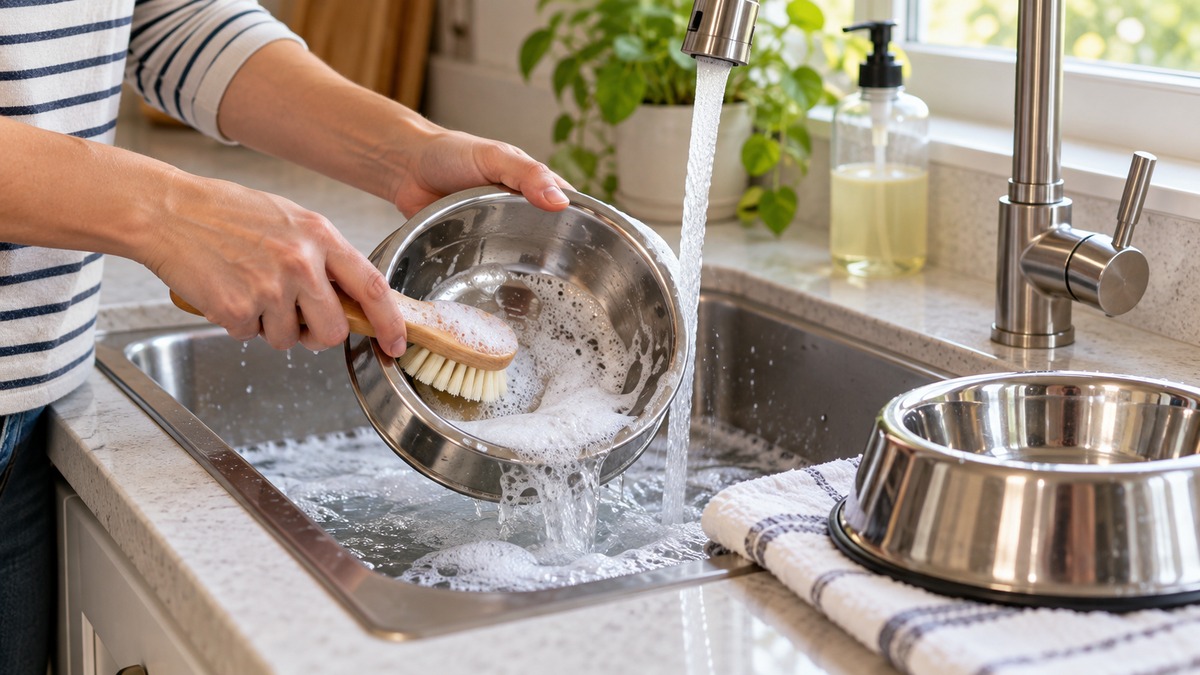
Start by emptying the bowl and removing any leftover food, drool, or debris stuck to the rim and base. The Maddie’s Fund handout lists the first step of cleaning as removing all debris from the object or surface. Removing debris first is important because the cleaning agent works on the surface, and food residue can stop it from reaching the metal.
Do this step at the sink, not on a bowl sitting on the floor, so the water and scrubbing stay in one place. Use a bowl brush or sponge for the inside curve and the rim, since these are the spots where food tends to sit.
Step 2: Scrub with a dishwashing detergent
Wash the bowl with a dishwashing detergent in warm water. The handout names a dishwashing detergent such as Dawn as a good choice for this step and explains that a detergent helps remove dirt and grease from surfaces. A degreaser is a stronger option for oily residue. The handout describes a degreaser as a very powerful detergent that specifically removes oils and other greasy debris.
Scrub the whole bowl, not only the bottom. Pay attention to the join where the rim meets the base, and the small ridge that some bowls have near the edge. Those areas hold moisture and food, so they need the same attention as the open surface.
Step 3: Rinse and dry
Rinse the bowl until no soap remains on the surface. The handout’s sequence for bleach-safe objects says to follow the scrub with a rinse and dry before any disinfection step. Leftover detergent can interfere with the next step, so do not skip the rinse.
Dry the bowl with a clean towel or let it air dry on a rack. Make sure the rim and the base are fully dry before you put food in the bowl again. A quick towel dry also means the bowl is ready for the next meal even on days you do not disinfect.
Step 4: Disinfect with diluted bleach when needed
The handout describes a dilution of household bleach as the best choice for disinfecting in a foster home, because it is highly effective and inexpensive. It also says that the dilution depends on the disease in question. A 1:32 dilution kills most infectious diseases except ringworm, and ringworm needs a stronger 1:10 dilution.
Bleach strength is the first thing to check. The handout notes that most household bleach sold in stores these days is an 8.25% concentration, even though most labels no longer list the concentration. It also warns that many older online recipes assume a 5.25% concentration, which is no longer the usual strength. Read the concentration on your bottle before you mix anything, and if your bottle is not 8.25%, use the handout’s approach to work out the right amount rather than copying a recipe.
For an 8.25% bleach, the handout gives these amounts:
- For a 1:32 dilution, add 1/3 cup of bleach to 1 gallon of water. The handout also gives an equivalent for a 32 oz spray bottle, which is about 17 ml of bleach to 32 oz of water.
- For a 1:10 dilution, add 1 cup of bleach to 1 gallon of water.
Then follow the disinfecting sequence. Spray the diluted bleach onto the bowl, cover the whole surface, and let it sit for a full 10 minutes of contact time. The handout explains that people often rinse too soon, but the bleach needs time to work. Apply enough solution that it does not evaporate before the 10 minutes is up. After the 10 minutes, rinse thoroughly and dry the bowl again.
Some infectious diseases are harder to remove from the environment. The handout says that for diseases such as feline panleukopenia virus, canine parvovirus, feline calicivirus, and ringworm, the disinfection and final rinse and dry steps should be repeated two more times. If you are dealing with one of these diseases, follow your veterinarian’s advice on how to proceed, because the handout is a cleaning guide and not a treatment plan.
Safety while using bleach
Bleach needs care. The handout says bleach can burn, and that people using it should wear gloves and masks, avoid exposing pets to the fumes, and make sure the room has adequate ventilation. The EPA-registered bleach label we opened says not to use the product at full strength for cleaning surfaces and to always dilute it strictly according to the directions.
How often to clean the bowls
The Maddie’s Fund handout gives a schedule for foster homes, which is the most direct guidance on frequency in our sources. It says to clean and disinfect at least weekly when all pets in the home are healthy, at least daily when a pet has an infectious disease, and as needed to clean up messes such as vomit, diarrhea, and nasal discharge. It also recommends cleaning before any new pets come into the household.
These are foster-home rules. The sources we opened do not give a single schedule for an ordinary family bowl. A practical routine is to wash the bowl with detergent after each meal, dry it, and then use the disinfecting step on the schedule that fits your household, keeping the foster-home guidance in mind if a pet is ill.
Hand washing after you clean
Handling a pet bowl means handling whatever the pet has touched. The UC Davis handwashing handout we opened says to wash hands after touching animals or their living area, before preparing food, and after leaving the animal area. It asks people to wet their hands with clean running water, apply soap, scrub well including the backs of the hands and under the fingernails, rub hands together for at least 20 seconds, rinse, and dry with a clean paper towel or air dry.
Wash your hands after you finish the bowl routine, and again before you prepare food. This matters most for children, older adults, and anyone with a weakened immune system, which the handout names as groups who should be especially careful.
How we chose
This guide is built only from sources we opened and read on 2026-10-23. The four sources are the Maddie’s Fund cleaning and disinfection handout for foster homes, the AKC article on cleaning a dog bed, a UC Davis handwashing handout, and an EPA-registered bleach label. We used the steps, dilutions, contact times, and cautions that these sources state, and we left out anything they do not state. We did not rank bowls, and this guide does not recommend any product. Where a point in a source is general, such as the advice to clean before you disinfect, we kept it general in the guide.
Common mistakes
- Disinfecting a dirty bowl. The handout is clear that cleaning comes first, and a surface cannot be disinfected until it has been cleaned.
- Rinsing the bleach off too early. The handout says the bleach needs the full 10 minutes of contact time, and a quick rinse does not give it that time.
- Using a bleach solution that is old. The handout says solutions must be made fresh at least every 24 hours, or more often, because bleach breaks down.
- Storing diluted bleach in a clear bottle. The handout says to keep it in an opaque container.
- Copying an old recipe for a stronger or weaker bleach. The handout notes that many online recipes still use a 5.25% concentration, while most store bleach is now 8.25%.
- Skipping the drying step. The handout’s sequence ends with rinse and dry, and standing water can leave residue in seams.
What we could not verify
- Whether a particular metal bowl is dishwasher-safe. The sources we opened do not say whether a dishwasher is a suitable way to clean metal bowls.
- Whether metals other than stainless steel, such as aluminum or steel with a painted or coated finish, can take bleach. The sources do not cover those materials.
- The right bleach strength for a bleach that is neither 8.25% nor the concentration the handout uses. The handout refers readers to an ASPCA bleach dilution calculator, but that page is not one of the sources in this guide.
- How often an ordinary household bowl needs disinfecting when no one in the home is ill. The handout’s frequency guidance is written for foster homes.
- Whether a rinse with plain water removes every trace of bleach from a bowl. The sources say to rinse thoroughly, but they do not say how many rinses are needed.
FAQ
Can I clean a metal dog bowl with dish soap?
Yes, according to the Maddie’s Fund handout, which names a dishwashing detergent such as Dawn as a good choice for the scrubbing step. Use warm water, scrub the whole bowl including the rim, rinse until no soap remains, and dry it.
Do I need bleach to clean a metal dog bowl?
Bleach is the disinfectant the handout recommends in foster homes. Routine cleaning is a separate step. The sources we opened do not say that every daily wash needs bleach, so the simplest routine is detergent and water, with bleach used when you need to disinfect.
How strong should the bleach solution be?
For most infectious diseases, the handout recommends a 1:32 dilution. For ringworm it recommends a stronger 1:10 dilution. Both figures assume household bleach at 8.25%, so read the concentration on your bottle before you mix.
How long should bleach stay on the bowl?
The handout calls for a full 10 minutes of contact time. Keep the bowl wet with the solution during that time so it does not dry out before the 10 minutes are up, then rinse thoroughly and dry.
Is stainless steel easier to clean than plastic?
The handout describes stainless-steel food and water bowls as very easy to clean and disinfect, and it lists plastic food and water dishes among the supplies that are not as easy to clean and disinfect. It also says stainless steel is bleach-safe, while bedding and similar items are not.
Should I wash my hands after cleaning the bowl?
Yes. The UC Davis handwashing handout says to wash hands after touching animals or their living area, and to rub hands together with soap for at least 20 seconds before rinsing and drying.
Bottom line
Clear the debris, wash with a dishwashing detergent, rinse, and dry. When you need to disinfect, use a freshly made 1:32 bleach solution for a full 10 minutes, or a 1:10 solution for ringworm, then rinse and dry again. Check your bleach concentration before you mix, and wash your hands afterward.
Sources
- https://www.maddiesfund.org/cleaning-and-disinfection-in-foster-homes/presentation_content/external_files/Educational%20Handout-%20Cleaning%20and%20Disinfection%20in%20Foster%20Homes.pdf
- https://www.akc.org/expert-advice/lifestyle/how-to-clean-a-dog-bed/
- https://ucfoodsafety.ucdavis.edu/sites/g/files/dgvnsk7366/files/inline-files/200948.pdf
- https://www3.epa.gov/pesticides/chem_search/ppls/005813-00001-20060925.pdf