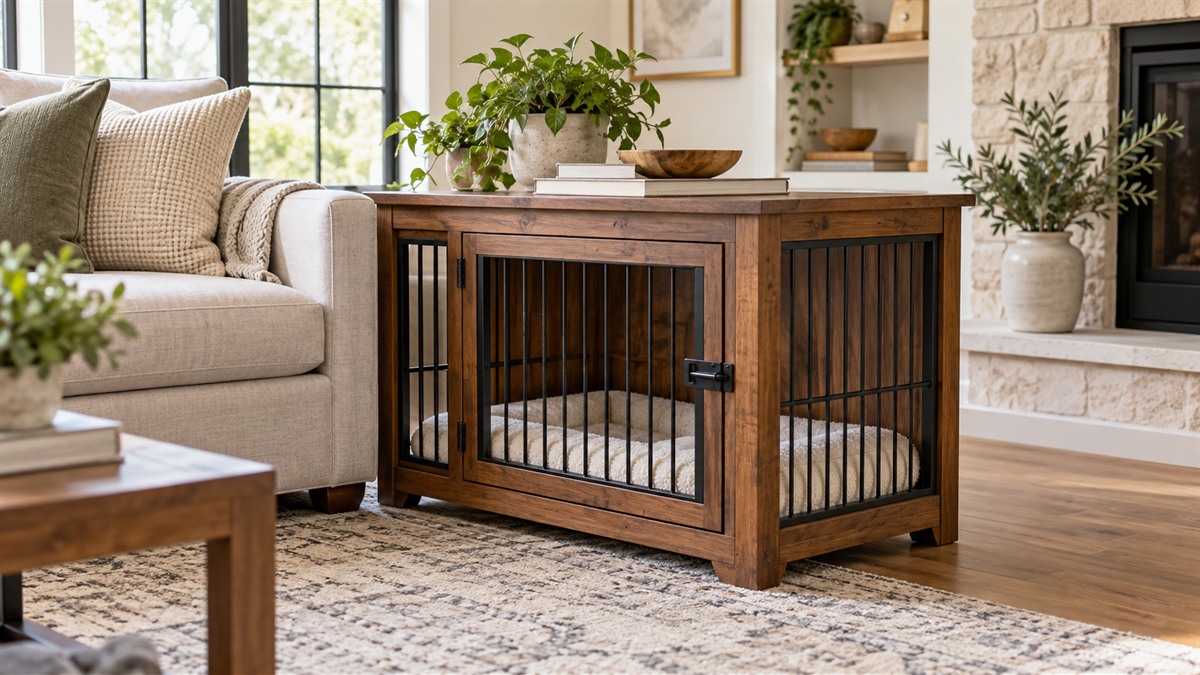
Hzuaneri 31.5-Inch Dog Crate Furniture Review
As an Amazon Associate we earn from qualifying purchases.
The Hzuaneri dog crate furniture suits a small or medium dog that is already comfortable in a crate and will live indoors, provided the dog fits the inside. The listing gives an inside space of 29.3 by 19.8 by 22.4 inches, a three-door arch design and a weight of 39.2 pounds, and it names French bulldogs, corgis and dachshunds as the intended breeds. It does not state a weight limit, and the chew and escape claims are the seller’s own words. Measure your dog and compare the numbers below before you order.
Quick answer
- Best fit: a small or medium dog that already accepts a crate and will stay indoors, in a living room or bedroom.
- Inside space: 29.3 x 19.8 x 22.4 inches, according to the listing. The dog, its bed and its bowl all have to fit inside that box.
- Not stated: a weight limit, a warranty period, and any independent result for the wood or the bars.
- Before first use: the chew and escape wording is the seller’s. Supervise a dog that chews, and check the bars and screws on a schedule.
Who this crate suits
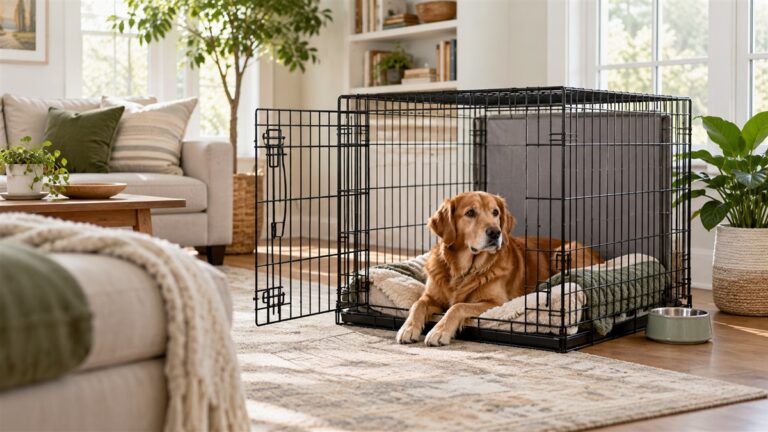
This crate is written for a crate-trained dog of small or medium size that will live indoors, mostly in a living room or a bedroom. The listing says the crate can double as a TV stand, a coffee table, a side table or a nightstand, which matters if it will sit in a room where people spend time. It is a poor fit for a large dog, for a dog that must stand tall to feel comfortable, and for any dog that chews wood or metal.
Owners of a puppy need a different plan. The American Kennel Club’s beginner guide suggests a larger crate, with part of it closed off by a divider, for a puppy that has a lot of growing ahead. This listing shows no divider, so a puppy would need one bought separately, or a second plan for the early months. If you want to think about what goes on top of the crate at night, our guide to a blanket over a dog crate at night covers the choices.
Older dogs need more thought. A crate gives a senior dog limited room to move, and the AKC notes that keeping a dog inside a crate for too long may be physically uncomfortable. If your dog has stiff joints or trouble with stairs, plan for a bed it can get on and off without strain. Our guide to orthopedic dog beds for senior dogs covers that choice.
What the listing says
The figures below come from the listing data collected on 2026-10-12. Each row says where the listing gives the figure, so you can check the bullets against the spec table yourself.
| Feature | What the listing says |
|---|---|
| Outside size | 31.5 x 22 x 24 inches (product dimensions) |
| Inside size | 29.3 x 19.8 x 22.4 inches (bullets) |
| Weight | 39.2 pounds |
| Material | Engineered wood and metal; 0.4-inch iron pipe with double welding points (bullets) |
| Bar gap | 0.4 inches (spec table) |
| Doors | Three doors, with two locks on each door (bullets) |
| Design | Arch front; can be used as a TV stand, coffee table, side table or nightstand (bullets) |
| Assembly | Required; assembly instructions and an accessory bag are included |
| Intended dogs | Medium breed size; French bulldogs, corgis and dachshunds named in the bullets |
| Use | Indoor (spec table) |
| Weight limit | Not stated |
| Warranty | Not stated in the listing data |
The listing gives no weight limit for the crate, no warranty period, and no independent result for the materials. Those gaps matter more than the marketing words, so the sections below work only from the stated numbers.
The fit calculation
Two numbers decide most of the fit: the floor area and the height. The floor area is the inside length multiplied by the inside width. Using the listing’s figures:
Floor area = inside length x inside width = 29.3 x 19.8 = 580.14 square inches, which is about 4.0 square feet (580.14 divided by 144 is 4.03).
Length check = inside length minus your dog’s nose-to-tail length. Take an illustrative dog that measures 24 inches from nose to base of tail. That dog leaves 29.3 minus 24, or 5.3 inches, for a bed, a bowl and turning around. That is a short margin, so a dog of that length would be a poor fit. This is an example with a made-up measurement, not a measurement of any real dog or of this crate.
Height check = the inside height of 22.4 inches, compared with the height your dog needs to stand with its head up. The listing gives no clearance above that figure. If your dog’s standing height is close to 22.4 inches, this crate is likely too low for it.
A bed takes up floor area as well. Suppose you plan a bed of 24 by 18 inches, which is an example size. It covers 24 x 18 = 432 square inches, leaving 580.14 minus 432, or 148.14 square inches, for the dog to lie in and turn. Run the same subtraction with the bed you actually buy, not with the example.
Chewing, escape and the seller’s wording
The listing calls the crate “Chewproof” in its spec table and uses anti-chew and anti-escape wording in its bullets. Those are the seller’s words, not results from an outside laboratory. The bullets do give specifications you can check against the crate itself: 0.4-inch iron pipe, double welding points, thickened engineered wood, and two locks on each door. Those facts are useful, but they do not show how a determined chewer will behave around the bars.
No crate is indestructible. A dog that bends bars, pulls at the wood or works at a latch needs supervision, and any part that loosens should be fixed or replaced before the crate is used again. Check the bars, welds, screws and latches once a week, and tighten or replace anything that moves. If your dog chews, give it chew toys of its own and watch how it uses them, as our guide to durable chew toys for small dogs explains.
Using the crate indoors: the size rule
The American Kennel Club’s beginner guide advises a crate large enough for a dog to stand up, lie down and turn around. It also says a crate bought for a growing puppy can be larger if a divider closes off part of it. The AKC’s newer crate-training guide makes the same point about puppies. It suggests buying a crate suited to the puppy’s adult size with a divider, so the puppy can grow into the space. The ASPCA’s travel guidance uses the same size rule for carriers in vehicles. That article is about transport, so treat its rule as a size guide and not as an instruction for a crate in a living room.
The AKC’s beginner guide also says a crate should never be used as punishment, and it describes the crate as a haven rather than a jail cell. The AKC’s newer guide adds that a dog of any age or breed can be taught to like its crate. Build that habit with short, calm stays before you leave a dog alone in one.
Apply that rule to your own dog. The listing gives the inside numbers, so you can compare them with your dog’s length and standing height without guessing. If the dog cannot stand, turn and lie down inside 29.3 by 19.8 by 22.4 inches, the crate is too small for it.
Buying checklist
- Measure your dog from nose to base of tail, and from the floor to the top of its head when it stands. Write both numbers down.
- Compare the nose-to-tail number with 29.3 inches, and the standing height with 22.4 inches.
- Subtract the floor area of the bed you plan to use from 580.14 square inches to see what space is left.
- Decide whether a divider is needed. This listing shows none.
- Ask the seller for a weight limit and a warranty period before ordering, since neither appears in the listing data.
- Confirm the room. The listing supports a living room or bedroom, and the furniture look is the seller’s own description.
Mistakes to avoid
- Treating “Chewproof” as a guarantee. The word is the seller’s, and the listing gives no independent result for it.
- Using it outdoors or in a car. The listing says indoor. The ASPCA article covers crates in vehicles, which need to be secured and are a different setup.
- Buying for a puppy without a plan for growth. The listing shows no divider, and the AKC suggests a divider for a puppy that is still growing.
- Skipping routine checks. The listing says assembly is required, so check the screws and bars after assembly and then on a schedule.
Product pick
Hzuaneri 31.5 Inch Dog Crate Furniture, Indoor Dog Kennel, White Brown
Best for: a crate-trained small or medium dog that will live in a living room or bedroom. The listing gives 29.3 x 19.8 x 22.4 inches inside.
Why it is here: it is the one listing from our search that matched the crate named in the title, and it is the subject of this review.
Skip if: your dog is large, needs more height than 22.4 inches, or chews wood or metal.
Limit: the listing states no weight limit for the crate.
How we chose
Our search for this keyword returned 25 results. One of them matched the crate in the title, and that listing is the only product this review covers. We did not rank it against other crates, and the other results are not covered here, so this is a single-product review rather than a comparison.
Our criteria were plain. We looked at the inside size, the outside size, the stated weight and materials, the door layout and the stated dog size. We treated any weight limit, warranty or durability claim as a gap unless the listing gave a figure for it. The listing data was collected on 2026-10-12, and the advice pages named at the end of this post were opened on 2026-10-21.
What we could not verify
- The weight limit. The listing gives none, and the advice pages we opened do not set one for this crate.
- Whether the wood and the 0.4-inch pipe resist a chewing dog. The listing claims resistance, but the pages we opened do not cover this product.
- Whether the locks stop a determined dog from escaping. The listing says the locks add protection, and no outside result confirms it.
- Warranty and replacement parts. Neither appears in the listing data.
- How long assembly takes. The listing says assembly is required and includes instructions, but it gives no time.
- Whether the crate’s height suits your room and your furniture. That depends on your home and your dog.
Frequently asked questions
Which dogs fit this crate?
The listing gives a medium breed size and names French bulldogs, corgis and dachshunds. It states no weight limit, so compare the inside numbers with your own dog before you buy.
Does it need assembly?
Yes. The listing says assembly is required and includes instructions and an accessory bag.
Can I use it as furniture?
The listing says it can serve as a TV stand, coffee table, side table or nightstand. Check the height and footprint against your room before you order.
Is it for outdoor use?
No. The listing says indoor. The ASPCA’s travel article covers crates in vehicles, which is a different setting with its own rules.
Can a chewing dog break out?
The listing claims anti-chew and anti-escape features, but it gives no outside result for them. Supervise a dog that chews, and check the bars, welds and latches on a schedule.
Bottom line
Buy this Hzuaneri crate only if your dog’s nose-to-tail length and standing height fit inside 29.3 by 19.8 by 22.4 inches, with room left for a bed. Treat the chew and escape wording as the seller’s claim, and keep checking the bars and latches.
Sources
- A Beginner’s Guide to Crate Training, American Kennel Club. https://www.akc.org/expert-advice/training/a-beginners-guide-to-crate-training/ (page updated 2018-06-18; opened 2026-10-21)
- Everything You Need to Know About Crate Training Your Dog, American Kennel Club. https://www.akc.org/expert-advice/training/how-to-crate-train-dog/ (page updated 2026-09-21; opened 2026-10-21)
- Traveling With Pets? Follow These Expert Dos and Don’ts to Keep Them Safe, ASPCA. https://www.aspca.org/news/traveling-pets-follow-these-expert-dos-and-donts-keep-them-safe (dated 2025-12-30; opened 2026-10-21)
Affiliate note for this page: As an Amazon Associate we may earn from qualifying purchases made through the links above.