Airline Approved Dog Crates: Cabin, Cargo and the Limits That Decide
As an Amazon Associate we earn from qualifying purchases. Details
Updated 19 October 2026 | Author: Editorial team, bestdogsstuff.com
Shoppers looking at airline approved dog crates usually want one answer first: which kind of crate their dog can fly in. Small dogs can often ride in the cabin in an approved carrier that fits under the seat in front of the owner. Larger dogs generally travel in cargo in an airline-approved crate. Which option applies depends on the dog’s size, the combined weight of dog and carrier, and each airline’s own rules, so check the airline before you buy a crate.
Quick answer
- Cabin travel uses an approved carrier that fits under the seat in front of you. AKC says small dogs can often travel this way.
- Cargo travel uses an airline-approved crate. AKC says larger dogs generally must travel this way.
- For cabin travel, AKC says the combined weight of dog and carrier usually must be under 20 pounds. Airlines set their own limits, so treat that figure as a guide.
- Contact the airline before you book, because most airlines limit the number of pets on each flight and require advance reservations.
Cabin or cargo: the first question
AKC’s airline travel guide gives the basic split in one line: dogs generally travel either in an airline-approved carrier under the seat in front of their owner, or in a crate in the cargo hold. The guide says a dog’s size is often the deciding factor. A small dog that stays in an approved carrier can sit beneath the seat in front of you. A larger dog usually goes into the aircraft’s cargo hold in a crate, and cargo travel brings its own steps for check-in and for the crate itself.
The cabin rule is strict. AKC says dogs must stay in their carriers for the whole flight and cannot sit on their owners’ laps. The carrier is the dog’s only space on the plane, so it has to be a place the dog can settle in for the trip. A dog that does not settle in a carrier at home is unlikely to settle in one during a flight.
Cargo travel has its own steps. AKC says that for a dog flying in cargo, you typically check the dog in with airline staff. Staff review the paperwork and inspect the crate to confirm it meets the airline’s size and safety requirements before they accept the dog for the flight. The same guide says direct flights are often the best option for cargo because they reduce handling and travel time. It also notes that airlines may suspend cargo pet travel during periods of extreme heat or cold, which can take a planned trip off the table at short notice.
How the carrier has to fit
AKC says a carrier should be waterproof and big enough for the dog to sit, stand, lie down and turn around comfortably. For cabin travel, the carrier also has to fit beneath the seat in front of you. These two rules pull in opposite directions. A carrier roomy enough for a comfortable dog may be too tall or too deep to fit under a seat, and whether it fits depends on the aircraft and the seat as well as the carrier.
The sources we opened do not give seat dimensions, and they do not give one carrier size that every airline accepts. That is why this post treats the listed size as one input to check, not as a finished answer. Some listing titles give a size, some give a weight, and only a few give both. Neither number tells you whether the carrier fits a particular seat.
During security screening, AKC says you will need to take the dog out of the carrier so that agents can inspect it. Plan for that step at the security line, and bring a leash so the dog stays under control while it is out of the carrier. A dog that is anxious in busy spaces may need extra time to settle before and after the screening.
Weight limits: checking the numbers
AKC describes two weight rules. For in-cabin travel, the combined weight of the dog and carrier usually must be under 20 pounds. For cargo or checked baggage, the combined weight limit for the dog and crate usually maxes out between 70 and 150 pounds. The same guide says many U.S. airlines focus more on whether the carrier fits under the seat than on a strict weight cutoff, so the 20 pound figure is not the only test.
The combined weight is the dog’s weight plus the empty carrier’s weight. Weigh the dog and the empty carrier separately, add the two numbers, and compare the total with the airline’s limit. Three examples show the arithmetic. A 12-pound dog plus a 5-pound carrier equals 17 pounds, which sits under the 20 pound figure. An 18-pound dog plus a 5-pound carrier equals 23 pounds, which is over that figure, so this dog would need an airline that allows more or a cargo crate. A 60-pound dog plus a 15-pound crate equals 75 pounds, which sits inside the 70 to 150 pound range that AKC gives for cargo.
| Example | Dog weight | Carrier or crate weight | Combined weight | Reference point from AKC |
|---|---|---|---|---|
| Small dog, cabin | 12 pounds | 5 pounds | 17 pounds | under 20 pounds |
| Heavier small dog, cabin | 18 pounds | 5 pounds | 23 pounds | over 20 pounds |
| Large dog, cargo | 60 pounds | 15 pounds | 75 pounds | inside 70 to 150 pounds |
The table shows why the empty carrier weight matters. A heavy hard-sided kennel can push a dog over a limit that the dog alone would meet. Weigh the carrier you will actually use, with its bedding, and not the figure you have in your head.
What the listing titles state
The nine listings in this set come from one Amazon search and were saved on 19 October 2026. We read the title and brand only. The table below shows what each title says about the carrier type, its size and its weight. It does not show seat fit, airline approval or the materials beyond the words in the title.
| Listing (short name) | Carrier type named in title | Size named in title | Weight named in title |
|---|---|---|---|
| Petmate Sky Kennel, 28in | Sky Kennel for air travel | 28in | 15 to 30 lbs |
| SportPet X-Large 35.5 | Durable plastic airline carrier, removable wheels | 35.5 (no unit) | not stated |
| SportPet Large 31.5 | Durable plastic airline carrier, removable wheels | 31.5 (no unit) | not stated |
| Petmate Sky Kennel, 21in | Sky Kennel for air travel | 21in | up to 15 lbs |
| SportPet Small 24 | Durable plastic airline carrier, no wheels | 24 (no unit) | not stated |
| Henkelion collapsible carrier | Soft-sided, collapsible, TSA airline approved | not stated | up to 15 lbs |
| Sherpa Original Deluxe, Medium | Travel pet carrier, airline approved | Medium | not stated |
| Lekereise expandable carrier | Soft-sided, top-expandable, underseat | 18 x 11 x 11 in | up to 15 lbs |
| Large soft-sided TSA carrier | Soft-sided, TSA, removable fleece pad | Large | not stated |
Three things stand out in the table. Four titles state a weight, and three of those four cap the dog at 15 pounds. Only the two Petmate titles and the Lekereise title use inches, and only the Lekereise title gives all three dimensions. The SportPet titles give numbers without units, so a reader should not assume they mean inches without checking the listing. Those points make the weight rule and the size check the two items that most need confirming before purchase.
Carrier type: soft-sided or plastic
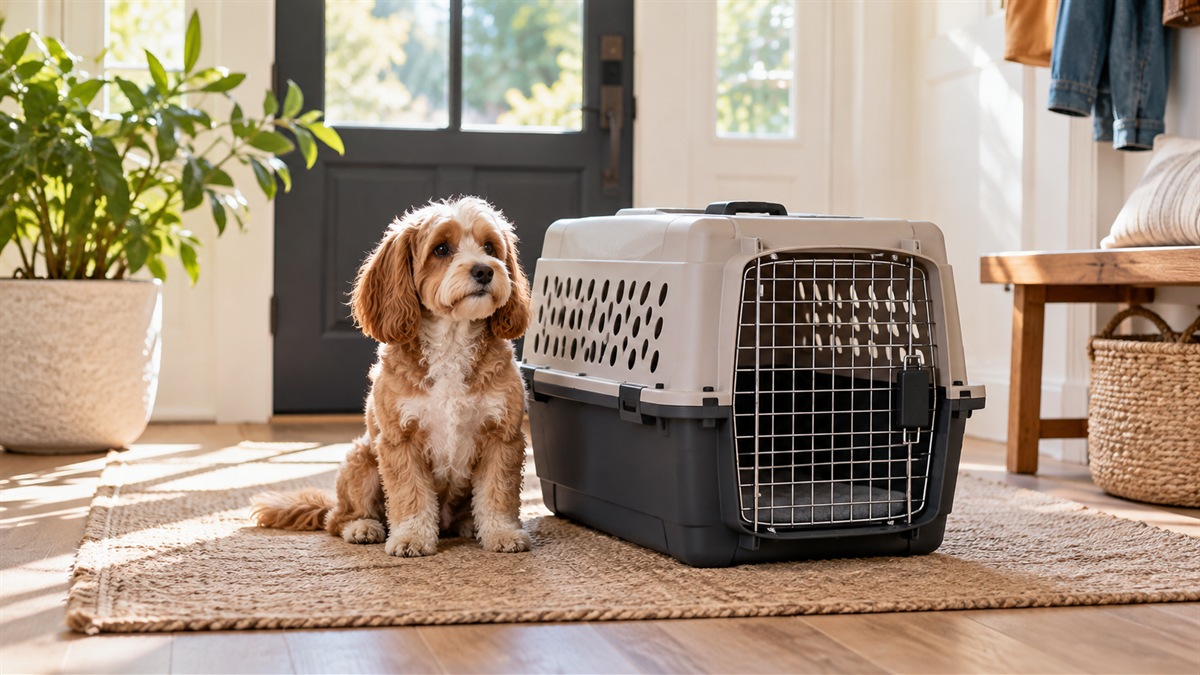
Three titles name a soft-sided carrier, three name a durable plastic carrier, two name the Petmate Sky Kennel, and one calls itself a travel pet carrier. Soft-sided carriers are easier to fold and store, and they can fit more easily under a seat when the dog is small. Plastic carriers hold their shape, which matters for cargo crates that must pass an inspection at check-in. AKC’s guidance on cargo focuses on the crate meeting the airline’s size and safety requirements, so a crate that keeps its shape may be the simpler choice for cargo.
Soft-sided and plastic are not automatic choices. A dog that chews soft fabric, or a dog that needs a firm floor, may do better in a plastic kennel even for a cabin trip, if the kennel fits under the seat. The type you buy should follow the dog and the airline’s answer, not the title alone.
The airline’s rules come first
AKC says weight limits vary by airline and that you should contact the carrier directly before booking. Its guide also says most airlines limit the number of dogs allowed on each flight and require advance reservations for pets. That makes the first call the most important step, because a flight can be full of pets before you buy a ticket.
The Vet’s Corner article on air travel adds a similar point. It says most airlines restrict the number of pets, both in the cabin and in cargo, allowed on each flight. It also says the airline guidelines list weight restrictions, crate requirements and temperature requirements, and that some airlines embargo travel at certain times of year or for certain breeds.
Documentation is the other item that changes by airline. AKC says documentation requirements vary by airline and destination, and that you may need vaccination records, rabies certificates, health certificates and, for some trips, proof of microchipping. The Vet’s Corner article says most airlines require a certificate of health within a specific period before the flight. That period is not given as a number of days in the page we opened, so ask both the airline and your veterinarian for the current window.
AKC also notes that some medications, especially tranquilizers and sedatives, can raise the risk of heart or breathing problems in dogs and generally are not allowed on flights. Talk with your veterinarian before any change to medication for travel. Our post does not give medical advice for your dog, and the sources we opened do not cover which medications suit which dog.
Preparing the dog for the crate
Preparation is where many owners lose time. The Vet’s Corner article advises buying the crate well ahead of the travel date, so the dog has time to get used to it. It suggests training the dog to stay in the crate and using it as a home for about a week before the trip, with treats inside and free access to the crate. A week is a practical minimum, and it is not a guarantee that a dog will be calm during the flight.
AKC’s crate-training guide says choosing the right crate size is an important part of successful crate training. It also recommends teaching the dog to enter the crate on cue, especially if you are traveling with your dog. A cue that the dog already knows makes the boarding and security steps easier, because the dog walks into the carrier instead of being pushed. Practice the cue at home in the same carrier you will use on the plane.
Pack the carrier with the dog’s usual bedding, a leash and collar, a name tag with a phone number, and sealed food and water supplies. The Vet’s Corner article lists these items as essentials, and it recommends chew toys over plush or squeak toys. A familiar blanket can help a nervous dog settle, but it should not block airflow or add weight you have not counted in the combined total.
How to choose the right airline crate
Use this order. It starts with the airline and ends with the purchase, so you do not buy a carrier that the airline will refuse.
- Ask the airline whether your dog can ride in the cabin or must travel in cargo on your route. Ask for the carrier size limit, the combined weight limit and the reservation deadline. Get the answer in writing if you can.
- Weigh your dog and the empty carrier you plan to use, then add the two. Use the combined figure when you compare it with the airline’s limit.
- Check that the carrier lets your dog stand, turn around and lie down. AKC gives this as the general rule for a comfortable carrier.
- For cabin travel, confirm that the carrier fits beneath the seat you will use. The title size alone does not prove this, so ask the airline for its under-seat dimensions.
- For cargo, confirm the crate meets the airline’s size and safety requirements before you book, because the staff inspect it at check-in.
- Start crate training at least a week before the trip, and practice the cue to enter the carrier.
The cards below apply that order to the nine listings. Each card says what its title states, what it does not state, and when to skip it.
1. Petmate Sky Kennel for Air Travel, 28in Dog Crate for Pets 15 to 30lbs (Sky Kennel for air travel, 28in size)
Pros
- The title gives a 15 to 30 pound dog range and a 28in size, so both numbers can be checked before buying.
- The title names it a Sky Kennel for air travel, which is the most specific air-travel wording in the set.
Cons
- The title does not say whether this size fits under a seat, so the 28in size must be checked against the airline.
- Its stated range starts at 15 pounds, so a smaller dog would need a smaller carrier.
Best for: A dog of 15 to 30 pounds whose airline confirms this size for the route.
Skip if: Your dog is under 15 pounds, or the airline's under-seat limit is smaller than the 28in size.
View on Amazon (affiliate link)
2. SportPet Airline Compliant X-LARGE 35.5 Travel Dog Kennel, Durable Plastic Airline Pet Carrier (Plastic kennel, X-Large 35.5 with removable wheels)
Pros
- The title lists removable wheels, which makes the kennel easier to move through an airport.
- At 35.5 the title marks this as the largest kennel in the set.
Cons
- At 35.5 the title points to a cargo-sized crate, so it does not suit under-seat travel.
- The title gives no weight range, so the dog and crate weight must be confirmed with the airline.
Best for: A large dog that must fly in cargo and needs the most floor space in this set.
Skip if: Your dog must ride in the cabin under the seat in front of you.
View on Amazon (affiliate link)
3. SportPet Airline Compliant LARGE 31.5 Travel Dog Kennel, Durable Plastic Airline Pet Carrier (Plastic kennel, Large 31.5 with removable wheels)
Pros
- The title gives a 31.5 size with removable wheels, a step down from the X-Large kennel in the same line.
- The title describes a durable plastic airline carrier, which is a firm shape for a cargo inspection.
Cons
- At 31.5 the title still points to a cargo crate rather than an under-seat carrier.
- The title does not give a weight limit, so the combined weight must be checked separately.
Best for: A large dog flying in cargo that needs more length than the Small 24 kennel provides.
Skip if: Your dog must fit under the seat, or the airline's cargo limit is below the dog and crate weight.
View on Amazon (affiliate link)
4. Petmate Sky Kennel for Air Travel, 21in Dog Crate for Pets up to 15lbs (Sky Kennel for up to 15 pounds, 21in size)
Pros
- The title sets a clear limit of up to 15 pounds, so the match to a small dog is easy to check.
- At 21in it is the smaller of the two Petmate Sky Kennels in the set.
Cons
- A dog above 15 pounds cannot use it, whatever the dog's length.
- The title does not say whether the 21in size fits under a seat on any airline.
Best for: A small dog of up to 15 pounds in a kennel for the cabin.
Skip if: Your dog weighs more than 15 pounds, or you want a soft-sided carrier.
View on Amazon (affiliate link)
5. SportPet Airline Compliant Small 24 Travel Dog Kennel, Durable Plastic Airline Pet Carrier (Plastic kennel, Small 24 with no wheels)
Pros
- The title says no wheels, so this kennel is carried rather than rolled through the terminal.
- The title names it an airline compliant kennel in a small size, which matches a small dog.
Cons
- The title says Small 24 without a unit, so the size must be checked against the seat or the cargo rule.
- The title gives no weight range, so the dog's weight must be checked with the airline.
Best for: A small dog that needs a plastic kennel and will not roll it through the airport.
Skip if: You need a kennel you can roll through a long walk to the gate.
View on Amazon (affiliate link)
6. Henkelion Cat Carriers Dog Carrier, TSA Airline Approved Small Dog Carrier Soft Sided, Collapsible (Soft-sided collapsible carrier, up to 15 pounds)
Pros
- The title names it soft-sided and collapsible, which makes it easier to store between trips.
- The title names TSA and airline approved wording, which the listing gives as its selling point.
Cons
- The title sets a 15 pound limit, so a heavier dog is outside this listing.
- The title does not state the interior size, so the under-seat fit must be checked by measuring.
Best for: A small dog of up to 15 pounds that will ride in the cabin.
Skip if: Your dog weighs more than 15 pounds, or you need a hard-sided crate for cargo.
View on Amazon (affiliate link)
7. Sherpa Original Deluxe Travel Pet Carrier, Airline Approved and Guaranteed On Board, Medium (Deluxe travel carrier, Medium, airline approved)
Pros
- The title gives a Medium size, so the length can be compared with your dog before you buy.
- The title uses the words Airline Approved and Guaranteed On Board, which is the brand's wording.
Cons
- We did not check the guarantee wording with the brand or any airline, so it is a claim and not a rule.
- The title gives no weight range or inside dimensions for the carrier.
Best for: A medium dog that will ride in the cabin in a soft-sided deluxe carrier.
Skip if: Your airline lists a specific carrier model or dimension that the title does not match.
View on Amazon (affiliate link)
8. Lekereise Top-Expandable Pet Carrier 18x11x11 in, Delta American United Airline Approved Soft Sided (Expandable soft carrier, 18 x 11 x 11 in, named airlines)
Pros
- The title gives 18 x 11 x 11 inches, the only full set of three dimensions in this set.
- The title names Delta, American and United, so those airlines' rules can be checked first.
Cons
- Naming three airlines does not cover every airline, so your own airline's current policy still applies.
- The title sets a 15 pound limit, so a heavier dog is outside this carrier.
Best for: A small dog up to 15 pounds flying with one of the three named airlines.
Skip if: You fly with an airline the title does not name, and it asks for its own carrier model.
View on Amazon (affiliate link)
9. Airline Approved Pet Carrier, Large Soft Sided Pet Travel TSA Carrier with Removable Fleece Pad (Large soft-sided TSA carrier with fleece pad)
Pros
- The title lists a removable fleece pad, which adds comfort for a dog that rests in the carrier.
- The title gives a Large size and TSA wording, so it may suit a larger cabin dog.
Cons
- The title gives no dog weight range or dimensions, so the combined weight must be checked by weighing.
- The listing data we used shows no brand, so the maker must be checked before buying.
Best for: A larger cabin dog that fits a large soft carrier and whose airline accepts this model.
Skip if: The airline requires a named carrier model or fixed dimensions that the title does not confirm.
View on Amazon (affiliate link)
Mistakes to avoid
- Buying a carrier before you have the airline’s size and weight rules. A carrier that is fine for one airline can be refused by another.
- Treating the title size as proof that the carrier fits under a seat. The title does not show seat dimensions.
- Adding the dog’s weight and forgetting the carrier. The combined weight is the number the airline uses.
- Assuming a cargo weight range is a guarantee. AKC describes the cargo limit as a usual maximum, and the airline sets the real figure.
- Introducing the carrier only in the week of travel. A dog needs time to settle in it.
- Forgetting the paperwork. A certificate of health has a set window before the flight, and the window varies.
If your dog will also ride in a car before the flight, our post on a blanket for the back seat of a car covers a different part of the trip. For bedding that goes inside a crate at home, see our post on a blanket over a dog crate at night. Neither post is about airline rules.
How we chose
We started from the question a dog owner types: which airline approved crate suits which dog. We wanted a post that puts the airline rule before the product, because the rule decides whether a carrier is usable at all.
We opened three AKC pages on 19 October 2026: the airline travel guide, the Vet’s Corner article on air travel with dogs, and the crate-training guide. We kept only the sentences we could match word for word in the saved page text. We did not open a product page for any listing, so the cards rest on the titles and brands in the search results.
The product set is nine listings from a single Amazon search. We kept all nine because each is a carrier or kennel by title, and each card has its own skip rule. We did not add or remove any listing from the set. The table above reports what each title says and nothing more.
What we could not verify
- Whether any listed carrier fits under a particular seat. The pages we opened give the rule, not the seat dimensions of any aircraft.
- Each airline’s current carrier size, dog weight and combined weight limits. AKC says these vary by airline, and the pages we opened are general guides.
- Whether any listed carrier is accepted by a particular airline. A title that says airline approved is the listing’s wording, not an airline’s approval.
- The materials, ventilation, wheel quality and stitching of any listing. The titles give only the words quoted in the table.
- The Sherpa title’s claim of being guaranteed on board. We did not check that wording with the brand or with any airline.
- The number of days in the health certificate window. The Vet’s Corner article says only that it is a specific period.
- Whether cargo rules for a specific route allow a particular crate. The airline must confirm this.
FAQ
Can a dog fly in the cabin with its owner?
Yes, when the dog stays in an approved carrier that fits under the seat in front of you. AKC says small dogs can often travel this way, and that they must stay in the carrier for the flight. Airlines set the size and weight limits, so confirm before you book.
Do I need a health certificate to fly with my dog?
Many airlines ask for one. The period varies, so ask your airline and your veterinarian for the current window and the paperwork for your destination.
What does the 20 pound limit include?
AKC says the combined weight of the dog and the carrier usually must be under 20 pounds for in-cabin travel. The carrier counts, so weigh the dog and the empty carrier together, add them, and compare the total with the airline’s figure.
Can a large dog fly in a soft-sided carrier?
AKC says larger dogs generally must travel in cargo in an airline-approved crate. A soft-sided carrier suits in-cabin travel only if it fits under the seat and the combined weight is within the airline’s limit. For a large dog, ask the airline which crate types it accepts for cargo.
How far ahead should I get the crate?
The Vet’s Corner article advises buying the crate well ahead of the travel date. Start crate training about a week before the trip so the dog is used to it. Buying early also gives you time to check the size against the airline’s rules.
Bottom line
Choose the carrier after the airline answers two questions: will your dog ride in the cabin or in cargo, and what is the combined weight limit for that route. Under-seat carriers suit small dogs, and crates suit larger dogs flying in cargo. A listing title can tell you the size or weight it names, but it cannot confirm seat fit or airline approval, so check those with the airline before you buy.
Sources
- AKC, Dog Airline Travel: dogs travel in an approved carrier under the seat or in a cargo crate; combined weight under 20 pounds for cabin; cargo limit 70 to 150 pounds; carriers waterproof and roomy; airlines may suspend cargo travel in extreme heat or cold
- AKC, Air Travel and Dogs (Vet’s Corner): contact the airline before booking; most airlines restrict pets per flight; buy the crate well ahead of travel; health certificate within a specific period
- AKC, Crate Training Your Dog: choose the right crate size; teach the dog to enter the crate on cue, especially when traveling