Best Dog Paw Snow Boots: Four Picks From Our Listing File
As an Amazon Associate we earn from qualifying purchases. Details
By Ken
The best dog paw snow boots are the ones that fit the paw, stay on through a walk and grip snow, ice and salt. A search for this usually comes from a cold dog, a salted sidewalk and a boot that keeps slipping off. Our research file holds twelve dog boot listings with titles, bullets and specifications. Four describe winter use with enough detail to card here. The other eight are wound-care kits, title-only items, or boots the listing describes as indoor or summer boots.
Quick answer
- For a suspender-style boot with a breed-length size chart, the Canada Pooch listing is the one to check first.
- For a connected four-boot design with reflective straps and six sizes, QBLEEV gives the most detail on fit.
- For a firm rubber sole and a water-resistant upper that the listing also ties to hot pavement, Kuoser is the closest to an all-season boot.
- Whatever boot you pick, rub a vet-approved paw protectant into the pads before a salted walk and check the paws for cracks or redness when you come in.
Start with the paw, not the boot
Cold is the first reason for a snow boot, but the paw is also where salt and ice do damage. AKC’s frostbite page says dogs are at risk once the temperature falls below 32 degrees Fahrenheit, and it names the paws, ears and tail as the most common areas affected. Its advice on prevention includes a warm coat, a sweater and boots for short-coated breeds and older, more fragile dogs. Boots are one tool in that plan, not the whole plan. If your dog also needs warmth on the body, our guide to waterproof dog coats with a harness covers that choice.
Cold is not the only hazard on a winter walk. The ASPCA’s cold-weather page warns that cold-weather chemicals like ice melts can be dangerous when a dog swallows them, and it says to keep those chemicals up and out of paws’ reach. Ice melt and salt end up on the fur and the paws, so the boot question and the cleanup question are linked.
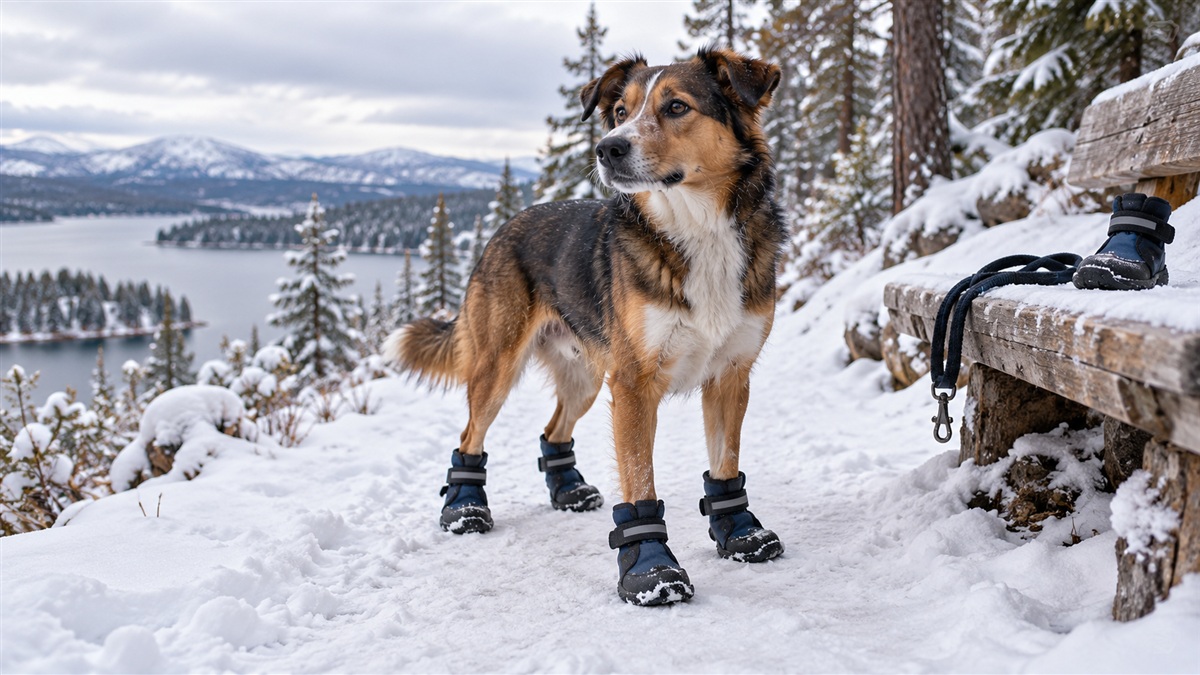
That gives a boot two jobs. It has to keep salt and cold off the foot, and it has to stay on while the dog walks. The four listings in this group answer the second job with fasteners and fit methods. They answer the first with sole and fabric wording. None of them gives a temperature rating, an insulation figure or a warmth comparison, and the pages we opened do not give a rating for boots either.
What the boot needs to block
Salt is the problem most owners already recognize. AKC’s paw-care page says that “salt and dirt can accumulate between your dog’s toes, around and between their pads, and underneath the nail, leading to irritation.” That is the spot where a boot helps most, because it keeps the mix from settling between the toes. The ASPCA makes the same point about booties, which “can also prevent sand and salt from getting lodged between bare toes and causing irritation.”
A boot does not replace cleanup. The ASPCA suggests massaging petroleum jelly or another vet-approved paw protectant into the paw pads before going outside, to protect against salt and chemical agents. It also says to use pet-friendly ice melts whenever possible. AKC recommends a different approach to ice on the pad. Instead of pulling ice balls out by hand, soak a towel in warm water and massage the icy pad gently to melt and loosen the ice.
None of the four carded listings mentions ice melt or salt cleanup in its bullets. The advice in this section comes from the two pages above, not from the boots themselves. Treat the boot as one layer, and treat the cleanup routine as the second layer.
How the four listings compare
The table below pulls the listing details that bear on a snow boot: the sizing method, the closure, the sole and the water wording. Each cell is what the listing says, not a measured result.
| Listing | Sizing in the listing | Closure in the specifications | Sole and water wording |
|---|---|---|---|
| Canada Pooch suspender boots, size 4 | Size chart by paw length, paw width and leg length; short lengths for Pugs, French Bulldogs and Beagles | Hook and loop, strap | Rubber soles for footing; water-resistant shell |
| QBLEEV suspender boots | Six sizes, XS to 2XL; choose the larger size between two sizes | Buckle, with a hook-and-loop closure in the bullets | Thickened rubber sole; waterproof in the title |
| LESYPET winter boots, size 3 | Trace the paw on paper and measure the outline; choose the larger size between two sizes | Drawstring, with reflective magic tape | Waterproof outer shell; rubber soles with texture |
| Kuoser boots, size 1 | Measure the widest part of the paw; the chart gives inner diameter | Two hook-and-loop straps | Rubber sole; water-resistant fabric |
Fit before you buy
Every carded listing sizes the boot by the paw, though the method changes from one to the next. LESYPET says it plainly: “Dog shoes sizes depend on paw size, not body size.” That matters because a large, heavy dog can have small feet, and a small dog can have a wide paw.
The method matters more than the number. Canada Pooch asks for paw length, paw width and leg length, because its suspender boots run up the leg. LESYPET asks you to trace the paw on paper and measure the outline, then choose the larger size when the measure falls between two sizes. Kuoser asks you to measure the widest part of the paw and says its size chart lists the inner diameter of the boot. QBLEEV uses six sizes and gives the same between-size rule as LESYPET.
The safe reading is simple. Measure the paw before you order, use the method in the listing you are buying, and when the number falls between two sizes take the larger one. A boot that is too large slips off on the first hill. A boot that is too small is uncomfortable to wear. Neither helps on a salted sidewalk.
Suspender boots and separate boots
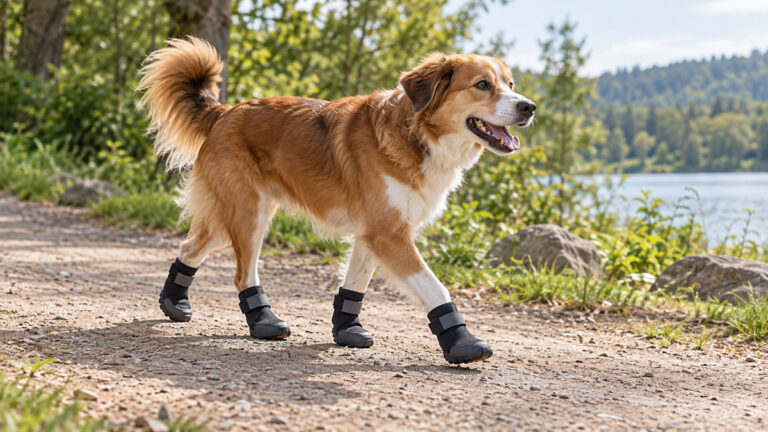
Two of the four are suspender designs. Canada Pooch and QBLEEV connect all four boots with a strap or elastic band, so the set moves as one piece. The Canada Pooch bullets say its “connected four-boot design and adjustable closures help keep dog boots with straps secure during movement.” The QBLEEV bullets say the elastic band lets the owner put the set on and take it off quickly.
LESYPET and Kuoser are separate boots that fasten at the top. LESYPET uses a drawstring and reflective magic tape. Kuoser uses two adjustable hook-and-loop straps. The LESYPET bullets say the shoes “open up wide, which makes them much easier to slip on over a large paw.” The Kuoser bullets say the boot is “easy to put on/take off with wide opening.”
A connected set is easier to keep together, since one band holds all four boots. A separate boot with a wide opening is easier to slip over a paw that does not like being handled. The listings do not say which design a dog accepts better. The AKC paw page does make one practical point about the adjustment period: “It may take a little time for your dog to get used to wearing dog booties.” Plan for a short introduction before a long walk, and check the paws afterward.
Two more details differ across the listings. Canada Pooch and Kuoser both list a unit count of four, while QBLEEV and LESYPET list a unit count of one. The listings do not say what arrives in the QBLEEV and LESYPET packages beyond the description, so the contents are worth checking on the order page before you buy.
Waterproof, water-resistant or neither
The word on the box matters, and these four listings do not use the same word. QBLEEV uses “waterproof” in its title and says its boots keep “your pet’s paws stay dry and comfortable while trekking or hiking, walking in rain, snow, and icy situation.” LESYPET describes “a waterproof outer shell to keep your dog’s legs dry.” Kuoser says its “high-quality water-resistant fabric keeps paws dry & clean in rain, snow and mud.” Canada Pooch describes its shell as “water-resistant for everyday cold and wet conditions.”
The four claims are not the same. In everyday use the two words describe different levels of protection. The listings do not give a rating or a method for comparing the two, so the word is the listing’s claim and nothing more. If wet paws are your main concern, read the material line on the label before you buy.
LESYPET’s bullets add a cold-weather note. They say “stiffness in cold temperatures is normal due to the waterproof material,” and they suggest storing the boots indoors before use. A boot that feels stiff at the door is not necessarily a bad boot, but it is worth checking the fit indoors before the first walk.
Soles and grip
Grip is where a snow boot earns its keep. The Kuoser bullets describe a “tough rubber sole” that provides stability and traction on tile, hardwood, sand and hiking trails. The LESYPET bullets say its rubber soles “have lots of texture to them for grip and stability,” and tie that texture to running in deep snow. The Canada Pooch bullets say the rubber soles “help provide footing on messy winter surfaces.” The QBLEEV bullets describe a thickened rubber sole with anti-slip grip on wet lawns and gravel.
QBLEEV also makes the strongest durability claim in the group. Its bullets say the thickened rubber sole “lasts 3 times longer than standard dog shoe soles.” The pages we opened do not explain how sole life is measured, and no listing in the file gives a comparison with another boot. Read it as the listing’s claim and nothing more.
A grip claim is also not a measurement of how a boot behaves on ice. The listings describe the sole in words. If your walks include steep ice or a hill, look for a sole with a visible tread and check whether the listing names the surface you walk on.
Cleaning and care
The care notes in these listings do not agree everywhere. The Canada Pooch bullets say its boots can be “spot clean or machine wash” inside out on a cold gentle cycle, then hung to dry, and that bleach, dry cleaning and ironing are not allowed. Its specifications say “Hand Wash Only.” The Kuoser bullets say the boot is “hand washable,” and its specifications also say Hand Wash Only. QBLEEV says to “simply wipe them down with a damp cloth.” The LESYPET part of the file gives no cleaning method in the bullets we have.
The disagreement matters because a boot that is washed the wrong way can lose its shape or its fasteners. Follow the label on the boot you receive, and if the label and the listing disagree, follow the label.
For salt and cold on the paw itself, the ASPCA page is more specific than any listing. It says to check “for cracks in paw pads or redness between the toes,” and to “bring a towel on long walks to clean off stinging, irritated paws.” That check applies whether or not the dog wears a boot, so make it part of the routine.
A simple walk plan for salted sidewalks
Build the routine around the four steps that the pages we opened support, and then choose the boot that fits the routine.
- Before the walk, rub a vet-approved paw protectant into the pads, as the ASPCA suggests. Ask your vet first if your dog has cracked pads or a skin condition.
- Put on a boot that fits the paw by the listing’s method, and check that it is fastened snugly.
- After the walk, if ice has formed, soak a towel in warm water and massage the pad gently rather than pulling the ice out by hand. AKC gives this method.
- Check the paws for cracks or redness between the toes, then dry the boot before the next walk.
A few of these steps depend on the owner, not the boot. The boot helps with step two and the towel helps with step four, but neither removes the need to check the paws. For a dog that walks in deep cold regularly, the same routine applies every day of the season, not just on the first snowy morning.
After a snowy walk, a towel or blanket on the seat helps keep the car clean and the dog comfortable. Our guide to blankets for the back seat of a car covers that choice in more detail.
Listings without a card
Eight of the twelve listings are not carded here. The VORDAKEM kit is a wound-protection product that combines a recovery boot with a self-adhering bandage, so it is for an injured paw rather than for snow. The Sunnymove two-pack is a wound-recovery boot for injured paws. Its bullets mention a fleece lining for winter, but the listing is built for wound care, so it is not carded.
Four listings are title-only: a waterproof stay-on boot for small and medium dogs, a winter snow boot with a fleece lining, a Dimicoo winter boot with an anti-slip sole, and a boot for hardwood floors and hot pavement. Their titles name winter or snow, but the file holds no bullets or specification lines for them, so we did not build a card from a title alone.
The paatata knob-closure boot is a breathable mesh boot. Its title mentions rain and snowy days, but its bullets describe the mesh upper as keeping paws cool on summer walks, so it is closer to a summer boot. The TEOZZO item is titled as a winter bootie, but its bullets say it is washable and not waterproof and suits indoor use or walks on dry days, so it is not carded.
How we chose
We set four rules from the listing data. The item had to be a dog boot or shoe, not a wound kit. Its title or bullets had to name snow, cold, winter, ice, salt or rain. It had to give at least one bullet or specification line beyond the title. And it had to describe a fit, closure or sizing method that a buyer could check before ordering.
Four items met all four rules: Canada Pooch, QBLEEV, LESYPET and Kuoser. The order of the cards is not a ranking. None of the listings gives a temperature rating, an insulation figure or a wear result, so the choices do not say which boot is warmest or longest-lasting.
What we could not verify
- Warmth. No listing gives an insulation figure or a temperature range, and the AKC frostbite page gives a risk threshold, not a rating for any boot.
- Whether a boot stays on a particular dog through a full snowy walk. The listings state fasteners and fit methods, not outcomes.
- The QBLEEV claim that its sole lasts three times longer than standard dog shoe soles.
- The Canada Pooch care instructions. The bullets allow a cold gentle machine wash inside out, and the specifications say Hand Wash Only. The label on the boot should settle it.
- The Kuoser leather toe cap. The bullets mention a soft leather toe cap, but the specifications list the material as polyester and rubber only.
- Contents. LESYPET and QBLEEV list a unit count of one, and the listings do not say whether that means one boot or a set.
- The uses LESYPET names for special-needs dogs. The pages we opened do not cover boots for those uses, so we do not repeat them.
- Breed fit. The Canada Pooch breed guidance is the listing’s own statement, and the pages we opened do not confirm it.
FAQ
Do all dogs need snow boots?
No. AKC gives 32 degrees Fahrenheit as the point where dogs are at risk from cold, and it names the paws, ears and tail as the most exposed areas. A dog that spends short periods outside in mild weather may not need a boot. A dog that walks on salted sidewalks every day has a stronger case for one, and the cleanup routine matters either way.
How do I measure my dog’s paw for snow boots?
Use the method in the listing you are buying. LESYPET says to trace the paw on paper, measure the outline and choose the larger size when the measure falls between two sizes. Canada Pooch asks for paw length, paw width and leg length. Kuoser asks for the widest part of the paw and says its chart gives the inner diameter.
Are waterproof and water-resistant the same?
Not in these listings. QBLEEV and LESYPET use “waterproof,” while Kuoser and Canada Pooch use “water-resistant.” The listings do not give a rating that compares the two, so read the material line on the label and decide by the wet conditions you expect.
Should I put something on my dog’s paws before a snowy walk?
If the pads are cracked, or your dog has a skin condition, ask your vet before you use any product.
How do I get my dog used to a boot?
Give it time. AKC says it may take a little time for a dog to get used to wearing booties. Start with short sessions, watch how the dog walks, and check the paws afterward for cracks or redness between the toes, as the ASPCA advises.
Is ice melt safe for paws?
The ASPCA says to use pet-friendly ice melts whenever possible, and to keep ice melt and other chemicals up and out of paws’ reach. A boot does not replace that step, because a dog can still lick its feet after a walk.
Bottom line
Choose the boot by the paw measurement first, the fastener second and the sole third. Check the cleaning label before you buy, because the listings disagree on care. Keep a towel by the door, and check the paw pads after every salted walk, as the ASPCA advises.
1. Canada Pooch Dog Suspender Boots & Paw Protectors, Black, Size 4 (Best for a suspender boot with a breed-length size chart)
Specs from the listing (checked ):
- Material: Shell: 96% Polyester, 4% Spandex Lining: 100% Polyester
- Closure Type: Hook & Loop, Strap
- Product Care Instructions: Hand Wash Only
- Package Dimensions: 11.1 x 7.2 x 3.98 inches; 15.87 ounces
Pros
- The bullets say the leg coverage shields paws and lower legs from snowballs, salt, mud and snow
- The bullets describe a water-resistant shell and rubber soles that give footing on messy winter surfaces
- The listing sorts sizing by length and breed, with short lengths for Pugs, French Bulldogs and Beagles
Cons
- The care instructions conflict: the bullets allow a cold gentle machine wash inside out, while the specifications say Hand Wash Only
- Sizing asks for three measurements, paw length, paw width and leg length, before the buyer can choose a size
Best for: A dog with long legs or a short-legged breed that needs a boot that stays up the leg in snow
Skip if: Your routine depends on machine washing, since the specifications say Hand Wash Only
View on Amazon (affiliate link)
2. QBLEEV Dog Suspender Boots, Waterproof Dog Rain Boots Paw Protector Shoes (Best for a connected suspender set with reflective straps)
Specs from the listing (checked ):
- Size: X-Small
- Material: Nylon
- Closure Type: Buckle
- Recommended Uses For Product: Hot Pavement, Muddy and Grassy, Outdoor Adventures, Protect Wounds, Rainy and Snowy Days
Pros
- The bullets describe an elastic band that connects all four boots, which the listing says makes them easy to put on and take off
- The bullets describe reflective details for night walks and name rain, snow and icy ground as uses
- The listing gives six sizes from XS to 2XL and tells buyers to choose the larger size between two sizes
Cons
- The listing says the sole lasts three times longer than standard dog shoe soles, and the pages we opened do not address that claim
- The specifications list one unit and the included component as legging pants, so the contents need checking before the order
Best for: A dog that needs the four boots to stay connected during play in wet snow
Skip if: You need a measured waterproof rating, since the listing describes waterproofing in words only
View on Amazon (affiliate link)
3. LESYPET Waterproof Dog Boots with Soft Lining Dual-Fasten Winter Pet Shoes Dog Paw Protectors (Best for a drawstring and tape-fastened winter boot)
Specs from the listing (checked ):
- Size: Size 3
- Closure Type: Drawstring
- Recommended Uses For Product: Outdoor Protection
- Package Dimensions: 11.22 x 8.11 x 2.95 inches; 9.59 ounces
Pros
- The bullets describe a waterproof outer shell with a soft interior lining that the listing says keeps the legs dry and warm
- The bullets describe a drawstring and reflective magic tape that the listing says keep the boot from slipping off
- The listing says the shoes open wide enough to slip on over a large paw, and gives a trace-and-measure method
Cons
- The bullets say stiffness in the cold is normal because of the waterproof material, so the boot may feel stiff at first
- The unit count is one, and the listing does not say whether one item is one boot or a full set
Best for: A dog with a wide paw that needs a boot that opens wide for an easy fit
Skip if: Your dog has short legs and you have not checked the boot height, since the listing asks buyers to consider height for short-legged breeds
View on Amazon (affiliate link)
4. Kuoser Dog Shoes for Hot Pavement & Winter Snow, Dog Boots & Paw Protectors (Best for a rubber-sole boot for snow and hot pavement)
Specs from the listing (checked ):
- Size: Size 1: width 1.57'' (4 Pcs)
- Material: Polyester, Rubber
- Closure Type: Hook & Loop
- Product Care Instructions: Hand Wash Only
Pros
- The bullets describe a tough rubber sole with traction on tile, hardwood, sand and hiking trails
- The bullets describe water-resistant fabric for rain, snow and mud, plus two adjustable hook-and-loop straps
- The listing says the size chart gives the inner diameter and asks buyers to measure the widest part of the paw
Cons
- The bullets name a soft leather toe cap, but the specifications list the material as polyester and rubber only
- The bullets say hand washable and the specifications say Hand Wash Only, so the cleaning method is fixed
Best for: A dog that walks on both snow and hot pavement and needs a boot with a firm rubber sole
Skip if: You need a fully waterproof boot, since the bullets use the term water-resistant
View on Amazon (affiliate link)
Sources
- ASPCA, Cold Weather Safety Tips: petroleum jelly or vet-approved protectant on paw pads before walks; booties keep salt out of toes; pet-friendly ice melt; check paw pads for cracks and redness (opened 2026-10-20)
- AKC, How to Care for and Clean Dog Paws and Paw Pads: salt and dirt between toes; warm towel to loosen ice on pads; adjustment to dog boots takes time (opened 2026-10-20)
- AKC, Can Dogs Get Frostbite?: risk below 32 degrees Fahrenheit; paws, ears and tail most exposed (opened 2026-10-20)