Dog Pads for Car Trips: 5 Listings Compared by Area, Count and Wash Type
As an Amazon Associate we earn from qualifying purchases.
Looking for the best dog pads for car trip use? The short answer is a pad that fits the floor of your crate, carrier or back seat, and that you can throw away or wash on the road. This guide compares five dog pads whose listings say they suit car, travel or road-trip use. For each one it gives the stated size, count, layer count and wash wording. The listings do not say how any pad holds up on car upholstery, so read the limits before you buy.
Quick answer
- Match the pad to the floor it covers. The five listings range from 24 x 18 inches (Sunheir, 2-pack) to 36 x 32 inches (SUGUNING, 60-count).
- Disposable pads suit trips where you can bag used pads. Washable pads suit trips where you can wash them at each stop or at the end of the day.
- Count pads from your stops, not from the pack size. The AKC advises stopping frequently for potty breaks.
- A pad sits under a restraint and does not replace one. The ASPCA says to secure a crate so it will not slide or shift in a sudden stop.
What a car-trip pad has to do
A pad on a car trip has a narrow job. It goes under your dog, on a surface you do not want wet: a crate floor, the base of a carrier, a back seat under a seat cover, or the cargo area. It should keep liquid off that surface. It should also come out cleanly when the trip ends or when the pad is full. Those are the only two jobs this guide asks a pad to do.
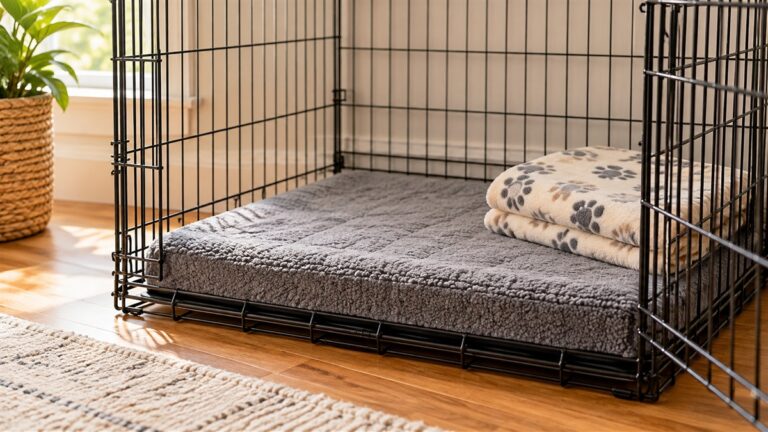
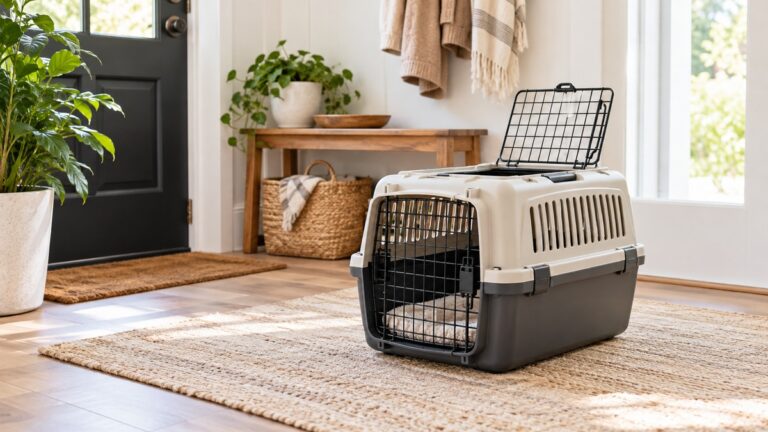
The restraint comes first. The ASPCA says to “secure your pet’s crate so it won’t slide or shift in the event of an abrupt stop.” It says hard-sided carriers with ventilation holes that are secured to the vehicle are the safest option, and it advises against wire or collapsible crates for transport because they can collapse or break open. A loose pad under a loose crate adds nothing to that plan. Anchor the crate or carrier first, then put the pad inside it.
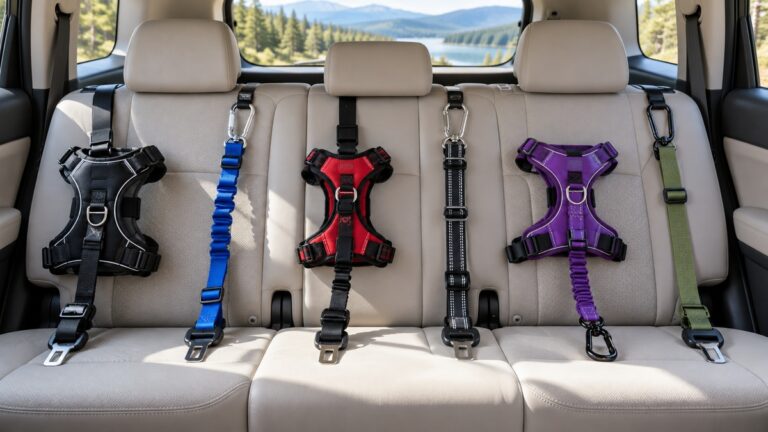
If no crate fits the car, the ASPCA says to keep the dog in the back seat in a harness attached to the seat buckle. The AKC says that “dog seat belts exist and work similarly to human ones,” and that it is “optimal” for dogs to ride in the backseat rather than the front, because the backseat keeps dogs from being harmed by air bags. The ASPCA puts it more bluntly: serious injury could occur if your pet is secured in the passenger seat during an accident. Those points set the restraint. The pad is one layer under whatever restraint you use.
A pad is not a heat plan. The ASPCA states: “Leave your animal alone for any amount of time in a parked vehicle.” Plan the stops so the dog is never left alone in a parked car, and do not count a pad as a reason to make an exception.
Size and surface: the numbers
Each listing states a size, and most state a count. Area is length times width, in square inches. The formula is area = length x width, using the spec-sheet dimensions. Where the title gives the size in a different order from the spec sheet, the table uses the spec-sheet order, and the limits section says so.
| Pick | Count | Stated size | Area per pad (sq in) | Layers stated | Wash wording | Weight stated |
|---|---|---|---|---|---|---|
| GREEN LIFESTYLE, 2-pack | 2 | 34 x 36 in | 1,224 | not stated | machine wash | not stated |
| SUGUNING, 60-count | 60 | 36 x 32 in | 1,152 | 6 | disposable (title) | 7.5 lb |
| COCOYO, 40-count | 40 | 36 x 30 in | 1,080 | 5 | not stated as washable | 5.84 lb |
| OneBug, 100-count | 100 | 34 x 28 in | 952 | 6 | disposable (title) | 10.6 lb |
| Sunheir, 2-pack | 2 | 24 x 18 in | 432 | not stated | machine wash and tumble dry | 0.36 kg |
Area is the first number to compare with your floor. A 24 x 18 inch pad (432 square inches) covers about 0.40 of the area of a 36 x 30 inch pad (1,080 square inches), because 432 divided by 1,080 is 0.40. The largest pick, GREEN LIFESTYLE at 34 x 36 inches (1,224 square inches), has about 2.8 times the area of the Sunheir pad, because 1,224 divided by 432 is about 2.83.
Count matters less than most owners expect. A 100-count pack of 34 x 28 inch pads holds 95,200 square inches of pad surface in total (100 x 952). On a trip, though, you use one pad at a time. The count tells you how many pads you own, not how many stops you can cover. The next section turns stops into a count.
How many pads for a trip
Use this formula: pads needed = number of stops x pads changed per stop, plus spares. The AKC says to “stop frequently for exercise and potty breaks,” so the stop count is yours to plan. Its complete guide also says to plan bathroom breaks ahead of time.
Here is an example. It is our assumption, not a figure from either source. A 10-hour drive with a stop every 2 hours has 5 stops. At one pad per stop plus 2 spares, the trip needs 7 pads. The stop interval and the one-pad rule are our working numbers, so change them to fit your dog and your route.
Two washable pads do not cover that same drive without washing. Two clean pads cover the first two stops. The third stop needs a washed pad, and so do the fourth and fifth. That is three washes on a 5-stop drive, under the same one-pad-per-stop assumption. The Sunheir listing says its pad allows approximately 20 uses. If that holds, a Sunheir pad lasts through several stops, but the listing does not say how that figure was reached, so treat it as the listing’s claim.
Washable or disposable on the road
Disposable pads need bags and a place to put them. In this guide that means OneBug, COCOYO and SUGUNING. The OneBug and SUGUNING titles name disposable pads. The COCOYO listing does not use the word washable. It describes an absorbent layer that turns liquid into gel for easy clean-up, which points to disposal at each stop rather than laundering.
Washable pads need a washer, a drying plan and time. In this guide that means GREEN LIFESTYLE and Sunheir. The GREEN LIFESTYLE listing gives its care as machine wash. The Sunheir listing gives machine wash and tumble dry.
Neither type wins every trip. A disposable pad saves laundry but takes space in the car and needs bags. A washable pad saves bags but needs laundry on the road or at the end of the trip. The stop count and your laundry plan decide it, so settle both before you pack.
Where the pad goes in the car
Three placements come up in the sources and the listings. The first is inside a secured crate, under the dog. The AKC says that if your dog rides in a crate, you should “try different locations to see if one suits your dog better.” It adds that you can experiment with covering the crate or leaving it uncovered. The second is the base of a hard-sided carrier, which the ASPCA describes as the safest option when it is secured to the vehicle. The third is a seat or cargo floor when there is no crate, and that placement only works with a restraint in place.
The GREEN LIFESTYLE listing says its pads help protect carpet, sofas, furniture, a car seat and a car trunk during travel. The Sunheir listing names car seats as a liner use under crates, dog beds and sofas. Neither listing says how the pad fastens to a seat, whether it moves on upholstery, or how well it protects the seat from a wet dog. That gap is listed below.
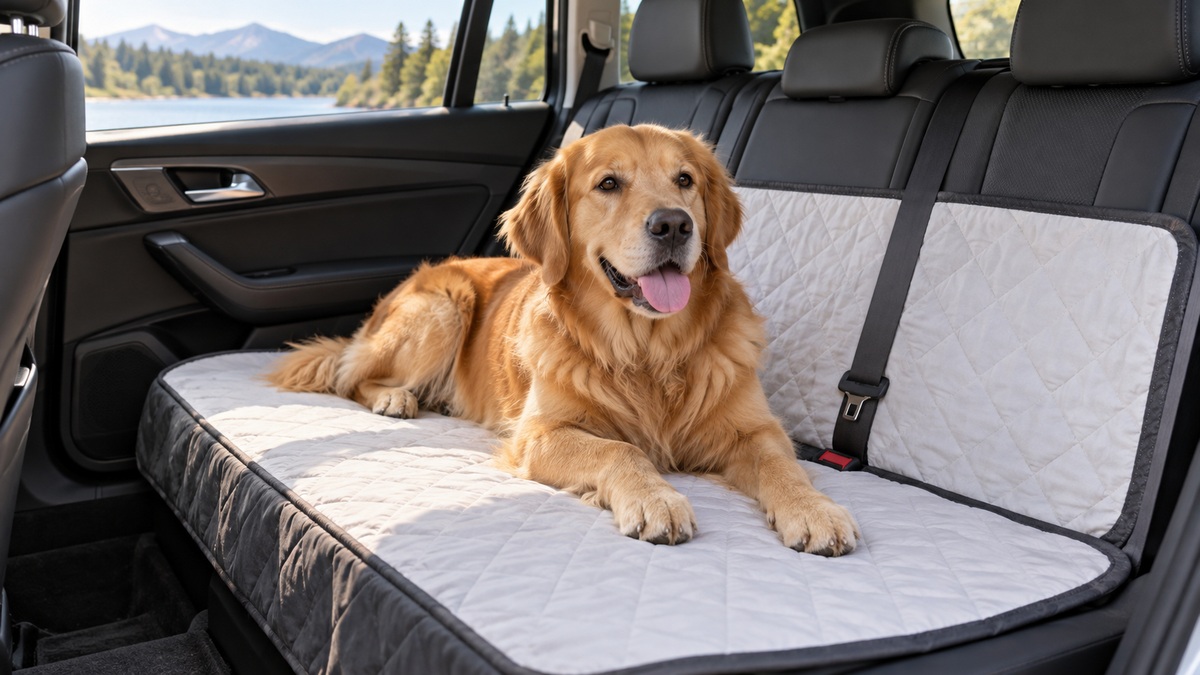
If you already use a back-seat cover, the pad goes under the dog, on top of the cover. For the cover itself, see our guide to pet covers for the back seat of a car, and for a blanket option see our guide to blankets for the back seat.
Product picks
The five picks are listed by stated area, smallest first. This is not a quality ranking. Each pick gives the reason it fits a car trip, a case where it is the wrong choice, and one limit.
Sunheir Washable Pee Pads for Dogs, 2-Pack (24 x 18 in)
Why it fits: the listing names car seats as a liner use, under crates and dog beds. It says the pad allows approximately 20 uses, and it describes a non-slip silicone base. At 432 square inches it is the smallest pick, so it suits a small crate floor or a carrier base. The listing gives machine wash and tumble dry as the care method.
Skip if: you need to cover a full crate floor or a rear seat.
Limit: there are two pads, and the listing gives no layer count.
GREEN LIFESTYLE Washable Pee Pads for Dogs, 2-Pack (34 x 36 in)
Why it fits: the listing says the pads help protect a car seat and car trunk during travel, and it names crates and pet carriers among the uses. At 1,224 square inches per pad it is the largest pick, and it is the only large washable one. Its care note is machine wash.
Skip if: you want disposable pads you can bag and leave behind on a multi-day trip.
Limit: there are two pads, so the trip needs washing at most stops. The listing gives no layer count and no weight.
OneBug 100-Count Extra Large Dog Pee Pads (34 x 28 in)
Why it fits: the listing says the pads are suitable for road trips, and it gives 100 pads with 6 layers. Each pad is 952 square inches. This is the pick to consider when you need many pads and expect many stops on a long route.
Skip if: you have little cargo room, since the spec sheet gives the pack weight as 10.6 pounds. The bullet calls the pads lightweight and easy to carry, so the listing disagrees with itself. Both figures are shown here.
Limit: the pack weight of 10.6 pounds is the spec-sheet figure, and the bullet’s size reads 28 x 34 inches while the spec sheet reads 34 L x 28 W.
COCOYO Dog Training Pads, 40-Count Black Carbon (36 x 30 in)
Why it fits: the listing says the pads can be used for dogs of all ages, and it names traveling as one use. It has 5 layers and an activated carbon layer that the listing describes as odor control. At 1,080 square inches per pad it is a mid-to-large pad, and the 40-count pack is a middle option in this group.
Skip if: you want a pad the listing describes as washable. This listing does not say that.
Limit: the spec sheet gives the pack weight as 5.84 pounds, and the listing does not say how the pad holds up on car upholstery.
SUGUNING Puppy Pads for Dogs, 60-Count (36 x 32 in)
Why it fits: the listing names a travel carrier and car use among its uses. It gives 60 pads with 6 layers, and each pad is 1,152 square inches. It is the largest disposable pick by area, and after OneBug it has the most pads in the pack.
Skip if: you want a pad the listing describes for dogs only. The listing also names cats, rabbits and other small animals.
Limit: the title gives 32 x 36 inches while the spec sheet gives 36 L x 32 W, so the order differs. The spec sheet gives the pack weight as 7.5 pounds.
How we chose
The rule was simple. A pick had to be a dog pad, by title or specification, and the listing’s own text had to say car, travel, trip or vehicle use. The listing data was recorded in our research file on 19 October 2026. We read 12 entries from that file.
- One entry is an adult incontinence pad, so it was dropped.
- Two entries, BESTLE and Glad, have no car, travel or trip wording.
- Four entries are already picks in our disposable pee-pad guide and our no-leak guide: IMMCUTE, KISENG, Tevila and Amazon Basics. We left them out so this guide does not repeat them. You can read those guides at our disposable pee-pad guide and our guide to pads that do not leak.
- Five remain. They are the picks above.
The picks are listed by stated area, not by quality, and we do not rank them. Specs come from the listing data in our research file. No pick is a recommendation for every car, every dog or every route.
What we could not verify
- How any pad performs in a car. Absorbency, slip, odor and stain protection are claims in the listings. The sources we opened do not cover pad performance.
- Whether a pad fits a particular seat, crate or carrier. The listed sizes are the only fit numbers in this guide, so check your own floor against them before you buy.
- Whether a pad stays in place on a car seat. The Sunheir listing names a non-slip silicone base, and the GREEN LIFESTYLE title names an anti-slip backing. Neither says how the pad grips upholstery in a moving car.
- How many uses a disposable pad gives on a trip. No listing here gives that figure. The one number is Sunheir’s approximately 20 uses, which is the listing’s claim.
- Layer counts for GREEN LIFESTYLE and Sunheir, which their listings do not state.
- Size order. OneBug’s bullet reads 28 x 34 inches while its spec sheet reads 34 L x 28 W, and SUGUNING’s title reads 32 x 36 inches while its spec sheet reads 36 L x 32 W. The table uses the spec-sheet order.
- OneBug’s weight. The bullet calls the pads lightweight, and the spec sheet gives 10.6 pounds. Both are shown.
Buying checklist
- Measure the inside floor of your crate, carrier or seat, then compare it with the listed size. Use the spec-sheet size where the title differs.
- Count your stops. Plan one pad per stop, plus spares, using the formula above.
- Decide disposable or washable before you pack. Disposable pads need bags and a bin. Washable pads need a washer and a drying plan.
- Read the care note. GREEN LIFESTYLE says machine wash, and Sunheir says machine wash and tumble dry.
- Pack the items the ASPCA lists for a road trip, including waste bags, a leash, food, a bowl, your veterinarian’s contact information and any travel documents your dog needs.
- Pack bottled water or water from home. The ASPCA says to always opt for it on a road trip.
Mistakes to avoid
- Using a pad as the restraint. The ASPCA says to keep the dog in the back seat in a harness attached to the seat buckle when no crate is used.
- Leaving the dog alone in the car. The ASPCA says: “Leave your animal alone for any amount of time in a parked vehicle.” A pad does nothing for that risk.
- Using a wire or collapsible crate. The ASPCA says never to use one when transporting a pet.
- Putting the dog in the front seat. The AKC says the backseat keeps dogs from being harmed by air bags, and the ASPCA warns that serious injury could occur in the passenger seat during an accident.
- Choosing by count alone. A 100-count pack does not help if the pad is too small for the crate floor. Compare area first, then count stops.
- Packing disposable pads without bags. Used pads need a sealed bag until you reach a bin.
FAQ
Do I need a pad if my dog rides in a crate?
A pad is optional. If your dog rides in a crate, the crate floor is the surface the pad protects. The AKC says to try different crate locations to see which one suits your dog. A pad does not change where the crate sits or how it is secured.
Are washable pads better than disposable pads for a car trip?
Neither is better for every trip. Washable pads, GREEN LIFESTYLE and Sunheir, need a washer and a drying plan. Disposable pads, OneBug, COCOYO and SUGUNING, need bags and a bin. Count your stops first, then choose.
How many pads should I pack for a long drive?
Use this formula: pads needed = number of stops x pads changed per stop, plus spares. For a 10-hour drive with a stop every 2 hours, that is 5 stops, so 7 pads with 2 spares. This uses our working assumption of one pad per stop, which neither source sets.
Can I put a pad on the back seat?
You can, if the pad stays put on your seat and the dog is restrained. The GREEN LIFESTYLE listing says its pads help protect a car seat during travel, and the Sunheir listing names car seats as a liner use. The ASPCA says to keep the dog in the back seat in a harness attached to the seat buckle. The pad goes under the dog and never replaces the harness.
What else should I pack with the pads?
The ASPCA lists food, a bowl, a leash, waste bags, grooming supplies, medication, a first-aid kit, your veterinarian’s contact information and any travel documents your dog needs. It also says to always opt for bottled water or water from home on a road trip. Feed your dog three or four hours before you leave, and offer an occasional small snack on longer rides.
Bottom line
Choose the pad by the floor it has to cover and by how you will dispose of it or wash it. Secure the crate or use a harness first, plan one pad per stop, and never leave the dog alone in a parked car.
Sources
- ASPCA, “Traveling With Pets? Follow These Expert Dos and Don’ts to Keep Them Safe,” dated December 30, 2025. https://www.aspca.org/news/traveling-pets-follow-these-expert-dos-and-donts-keep-them-safe (opened 2026-10-21)
- AKC, dog seat belt guide, “Dog Seat Belts: What You Need to Know to Keep Your Dog Safe,” updated March 10, 2026. https://www.akc.org/expert-advice/travel/dog-seat-belts-what-you-need-to-know-to-keep-your-dog-safe/ (opened 2026-10-21)
- AKC, “Complete Guide to Traveling With Your Dog,” updated March 10, 2026. https://www.akc.org/expert-advice/travel/complete-guide-to-traveling-with-your-dog/ (opened 2026-10-21)
As an Amazon Associate we earn from qualifying purchases.