Best Dog Poop Scooper
As an Amazon Associate we earn from qualifying purchases.
The best dog poop scooper should match the cleanup surface and the amount of waste, while keeping the handle long enough for a comfortable working posture. Toozey’s 43.31-inch metal tray-and-rake set offers the longest clearly stated handle here and suits repeated yard cleanup. Pawler is the most versatile three-piece setup, combining a 36-plus-inch handle with a 9-by-9.5-inch tray, rake, and spade. For a lighter one-hand grabber, WOILIFE provides a foldable 32-inch ABS jaw. The right mechanism depends more on grass, gravel, or pavement than on dog size.
Quick answer
- Best long-handle tray set: Toozey lists a 43.31-inch handle and metal tray-and-rake construction.
- Best three-tool set: Pawler includes a rake, spade, and 9-by-9.5-inch tray on handles longer than 36 inches.
- Best bag-lined bin: Arm & Hammer uses an adjustable 32-inch handle, swivel bin, rake, and fitted bags.
- Best light one-hand grabber: the 28-inch ienjoyed ABS jaw weighs 14.4 ounces.
Choose the pickup mechanism before the handle length
There are three mechanisms in this group. Tray-and-rake sets move waste across the surface and into an open receiver. Swivel-bin sets add a deeper container that can be lined with a bag. Jaw grabbers close around one deposit when the user pulls a handle. Each approach changes what happens to grass, gravel, leaves, and soft waste.
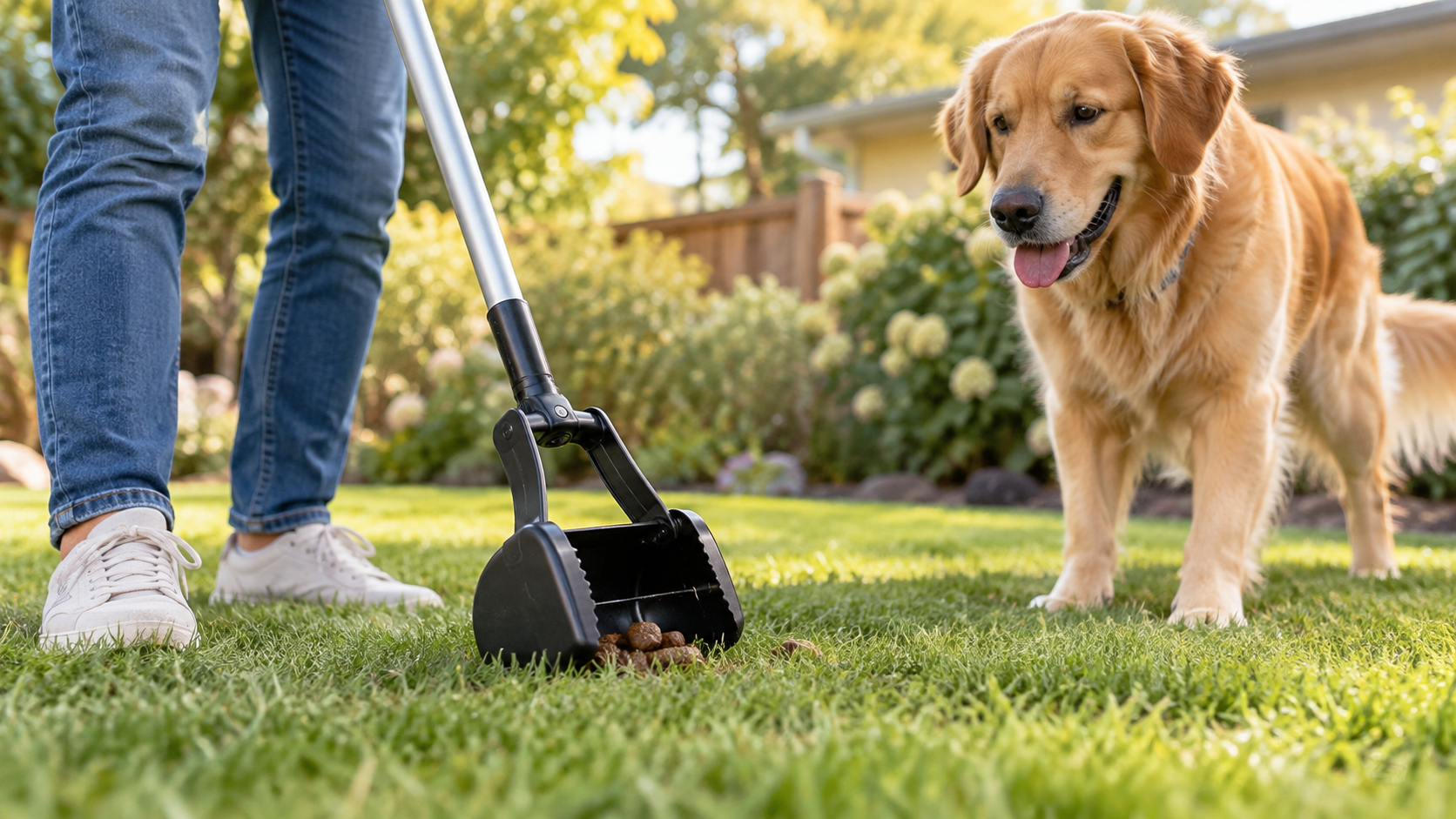
A rake can work through grass while leaving much of the lawn material behind. A flat spade can approach waste on concrete or packed dirt. Pawler includes both, so the user can change the collecting tool while keeping the same tray. Toozey supplies a metal rake and tray but no separate spade in the listed components. HUZSV includes all three pieces: metal rake, spade, and swivel bin.
A jaw grabber is faster to deploy and keeps one hand on the operating handle. WOILIFE uses a 32-inch folding ABS body with two stainless-steel springs. The ienjoyed model is 28 inches long and also uses a spring-operated ABS jaw with teeth. The listing says the gaps allow smaller debris such as rocks or leaves to fall away, although the behavior will depend on deposit consistency and surface.
Arm & Hammer takes a hybrid approach: a rake pushes waste into a bag-lined swivel bin. It includes two fitted bags and uses side hooks to hold their handles. That can reduce direct contact between the bin and waste, but it also makes compatible bag fit part of the ongoing routine. For portable bags without a yard tool, see our comparison of bags for picking up dog waste.
Handle length changes reach, storage, and leverage
| Scooper | Published handle/overall length | Mechanism | Listed item weight | Storage feature |
|---|---|---|---|---|
| Toozey | 43.31 in | Metal tray and rake | 3.3 lb | No method stated |
| HUZSV | 40.16 in size; bullet also says adjustable to 36 in | Swivel bin, rake, and spade | 4.16 lb | Push-click assembly |
| Pawler | More than 36 in | 9 × 9.5-in tray, rake, spade | 2.9 lb | Hanging holes |
| Arm & Hammer | Adjustable to 32 in | Swivel bin and rake | 1.6 lb | Snap-together hanging |
| WOILIFE | 32 in | Folding jaw grabber | 1.23 lb | Folds in half |
| ienjoyed | 28 in | Jaw grabber | 14.4 oz | No method stated |
The longest and shortest figures differ substantially. The formula is 43.31 – 28 = 15.31 inches. Toozey therefore provides 15.31 inches more stated reach than the ienjoyed grabber. Relative to Pawler’s minimum stated 36 inches, Toozey adds at most 7.31 inches because Pawler says “36+” rather than an exact endpoint.
A longer handle may reduce how far someone reaches toward the ground, but it also increases the turning radius and storage height. A short user may find an extra-long tool awkward, while a tall user may dislike a 28-inch grabber. Pawler claims suitability across a broad user-height range, yet it provides no adjustable increments or ergonomic test. Judge the tool from actual handle length, grip position, and mechanism rather than a universal comfort promise.
Grass, gravel, and pavement favor different edges
On grass, a rake can lift a deposit while its tines pass between blades. If the tines are too widely spaced for the waste consistency, material may remain. On gravel, aggressive raking can move stones into the tray; a jaw with openings may shed some smaller debris, but it can also press soft material into the surface. On pavement, a flat spade can approach at a shallow angle.
Pawler, HUZSV, Toozey, WOILIFE, and ienjoyed all claim use across multiple outdoor surfaces. Those statements do not include pickup percentages, tine spacing, or tests with different waste consistencies. Arm & Hammer says its bin-and-rake design works on yard and other surfaces but provides little surface-specific detail.
If the yard contains long grass and loose gravel, a three-piece set offers the most flexibility. If cleanup occurs mainly on a patio, the spade may be more useful than the rake. If each pickup is isolated and the surface is firm, a jaw grabber minimizes the number of separate tool parts. No mechanism removes the need to inspect the area afterward.
Tray capacity is rarely quantified
Pawler gives the only direct tray dimensions: nine by 9.5 inches. Its opening area is 9 × 9.5 = 85.5 square inches, but depth is not stated, so volume cannot be calculated. Toozey describes an extra-large tray without numerical width, length, or depth. HUZSV calls its swivel bin large, and Arm & Hammer supplies overall product dimensions rather than internal bin dimensions.
A deep bin can reduce trips to a disposal point during multi-dog yard cleanup, but it also carries increasing weight and odor until emptied. A wide shallow tray may be easier to rake into yet more likely to spill when tilted. Capacity language should be assessed together with the route to the trash and the frequency of cleanup.
The ienjoyed specifications include a 1.5-pound capacity field, but this is not explained as waste capacity or tested load. The tool itself weighs about 0.9 pound. We did not use the 1.5-pound field as a recommendation because the listing provides no method or connection to normal pickup volume.
Bag systems shift cleanup from the tool to the liner
Arm & Hammer includes two fitted scented bags. The listing describes them as twice as thick as a standard grocery bag, but no mil thickness is given and a grocery bag is not a fixed benchmark. The bags loop over hooks on the bin, then tie closed by their handles. Refill bags are sold separately according to the listing.
HUZSV includes 100 bags and calls them twice as thick as regular grocery bags, again without an absolute thickness. Its listing also describes the bin as odor-locking, but no seal specification or odor test is supplied. A bag-lined bin may simplify washing when the liner stays intact; leaks or misplaced edges can still soil the tool.
If ongoing bag availability matters, check dimensions and attachment method before relying on generic substitutes. A separate dispenser can keep bags accessible on walks; our dog poop bag dispenser comparison focuses on pack counts and sizes rather than yard scooping tools.
Material affects weight and rinsing, not invulnerability
Pawler identifies metal and aluminum. Toozey describes a metal tray-and-rake structure. HUZSV specifies an aluminum handle with metal rake and spade. These sets weigh from 2.9 to 4.16 pounds. Their listings make rust-resistance or durability claims, but they do not state alloy grades, coating thickness, salt exposure, or corrosion-test results.
WOILIFE and ienjoyed use ABS for their jaw bodies, paired with spring hardware. They weigh 1.23 pounds and 14.4 ounces respectively. Lower weight can simplify one-hand operation and transport, but plastic jaws and hinges still need inspection. No scooper is unbreakable. Avoid forcing a jaw around rocks, frozen material, or objects larger than its normal opening.
Rinse residue promptly as the listing allows, then dry the tool before folding or storing it. Pay attention to spring recesses, push-pin joints, the lip of the tray, and bag hooks. Do not leave a wet metal set leaning where runoff can remain in tubing or joints.
Folding and sectional handles trade rigidity for storage
WOILIFE folds in half after a lock is released. Arm & Hammer snaps together for hanging, and Pawler uses push-pin assembly. HUZSV also describes push-click assembly. These features reduce package size or simplify storage, but every joint becomes an inspection point.
Before use, confirm that each pin is fully seated, each tube section is aligned, and the folding lock has engaged. Do not lift a loaded bin by a partially connected handle. Store the tool where the jaw or tray cannot fall open into a walkway and where children cannot operate the springs.
A compact grabber may be easier to take on a trip, but it remains a waste tool and needs a separate clean storage location. Do not place a rinsed but damp scooper beside food, bowls, toys, or grooming supplies. A storage hole or folding joint is useful only if the household has a hygienic place to use it.
Build the tool around pickup frequency
Daily pickup creates a different job from clearing a large yard once a week. Frequent collection means fewer deposits per round, so a small jaw or compact bin may be sufficient and quick to rinse. Less frequent collection increases the value of a larger tray, deep swivel bin, or bag-supported receiver because repeated trips to the disposal point become the slow part of the task.
Count the number of separate actions each mechanism requires. A jaw grabber opens, closes, transports, and releases one load. A rake-and-tray set requires two handles but can gather several deposits before emptying. A bag-lined swivel bin adds the steps of fitting, closing, and replacing the liner. There is no universally shortest workflow; the result depends on yard size, waste amount, distance to disposal, and the user’s ability to carry one or two tools.
Keep the route clear before beginning. A long tray handle can strike fencing, shrubs, furniture, or a second tool when the user turns. A loaded open tray can spill on stairs or slopes. Plan a stable path to the disposal point and avoid setting a contaminated rake directly on decks, door thresholds, or storage-room floors.
Inspect joints and springs before they fail during use
Sectional poles should feel rigid once assembled. If a push pin does not extend fully through its hole, separate and reconnect the pieces rather than relying on friction. Folding grabbers should lock straight without play at the hinge. Squeeze the operating handle before approaching waste and confirm that both sides of the jaw close together.
Springs, pins, and thin tray edges are wear points. Dirt can hide cracks or corrosion, so inspection belongs after cleaning as well as before use. Stop using a tool if a jaw sticks, a spring protrudes, a handle rotates unexpectedly, or a tray edge becomes sharp. A product’s durability language is not a reason to continue with damaged hardware.
Cold conditions can make some plastics less forgiving, while wet storage can affect metal parts and internal tubing. The listings do not give operating-temperature ranges or winter-storage directions. Store the scooper dry and protected from unnecessary exposure, and avoid forcing frozen waste or compacted debris with a mechanism designed for routine collection.
Label the storage position if several yard tools hang together. Keeping the contaminated working ends separated from rakes used for gardening reduces accidental cross-use, and a fixed location makes it easier to notice when one component of a multi-piece set is missing.
How we chose
We compared all six supplied products using their ASINs, titles, bullets, and specifications. Every entry is a physical waste pickup tool rather than a bag dispenser alone. We grouped them by tray/rake, swivel-bin, and jaw mechanisms so that different uses were not reduced to a single length ranking.
Exact handle length received the most weight, followed by included tools, tray dimensions, item weight, bag system, assembly, storage, material, and stated surface use. We treated comfort, rust, odor, breakage, and surface-performance language as seller claims where no common protocol was provided.
All six remain in the product cards because each contributes a distinct length, mechanism, or package. Dog-weight ranges are not supplied for these tools. That omission is noted, although surface and waste volume are more relevant than the dog’s body weight for selecting a yard scooper.
What we could not verify
The listings do not provide shared pickup tests, tine spacing, jaw force, spring-cycle counts, tray volume, metal grade, coating thickness, corrosion testing, bag dimensions, bag film thickness, or odor-containment results. Multi-surface claims therefore cannot establish a reliable performance order.
HUZSV is titled and sized at 40.16 inches while one bullet says its handle adjusts to 36 inches. We could not reconcile those figures. Pawler says more than 36 inches without an exact total. None of the selected products states a dog-weight range, and the listings do not provide an individualized ergonomic recommendation for user height or mobility.
Best dog poop scoopers by yard routine
Toozey 43.31-inch tray and rake: best longest-handle candidate
Toozey has the longest clearly stated handle in the group at 43.31 inches. The metal set uses an extra-large tray and rake and weighs 3.3 pounds. Its listing identifies grass, gravel, dirt, and general yard cleanup as intended surfaces and describes a bag-supported disposal setup.
Skip if: a 43.31-inch rigid tool is awkward for your height or storage area.
Limitation: tray dimensions, metal grade, bag size, and dog-weight range are not stated.
Pawler three-piece set: best rake-and-spade versatility
Pawler combines handles longer than 36 inches with a rake, spade, and 9-by-9.5-inch tray. The 2.9-pound metal/aluminum set uses push-pin assembly and hanging holes. The two collecting tools make it the clearest candidate for a yard containing both grass and harder surfaces.
Skip if: you want one-hand jaw operation or a bag-lined enclosed bin.
Limitation: exact handle length, tray depth, metal specification, and dog-weight range are not stated.
Arm & Hammer 32-inch swivel bin: best fitted-bag system
This 1.6-pound set combines an adjustable handle up to 32 inches, rake, swivel bin, and two fitted bags. Bag handles loop over side hooks and tie after use. The tool snaps together for compact hanging storage.
Skip if: you do not want to depend on a bin-liner format or need more than 32 inches of reach.
Limitation: internal bin dimensions, absolute bag thickness, and dog-weight range are not stated.
HUZSV swivel-bin set: best bundle with bag supply
HUZSV includes a swivel bin, metal rake, spade, and 100 bags. The full listing size is 40.16 inches and item weight is 4.16 pounds. Push-click assembly and an aluminum handle support a multi-piece yard station intended for grass, dirt, and gravel.
Skip if: the length inconsistency prevents confident fit or you prefer a lighter tool.
Limitation: one bullet says 36 inches while the product size says 40.16 inches; no dog-weight range is stated.
WOILIFE 32-inch folding grabber: best portable jaw candidate
WOILIFE uses a 32-inch ABS body, one-hand pull handle, and two stainless-steel springs. It folds in half for storage and weighs 1.23 pounds. The listing directs users to place a bin bag over the jaw for wet or soft waste.
Skip if: a tray and rake are better suited to the yard surface or waste consistency.
Limitation: folded dimensions, jaw capacity, spring-cycle result, and dog-weight range are not stated.
ienjoyed 28-inch grabber: best lightweight one-piece candidate
The ienjoyed ABS grabber is 28 inches long and weighs 14.4 ounces. A pull handle operates two springs, and the toothed jaw has gaps intended to release small debris. It is the shortest and lightest clearly documented option here.
Skip if: 28 inches requires uncomfortable bending or a deep bin is needed for repeated pickups.
Limitation: the unexplained 1.5-pound capacity field is not a usable volume rating, and no dog-weight range is stated.
FAQ
Is a rake or jaw scooper better for grass?
A rake can work between grass blades and move waste toward a tray or bin. A jaw closes around one deposit and may be faster for isolated cleanup. Performance depends on grass height and waste consistency, neither of which is standardized in the listings. A three-piece set offers both rake and spade options.
What handle length reduces bending?
The appropriate length depends on the user’s height, arm position, and mechanism. Published figures range from 28 to 43.31 inches. Longer reach can reduce the distance toward the ground, but an overly long or heavy tool may be awkward. Compare the actual number with a comfortable household tool before choosing.
Can I use a pooper scooper on gravel?
Several listings claim gravel use. A rake may collect stones, while a toothed jaw may let some small debris fall through. Work slowly and inspect the spot afterward. The product entries do not provide a common gravel-size or pickup test, so no model has a verified universal advantage.
Should I line the scooper with a bag?
Use the design as directed. Arm & Hammer is built around fitted bin bags, HUZSV supplies bags, and WOILIFE specifically recommends a bag over the jaw for wet or soft waste. Confirm that the liner does not interfere with moving parts and dispose of it according to local requirements.
How do I clean and store a scooper?
Remove residue promptly, rinse only as the maker permits, and dry the entire tool. Inspect pins, springs, jaws, tray edges, tubing, and bag hooks. Store it in a dedicated sanitary location away from dog food, bowls, toys, and grooming items.
Does scooper size depend on dog weight?
None of these products gives a dog-weight range. Waste volume, number of dogs, pickup frequency, surface, and user reach are more direct selection factors. A large tray helps repeated cleanup, while a light jaw may suit single deposits regardless of the broad breed label in a title.
Bottom line
Choose the pickup edge for the surface, then select a handle you can control and store. Toozey offers the longest documented reach, Pawler provides the most flexible rake-and-spade set, and Arm & Hammer has the clearest fitted-bag workflow. Pick a folding jaw only when one-hand operation matters more than tray capacity.
Sources
- American Kennel Club health advice — opened October 25, 2026
- Merck Veterinary Manual for dog owners — opened October 25, 2026
- Cornell Riney Canine Health Center — opened October 25, 2026