Best Brush to Remove Dog Undercoat: Rakes, Pin Length and Technique
As an Amazon Associate we earn from qualifying purchases. Details
By Ken
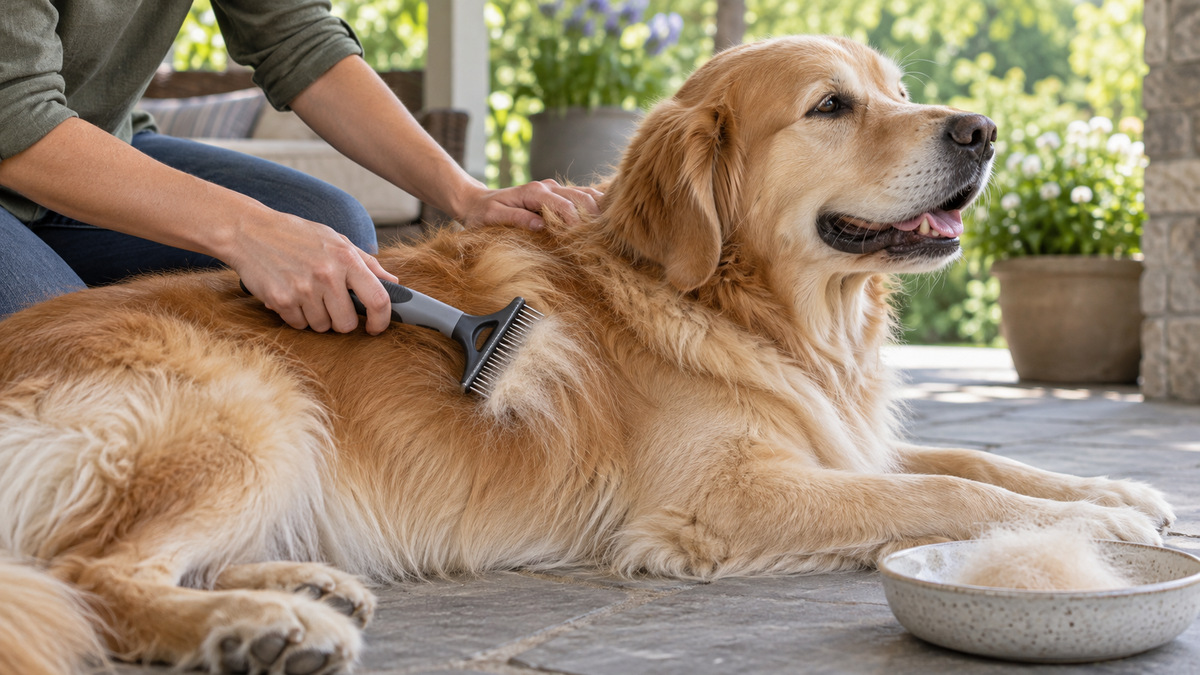
The best brush to remove dog undercoat is a rake or a pin tool that reaches down through the topcoat to the soft layer beneath, with pins long enough for the coat and a head wide enough to cover the dog’s back in a few passes. This guide compares nine listings on pin design, head shape, dual-sided heads and the coat types each one names. The American Kennel Club says undercoat rakes have “one or two rows of metal pins designed to penetrate through to the undercoat to remove loose fur, and remove and prevent mats.” Pin length is the detail that decides whether a rake works on your dog, and most listings do not state it.
Quick answer
- A rake is the right first tool for an undercoat. AKC describes it as a tool with rows of pins that reach the undercoat, which a slicker or a bristle brush does not do on a thick double coat.
- Match the pin length to the coat length. AKC says you must choose the correct pin length for the coat, so a rake with short pins will skim a long coat.
- Two-sided rakes give a wide side for tangles and a dense side for loose hair. The listings describe 9-tooth and 17-tooth sides, and the dense side is the one that removes undercoat.
- Work the tangles out first, then rake in short passes. Stop when the rake brings out less hair, and check the skin as you go.
What the undercoat is and why it comes out in clumps
A double coat has two layers. The topcoat is the longer, coarser hair that you see. The undercoat is the soft, dense layer beneath it, and it is the layer that sheds most heavily in spring and autumn. AKC’s brush guide says: “Remember to brush the undercoat, as well as the top coat, if your dog is double-coated.” A brush that only smooths the top layer leaves the undercoat in place, and the clumps keep arriving on the floor and the bed.
Undercoat hair comes out in clumps because it is trapped against the skin until the coat is raked. A brush that is too gentle slides over the top and never reaches the base of the coat. A rake with the right pins catches the clump and lifts it out in one pass. That is why the tool matters more on an undercoat than on a single short coat.
AKC’s shedding article says that during heavy shedding periods, “switching to a coat rake or de-shedding tool can help remove large amounts of loose undercoat hair.” The phrase “large amounts” is the reason to keep a rake in the grooming kit. Other tools can keep the coat tidy between sessions, but the rake is the tool that takes out the bulk of the undercoat when the dog is blowing its coat.
Rake, slicker or comb: which tool reaches the undercoat
Three tool types appear in this group, and they do different jobs on a double coat. A rake has rows of pins or blades that go through the topcoat. A slicker has short, fine pins and works best on the topcoat and on tangles. A comb has teeth at fixed spacing and works well on knots and on the feathering at the legs and tail. AKC’s brush guide says that wide-toothed combs can help remove mats and tangles, and that undercoat rakes work on double-coated breeds of every fur length.
The listings in this group mix these types. The LUWION, KIZO ESLO and STALTWO tools are rakes with extra-wide or extra-large heads, and the Maxpower Planet and FURminator tools are dual-sided rakes or deshedding tools. The Saccison pair is a slicker with long pins, and the KUEIOX seven-piece kit includes an undercoat rake among other tools. For the undercoat step, the rake is the tool to choose, and the slicker or comb is the finishing tool.
Pin design is the difference that matters most. A rake with long pins reaches the undercoat under a long topcoat. A rake with short or tightly spaced pins works best on a thinner double coat. AKC’s brush guide adds a warning on pin length: “However, you must choose the correct pin length for your dog’s coat length.” The guide does not give numbers, and most of the listings here do not state pin length in inches either, so the decision rests on the coat you can see.
Two sides, two jobs: the 9-tooth and 17-tooth rake
Several listings in this group describe a dual-sided rake with a 9-tooth side and a 17-tooth side. The listings describe the 9-tooth side as the one that tackles stubborn mats and tangles, and the 17-tooth side as the one that thins the coat and removes loose hair. The 17-tooth side has 8 more teeth than the 9-tooth side (17 – 9 = 8), so it covers more of the coat in each pass and takes out more undercoat.
The pattern is the same across the brands. The Maxpower Planet grooming rake, the STALTWO tool and the KIZO ESLO rake each describe a wide side and a dense side, and the listing for the Saccison set does not describe a dual-sided design at all. Use the wide side first on a tangled area, then move to the dense side for the undercoat. Do not start on the dense side of a mat, because the fine teeth catch on the knot and pull.
The table below compares the two sides as the listings describe them. It gives the job and the tooth count of each side, using the numbers from the listings.
| Side of a dual-sided rake | Tooth count (listing) | Job the listing gives it |
|---|---|---|
| Wide side | 9 | Stubborn mats and tangles |
| Dense side | 17 | Thinning the coat and removing loose hair |
Pin length and the coat length
Pin length is the number that most listings leave out, and it matters more than the tool name. A pin that is too short skims the topcoat and never reaches the undercoat. A pin that is too long on a thin or short coat can scratch the skin under the hair. AKC says the correct pin length depends on the coat length, and that the owner should choose the pin accordingly.
Where a listing gives the length, the card says so. The Saccison set states a pin length of about one inch and a tilt of about 45 degrees, which the listing says reaches through dense coats. The LUWION listing gives an extra-wide head and a product size, but no pin length. The KIZO ESLO listing gives an extra-large head with rounded stainless steel blades, but again no pin length in inches. For a long coat, check the pin length on the product page before you buy, and compare it with the coat depth you can see when you part the hair.
A quick check helps. Part the topcoat with your fingers and look at the undercoat. If the undercoat is deep and thick, a long-pin rake is the better choice. If the undercoat is thin and close to the skin, a shorter pin is safer and easier to control.
Technique on a double coat
Start with the tangles, not the undercoat. AKC’s managing shedding article says: “Remove tangles with a steel comb or a mat-splitting tool before brushing further.” A rake pulled through a mat tightens the knot and pulls the hair. Open the tangles with a comb or the wide side of a rake, and only then move to the undercoat.
Use short passes and change direction. AKC’s shedding article says to “Brush in multiple directions until less hair is collected.” On a double coat, the undercoat often lies in several directions, so a single pass from head to tail misses the hair that sits against the body. Work from the back to the belly, from the shoulder to the hip and across the legs, and keep checking the amount of hair the rake brings out.
Keep the stroke light. AKC’s brush guide says to “Maintain a light touch when using slicker brushes, as pressing down hard could cause your dog discomfort.” The same logic applies to a rake: the pins should pass through the coat, not press into the skin. Stop if the dog flinches, if the skin reddens or if a spot looks sore.
Check the skin as you go. Regular grooming lets you look at the coat, teeth, eyes, ears and nails, and any unusual skin change should be shown to a veterinarian. A rake that catches on the same spot every time may be snagging a mat or a skin problem, and the answer is to stop and look, not to rake harder.
How often to rake the undercoat
The undercoat needs most attention in shedding season. Texas A&M’s Pet Talk article recommends brushing three to four times a week for five to 10 minutes, and it notes that thicker coats benefit from brushes made for deshedding. For a double coat in heavy shedding, a rake session of 10 minutes three times a week totals 30 minutes (3 x 10 = 30). That is enough time to reach the undercoat across the back, sides and legs without overworking the skin.
Between heavy seasons, a shorter session keeps the undercoat from building up. Two sessions of 10 minutes a week give 20 minutes of rake time (2 x 10 = 20), and that is a practical maintenance load for many double-coated dogs. The rake can then rest in its bag for the rest of the year, and it comes out again when the coat starts to blow.
Kits and combos for the undercoat
A kit can help a double-coated dog because the undercoat job needs a rake, and the tangles need a comb. The KUEIOX seven-piece kit includes an undercoat rake with 9- and 17-tooth sides, a slicker brush with a retract button, a comb, a nail clipper and a bath brush. The listing’s directions say to use the 9-tooth side first for stubborn tangles and the 17-tooth side for thinning, which matches the two-side pattern in the other listings.
A kit spreads its value across several tools, and the rake is only one of them. Check the rake’s size and pin design on the listing, not the number of pieces in the bag. A single well-chosen rake can do more for the undercoat than a larger set with a small rake.
How we chose
The research file has twelve listings for this query, and we used nine of them. We used nine. The three we left out are the Oxyfresh dental chew toy, which is a rubber chew toy for teeth and not a brush, the KEEPLKVOC nine-piece small animal kit, whose title names rabbits and guinea pigs, and the POODLIE dematting comb, which is designed for knots and mats rather than for the undercoat. Listings without a card: the Oxyfresh dental chew toy, the KEEPLKVOC kit and the POODLIE dematting comb.
The cards keep the listing’s own tool type, pin or tooth design, head description and stated uses, and they say when a listing gives no pin length or head size. No product came from outside the research file, and the listing data was not edited. Several listings have empty bullets, and the card for each one relies on the title or the fields that exist.
The sources are AKC’s brush guide, AKC’s managing shedding article and AKC’s grooming guide, together with the Texas A&M Pet Talk article on shedding. We opened each page for this post and matched every quoted sentence to the saved text. The tooth counts and the pin length of the Saccison set come from the listing data, and the arithmetic in the post uses those numbers.
What we could not verify
- Pin length on most rakes. Only the Saccison set gives a pin length, and the others give no length in inches.
- Head width. The LUWION and KIZO ESLO listings describe extra-wide or extra-large heads, but they give no width in inches, so the reach across a large back is not stated.
- Shedding reduction figures. The STALTWO listing claims a large percentage reduction in shedding, with no method.
- The contents of the KUEIOX kit beyond its listed pieces, and the piece sizes, which the listing does not give.
- Whether the 9-tooth and 17-tooth sides are the same across brands. The listings describe them, but no source in this batch measures them.
- Suitability for a specific coat. The listings name coat types, but none gives a test for a particular undercoat.
- Warranty terms. The KIZO ESLO listing mentions a lifetime warranty for replacement or refund, and the terms are not reproduced in the listing data.
The listings, one by one
Each card gives the stated tool type, pin or tooth design, head description and coat types. The skip line names the situation where the tool does not fit the undercoat job, such as a thin coat, a short pin or a use the listing does not cover.
1. 3-in-1 Multifunctional Pet Grooming Brush, Dematting Comb + Deshedding Blade + Massage Pin Comb (Three-in-one comb with a dematting blade and a thinning blade)
Specs from the listing (checked ):
- Material: Abs Plastic, Stainless Steel
- Package Dimensions: 7.68 x 3.94 x 1.97 inches; 3.2 ounces
- Hair Type: All Hair Types Including Thick, Long, Short, Curly, And Straight Pet Fur
Pros
- The bullets describe a dematting comb with sharp blades for severe tangles, a foldable thinning blade and an air-cushion pin brush in one tool
- The listing says the tool suits thick, long, short, curly and straight coats
Cons
- The listing gives one size only, labeled Standard, so the head width and pin length for a large double coat are not stated
Best for: An owner who wants one tool for tangles, thinning and undercoat work across coat types
Skip if: You need a fixed large rake head, since the thinning blade folds
View on Amazon (affiliate link)
2. 2PCS Slicker Brush for Dogs & Pet Comb,Professional Dog Grooming Brush (Two-piece slicker with long angled pins)
Specs from the listing (checked ):
- Product Dimensions: 1.97 x 1.97 x 1.97 inches; 6 ounces
- Manufacturer: Saccison
Pros
- The bullets give a pin length of about 1 inch and a tilt of about 45 degrees, which the listing says reach through dense coats to the undercoat
- The bullets say the rounded pin tips protect the skin, and the handle is ergonomic for longer sessions
Cons
- The listing says it is designed for medium-length and curly coats, so a short double coat is not its target
Best for: An owner of a doodle or poodle-type dog with a thick, curly coat that mats in the undercoat
Skip if: Your dog has a short, dense double coat, since the listing aims the pins at medium and curly coats
View on Amazon (affiliate link)
3. Self-cleaning pet grooming brush – gentle and skin-friendly, effectively removes loose undercoat (Orange self-cleaning brush with a fine-tooth comb)
Specs from the listing (checked ):
- Bristle Material: Stainless Steel
- Handle Material: Plastic
- Package Dimensions: 8.19 x 4.13 x 2.64 inches; 5.29 ounces
Pros
- The set has a self-cleaning brush for the whole body and a fine-tooth comb for tricky spots, and the bullets say the two together capture more loose hair
- The bullets describe polished stainless steel pins with smooth ball tips for thick coats
Cons
- The listing gives no pin length or head size, so the reach into a dense undercoat is not stated
Best for: An owner who wants a self-cleaning brush and a comb for loose undercoat on a medium coat
Skip if: You need a rake with long pins for a thick undercoat
View on Amazon (affiliate link)
4. FURminator Small Dog Undercoat Deshedding Tool Dual Grooming Brush (Small-dog undercoat tool with a dual grooming brush)
Specs from the listing (checked ):
- weight_class: small dogs under 25 lb
- tool: stainless steel edge and skin guard
- handle: ergonomic non-slip handle (brush)
Pros
- The listing describes a deshedding tool that reaches through the topcoat to remove loose undercoat, with a stainless steel edge and a skin guard
- The set pairs metal bristles for loose hair with nylon bristles that smooth the coat
Cons
- The listing is written for small dogs under 25 pounds, so a larger double coat is outside its stated weight class
Best for: A small double-coated dog that sheds in the house
Skip if: Your dog weighs more than 25 pounds
View on Amazon (affiliate link)
5. Maxpower Planet Dog Grooming Rake, Deshedding Undercoat Brush, Dogs & Cats (Blue dual-sided undercoat rake)
Specs from the listing (checked ):
- Bristle Material: Stainless Steel
- Handle Material: Rubber
- Product Dimensions: 6.6 x 3.9 x 2 inches; 4 ounces
Pros
- The bullets describe a 9-teeth side for mats and tangles and a 17-teeth side to thin and deshed after
- The bullets say the teeth are sharpened but finely rounded, which the listing says helps avoid irritation
Cons
- The listing gives no pin length in inches, so the depth of the reach into the undercoat is not stated
Best for: A dog with a dense double coat that needs a rake for mats and undercoat
Skip if: You want a pin length stated in inches before you buy
View on Amazon (affiliate link)
6. Staltwo Deshedding Dog Brush for Shedding, Undercoat Rake for Dog&Cat (Orange extra-wide double-sided undercoat rake)
Specs from the listing (checked ):
- Material: Rubber
- Size: 6.6 x 3.8 x 1.02 Inch
- Item Highlight: Orange Extra-Wide Double-Sided Pet Grooming tool | Shedding Control for Long/Medium-Haired Dogs and Cats, Knot Removal
Pros
- The item highlight describes an extra-wide, double-sided pet grooming tool for long and medium-haired dogs and cats
- The bullets say the rake can be used as a dematting brush, a detangling comb or an undercoat rake, so one tool covers several steps
Cons
- The bullets claim a 95 percent reduction in shedding, a figure with no method, and the listing gives no pin length
Best for: A medium or long-haired dog that needs a wide rake for the undercoat
Skip if: You need a stated pin length or a stated weight class before ordering
View on Amazon (affiliate link)
7. Dog Grooming Rake, Deshedding Undercoat Brush, Dogs & Cats (LUWION Premium Pet Grooming Brush) (Extra-wide undercoat rake for medium and large dogs)
Specs from the listing (checked ):
- Product Dimensions: 6.9 x 3.7 x 1 inches; 4.66 ounces
- Manufacturer: LUWION
Pros
- The bullets describe an extra-wide two-in-one head with a dematting side and an undercoat side, and say it is a practical choice for medium and large dogs
- The bullets say the rounded stainless steel teeth move through the coat with controlled contact
Cons
- The listing gives the product size but no pin length, so the reach into the undercoat cannot be checked from the listing
Best for: A medium or large double-coated dog that needs a wide head for faster grooming
Skip if: Your dog has a short coat, since the listing aims at medium, long and thick coats
View on Amazon (affiliate link)
8. KUEIOX Pet Grooming Kit – 7 PCS Green Deshedding Brush Set with Undercoat Rake, Slicker Brush, Bath (Green seven-piece kit with an undercoat rake)
Specs from the listing (checked ):
- Pack: 7 Pack
- Package Dimensions: 9.92 x 6.1 x 2.52 inches; 7.05 ounces
Pros
- The kit includes an undercoat rake with 9-tooth and 17-tooth sides, a slicker brush with a retract button, a comb, a nail clipper and a bath brush
- The listing gives directions for each tool, starting with the 9-tooth side for tangles and the 17-tooth side for thinning
Cons
- The listing has no bullets and gives seven pieces without piece sizes, so the rake head is not measured
Best for: An owner who wants a rake, a comb and a nail kit in one set for a double-coated dog
Skip if: You want a single rake with a stated head size and pin length
View on Amazon (affiliate link)
9. XL+ Undercoat Rake for Dogs & Cats, Dog Brush for Shedding, Dematting Comb (Brown extra-large undercoat rake with a wood handle)
Specs from the listing (checked ):
- Handle Material: Wood
- Bristle Material: Stainless Steel
- Package Dimensions: 8.74 x 5.71 x 1.65 inches; 6.35 ounces
Pros
- The listing describes a two-sided hooked-blade head with wide teeth for mats and fine teeth for deshedding, and an extra-large head that covers more coat per stroke
- The handle is solid wood with a metal frame, and the listing says it is backed by a lifetime warranty for replacement or refund
Cons
- The listing warns against forcing the rake through tight mats or using it on irritated or injured skin, so it is not a tool for every session
Best for: A large double-coated dog with a thick undercoat that needs a wide rake in shedding season
Skip if: Your dog has irritated or injured skin, or tight mats that the rake cannot open
View on Amazon (affiliate link)
Mistakes that leave the undercoat in place
- Raking a tangled coat. A rake pulled through a mat tightens the knot. Open the tangles first.
- Using only the topcoat brush. A slicker stops at the topcoat on a double coat, so the undercoat stays behind.
- Choosing the wrong pin length. AKC’s advice is to match the pin to the coat length, and a short pin will not reach the undercoat of a long coat.
- Pressing hard. A light touch is the advice in AKC’s brush guide.
- Raking the same spot too long. Stop when the rake brings out less hair, and check the skin.
- Waiting for the blow. Short sessions through the year keep the undercoat from building up into large clumps.
For bedding that catches the undercoat hair, our guide to a blanket that protects a bed from a dog covers a practical way to keep the bed clean. For a comparison of two brush types, the Dexas and PrimeCat brush comparison puts the tools side by side.
FAQ
What is the best tool to remove dog undercoat?
A rake with pins or blades that reach through the topcoat is the usual answer, because AKC describes undercoat rakes as designed to penetrate to the undercoat and remove loose fur. Choose the pin length to match the coat, and use a comb or the wide side of a dual-sided rake for tangles before the undercoat pass.
How do I rake an undercoat without hurting my dog?
Open the tangles first, use short passes in several directions, and keep the touch light. AKC’s brush guide advises a light touch, and the managing shedding article advises brushing in multiple directions until less hair is collected. Stop if the dog flinches or if the skin looks red.
What is the difference between the two sides of a dual-sided rake?
The listings describe a wide side with 9 teeth for mats and tangles, and a dense side with 17 teeth for thinning and removing loose hair. The dense side has eight more teeth, so it covers more coat per pass. Start with the wide side on a tangled area and finish with the dense side on the undercoat.
How often should I rake a double-coated dog?
Texas A&M’s Pet Talk article recommends brushing three to four times a week for five to 10 minutes, and it notes that thicker coats benefit from deshedding brushes. In heavy shedding season, a rake session three times a week is a practical start. Between seasons, two short sessions a week can keep the undercoat from building up.
Can a rake damage the coat?
A rake that is pressed hard or pulled through a mat can catch the topcoat and irritate the skin. Use the right pin length for the coat, open the tangles first and keep the touch light. If the coat looks thinner or if you see skin changes, speak with your veterinarian rather than changing tools.
Bottom line
For the undercoat, choose a rake whose pin length matches the coat, use the wide side for tangles and the dense side for the undercoat, and rake in short, light passes. Treat every shedding percentage on a listing as a claim, check the pin length on the product page, and bring any skin change to your veterinarian.
Sources
- AKC, Types of Dog Brushes: undercoat rakes reach the undercoat; wide-toothed combs for mats; choose the correct pin length; brush the undercoat on double coats; light touch
- AKC, Managing Dog Shedding: switch to a coat rake or de-shedding tool in heavy periods; remove tangles first; brush in several directions; tools for double coats
- AKC, How to Groom a Dog: regular grooming allows checks for potential problems; mats commonly develop behind the ears and under the legs
- Texas A&M School of Veterinary Medicine, Pet Talk: Reduce dog shedding: three to four brushing sessions a week for five to 10 minutes; brushes made for deshedding for thicker coats