Best Dog Sling Carrier
As an Amazon Associate we earn from qualifying purchases.
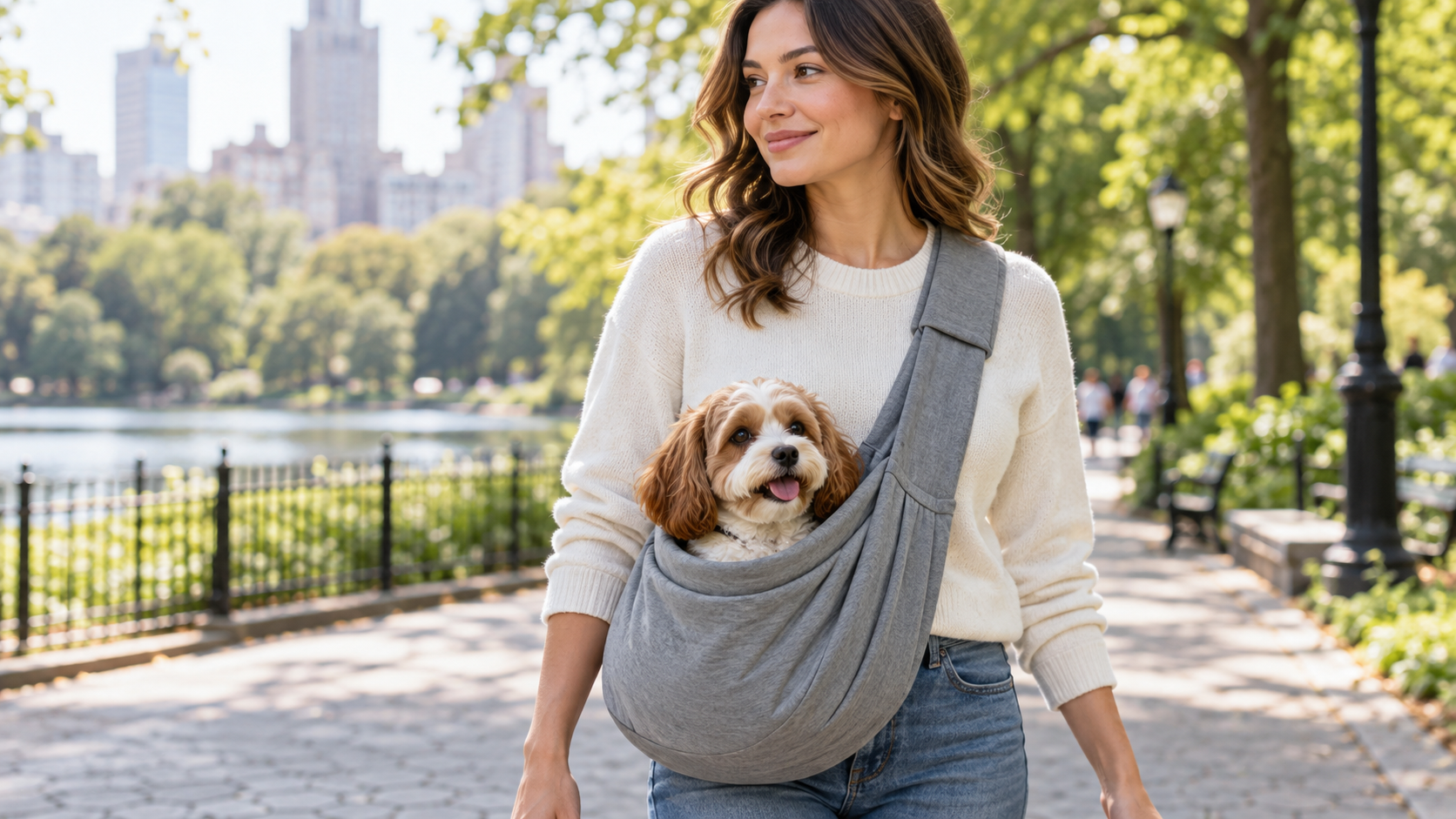
The best dog sling carrier must fit both bodies: the dog needs enough supported space to settle, and the wearer needs a strap or wrap that places the load securely. Tirige is the most transparent small-dog option here, listing a 3- to 7-pound range, a maximum 10-inch back length, a 24- to 34.5-inch strap, a mesh top, and a harness-only tether. For a heavier dog, Ownpets lists a 15- to 25-pound range, a 12-inch-deep bag, a 13.7-inch width, and a 24- to 45-inch strap. Weight alone is not enough; body length, posture, opening security, and support structure all matter.
Quick answer
- Best documented small sling: Tirige Small fits a listed 3–7 pounds and back length up to 10 inches, with adjustable depth and a mesh top.
- Best documented larger sling: Ownpets XL lists 15–25 pounds, a 12-inch depth, 13.7-inch width, and bottom support pad.
- Best flexible front wrap: AnccoPlus supports dogs up to 20 pounds and sizes the wearer by bust measurement.
- A built-in tether should attach to a correctly fitted harness, not the dog’s neck, and the dog should remain supervised.
A sling has to fit the dog and the wearer at the same time
Carrier sizing is a two-variable problem. The dog contributes weight, back length, body depth, width, and preferred resting posture. The person contributes torso size, shoulder position, crossbody length, and carrying tolerance. A product can fall inside the dog’s pound range and still place the opening at an awkward height or compress a long body.
Tirige provides the clearest two-dimensional dog guidance: the selected Small is for 3 to 7 pounds and a back length up to 10 inches. Ownpets gives a 15- to 25-pound interval and actual bag depth and width. Supet gives overlapping size ranges but conflicts slightly: its bullet says Regular 4 to 14 pounds and Plus 11 to 21 pounds, while the selected size field says S at 4 to 12 pounds.
AnccoPlus takes a wrap approach. It tells the person to measure the fullest part of the bust and choose Regular or Plus, while the dog limit is up to 20 pounds. That makes human fit unusually prominent but omits dog-compartment dimensions. PAWPUBBY is titled for 5 to 20 pounds and offers adjustable depth, yet its listed overall dimensions do not clearly describe the usable pouch interior.
| Carrier | Published dog range | Dog-space details | Wearer adjustment | Base/support format |
|---|---|---|---|---|
| Tirige Small | 3–7 lb; back up to 10 in | 16 × 6 × 7.5 in overall | 24–34.5-in shoulder strap | Flexible; no rigid base |
| Ownpets XL | 15–25 lb | Approx. 12 in deep, 13.7 in wide | 24–45-in strap, 1.45 in wide | Bottom support pad |
| AnccoPlus Regular | Up to 20 lb | No compartment dimensions stated | Wearer Regular S–L; adjustable back straps | Elastic front wrap |
| Supet selected S | 4–12 lb field; bullet says Regular 4–14 lb | 15.7 × 3.1 × 11.8 in listed | Adjustable straps | Flexible cotton-blend wrap |
| PAWPUBBY | 5–20 lb in title | Adjustable pouch depth | Adjustable webbing | Flexible polyester sling |
| TOMKAS | 3–10 lb in title | Large opening; capacity adjusted by safety belt/snaps | Adjustable strap in title | Flexible polyester sling |
Weight ranges overlap, but they do not create equivalent fit
Tirige covers a narrow four-pound span from 3 to 7 pounds. TOMKAS covers seven pounds from 3 to 10. PAWPUBBY covers 15 pounds from 5 to 20. Ownpets covers 10 pounds from 15 to 25. Supet’s stated ranges overlap from 11 to either 12 or 14 pounds depending on which selected field is used.
The formula for an interval width is maximum – minimum = range span. Ownpets spans 25 – 15 = 10 pounds. PAWPUBBY spans 20 – 5 = 15 pounds. A broader span does not prove greater adjustability; it can also indicate that critical dimensions are missing. Tirige’s smaller interval is paired with a back-length limit, which gives more fit information than a broad weight statement alone.
A long, narrow dog and a compact dog can share the same weight while occupying a sling differently. Measure from the base of the neck to the base of the tail where the listing requests back length. Observe whether the dog naturally curls, sits upright, or braces its front legs. The carrier must permit a stable posture without the dog hanging from an opening or tether.
Flexible wraps and supported-bottom slings carry weight differently
Tirige explicitly says there is no rigid base. Its polyester lining, light padding, and nylon shell create a flexible pouch. AnccoPlus uses a 95% cotton and 5% spandex body with covered elastic, designed to hold the dog at the wearer’s front. Supet also uses a flexible cotton-blend wrap. These designs conform around the dog but do not provide a level rigid platform.
Ownpets is the only selected product whose title names a bottom support pad. Its 12-inch depth and 13.7-inch width are the clearest compartment figures for the higher weight range. A pad can distribute contact differently, but the listing does not give pad thickness, rigidity, removable dimensions, or a flex test.
PAWPUBBY and TOMKAS sit between those concepts. PAWPUBBY changes bag depth with a drawstring. TOMKAS changes capacity through a safety belt and snaps near a large opening. Neither supplies a numerical base size. An adjustable opening is not the same as a supportive floor, so choose based on the dog’s posture rather than counting closures.
Opening security needs more than one marketing phrase
Tirige uses a drawstring mesh top plus a built-in tether. PAWPUBBY uses a drawstring closure and internal clip. TOMKAS describes snaps and a movable safety belt. Ownpets lists a collar hook. Supet and AnccoPlus use enveloping wrap tension rather than a distinct top mesh in the supplied information.
A tether is a backup connection, not a suspension point. Tirige gives the clearest instruction: attach it only to a properly fitted harness, never a collar. Ownpets says to connect its hook to a collar, but loading the neck is not an appropriate fallback if a dog attempts to jump. Use a harness connection when the carrier design and harness are compatible, keep the tether short enough to prevent exit without pulling the dog into an unnatural posture, and supervise continuously.
No sling is escape proof for every dog. A drawstring can loosen, a snap can remain open, elastic can shift, and a determined dog can climb. Check the opening each time the wearer bends, reaches, or changes pace. Keep both hands available during loading and unloading even if the product is described as hands free during carrying.
Strap range determines where the dog rides
Ownpets provides the broadest numerical strap interval: 24 to 45 inches, a 21-inch adjustment span. Tirige runs from 24 to 34.5 inches, a 10.5-inch span. The formula is maximum strap length – minimum strap length = adjustment span. Ownpets therefore offers 10.5 inches more stated adjustment range.
Those figures do not establish which strap is more comfortable. Ownpets lists a 1.45-inch width; Tirige mentions a wide lightly padded section without width. PAWPUBBY, TOMKAS, and Supet call their straps adjustable but give no interval. AnccoPlus adjusts across the wearer’s back and is sized by bust rather than a crossbody-length number.
Set the carrier high enough that the dog does not swing against the hip, but not so tight that the pouch compresses breathing or posture. Walk indoors first. Check whether the carrier shifts when turning, whether the strap presses the neck, and whether the dog remains level. Stop if the load feels unstable or causes discomfort.
Airflow descriptions do not replace observation
Tirige has a mesh top. PAWPUBBY uses 3D air mesh inside. AnccoPlus describes 3D air mesh and sponge at the wearer’s back. Supet calls its cotton-blend wrap breathable. TOMKAS and Ownpets do not provide a comparable mesh-area measurement.
The listings do not state mesh dimensions, air-permeability values, temperature limits, or maximum wear time. A dog can become warm inside fabric close to a human body even when mesh is present. Monitor breathing, behavior, body position, and environmental conditions. Move to shade or end the carry when the dog is uncomfortable.
PAWPUBBY calls its exterior mildly water resistant, but that does not make the opening weather sealed. Tirige calls its nylon shell water repellent. Light surface resistance is different from keeping the dog dry in sustained rain. Carrying fabric can also become heavier and less comfortable when wet.
Pockets are useful only when they do not crowd the dog
Tirige includes three pockets: a phone slip pocket, zippered pocket, and flap pocket. It also has a side zipper for reaching the pet without opening the mesh top. Ownpets supplies one front pocket. TOMKAS includes a zipper pocket in its title. The other selected listings do not provide comparable storage details.
Keep pocket loads light and flat. Keys, rigid bottles, and bulky objects can press into the dog or change how the sling hangs. A phone can add heat against the carrier, and a leash clipped outside can swing. Test the carrier with the actual pocket contents before leaving home.
A sling is not a substitute for a structured travel bag in every setting. Our guide to carrier bags for small dogs compares weight, dimensions, and fasteners for that separate format. If the carrier needs a removable liner, the dog carrier pad comparison focuses on pad dimensions.
Loading should happen close to a stable surface
Open and adjust the sling before lifting the dog. Stand or sit beside a low stable surface, support the dog’s body, lower it into the pouch, then close the opening and connect the backup tether as directed. Do not hold the dog by the legs, neck, or tether while arranging fabric.
Reverse the sequence for unloading. Support the body before releasing the opening so the dog cannot jump unexpectedly. Avoid loading near traffic, stairs, escalators, or a moving vehicle. A carrier that is secure while upright can change shape when the person bends forward.
Introduce the sling in short indoor sessions. Let the dog settle while the wearer remains still, then take a few steps and reassess. The product listing cannot determine whether an individual dog accepts confinement or close body contact. Do not force prolonged carrying when the dog struggles or repeatedly attempts to exit.
Know what a sling does not provide
These are wearable carriers for supervised walking or short outings. None of the listings supplies a crash-test result, airline compliance statement, rigid protective shell, or secure vehicle-anchoring method. Do not use a sling as a car restraint or assume it qualifies for cabin travel. For a detailed look at one related model, see the ARZQUT small carrier sling assessment.
Medical and recovery claims in product copy should not drive selection. A dog that is injured, recovering, elderly, painful, or unable to walk needs guidance from a veterinarian about whether carrying is appropriate and which posture or support is required. A generic sling may place pressure where it is not suitable.
Hands free describes the wearer’s normal posture, not permission to ignore the dog. Keep checking the opening, tether, fabric, and body position. Avoid running, cycling, cooking, or other activities in which a sudden movement or hazard could affect the carried dog.
Inspect the sling after every wash and before every outing. Look for stretched elastic, slipped strap adjustment, loose stitching, damaged mesh, weakened snaps, and bent tether hardware. Retire the carrier when any load-bearing part no longer returns to its intended position. Check both sides of each seam, not only the visible exterior.
How we chose
We compared all six supplied sling listings using their ASINs, titles, bullets, and specifications. Eligibility required a wearable sling or wrap intended to carry a small dog. We prioritized a complete weight interval, dog-body measurement, compartment size, strap range, opening design, tether instruction, base support, materials, pockets, and item weight.
Products with explicit limitations received more weight than those relying on broad comfort language. Anxiety, pain, orthopedic, strain, airflow, escape, and safety claims were not treated as established outcomes. We distinguished a flexible pouch from a rigid carrier and did not infer airline or vehicle suitability.
All six remain because their differences are substantive: measured small pouch, supported XL bag, front wrap, adjustable-depth sling, snap-adjusted small sling, and cotton-blend wrap with overlapping sizes. Where a listing omitted a dog-weight range or supplied conflicting ranges, the card says so.
What we could not verify
The listings do not provide shared seam-load tests, strap-slip tests, tether strength, base-rigidity measures, mesh airflow, pressure mapping, escape tests, or maximum continuous carry time. They do not establish medical suitability, anxiety reduction, pain relief, or wearer strain reduction.
Supet lists 4 to 12 pounds in one field and 4 to 14 pounds for Regular in a bullet. TOMKAS’s title states 3 to 10 pounds, but its structured fields omit that range and useful strap length. PAWPUBBY’s large overall measurements do not identify the usable pouch. No listing proves vehicle-crash or airline compliance.
Best dog sling carriers by fit
Tirige Small: best documented tiny-dog fit
Tirige lists a 3- to 7-pound range and maximum 10-inch back length. The 16-by-6-by-7.5-inch flexible pouch uses a 24- to 34.5-inch padded strap, adjustable depth, smooth polyester lining, mesh top, three pockets, side access, and a harness-only tether. It weighs 12.16 ounces and has no rigid base.
Skip if: the dog exceeds either the weight or back-length limit or needs a rigid floor.
Limitation: internal usable dimensions and tether-strength figures are not stated.
Ownpets XL: best documented heavier-dog sling
Ownpets lists 15 to 25 pounds, an approximately 12-inch-deep and 13.7-inch-wide bag, a bottom support pad, and a 24- to 45-inch strap that is 1.45 inches wide. It adds a front pocket and machine-washable, foldable construction.
Skip if: the dog is outside the weight interval or its body does not settle within the stated bag dimensions.
Limitation: pad thickness and rigidity are not stated, and the listing directs the safety hook to a collar rather than providing the clearer harness-only instruction.
AnccoPlus Regular: best front-wrap candidate
AnccoPlus uses a 95% cotton, 5% spandex front wrap with covered elastic and 3D mesh at the wearer’s back. The dog limit is up to 20 pounds, while the selected Regular size is intended for wearer sizes S through L based on bust measurement. Back straps can be adjusted for different users.
Skip if: you need a structured base, top mesh enclosure, or numerical dog-compartment dimensions.
Limitation: no minimum dog weight, back-length range, compartment dimensions, or tether is stated.
PAWPUBBY adjustable-depth sling: best flexible depth control
PAWPUBBY is titled for dogs and cats weighing 5 to 20 pounds. Its polyester sling uses 3D air mesh inside, a drawstring-adjustable pouch depth, adjustable shoulder webbing, an internal clip, and a mildly water-resistant exterior. It weighs 12.8 ounces.
Skip if: you need a rigid platform or verified internal width and depth.
Limitation: the 28.74-inch listed dimensions do not clearly describe usable pet space or strap range.
TOMKAS cream sling: best small snap-adjusted candidate
TOMKAS is titled for 3- to 10-pound pets and uses polyester, a large opening, snaps, a movable safety belt, zipper pocket, and adjustable strap. The safety belt changes the bag’s capacity, according to the listing. It is intended as a flexible carrier for small animals.
Skip if: you need a published back-length limit, rigid base, or numerical strap interval.
Limitation: the structured specifications omit the title’s weight range and do not provide usable pouch dimensions.
Supet selected S: best cotton-blend wrap with overlapping size choices
Supet uses a cotton-blend front pouch with adjustable shoulder straps. The selected S field says 4 to 12 pounds, while the bullet says Regular fits 4 to 14 and Plus fits 11 to 21 pounds. Listed dimensions are 15.7 by 3.1 by 11.8 inches.
Skip if: the conflicting selected-size limit affects the dog’s fit or you want a rigid-bottom bag.
Limitation: the upper weight differs between fields, and no back-length or usable compartment measurement is stated.
FAQ
How do I size a dog sling carrier?
Use the exact weight interval plus any back-length and compartment measurements. Tirige combines 3 to 7 pounds with a 10-inch back limit; Ownpets combines 15 to 25 pounds with bag depth and width. Also measure the wearer as directed and confirm the strap places the dog stably.
Should the safety tether attach to a collar or harness?
Tirige explicitly instructs connection to a properly fitted harness, never a collar. A tether should prevent exit without loading the neck or suspending the dog. Keep it short, supervised, and compatible with both the harness and carrier. Do not use it as a lifting point.
Is a rigid bottom better?
A support pad can provide a more defined floor, while a flexible sling conforms around the dog. Neither is automatically correct for every posture. Ownpets lists a bottom pad; Tirige explicitly has no rigid base. The listings do not supply shared pressure or support tests.
Can a dog sling be used in a car?
None of these listings provides a crash-test result or vehicle-anchoring method. A wearable sling should not be assumed to function as a car restraint. Use appropriate vehicle travel equipment separately and follow its installation instructions.
How long can a dog stay in a sling?
The listings do not establish a universal time. Duration depends on fit, posture, temperature, dog behavior, and the wearer’s stability. Begin with short supervised sessions, check the dog frequently, and end the carry if position shifts or discomfort appears.
Can I carry a dog recovering from an injury?
Ask a veterinarian first. A generic sling may place pressure on an area that needs protection or hold the dog in an unsuitable posture. Product copy about injury, surgery, pain, or anxiety does not establish medical appropriateness for an individual dog.
Bottom line
Fit the dog’s weight and body length, then fit the strap to the wearer. Tirige is the clearest tiny-dog choice, Ownpets provides the most useful figures for 15 to 25 pounds, and AnccoPlus is the distinct front-wrap option. Reject any sling that requires the tether to bear weight, lets the dog climb out, or places the load unstably.
Sources
- ASPCA dog care — opened October 25, 2026
- American Kennel Club training advice — opened October 25, 2026
- American Kennel Club health advice — opened October 25, 2026