Best Way to Pick Up Dog Poop From Grass
As an Amazon Associate we earn from qualifying purchases. Details
The best way to pick up dog poop from grass is to scoop it promptly, bag it, tie the bag tightly and put it in a trash container. The Washington State University (WSU) Extension materials we opened describe the same three-step routine: scoop it, bag it and put it in the trash. The steps below focus on timing, the bag, the disposal and the area around the spot. This guide does not recommend any product.
Quick answer
- Scoop the waste as soon as you find it. WSU says freshly deposited droppings that carry bacteria and parasites are immediately infectious to people.
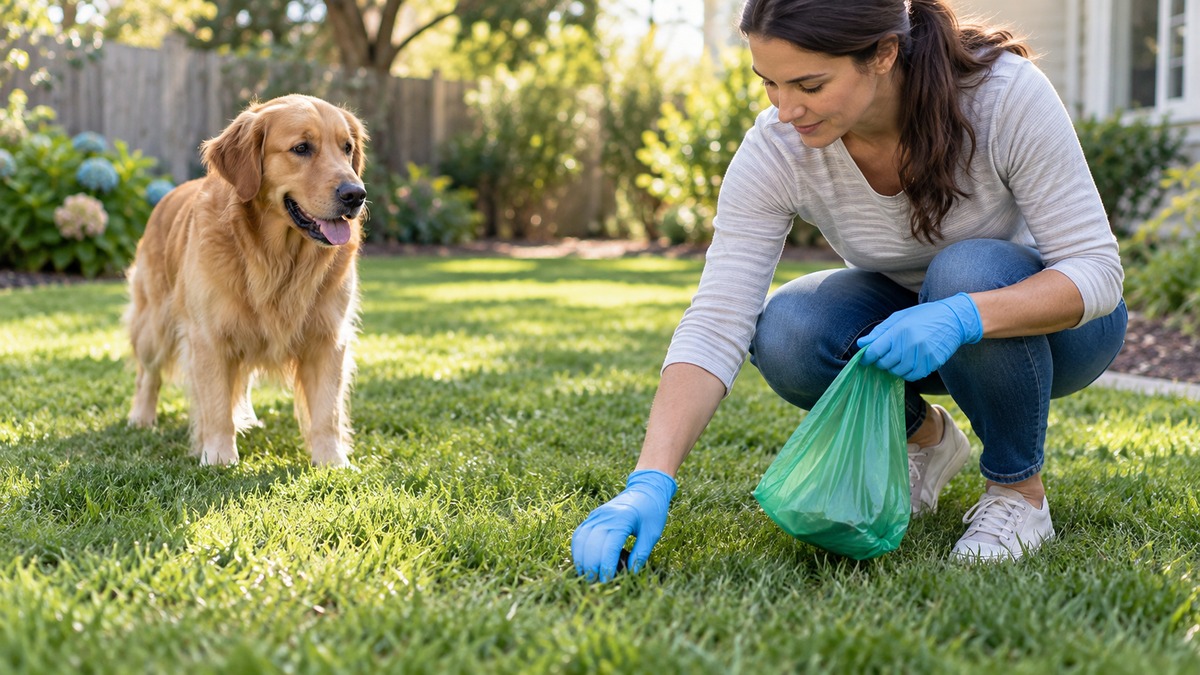
- Turn a bag inside out over your hand, pick up the waste, turn the bag back, and tie it tightly so it does not open.
- Put the bag in a trash can if one is available. If there is no trash can, take the bag home.
- Do not leave bags by the side of a trail or toss them into the woods. WSU says that creates two kinds of pollution.
- Pick up waste that is near a storm drain, a ditch or other water, because WSU says runoff can carry it to streams, rivers and lakes.
- Do not let waste sit in the grass to break down. WSU says parasite eggs can remain viable in soil for years.
How we chose this method
We limited this guide to WSU Extension sources. We opened three WSU pages on 2026-10-23: its managing pet waste guide, its Dog Waste Fact Sheet from Clallam County, and its rural stormwater dog waste document. We quoted only sentences that appear in the text of those pages. We did not test any scooper, bag or tool, and we do not recommend any product. The steps follow the order the WSU materials describe: pick up promptly, bag it, dispose of it, and pay attention to where the waste lands. Where the sources are silent, the section “What we could not verify” says so.
Step 1: Pick up the waste promptly
Timing is the first decision. WSU’s materials say freshly deposited dog droppings that contain harmful bacteria and parasites are immediately infectious to people. WSU lists salmonella, campylobacter and giardia cysts among the organisms in fresh waste. That means the time to pick up is right after the dog goes, not later in the day.
WSU also discusses roundworm, and it is easy to misread that point. Its guidance says roundworm eggs must age a week or more in dog stool to become infectious. That fact is about when roundworm eggs become a problem, and it is not a reason to leave waste on the grass for a week. WSU’s hookworm note says hookworms take 6 to 12 days to become infectious and may survive up to 3 to 4 weeks in the environment. The practical reading is that waste should be picked up in the first place, rather than left to age.
Step 2: Use a bag that closes
WSU’s routine uses a bag. The WSU Dog Waste Fact Sheet describes placing a hand inside the bag, like putting on a glove, and the rural stormwater document uses the same wording. The WSU materials describe this as the way to handle the bag while you pick up the waste.
Two points about bags come from the WSU materials. First, biodegradable bags are not necessary, according to WSU. Second, WSU says that once in the landfill, plastic may not ever decompose, even if it is biodegradable. The sources therefore do not treat a biodegradable label as a reason to skip a careful pickup. Choose a bag that holds, and keep the waste inside it until it reaches a trash container.
Step 3: Pick up the waste correctly
Use the same steps every time, so you do not miss a step on a busy walk:
- Place your hand inside a bag, as if you are putting on a glove.
- Pick up the dog waste and turn the bag inside out over your hand. The WSU fact sheet uses that sequence, with the free hand doing the turning.
- Secure the bag, and make sure it is tied tightly so it does not open when thrown away. WSU says to tie it tightly.
- Put the bag in a trash can if one is available, or take it home and dispose of it.
If you are on grass with no trash can nearby, WSU says to take the bag home. The sources do not describe a second option, so do not leave the bag in the grass, on the curb or in a shrub.
Step 4: Look at where the waste is and what is near it
WSU’s rural stormwater document explains that when it rains, storm water runoff carries pollutants and pet waste pathogens, bacteria and excess nutrients from upland areas to nearby streams, rivers, lakes and coastal waters. It also says the closer dog waste is deposited to water, or to a transport conduit such as a storm drain or roadside ditch, the higher the chances that pet waste will reach the water and cause pollution.
For a lawn, this means checking the spot and the grass around it. If the spot is close to a storm drain, a ditch or a stream, WSU’s guidance is that it is extra important to pick up any waste that can get to water. WSU’s managing pet waste page uses the phrase “pick up any waste that can get to water” for this case. The sources do not give a distance from water that is safe, so this guide does not give one.
The same WSU document also notes that vegetation or other barriers, the size and frequency of rainfall, the amount of contaminant in the feces, the soil type and the evaporation rate all play a role in contamination. The sources do not turn those factors into a formula, so treat the rule as simple: pick up what you can see, every time.
Step 5: Dispose of the bag properly
Disposal is where many pickups fail. WSU’s guidance is clear: put the bag in a trash can when one is available, and take it home when none is available. WSU also says never to leave bags by the side of the trail or toss them into the woods. Its wording is that doing so creates two kinds of pollution, pet waste and plastic waste.
Plan for disposal before the walk. Carry the bags, and keep a few spares in a pocket or a leash bag so you can handle a second pickup without having to find a new bag in the grass. WSU’s materials mention bringing an extra bag on the trip. The sources do not say how many bags to carry, so choose a number that suits your route.
Step 6: Do not let waste sit in the grass
Leaving waste on the lawn is the step most people underestimate. WSU’s Dog Waste Fact Sheet says that if feces are washed into the soil and allowed to disintegrate into the ground, parasite eggs can remain viable for years, which results in long-term contamination of the soil. That is why this guide does not recommend letting waste break down on the lawn. The sources we opened say to pick it up and dispose of it in the trash, not to leave it to break down. If you have a yard that has had waste left on it, the WSU materials do not describe a cleanup method for the soil, so do not guess.
Step 7: Keep the route tidy and the bags out of sight
WSU’s guidance is to keep bags out of the environment entirely, and not to leave them along trails or in wooded areas. The sources we opened do not describe a pocket or carrying method, so choose one that fits your route and clothing.
Common mistakes
- Waiting to pick up the waste. WSU says freshly deposited droppings are immediately infectious to people.
- Relying on the idea that waste is safe after a week. WSU’s roundworm point is about when eggs become infectious, and the materials do not treat it as a safe waiting period.
- Using a biodegradable bag as an excuse to leave the waste. The bag does not change the need to pick up promptly and dispose of it.
- Leaving the bag tied loosely. WSU says to tie it tightly so it does not open when thrown away.
- Leaving bags beside a trail or in the woods. WSU says bags left that way add plastic waste to the pet waste problem.
- Ignoring waste near a storm drain, ditch or stream. WSU says runoff can carry it to water.
- Letting waste sit in the grass to break down. Waste that washes into the soil can leave parasite eggs there for a long time.
What we could not verify
- The WSU pages we opened do not cover composting. This guide does not give a composting instruction.
- The sources do not address flushing waste. This guide does not recommend it or rule it out.
- The sources do not give a hand-washing routine. This guide makes no claim about hand washing.
- The sources do not give a minimum distance from water that makes waste safe to leave. We do not state one.
- The sources do not compare scoopers, bags or grass rakes, and this guide does not recommend any product.
- The sources do not say how long each organism remains infectious in every climate. The hookworm figures come from the WSU page and apply to the conditions described there.
- Local rules on pet waste vary, and the sources we opened do not cover every municipality. Check the rules where you live.
FAQ
How soon should I pick up dog poop from grass?
WSU says freshly deposited dog droppings that carry bacteria and parasites are immediately infectious to people. Pick it up as soon as you can after the dog goes.
Is a biodegradable bag better for picking up dog poop?
WSU says biodegradable bags are not necessary. It also says that once in the landfill, plastic may not ever decompose, even if it is biodegradable. Use a bag that holds, and tie it tightly.
What if there is no trash can nearby?
WSU says to take the bag home and dispose of it. Do not leave it on the grass or on a trail.
Can I leave dog poop on the lawn to break down?
No, based on the WSU materials. WSU says parasite eggs can remain viable in soil for years when waste disintegrates into the ground, which results in long-term contamination of the soil.
Why does it matter if waste is near a storm drain?
WSU says runoff from rain carries pet waste pathogens, bacteria and excess nutrients to nearby streams, rivers, lakes and coastal waters, and that the closer the waste is to water or a conduit such as a storm drain, the higher the chances it reaches the water.
How do I pick up waste without touching it?
WSU describes placing a hand inside the bag like putting on a glove, picking up the waste, and turning the bag inside out with the free hand. Tie the bag tightly afterward.
Bottom line
Pick up dog poop from grass promptly, bag it, tie the bag tightly and put it in the trash. If there is no trash can, take it home. Pay extra attention to waste near storm drains, ditches and streams, and never let waste sit in the lawn to break down. For related reading on walking gear, see the guide to leashes for bike riding and the guide to retractable leashes.
Sources
- https://extension.wsu.edu/clallam/watershed-stewardship/managing-pet-waste/
- https://wpcdn.web.wsu.edu/wp-extension/uploads/sites/2069/2018/08/Final-Dog-Waste-Fact-Sheet-Clallam-7.5.18.pdf
- https://ruralstormwater.wsu.edu/documents/2022/09/dog-waste.pdf