DIY Dog Float Vest: What the Catalog Supports and What It Does Not
As an Amazon Associate we earn from qualifying purchases. Details
Updated 20 October 2026 | Author: Editorial team, bestdogsstuff.com
The person typing diy dog float vest wants to make a flotation vest for a dog at home, or wants to know whether a homemade vest can stand in for a manufactured one. The catalog behind this search holds twelve records, and seven of them are flotation vests. None of the records gives a pattern, a materials list or build steps, and the pages we opened do not address homemade vests. This post does not give a build guide. It shows what the manufactured vests state, what the sources say about checking any vest, and why a homemade vest has no figure to check against.
Quick answer
- The set contains no DIY build. The seven flotation records are manufactured vests, and the other five records are not flotation products at all.
- The BoatUS Foundation page says pet life jackets carry no buoyancy rating and that no design standard exists for dogs. A homemade vest therefore has no rating to check, and a manufactured vest carries only the maker’s own words.
- The sources ask for a well-fitting vest, a lifting handle, a fit test before the first trip and close supervision in the water.
- If a homemade vest is the plan anyway, the same checks apply, and no dog should be left unattended in or near the water.
What the seven flotation records state
The table lists what each flotation record prints for size, neck and chest, weight, handle and buoyancy. A dash means the record does not state that figure, and the table does not fill it in from another source.
| Listing (short name) | Size label | Neck and chest stated | Weight stated | Handle | Buoyancy wording |
|---|---|---|---|---|---|
| BRKURLEG vest, green XL | X-Large (specification); Small dog size | Size chart in the product images only | Not stated | Reinforced rescue handle | High buoyancy; polyethylene foam |
| KISFLY vest, XXL | XXL | Measure neck, chest and back length; no figures | 1.1 pounds minimum (specification) | Reinforced top rescue handle | Built-in pearl cotton flotation foam |
| ZippyPaws XX-small | XX-Small | Neck 10 inches; chest 10 inches (specification); chest girth 6 to 10 inches (bullet) | 5 pounds minimum | Padded handle | Dense foam panels |
| A-MORE medium | Medium | Neck 13.8 inches; chest 25.2 inches | 15.4 pounds minimum | Safety handle on top | No buoyancy wording |
| EMUST vest | Medium (specification); All breed sizes | Size chart referenced; no figures | Not stated | Two handles on L, XL and 2XL only (bullet) | Superior buoyancy in the title; high buoyancy material in the bullets |
| LeLePet vest, M | M (specification); puppy age | Chest girth named as the key measure; no figures | Not stated | Reinforced top rescue handle | High-density pearl cotton foam |
| Outward Hound Granby, Large | Large | Chest girth 28 to 32 inches; chest 32 inches and neck 14 inches (specification) | 25 kg minimum | Strong top handle for lifting | Maximum-buoyancy vest for large dogs |
Read the table across. Three records print both a neck and a chest figure in their specifications: the ZippyPaws, A-MORE and Outward Hound records. The other records name a size chart or a measuring step without printing the figures, so a buyer has to get the numbers from the product page or from the dog.
The buoyancy column shows the problem in one place. Two records use the word buoyancy in a bullet or title, and one uses “maximum-buoyancy” for large dogs, but none prints a buoyancy figure. The A-MORE record has no buoyancy wording at all. A reader who wants a number to compare will not find one in this set.
Arithmetic on the printed figures
Subtracting the printed bounds gives the spread a single size covers. The Outward Hound chest girth runs from 28 to 32 inches, so 32 minus 28 equals 4 inches of girth for one size. The ZippyPaws bullet gives 6 to 10 inches, so 10 minus 6 equals 4 inches for the smallest size. A dog that measures between two sizes is not covered by the spread of one size alone.
The chest figures differ between sizes. The Outward Hound chest of 32 inches sits 32 minus 25.2 equals 6.8 inches above the A-MORE medium chest of 25.2 inches. The minimum weight figures also differ, and the A-MORE minimum of 15.4 pounds is 15.4 minus 5 equals 10.4 pounds above the ZippyPaws minimum of 5 pounds. Those are the listing’s own figures, and none of them is a test of how a vest floats a dog.
Why a homemade vest cannot be checked
The BoatUS Foundation page says plainly that pet life jackets do not come with buoyancy ratings the way human life jackets do: “Pet life jackets do not come with buoyancy ratings, as do human life jackets (the Coast Guard requires it).” The same page says that no design standard exists for dog life jackets: “There are no standards in life jacket design for dogs, and the Coast Guard doesn’t certify them, so it’s up to the owner to find a jacket suitable for their dog.”
That is the central point for a DIY search. A manufactured vest carries the maker’s own figures and wording, and no federal rating confirms them. A homemade vest has none of those figures at all. There is no maker’s statement, no size chart prepared by a manufacturer and no rating for a buyer to compare, so the checks have to come from the dog and the water, not from a number on a label.
The pages we opened do not describe a homemade vest, do not give a method for building one and do not say that one floats a dog. This post therefore makes no claim that a DIY vest works or fails. It only states what the sources do and do not support.
Fit: the measurements the sources and records ask for
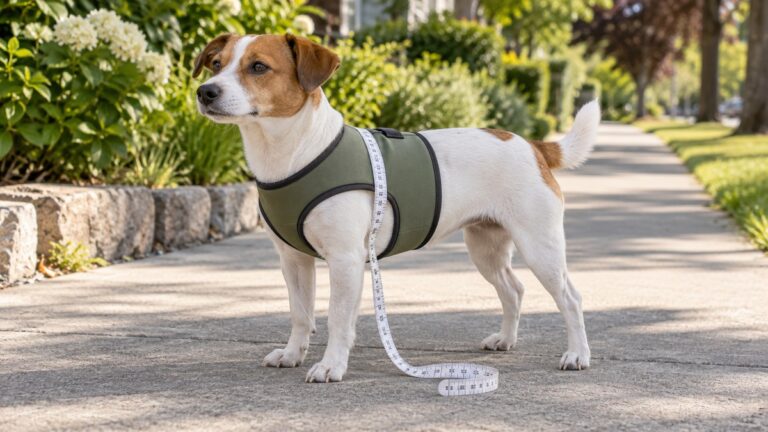
The fit steps are the one part of this topic that the sources do address. The BoatUS page lists the measurements to take: neck, chest girth taken behind the front legs, length from back of collar to top of tail, and weight. The records ask for the same figures in one form or another.
The University of Wisconsin School of Veterinary Medicine page on beach trips gives the next step: “Before venturing out, place the jacket on your dog to test the fit and help them get used to wearing it.” A fit test before the first water trip is the cheapest check in the process, and it is the same check whether the vest is bought or made.
The records ask for a close fit as well. The BRKURLEG record says to measure the chest girth and back length and to order the larger size between two sizes. The ZippyPaws record gives a neck and chest of 10 inches each for its smallest size, which shows how close the bounds can be. A vest that slips or rides up is a fit problem, and no source here says how a homemade vest keeps its fit under load.
For the harness side of fit, our harness to wear all the time guide and our large dog harness roundup cover the everyday fit questions that a vest raises, and they are worth reading before a dog spends time on a boat.
Handles and the grab point
Every flotation record in this set names a handle, and the BoatUS page treats the handle as essential. Its line is short: “A lifting handle is a must.” The page also notes that a handle can help when the owner needs to reach the dog with a boat hook. Every flotation record names a handle in some form. The EMUST record is the one exception to a handle on each size, because its two handles are stated only for the largest sizes.
A homemade vest has to carry the same grab point. Stitching a handle to a vest is the step most likely to be done too lightly, and nothing in the sources tells a home builder how to test a handle. The records give handle positions and lengths in words only, so a buyer should check the handle’s position and the seams on the product before buying, and should test any handle the same way before using it.
Supervision and the water rules
The sources agree on supervision. The University of Wisconsin page says to “always keep a close eye on them in the water.” The Wisconsin summer page says that close supervision and a rescue plan are key to keeping a dog safe during swimming excursions, and it adds that a life jacket is worth considering for a dog that is inexperienced or a weak swimmer. The Clemson University page says to ensure the dog is always supervised and never to leave pets unattended in or near the water.
Those points apply whether the vest is bought or made. A vest does not replace a person in the water, and no record in the set claims that it does. The records describe floating, handles and reflective stripes, but they do not describe rescue, and the sources do not say a vest makes a dog safe in deep or moving water.
The five records that are not flotation vests
Five of the twelve records in this set are not flotation products, and this post leaves them out of the picks. The Idepet record is a costume coat for holidays, with a leash hole and a Christmas and Halloween theme. The AUROTH record is a tactical harness with Molle straps and a front clip for no-pull walks. The YIMEIS record is a no-pull puppy harness with a leash, and the Voyager record is a step-in harness for small dogs. The SafetyPUP XD record is a blaze orange vest for hunting areas, whose bullets describe visibility and not flotation, and its specifications give no buoyancy wording.
These are not substitutes for a flotation vest. A harness or a coat does not float a dog, and a reader who buys one for water use would be buying the wrong tool. The exclusions are a fact about the catalog set, not a judgment on those products for their own uses.
Choosing between a homemade and a manufactured vest
The decision comes down to what can be checked. A manufactured vest can be measured against a printed chart, fitted on the dog before use, inspected for its handle and seams, and compared with the maker’s figures and warranty. A homemade vest can be fitted and inspected too, but it has no maker’s figures and no rating, and the sources give no method for building one to a standard. The buyer who wants a checkable product should look at the manufactured records above and check each figure against the dog.
If the owner still prefers to build one, the fit test, the handle test and the supervision rules in this post apply without change. The sources do not make a homemade vest a recommended option, and this post does not recommend one.
Mistakes to avoid
- Assuming a vest’s buoyancy can be read from its look. Pet life jackets have no buoyancy rating, so the look of the foam says nothing measured.
- Skipping the fit test. The UW page says to test the fit on the dog before going out.
- Ignoring the handle. The BoatUS page calls a lifting handle a must.
- Buying a non-flotation product. Five records in this set are coats, harnesses or hunting vests.
- Leaving the dog unattended in the water. The Clemson page says never to leave pets unattended in or near the water.
- Treating a size label as a fit. Four records give a size label with no printed chest figure.
The picks below cover the seven flotation vests in the set, in the order the table above lists them. Each pick states what its record prints, what it leaves out, and when to skip it. The five non-flotation records are not picks, for the reason given above.
1. BRKURLEG Dog Life Jacket, Dog Life Vest for Swimming & Boating with High Buoyancy & Rescue Handle (reflective flotation vest with a rescue handle, labeled X-Large)
Pros
- The bullets describe high-density foam buoyancy and a reinforced rescue handle for lifting the dog from a boat, pool or lake.
- The bullets give a size chart and say to order the larger size when the dog measures between two sizes.
Cons
- The specifications give an X-Large label next to a Small dog breed size, so the record conflicts with itself.
- The size chart sits in the product images, not in the text, so the chest and neck figures cannot be read from the record.
Best for: A buyer who wants a foam flotation vest with a rescue handle and reflective stripes, after measuring the dog against the chart.
Skip if: The size label conflicts with your measurement, or you need printed chest figures before ordering.
View on Amazon (affiliate link)
2. Large Dog Life Jacket XXL, Swimming Vest with Rescue Handle (XXL flotation vest with a rescue handle and reflective panels)
Pros
- The bullets describe built-in pearl cotton flotation foam, a reinforced top rescue handle and reflective panels.
- The bullets list XS to XXXL sizes with adjustable neck and chest straps and a hook-and-loop closure.
Cons
- The record prints no neck or chest measurement, only the instruction to measure neck, chest and back length.
- The specifications give a minimum weight recommendation of 1.1 pounds, which does not look like a dog weight.
Best for: A large dog where the owner will measure the neck, chest and back length before choosing the XXL size.
Skip if: You need printed chest figures or a realistic minimum weight before ordering.
View on Amazon (affiliate link)
3. ZippyPaws Adventure Dog Life Jacket – Dog Life Vest for Swimming & Boating (XX-small flotation vest for a chest of 6 to 10 inches)
Pros
- The bullets give a chest girth of 6 to 10 inches for the XX-small size, and the specifications print 10 inches for both neck and chest.
- The bullets describe dense foam panels, a padded handle and reflective stripes.
Cons
- The specifications list a minimum weight of 5 pounds, and the chest figures in the bullets are the only size guide.
- The specifications carry marketing fields such as a league name and a theme, which do not describe performance.
Best for: A very small puppy or toy dog with a chest of 6 to 10 inches, measured before the first water trip.
Skip if: The dog's chest measures outside 6 to 10 inches, or the dog is below the 5 pound minimum.
View on Amazon (affiliate link)
4. Dog Life Jackets,Saver Life Jacket,Swimming Vest Quick-Drying,Dog Saver Vest with Safety Handle (medium life jacket with printed neck and chest figures)
Pros
- The specifications print a neck of 13.8 inches and a chest of 25.2 inches for the medium size.
- The bullets describe a top safety handle and adjustable velcro and buckle straps at the waist and neck.
Cons
- The bullets make no buoyancy claim, and the specifications give no buoyancy figure.
- The specifications give a minimum weight of 15.4 pounds, which is 10.4 pounds above the ZippyPaws minimum of 5 pounds.
Best for: A medium dog whose neck and chest are close to 13.8 and 25.2 inches, where the owner accepts that no buoyancy figure is printed.
Skip if: You need a stated buoyancy claim, or your dog weighs under 15.4 pounds.
View on Amazon (affiliate link)
5. EMUST Dog Life Preserver, Superior Buoyancy Dog Flotation Vest for Dogs (flotation vest with two handles on the largest sizes)
Pros
- The bullets describe reflective strips, quick-release buckles and a D-ring for a leash.
- The bullets say the sizes run from XS to 2XL, with two handles stated only for the L, XL and 2XL sizes.
Cons
- The specifications give a Medium label and an all-breed size, and no neck or chest figure is printed.
- The title says superior buoyancy, but the bullets give only a high buoyancy material description with no figure.
Best for: A dog in the L to 2XL range, where the two-handle design is part of the choice.
Skip if: Your dog is in a size below L, since the two-handle design is stated only for L to 2XL.
View on Amazon (affiliate link)
6. LeLePet Dog Life Jacket, High Flotation Swim Vest for Dogs M Red (M flotation swim vest with a rescue handle and reflective stripes)
Pros
- The bullets describe ripstop Oxford fabric, high-density pearl cotton foam and a reinforced top rescue handle.
- The bullets say chest girth is the key measurement and give a size range of XS to XXL.
Cons
- The record prints no neck or chest figure, so the M size cannot be checked from the listing.
- The specifications give an age range of puppy, while the sizing bullets describe XS to XXL for most breeds.
Best for: A dog whose chest girth has been measured against the maker's size chart before the first water trip.
Skip if: You need printed chest figures or an adult-age label before ordering.
View on Amazon (affiliate link)
7. Outward Hound Granby Splash Dog Life Jacket, Life Vest, Orange, Large (large maximum-buoyancy vest for a 28 to 32 inch girth)
Pros
- The bullets give a chest girth of 28 to 32 inches for the large size, and the specifications print a 32 inch chest and a 14 inch neck.
- The bullets describe a front float that helps support the head and neck, and a strong top handle for lifting.
Cons
- The specifications give a minimum weight recommendation of 25 kg, and the record does not say how that figure was set.
- The chest range is 4 inches wide, since 32 minus 28 equals 4, so a dog between sizes has little room to adjust.
Best for: A large dog with a girth of 28 to 32 inches that will wear a maximum-buoyancy vest with a top handle.
Skip if: The dog's girth falls outside 28 to 32 inches, or the dog is below the minimum weight recommendation.
View on Amazon (affiliate link)
How we chose
We started from the question a dog owner types: whether a DIY dog float vest is a workable plan, and what the catalog and the sources support. We wanted the answer to come from the records’ own figures and wording, and from the sources’ statements about fit, handles and supervision.
Each of the twelve records was read for its title, bullets and specifications. The records hold no price, stock or rating data in this post, and none appears here. We did not add or remove any record from the set. We kept seven flotation vests as picks and left out five records that are not flotation products, each for the reason given in the section above.
The sources were opened with curl on 20 October 2026. The two University of Wisconsin School of Veterinary Medicine pages and the Clemson University News page are university sources. The BoatUS Foundation page is a nonprofit boating source and not a government or university page, and it is cited for the points about buoyancy ratings and handles. We did not use retailer pages, product pages or search snippets as evidence, and we did not find a government or university source that addresses homemade vests.
Each pick received a skip rule taken from its own record, and each pro and con is written from that record alone. No two picks share a pro or con. The picks are not ranked, because the records give no buoyancy comparison.
What we could not verify
- Whether a homemade dog float vest floats a dog, or how much support it gives. The pages we opened do not address homemade vests, and no source here gives a build method.
- The buoyancy of any manufactured vest in this set. No record prints a buoyancy figure, and the BoatUS page says pet vests carry no rating.
- The slip-out risk for any vest. The sources do not address a dog slipping out of a vest, and no record gives a test for it.
- The chest and neck figures for the KISFLY, EMUST and LeLePet records, which name size charts without printing the figures.
- The KISFLY minimum weight of 1.1 pounds, which does not look like a dog weight and may be a listing error.
- The BRKURLEG size conflict, where the specification gives an X-Large label beside a Small dog breed size, and the size chart sits only in the product images.
- The EMUST handle count below the largest sizes, which the bullets do not state.
- The Outward Hound minimum weight of 25 kg, which the record does not explain.
- Whether any handle, seam or strap holds under load. The records name the parts and give no strength test.
- Current price, stock and warranty terms beyond what the records print.
FAQ
Can I make a dog float vest at home?
This set contains no build or pattern, and the pages we opened do not address homemade vests. This post does not recommend building one. If you build one anyway, do the same fit test, handle check and supervision steps the sources call for.
Does a dog life vest have a buoyancy rating?
According to the BoatUS Foundation page, pet life jackets do not come with buoyancy ratings the way human life jackets do, and no design standard exists for dogs. The records in this set print no buoyancy figure either.
How do I measure my dog for a vest?
Use the measurements the BoatUS page lists: neck, chest girth taken behind the front legs, length from back of collar to top of tail, and weight. Then match them to the record’s size chart, and order the larger size if the measurement falls between two sizes where the record says to.
Should a dog wear a vest in the water all the time?
The sources say a life jacket is worth considering for a dog that is inexperienced or a weak swimmer. They also say to keep close supervision and never leave pets unattended in or near the water. A vest does not replace either one.
Are the non-flotation records in this set useful for water?
Not as flotation. The coat, harnesses and hunting vest in this set are not flotation products, and none of them states a buoyancy figure. Use one of the seven flotation vests if the dog needs a vest for water.
Bottom line
There is no DIY build in this set, and no source here shows that a homemade vest floats a dog. If a vest is part of a water plan, choose a flotation record whose size, handle and fit you can check on the dog, and keep the supervision rules in place whatever the vest.
Sources
- University of Wisconsin School of Veterinary Medicine, Beach Bound With Your Dog? Eight Tips for Safe Water Excursions: before venturing out, test the jacket’s fit on the dog; always keep a close eye on the dog in the water
- University of Wisconsin School of Veterinary Medicine, Summer pet safety: 6 things owners should know: close supervision and a rescue plan are key; consider a life jacket for dogs who are inexperienced or weak swimmers
- Clemson University News, Water safety tips could save pets’ lives: ensure a well-fitting life jacket; never leave pets unattended in or near the water
- BoatUS Foundation, Doggie Life Jacket Tests: pet life jackets have no buoyancy ratings; no design standard for dogs; a lifting handle is a must; measure neck, chest and back length and weight