Dog Eye Wipes
As an Amazon Associate we earn from qualifying purchases.
Best Dog Eye Wipes: Six Options for Gentle External Cleanup
Dog eye wipes are premoistened pads for cleaning the fur and skin around a dog’s eyes, not the eyeball itself. A useful wipe needs a manageable shape, enough moisture to soften external residue, and a formula the dog tolerates. This comparison covers six round-pad options with counts from 50 to 120, including fragrance-free and scented choices. It also shows how to avoid cross-contamination, estimate supply duration, and distinguish routine grooming from signs that need veterinary attention.
Quick answer
- Best fragrance-free count-and-size combination: Palmer’s supplies 100 round wipes listed at 3.2 inches.
- Best larger count: MEDUWEDU lists 120 three-inch pads, though its coconut scent will not suit every household.
- Best for a textured surface: Angels’ Eyes describes 100 textured pads and gives an age note for puppies older than 12 weeks.
- Use boundary: wipe outward over surrounding fur; do not rub the eye, and stop if the dog shows pain or irritation.
Dog eye wipe comparison
| Product | Listed count | Pad detail | Scent information |
|---|---|---|---|
| PawSono | 100 | 3-inch round, dual texture | Unscented |
| MEDUWEDU | 120 | 3-inch nonwoven round | Coconut |
| Angels’ Eyes | 100 | Textured round pad | Aloe scent |
| PHASORRA | 100 | 3-by-3-inch round pad | Listing language is inconsistent |
| Palmer’s | 100 | 3.2-by-3.2-inch round pad | Fragrance-free |
| TropiClean | 50 per stated container | Plant-fiber round pad | No clear scent detail in the supplied record |
Keep the wipe outside the eye
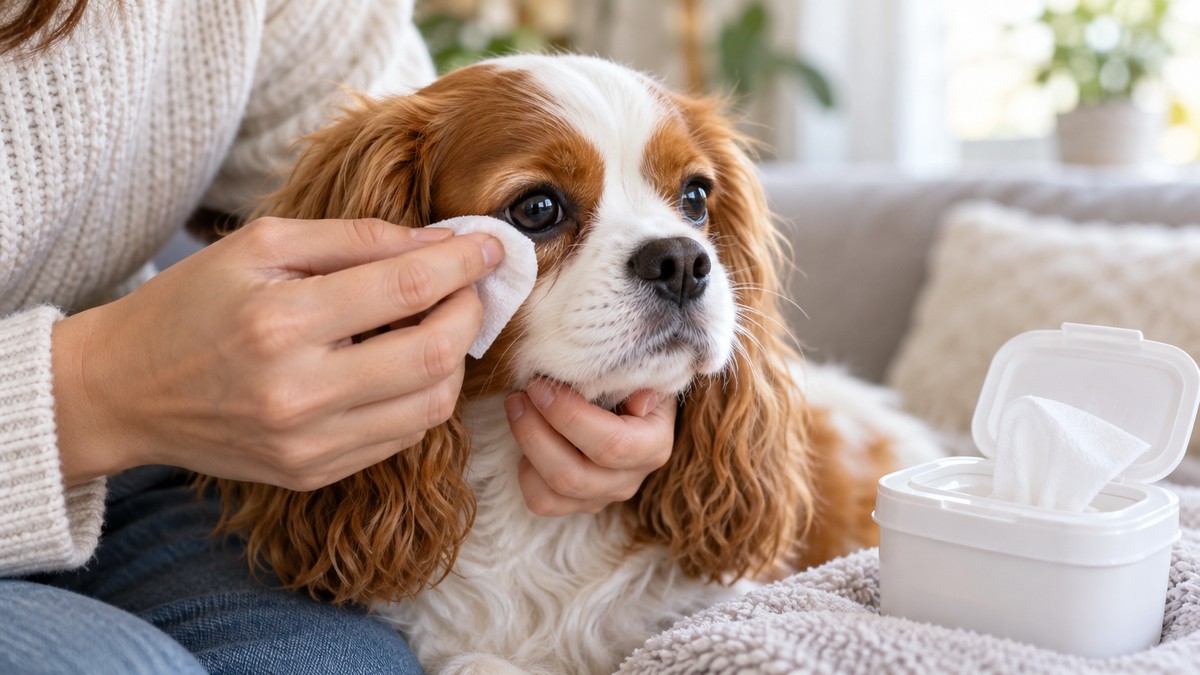
The product category name can be misleading. These pads are meant for the external area around the eye: the cheek, facial folds, and hair where moisture or dried material collects. They are not eye drops and should not be swept across the cornea or pushed beneath an eyelid. Read the current label before use because directions and cautions can differ among formulas.
Begin with clean hands and a dog positioned on a stable, non-slip surface. If residue is dry, hold the pad against the affected hair briefly without pressing on the eyeball. Wipe from the inner facial area outward, using a light movement rather than repeated scrubbing. A second pass should use a clean surface. Pat damp fur dry if the label permits, especially where skin folds trap moisture.
Never probe a stubborn crust with a fingernail, comb point, or cotton swab near the eye. Do not continue until the skin looks raw or the dog struggles. Material that will not soften with a gentle external wipe can wait for professional advice; forcing removal is a poor trade for a cosmetic result.
Use a separate pad for each side
One pad may look large enough for both eyes, but capacity is not the only consideration. Using a fresh pad for the second side limits transfer of discharge and debris across the face. Fold or rotate a pad only while working on the same side, and discard it when the clean surface is gone. Do not return a used pad to the container.
This one-side, one-pad rule also makes observation clearer. When each side has its own wipe, you can compare color and amount without mixing material. That comparison may help you notice a one-sided change worth reporting to a veterinarian. It does not diagnose the cause; it simply preserves better information.
Multi-dog homes need another boundary. Wash hands between dogs and avoid touching the tub opening with a used glove or damp fingers. If one dog has unexplained eye signs, do not share the container during the assessment period unless a veterinary professional says the hygiene approach is appropriate.
Pad diameter affects handling, not effectiveness by itself
PawSono and MEDUWEDU both state a three-inch diameter. PHASORRA gives a three-by-three-inch round-pad measurement, while Palmer’s lists 3.2 by 3.2 inches. Those dimensions describe the overall pad, not the thickness or absorbent capacity. A slightly larger circle offers more surface for folding, but material and moisture level determine how it behaves against facial hair.
A large pad can be easier to grip with wet hands; it can also cover more of the muzzle than needed on a small face. Fold the pad into a controllable edge rather than bunching it into a thick wad. Around deep folds, work only where you can see the pad’s edge. None of these records provides a dog weight range, so pad fit must be judged by facial structure and handling control rather than breed-size marketing.
Texture can help, but pressure still matters
PawSono describes a dual-texture design, and Angels’ Eyes identifies its pads as textured. Texture may help lift softened surface material from hair. It does not authorize harder rubbing. Fine facial skin can become irritated when a textured pad repeatedly crosses the same spot, particularly if the area is already damp or inflamed.
The other selected listings emphasize nonwoven or plant-fiber construction without enough comparable information to rank surface roughness. Terms such as soft and gentle are descriptive claims, not standardized measurements. If texture is important, inspect the pad before the first use and test one brief stroke on surrounding fur while watching the dog’s response.
Scent is a practical selection factor
PawSono is listed as unscented, while Palmer’s is described as fragrance-free. Those terms are useful screening details, although they are not proof that every dog will tolerate the formula. MEDUWEDU has a coconut scent and Angels’ Eyes has an aloe scent. A scented product may be acceptable to one household and distracting to another, especially because the pad is used close to the nose.
PHASORRA presents a data conflict: the product branding references blueberry, while another supplied bullet says no added fragrance. Without the current ingredient panel and packaging, it would be unsafe to classify it confidently as scented or fragrance-free. Shoppers avoiding fragrance should verify that detail before use rather than relying on the product title or a single promotional phrase.
TropiClean’s research record does not provide a clear scent designation. Absence of a scent description is not the same as fragrance-free. Ingredient sensitivities are individual, and even a familiar maker does not guarantee tolerance around every dog’s face.
Formula labels need more attention than front-panel themes
PawSono refers to a plant-based formula. MEDUWEDU supplies an ingredient list in the research record, and Palmer’s highlights cocoa butter and vitamin E. Angels’ Eyes states that its pads are free of alcohol and dyes. TropiClean describes plant fibers and says its formula is free of alcohol, dyes, and parabens. These are meaningful label distinctions, but they do not establish treatment capability or universal safety.
Review the full current ingredient list, directions, warnings, and expiration information. Stop using a new wipe if the external area becomes redder, the dog paws at the face, or discomfort appears after application. Rinse or seek guidance according to the label and a veterinary professional’s direction; do not attempt to neutralize one product with another.
Calculate supply from actual pad use
Count comparisons become useful only after accounting for both sides. The formula is estimated sessions = total pads ÷ pads used per session. At two pads per session, MEDUWEDU’s stated 120 count yields 120 ÷ 2 = 60 sessions. A 100-count tub yields 50 sessions, and a 50-count container yields 25. This assumes one pad for each side and no extra pad for heavy residue.
Frequency then converts sessions into days. If a dog’s appropriate routine were every other day, 50 sessions would span about 100 days. That is an inventory example, not a universal grooming schedule. The label, actual need, veterinary advice, and the product’s usable period after opening take priority. Pads that dry out, become contaminated, or pass their marked date should not be kept merely to satisfy the arithmetic.
TropiClean needs extra caution in count calculations. The record says 50 count but also contains wording that may indicate a four-pack, while its included-components field is not fully clear. We treat 50 as the count for the stated container and do not claim a confirmed total shipment count. Verify the live listing before comparing total inventory.
Container design affects everyday hygiene
Premoistened wipes depend on a reliable seal. Close the lid immediately after removing a pad, keep the tub upright, and store it under the label’s temperature and light instructions. Do not add water to a drying stack; that changes the prepared formula and does not restore the product as manufactured.
The package measurements offer a rough storage guide. PawSono is listed at 3 by 3 by 3 inches and 10.58 ounces. MEDUWEDU is 2.83 by 3.54 by 2.87 inches and 8.78 ounces. PHASORRA is 3.54 by 3.19 by 3.19 inches and 8.78 ounces. Palmer’s is 2.5 by 2.5 by 3 inches and 7.41 ounces. TropiClean is 3.15 by 1.08 by 6.69 inches and 6.74 ounces. Angels’ Eyes is listed at 3 by 2.5 by 2.5 inches. These figures describe packages and should not be treated as exact pad-container geometry where the record does not say so.
Build a calm face-handling routine
Some dogs object to the approach of a hand more than to the wipe itself. Practice in small steps: show the closed tub, reward calm interest, touch the cheek with a dry finger, then introduce a folded pad for one brief outward movement. Finish before the dog becomes restless. Progress over several sessions is safer than holding the muzzle tightly to complete both sides.
Stand or sit beside the dog instead of looming over the head. Support the chin lightly only if the dog has learned that position. Keep long hair away from the eye with your free hand, and never let the edge of the pad disappear beneath an eyelid. If safe handling requires force, pause and ask a groomer or veterinary team for a technique demonstration.
Know when routine grooming should stop
Eye-area residue can be a grooming issue, but a wipe cannot explain why it appeared. Sudden or one-sided discharge, squinting, repeated pawing, swelling, marked redness, cloudiness, an injury, or visible pain should prompt veterinary contact. The same is true when the pattern changes quickly or returns despite careful external cleaning.
Do not use cosmetic improvement as the only measure of success. Old staining can remain on hair after fresh material has been removed. Repeatedly rubbing to chase a lighter color may irritate the skin without addressing the reason for moisture. Record changes in amount, color, frequency, and behavior so a professional receives a clearer history.
Puppy and short-muzzle considerations
Angels’ Eyes is the only selected listing with a stated age detail: puppies older than 12 weeks. That does not create an age rule for the other five products. For a puppy without clear label guidance, verify suitability with the manufacturer or veterinarian before use. Smaller animals also leave less room between the fingers, pad edge, and eye, making restraint and visibility especially important.
Dogs with prominent eyes, facial folds, or hair that contacts the eye may need an individualized care plan. Anatomy affects moisture collection and access, but it does not justify diagnosing a breed-based cause at home. Ask a veterinarian or experienced groomer to demonstrate external cleaning for the dog’s face shape.
Compare routines with a seven-day observation log
A short log separates day-to-day impressions from a genuine change. For seven days, record whether residue appeared on the left side, right side, or both; the time it was noticed; the number of clean pads used; and how the dog behaved. Use plain descriptions such as clear moisture, dry brown material, or thicker discharge without assigning a diagnosis. Note outdoor activity, bathing, grooming, or a newly opened formula because those details may help a professional interpret the sequence.
Photographs can support the record when taken from the same distance and under similar light. They should never delay care for a painful-looking eye. Avoid flash close to the face, and do not pry the eyelids apart for a picture. A calm photograph of the surrounding fur is enough for tracking cosmetic staining; examination of the eye itself belongs with a veterinary professional.
At the end of the week, look for pattern rather than a target color. Fewer pads required for ordinary external cleanup may indicate a more manageable routine, but white fur remaining discolored does not prove that fresh debris is still present. Stop the comparison early if symptoms worsen or the dog becomes uncomfortable.
Plan a clean setup before opening the tub
Place the sealed container, a dry towel, a waste bag, and any reward within reach before bringing the dog into position. This prevents walking away with an open tub or touching drawers after handling facial residue. Pull one pad with clean, dry fingers and close the lid. If two sides will be cleaned, remove the second pad only when you are ready for it so it stays moist and uncontaminated.
Choose a room with enough light to see the pad edge at all times. A mirror can help a solo handler observe the far side of a small dog’s face, but it is not a substitute for stable positioning. Keep bottles, combs, and sharp grooming tools off the working surface. The goal is a short, predictable sequence with no reaching across the dog’s eyes.
Afterward, discard used pads where another pet cannot retrieve them. Wash hands, dry any moisture left on facial folds as permitted by the directions, and wipe the container exterior if it was touched with damp hands. Storage hygiene protects the unused stack; it does not sterilize pads that have already been exposed.
Introduce a new formula one variable at a time
Changing the wipe, facial shampoo, food, and grooming schedule on the same day makes it difficult to identify what preceded a reaction or improvement. When routine care is appropriate, keep other variables steady and introduce one new external product according to its label. Record the exact product and opening date. Do not combine solutions on one pad unless the manufacturer explicitly directs that use.
A small external-area trial cannot guarantee that later use near the eye will be tolerated, but it may reveal an obvious issue before a full session. Ask a veterinarian how to approach this when the dog has known skin sensitivities or a current eye concern. “Plant-based,” “natural,” and recognizable ingredient names do not remove the possibility of irritation.
If the dog reacts, stop the routine and keep the packaging available so its ingredient list and lot information can be reviewed. Do not immediately test the next product on already irritated skin. Follow professional and label guidance for any cleanup, and document when the signs began relative to application.
How we chose
We selected premoistened pads explicitly intended for external dog eye-area grooming and required at least three matching products. Comparison focused on count, pad size, texture, scent disclosure, container information, and formula statements that could be traced to the supplied research. Liquids, powders, comb-only products, and general body wipes were left out because they change the application method.
We favored products with concrete disclosures and called out conflicting or incomplete records instead of resolving them by assumption. No item received preference because of promotional rank, star scores, or unverified performance language. A place in this roundup means the format matches the use case, not that it is appropriate for every dog.
What we could not verify
The records do not establish pad thickness, moisture per pad, pH, exact shelf life after opening, lid durability, or comparative softness. We could not confirm long-term results, individual tolerance, or how quickly any tub dries during ordinary use. Except for the stated Angels’ Eyes puppy note, there are no numerical age or dog weight ranges.
PHASORRA’s scent wording is inconsistent, and TropiClean’s total shipped count is ambiguous. Current ingredients, quantities, directions, warnings, and package contents can change, so confirm them on the label and product page before purchase.
Six dog eye wipe picks
1. PawSono Eye Wipes
Why it stands out: The tub contains 100 unscented, three-inch round pads with a stated dual-texture surface. That combination offers a defined diameter and two surface options without an added scent claim.
Skip it if: You prefer a single smooth texture or need a label with a specific puppy age statement.
Limitation: Pad thickness, moisture level, and dog size range are not disclosed in the supplied record.
2. MEDUWEDU Eye Wipes
Why it stands out: This option has the largest clearly stated count in the group at 120 pads. Each nonwoven round is listed at three inches, making supply and handling comparisons straightforward.
Skip it if: You want an unscented or fragrance-free product; the listing identifies a coconut scent.
Limitation: The record does not provide pad thickness, measured moisture, or a dog weight range.
3. Angels’ Eyes Gentle Tear Stain Wipes
Why it stands out: The 100-count textured pads include the clearest puppy guidance among these selections: older than 12 weeks. The listing also says the formula is free of alcohol and dyes.
Skip it if: You avoid scented products, because the record describes an aloe scent.
Limitation: Exact pad diameter and thickness are not supplied, and no dog weight range is stated.
4. PHASORRA Eye Wipes
Why it stands out: The tub supplies 100 round pads listed at three by three inches, a useful size disclosure for shoppers who fold pads for controlled external wiping.
Skip it if: Fragrance avoidance is nonnegotiable and you cannot confirm the current label.
Limitation: Blueberry branding conflicts with a supplied statement about no added fragrance. We could not verify which description governs the current product, and no dog size range is given.
5. Palmer’s for Pets Eye Wipes
Why it stands out: The fragrance-free formula comes on 100 round pads listed at 3.2 by 3.2 inches, the largest stated pad dimension in this selection. The record highlights cocoa butter and vitamin E.
Skip it if: You prefer a textured two-sided pad or a formula without the highlighted conditioning ingredients.
Limitation: Surface texture, pad thickness, and dog weight range are not specified.
6. TropiClean Spa Tear Stain Wipes
Why it stands out: The plant-fiber pads are described as free of alcohol, dyes, and parabens. The record gives a 50-count container figure, useful for shoppers wanting a smaller initial supply.
Skip it if: You require an unambiguous total shipment count or clearly stated scent classification before ordering.
Limitation: The source wording mixes a 50-count description with a possible four-pack reference, so the total included quantity must be confirmed. No pad diameter or dog size range is supplied.
FAQ
Can dog eye wipes touch the eyeball?
Use these pads on the external fur and skin around the eye according to the label. Do not rub the eyeball, slide a pad under an eyelid, or substitute a grooming wipe for veterinary eye medication.
Can I use one wipe for both eyes?
A separate pad for each side reduces transfer of debris and keeps observations distinct. Do not put a used wipe back into the tub or touch the remaining stack with its soiled surface.
Are fragrance-free wipes automatically hypoallergenic?
No. Fragrance disclosure is one selection factor, not a guarantee against sensitivity. Read the complete ingredient list and stop if redness or discomfort appears.
How should I soften dried material?
Follow the product directions. In general, a moistened pad can be held gently against the external hair before wiping outward, without pressing on the eye. Do not pick or scrape a stubborn crust.
How often can I use eye wipes?
Use the frequency on the current label and adjust only with appropriate professional guidance. Need varies, and repeated cleaning is not a substitute for evaluating a new or worsening discharge pattern.
When should I call a veterinarian?
Seek guidance for pain, squinting, swelling, injury, cloudiness, significant redness, rapid change, persistent one-sided discharge, or repeated pawing. Those signs go beyond an ordinary cosmetic cleanup decision.
Bottom line
Choose dog eye wipes by clear pad dimensions, count, scent preference, formula disclosure, and the control you have around the dog’s face. Palmer’s offers a fragrance-free 100-count option with a stated 3.2-inch size; PawSono combines unscented pads with dual texture; MEDUWEDU has the largest confirmed count. Angels’ Eyes supplies an age note, while PHASORRA and TropiClean require extra listing verification. Use one pad per side, wipe only the external area, seal the container promptly, and treat discomfort or changing discharge as a reason to stop grooming and seek advice.
For related buying guides, see Best Dog Shampoo and Best Dog Grooming Table.
Sources
- Merck Veterinary Manual: Dog Owners — opened October 26, 2026.
- Cornell University Riney Canine Health Center — opened October 26, 2026.
- VCA Animal Hospitals: Dog Care — opened October 26, 2026.