Best Gates for Puppies: Mount Type, Opening Width and the Stair Rule
As an Amazon Associate we earn from qualifying purchases. Details
Updated 20 October 2026 | Author: Editorial team, bestdogsstuff.com
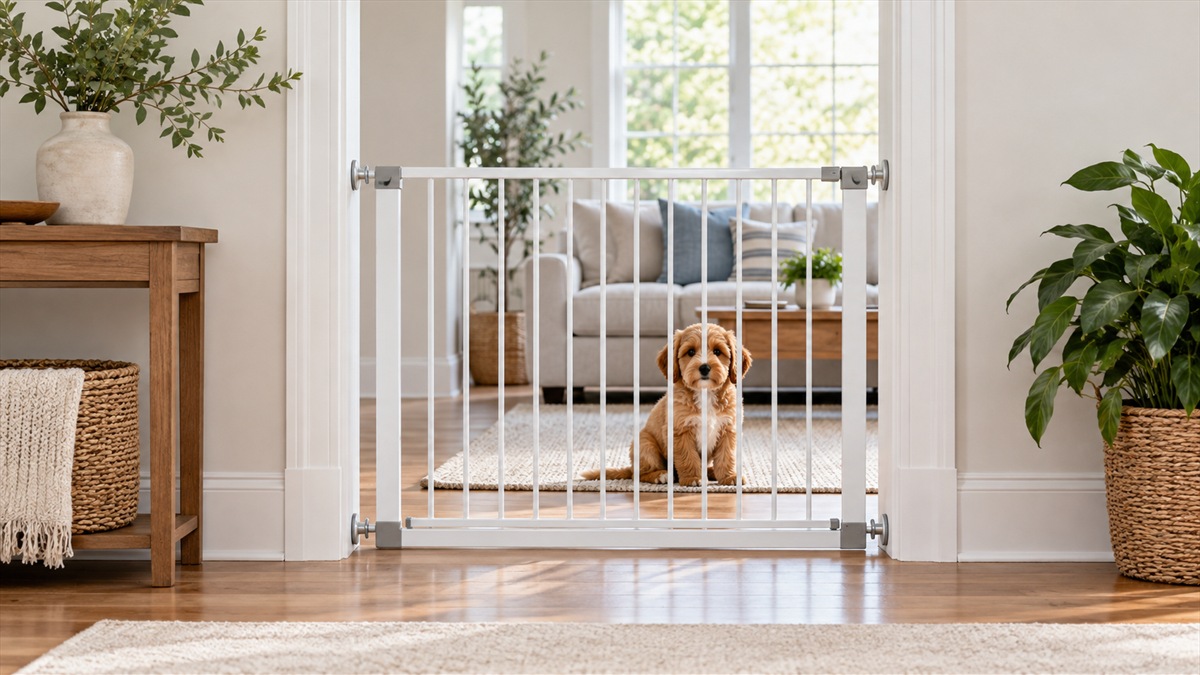
The person typing best gates for puppies wants a gate that keeps a young dog out of a room or away from the stairs, and that the puppy cannot push, squeeze under or climb. This set of eight gates includes pressure-mounted gates, wall-mounted retractable mesh, freestanding panels and one tall pet gate. Their mount types differ, and that difference matters most at the top of stairs. The sources below set that rule first, and the listing figures show the widths and heights each gate prints.
Quick answer
- Do not put a pressure-mounted gate at the top of stairs. The University of Wisconsin-Oshkosh Head Start page says those gates are not secure enough to prevent falls there, and the Safety 1st manual says never use the gate at the top of stairs.
- Measure the opening before you choose. The width ranges in this set run from a span of 6 inches to a span of 27.5 inches, and two records name openings that do not fit.
- Heights run from 23 to 75.2 inches. No source here says how tall a puppy gate must be, so match the height to the puppy’s age and the maker’s instructions.
- Read the mount line and the limitations line. The federal gate standard materials say the limitations statement must cover the mounting hardware and where to install the gate.
What the sources say about installation
The most useful rules in this post come from sources about gates in general, not about puppies. The U.S. Consumer Product Safety Commission’s transcript on gates and enclosures says that testing is done on products installed according to the manufacturer’s instructions: “Testing shall be completed on the products installed according to the manufacturer’s instructions.” The same transcript says gates must carry a limitations statement covering the mounting hardware and where to install the gate relative to the floor: “Gates must have a statement of limitations regarding the use of any included mounting hardware and information regarding where to install the gate relative to the floor.”
The Federal Register final rule for the gate standard, published July 6, 2020, puts the install problem in the consumer’s hands: “Correct installation of pressure-mounted gates depends on consumer awareness and behavior to install the gate correctly.” That sentence matters for a puppy gate because the same mount that is easy to fit can be fitted badly, and the rule says correct installation depends on the buyer.
These are the federal and manufacturer rules for gates for children. A puppy’s climbing, pushing and jumping are different, and the sources here do not cover puppy behavior. Read every rule as a starting point for the installation, not as a guarantee for a particular dog.
The stair rule
The top of the stairs is the one place where the mount decides the outcome, and the sources agree on it. The University of Wisconsin-Oshkosh Head Start page says: “Use hardware-mounted gates at the top of stairs. Gates that only press against walls—pressure-mounted gates—are not secure enough to prevent falls at the top of stairs.” It also says to check the manufacturer’s instructions, because some gates need to be installed at floor level.
The Safety 1st Easy Install Walk-Thru Gate instructions, a 2015 manufacturer sheet hosted by Indiana University’s Safety Store, say the same thing from the maker’s side: “To prevent falls, NEVER use at top of stairs.” The same sheet adds: “To prevent serious injury or death, securely install gate or enclosure and use according to manufacturer’s instructions.”
The records in this set do not all state a mount that can be used at the top of stairs. Three say pressure mount, one says pressure or hardware mount, and some say freestanding or wall mount without saying which hardware is used. The Regalo listing says in its bullets that the gate should never be used at the top of stairs to prevent falls, which agrees with the sources. The Joyofcife listing names staircases as a use for a pressure-mounted gate, which the sources do not support at the top of stairs.
Mount types in this set
The table lists each record’s mount line, its width and height, and the dog or baby target the record prints. A dash means the record does not state that figure.
| Listing (short name) | Gate type | Width stated | Height stated | Mount stated | Target stated |
|---|---|---|---|---|---|
| keny auto-close gate | Stair or doorway gate | 29 to 42.5 inches (title) | 30 inches | Pressure or hardware | Babies and dogs |
| cideny retractable gate | Retractable mesh | Up to 55 inches | 34 inches | Wall mount | Baby, dog, pet, toddler, child |
| Clearlature acrylic gate | Freestanding, three panels | 60 inches total | 24 inches | Freestanding | Cat and dog; all ages |
| probebi retractable gate | Retractable mesh | 0 to 54 inches (bullet) | 34 inches | Wall mount | Baby, dog and pet |
| PETMAKER wood and metal gate | Freestanding, three panels | 54 inches long; openings 33 to 46 inches | 24 inches | Freestanding | Dog |
| MYPET portable gate | Pressure mount | 26 to 40 inches | 23 inches | Pressure mount | Dog |
| Joyofcife tall gate | Pressure mount, extra tall | 30 to 36 inches | 75.2 inches | Pressure mount | Cat and dog |
| Regalo superwide gate | Pressure mount | 30.5 to 58 inches | 30 inches | Pressure mount | Babies 6 to 24 months; small to medium pets |
Several widths come from titles or bullets rather than the specification line. The cideny figure is a maximum, and the probebi figure starts at 0 inches, so it is a maximum rather than a usable opening. Read each width as the listing’s own statement.
Width: the arithmetic of the opening
Subtracting the smallest opening from the largest gives the span a single gate covers. The keny gate spans 42.5 minus 29 equals 13.5 inches. The MYPET gate spans 40 minus 26 equals 14 inches. The PETMAKER gate spans 46 minus 33 equals 13 inches, using the opening range in its bullets. The Joyofcife gate spans 36 minus 30 equals 6 inches, which is the narrowest adjustment in the set. The Regalo gate spans 58 minus 30.5 equals 27.5 inches, the widest adjustment.
A narrow span leaves little room for error in the measurement, because the gate has to fit one opening within a few inches. A wide span allows for more openings, but the listing’s own fit list is the test. The keny listing says it does not fit openings between 31.8 and 33.4 inches, or between 38.7 and 40.3 inches. The Regalo listing gives a long list of fit combinations and says some ranges, such as 31 to 36.5 inches, do not fit. Measure the opening at the top, middle and bottom, and check the list against the smallest figure.
Height and the gap at the bottom
Heights in this set run from 23 inches on the MYPET gate to 75.2 inches on the Joyofcife gate. The difference between the cideny or probebi height of 34 inches and the MYPET height of 23 inches is 34 minus 23 equals 11 inches. The Joyofcife height is 75.2 minus 34 equals 41.2 inches above the cideny gate.
No source in this post says how tall a gate must be for a puppy of a given age. The UWOSH page gives one floor rule, which is that a gate should be mounted less than 3 inches from the floor to prevent a child from crawling underneath. That rule is written for children, so treat it as a check on the gap at the floor, not as a puppy standard.
Retractable mesh and bars
Two records use retractable mesh. The cideny gate is wall mounted, 55 inches wide at most and 34 inches tall, and its bullets say the mesh retracts when not in use and that the lower bracket sits 6.5 inches above the floor. The probebi gate is also a retractable mesh gate, 54 inches wide and 34 inches tall, with a two-step lock. Its bullets say there is no bottom rail to trip over, which is the seller’s wording with no test named.
A mesh gate has no bar at the bottom, so there is no rail for a puppy to step over. That is a feature the listings describe. It is not a measured result, and the records do not show how a puppy behaves against mesh. The mesh also needs a secure wall fixing, so the hardware line should be read before buying.
Freestanding and tall pet gates
The Clearlature, PETMAKER and Joyofcife records are freestanding or tall pet gates. The Clearlature gate is three clear acrylic panels, each 20 inches wide and 24 inches tall, with non-slip feet that the bullets say prevent tipping. The PETMAKER gate is a three-panel wood and metal accordion, 54 inches long and 24 inches tall, which its bullets say needs no drilling. The Joyofcife gate is 75.2 inches tall and pressure mounted, with an adjustable width of 30 to 36 inches.
Freestanding gates do not depend on a wall fixing, so they are not the same as a stair gate at the top of the stairs. A freestanding gate at the top of stairs would need its own check on the maker’s instructions and the UWOSH rule, which says hardware mounting is the one to use at that point. None of the freestanding gates in this set states hardware mounting for the top of stairs.
For a comparison of doorway gates from this network, see our Regalo and Cideny doors, gates and ramps comparison. For the stair side of the same question, our stairs and steps comparison covers the equipment a stair gate has to work with.
Latches, locks and doors
Each gate has a latch or a lock, and the listings describe them differently. The keny gate has an auto-close door that swings in two directions, and its bullets say the double lock is tough for babies or dogs to open. The cideny gate has a double lock and a one-hand operation. The probebi gate has a two-step lock, pressing down and rotating left to lock. The MYPET and Regalo gates each have a latch, and the Joyofcife gate has what its bullets call a quadruple lock.
The lock claims are the sellers’ words. The records name no test for how a puppy works a latch, and the sources do not compare latches. Check the latch on the gate you buy, and make sure the door swings the way the opening needs.
Mistakes to avoid
- Putting a pressure-mounted gate at the top of stairs. The UWOSH page and the Safety 1st sheet both say no.
- Buying by the age label. The Regalo gate is labeled for babies 6 to 24 months, and the keny gate names babies and dogs. The label does not measure a puppy’s fit.
- Skipping the fit list. The keny and Regalo records name openings that do not fit.
- Assuming a freestanding gate is hardware mounted. A freestanding gate is not fixed to the wall.
- Reading a bullet as a test. Several bullets call a gate trip-free, rigorously tested or climb-proof with no test named.
- Ignoring the installation sheet. The CPSC transcript says the gate is tested as installed by the maker’s instructions.
The picks below cover all eight gates in the set, in the same order as the table above. Each pick states what its record prints, what it leaves out, and when to skip it. The stair rule in this post applies to every pick.
1. keny 29″-42.5″ Baby Gate for Stairs, Auto Close Safety Dog Gate (auto-close stair gate for a 29 to 42.5 inch opening)
Pros
- The title and bullets give an opening range of 29 to 42.5 inches, with 4.5 and 6.9 inch extension kits named.
- The bullets describe an auto-close door that swings in two directions, with a double lock design.
Cons
- The bullets say the gate does not fit openings between 31.8 and 33.4 inches, or between 38.7 and 40.3 inches.
- The specifications give a pressure or hardware mount, so the mount actually supplied must be confirmed before any use at the top of stairs.
Best for: A stair or doorway opening between 29 and 42.5 inches, outside the two excluded ranges.
Skip if: You plan to fit it at the top of stairs with only a pressure mount.
View on Amazon (affiliate link)
2. Retractable Baby Gate for Stairs & Doorways, Dog Gate Indoor Outdoor (retractable mesh gate, 55 inches wide and 34 inches tall)
Pros
- The specifications give 55 inches wide and 34 inches tall, with a wall mount and a retractable closure.
- The bullets describe mesh that retracts when not in use and a lower bracket 6.5 inches above the floor.
Cons
- The bullets call the gate trip-free and safer for toddlers, which are the seller's words with no test named.
- The specifications list the age range as baby and the target species as baby, dog, pet, toddler and child, so the label does not separate puppy use.
Best for: A wide opening where a retracting mesh gate is wanted, fixed to a wall.
Skip if: You want a pressure mount at the top of stairs, since this record is a wall mount.
View on Amazon (affiliate link)
3. Clear Acrylic Dog Gates Freestanding,Transparent Fence for Christmas Tree (freestanding clear acrylic gate, three panels, 60 inches total)
Pros
- The specifications list a freestanding mount and three panels of 20 by 24 inches, and the bullets give 60 inches in total width.
- The bullets describe 5mm clear acrylic with non-slip feet that the bullets say prevent tipping.
Cons
- The title refers to a Christmas tree, which does not match the dog gate use in the bullets, so the product page should be checked.
- The specifications give a 12.8 pound item weight, and the bullets do not say how the gate is anchored at a stair.
Best for: A room opening or a freestanding play barrier where a clear panel is wanted and no drilling is possible.
Skip if: You need a gate at the top of stairs, since a freestanding gate is not fixed to the wall.
View on Amazon (affiliate link)
4. PRObebi Retractable Baby Gates for Stairs & Doorways, Dog Gate 0-54″ W × 34″ H, Black (retractable mesh gate, 54 inches wide and 34 inches tall)
Pros
- The specifications give 54 inches wide and 34 inches tall, and the box includes anchors, screws and tie straps.
- The bullets describe a two-step lock that the listing says keeps babies and strong dogs in, with no bottom rail.
Cons
- The bullets claim the bottom bracket adjusts to any baseboard, but the record gives no baseboard height range.
- The bullets claim there is no trip hazard, which is the seller's wording with no test named.
Best for: A doorway or hallway with a wall to fix to, where a retracting mesh gate is wanted.
Skip if: You need a pressure-mounted gate at the top of stairs, since this gate is wall mounted.
View on Amazon (affiliate link)
5. Pet Gate – 3-Panel Indoor Foldable Dog Fence for Stairs, Hallways, or Doorways – 54×24-Inch Wood (three-panel freestanding wood and metal gate, 54 by 24 inches)
Pros
- The specifications give 54 inches long and 24 inches tall, and the bullets give openings of 33 to 46 inches.
- The bullets describe a freestanding accordion design that needs no drilling and folds for storage.
Cons
- The bullets say the gate can go at the top or bottom of stairs, but a freestanding gate is not hardware mounted, and the UWOSH page says hardware mounting is the rule at the top.
- At 24 inches tall it is shorter than the 30 to 34 inch gates in this set, and the bullets name cats and small dogs as users.
Best for: A doorway between 33 and 46 inches for a small puppy or a household with a cat and a puppy.
Skip if: You need a gate at the top of stairs, or your opening is outside 33 to 46 inches.
View on Amazon (affiliate link)
6. MYPET North States Paws Portable Pet Gate: 26-40″ Wide. Pressure Mount. No tools needed. Made (portable pressure-mount gate, 26 to 40 inches wide and 23 inches tall)
Pros
- The bullets give an opening of 26 to 40 inches and a 23 inch height, with rubber bumpers and room for up to 4 inches of molding.
- The specifications give a 1 year manufacturer warranty and a latch closure on a pressure mount.
Cons
- The bullets say it will not work in a wider doorway, and at 23 inches it is the shortest gate in this set.
- The bullets say the gates are rigorously tested, but the record names no test method.
Best for: A doorway between 26 and 40 inches for a puppy that needs a short, portable barrier.
Skip if: The opening is wider than 40 inches, or the gate is needed at the top of stairs.
View on Amazon (affiliate link)
7. Extra Tall Cat Gate for Doorway – 75.2“ Pressure-Mounted Transparent Cat Gate for Pets, Fits (extra tall pressure-mount pet gate, 75.2 inches, with a cat gate title)
Pros
- The specifications give 30 by 75.2 inches, and the bullets give an adjustable width of 30 to 36 inches with extensions included.
- The bullets describe a quadruple lock and a climb-resistant design, which the listing states without a test.
Cons
- The title calls it a cat gate, but the specifications list cat and dog as target species, so the label does not settle the dog use.
- The bullets name staircases as a use for a pressure-mounted gate, which the UWOSH page does not support at the top of stairs.
Best for: A doorway between 30 and 36 inches for a dog that needs a very tall barrier, with the mount checked first.
Skip if: You need a gate at the top of stairs, since this gate is pressure mounted.
View on Amazon (affiliate link)
8. Regalo Safety 30.5″-58″ Extra Wide Baby Gate, Bottom of Stairs & Doorways (superwide pressure-mount gate, 30.5 to 58 inches, for babies from 6 to 24 months)
Pros
- The bullets give fit combinations across 30.5 to 58 inches, and the specifications give 58 by 30 inches with a latch closure.
- The bullets say the gate should never be used at the top of stairs, which matches the UWOSH and Safety 1st sources.
Cons
- The age label and the bullets name babies from 6 to 24 months, with small to medium pets as the only other use the bullets state.
- The bullets list fit combinations and name ranges that do not fit, so the opening must be measured against the full list.
Best for: A bottom-of-stairs or doorway opening between 30.5 and 58 inches, used away from the top of stairs.
Skip if: The dog is large, or the opening falls in one of the listed gaps.
View on Amazon (affiliate link)
How we chose
We started from the question a dog owner types: which gate suits a puppy, and what the listing and the sources say about mounting and fit. We wanted the answer to come from the mount line, the width and height figures and the installation statements, with the stair rule taken from the sources.
Each of the eight records was read for its title, bullets and specifications. The records hold no price, stock or rating data, and none appears in this post. We did not add or remove any record from the set. All eight are pet or baby gates, so all eight are picks.
The sources were opened with curl on 20 October 2026. The CPSC transcript and Federal Register rule are government documents, the UWOSH page is a university page, and the Safety 1st sheet is hosted by a university safety store. The CPSC web pages returned an access block when opened, so this post relies on the CPSC transcript PDF and not on the CPSC web pages.
Each pick received a skip rule taken from its own record, and each pro and con is written from that record alone. No two picks share a pro or con. The picks are not ranked, because the records give no test or comparison data.
What we could not verify
- The CPSC web pages on top-of-stairs gates. Those pages returned an access block, so the top-of-stairs rule here rests on the UWOSH page and the Safety 1st sheet.
- How a puppy of a given size or breed climbs, squeezes, pushes or jumps a gate. No source here covers puppy behavior.
- Whether any gate fits a particular opening. The fit lists are the records’ own statements, and the keny and Regalo lists name ranges that do not fit.
- The Clearlature title, which refers to a Christmas tree while the bullets describe a dog gate, so the product page should be checked.
- The Joyofcife title, which says cat gate while the specifications list cat and dog as targets.
- The mount line for the keny gate, which reads pressure or hardware, and does not say which the buyer gets.
- The latch and lock claims in the bullets, including the claims that a dog cannot open the lock.
- The rigorous testing claim in the MYPET bullets, which names no test method.
- The warranty terms. The MYPET record gives 1 year, the Regalo record gives a 6 month limited warranty, and several records give none.
- Current price and stock for any gate.
FAQ
Can I use a pressure-mounted gate at the top of stairs?
No, according to the University of Wisconsin-Oshkosh Head Start page and the Safety 1st manual. The UWOSH page says to use hardware-mounted gates at the top of stairs, because pressure-mounted gates are not secure enough to prevent falls there. The keny record is pressure or hardware mounted, so check which one you have before using it at the top of stairs.
What width does a puppy gate need?
Measure the opening, then compare it with the widths the record prints. The spans in this set run from 6 inches to 27.5 inches. Two records name openings that do not fit, so check those lists before ordering.
How tall should a puppy gate be?
No source here gives a height for a puppy. The heights in this set run from 23 to 75.2 inches. Match the height to the puppy’s age and to the maker’s instructions, and recheck it as the puppy grows.
Are mesh gates better than bar gates for puppies?
The records describe mesh gates with no bottom rail to trip over, which is the seller’s wording. No source we opened compares mesh and bar gates for puppies, so this post does not rank them.
Can a gate made for babies serve a puppy?
The Regalo record is labeled for babies from 6 to 24 months and for small to medium pets. The keny record names babies and dogs. The CPSC transcript says gates must state their limitations, so read the limitation statement for the use you plan.
Bottom line
Start with the mount, not the color. Use a hardware-mounted gate at the top of stairs, measure the opening against the printed fit list, and read the installation and limitation statements before the puppy meets the gate.
Sources
- US Consumer Product Safety Commission, Overview of Gates and Enclosures Requirements: testing is done on products installed per the manufacturer’s instructions; gates must state limitations on mounting hardware and floor placement
- Federal Register, Safety Standard for Gates and Enclosures, final rule (2020): correct installation of pressure-mounted gates depends on consumer awareness and behavior
- University of Wisconsin-Oshkosh Head Start, Safety using Baby Gates on Stairs: use hardware-mounted gates at the top of stairs; pressure-mounted gates are not secure enough to prevent falls there
- Dorel Juvenile, Safety 1st Easy Install Walk-Thru Gate instructions (hosted by Indiana University Safety Store): never use at the top of stairs; install securely and use according to the manufacturer’s instructions