Best Deshedding Brush for Long Hair Dogs: Tangles First, Then Shedding
As an Amazon Associate we earn from qualifying purchases. Details
By Ken
The best deshedding brush for long hair dogs is a tool that can work through tangles before it takes out loose undercoat, because on a long coat the two jobs happen in that order. This guide compares ten listings with that sequence in mind. Each card says whether the tool is a slicker, a rake, a bath brush or a kit, and each one states the listing’s own claims about tangles, undercoat and pin design. The American Kennel Club says that long-coated breeds often do best with daily brushing, which changes how much of a deshedding tool you need and how often you use it.
Quick answer
- On a long coat, start with tangles. AKC advises removing tangles with a steel comb or a mat-splitting tool before brushing further, and that order protects the coat from pulling.
- Use a slicker or pin brush to lift tangles and loose hair, then a rake or de-shedding tool for the undercoat in heavy season. Finish with a bristle brush for shine.
- Long-coated dogs often need brushing more often than short-coated dogs. The ASPCA says a long, silky coat needs daily attention, so plan short daily sessions rather than one long weekly one.
- Treat the listing’s shedding percentages as claims. The bath brushes and kits here do not state a method for any shedding figure.
Long hair means tangles first
A long coat sheds into the tangles it already has, and that is why a deshedding brush on a long coat can pull. A loose hair is easy to lift. A loose hair caught in a knot takes the knot with it, and the dog feels the tug. AKC’s shedding article says it plainly: owners should “Remove tangles with a steel comb or a mat-splitting tool before brushing further.” The step is not optional on a long coat, and it sits before any deshedding tool in the routine.
Mats form in predictable places. AKC’s grooming guide says “Mats commonly develop behind the ears and under the legs.” On a long-haired dog those are the spots to check first, along with the chest, the armpits and the tail. A tool that works well on the back can still miss a mat under a leg, so run your fingers through the coat before the brush starts. If you find a mat that the brush cannot open, stop and work on it with a comb rather than forcing the brush through.
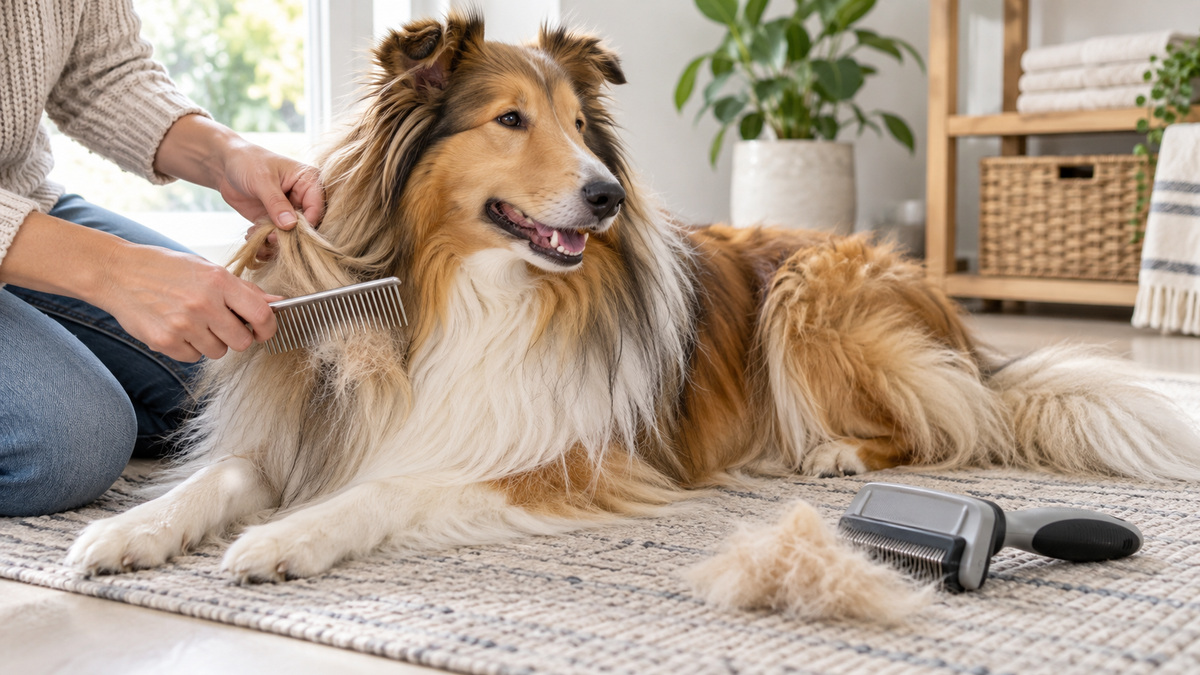
The ASPCA gives the same starting point for long coats. Its grooming tips say to “Gently tease out tangles with a slicker brush, and then brush your pet with a bristle brush.” In practice, that means the slicker opens the knots and the bristle brush smooths the coat afterward. The ASPCA also says that for dense mats, the owner “may try clipping the hair, taking care not to come near the skin,” which is a decision for a groomer on a very long coat. A brush cannot undo a mat that has already tightened against the skin.
How often a long coat needs brushing
Frequency is the question that long-haired owners ask most. AKC’s grooming guide says that “Most dogs only need a few brushing sessions a week, though long-coated breeds often do best with daily brushing.” The ASPCA gives a more detailed schedule that sorts coats by type, and the sorting is useful for planning.
| Coat type (ASPCA example) | Brushing guidance | Tool the ASPCA names |
|---|---|---|
| Smooth, short coat | Once a week | Rubber brush, then bristle brush |
| Short, dense fur prone to matting | Once a week is fine | Slicker brush, then bristle brush |
| Long, silky coat | Daily | Slicker brush, then bristle brush |
| Long hair that is frequently matted | Daily routine | Slicker brush, then bristle brush |
The table shows a clear pattern for long hair. Once a week is enough for short coats, and a long coat that matts often needs a daily routine. The daily session does not have to be long. Five to 10 minutes of slicker work and a bristle finish can keep a long coat from building up. A daily session also gives you a chance to check the skin and feet, which AKC’s grooming guide recommends when it says regular sessions “allow you to check your dog’s coat, teeth, eyes, ears, and nails for signs of potential problems.”
Heavy shedding periods change the arithmetic. Texas A&M’s Pet Talk article recommends brushing three to four times a week for five to 10 minutes during shedding in general, which is a floor rather than a ceiling for a long coat. On a long coat in peak season, the daily routine and the deshedding tool work together. Five minutes a day of a rake for the undercoat adds up to 35 minutes a week (5 x 7 = 35), which is a reasonable load for a long-haired dog.
Slicker, pin brush and bristle: the order of the tools
AKC’s brush guide describes the tools that long coats use most. A slicker has “short, tightly-packed wire pins” that the guide says are used on “medium-coated, long-coated, wire-coated, and curly-coated dogs to remove mats (and prevent mats from forming) by removing loose hair.” A pinhead brush, which looks like a human hair brush with spaced pins, is described as “best used as finishing brushes for long-coated breeds to smooth the hair and remove dirt.” A bristle brush is the finishing tool that AKC calls a way “to smooth the coat and add shine” on double-coated breeds.
Those three tools make a sequence. Use the slicker or the pin brush to open the coat, the rake or de-shedding tool to take out loose undercoat, and the bristle brush to finish. The listings in this group cover all three roles. The POODLIE slicker and the Swihauk pink brush are pin-head slickers, the Flying Pawfect long-pin slicker is aimed at long coats, the FURminator and Docrok tools are the rakes that fit the undercoat step, and the KylePet brush pairs a pin side with a bristle side.
Pin length matters on a long coat more than on a short one. AKC’s brush guide says that “However, you must choose the correct pin length for your dog’s coat length.” A short pin does not reach an undercoat under a long topcoat, and a long pin that is pressed hard can scratch the skin under a thin coat. Where the listing gives pin length, the card says so. Where it does not, the card says the length is unstated, and the buyer should check the product page before using the tool on a long coat.
Deshedding tools and the undercoat
Deshedding tools for long coats have a row of fine teeth or blades that reach through the topcoat. AKC’s shedding article recommends that during heavy shedding periods, “switching to a coat rake or de-shedding tool can help remove large amounts of loose undercoat hair.” That is the step to use after the tangles are open, and it is the step that removes the most hair from a long-haired dog.
The FURminator large-dog tool in this group is aimed at a specific size. Its bullets say it is designed for dogs over 50 pounds, and its title names long hair. The FURminator bundle is a different product: a medium-dog long-hair tool with a rinse-free spray, sized for dogs of 25 to 50 pounds. The listing gives that weight class as a fact and a claim about loose-hair reduction in a bullet with an asterisk. Read the weight class first, because a tool made for a 70-pound dog is not the right size for a 20-pound dog with the same coat.
Rakes and combs with two rows of pins or teeth can do more than the rake alone. The Docrok and MIU PET tools include a wide side for dematting and a dense side for deshedding. The KylePet brush combines a bristle side with a pin side. The advantage is that one tool can open a tangle and then remove the undercoat, which saves a change of brush mid-session. The disadvantage is that the dense side of a rake may be too fine for a long coat that is only lightly matted.
Bath brushes and kits
Two items in this group are not primarily deshedding tools. The Bodhi Dog shampoo brush is a rubber bath brush for showers and sprayers, and its bullets say it can double as a deshedding tool. The bullets also say its rubber teeth remove pet hair without tugging as much as other brushes. It is a useful second tool for a long coat during a bath, where the water and shampoo loosen the undercoat. It is not a substitute for a rake on a dry, heavily shedding coat.
The KUEIOX six-piece bag is a kit. Its bullets name a self-cleaning brush, a double-sided de-shedding rake and a bath brush, and the text we read cuts the list short. The kit suits a long coat only if the rake matches the coat, and the card says the full contents could not be confirmed from the listing. Kits can give you the right tools in one order, but a kit does not guarantee a rake with the right pin length.
The UGNEL two-piece set is not in the card list. Its title and bullets mix a dog shedding brush with a mane and tail comb for horses, and its brand field is empty, so it does not give a clear answer to the question of a long-hair dog brush. We left it out.
How we chose
The research file for this question holds twelve listings, and we used ten of them. We used ten. The two we left out are the UGNEL set, whose title and bullets combine a dog brush with a horse mane and tail comb and whose brand field is empty, and the POODLIE dematting comb, which is designed to cut and comb out mats rather than to remove undercoat. Neither is a deshedding brush for a long-haired dog, so the card list would give a misleading answer if they were included. Listings without a card: the UGNEL set and the POODLIE dematting comb, both explained above.
The cards keep the listing’s own wording, labelled as a listing claim where it makes a claim. Each card states the tool type, its stated weight class or hair type where the listing gives one, and the points that matter for a long coat, such as pin length, reach or the caution on the comb. We did not add products from outside the research file, and we did not change the listing data. Empty bullet fields are shown as empty, and the card relies on the title or the specification fields.
The sources are AKC’s brush and shedding pages, AKC’s grooming guide and the ASPCA grooming tips. We opened each page for this post and matched the quoted sentences to the saved text. The table of brushing frequency uses the ASPCA’s own coat categories, and the arithmetic is shown where it is used.
What we could not verify
- Pin length on most tools. Several listings do not give pin length, and the AKC point about the correct pin length cannot be checked against them.
- Reach across a long coat. Few listings give a head width, so the number of passes needed on a long coat is not stated.
- The percentage claims. One rake listing claims a large reduction in loose hair with an asterisk that the listing does not explain.
- The FURminator warranty. The listing says the tool is guaranteed to work or the money is returned, and the terms are on the product label, which is not in the listing data.
- The KUEIOX contents. The bullets cut off the list of tools, so the complete set is not known.
- The MIU PET set. It has no bullets, and its only use note is a caution about the detangling comb’s angle.
- The Bodhi bath brush’s suitability for a dry coat. Its listing describes a shower and sprayer tool first.
- Long-coat safety for any particular dog. The listings do not discuss sensitive skin, and the sources we opened do not cover deshedding for a dog with a skin condition.
The listings, one by one
Each card lists the tool type, the weight class or hair type the listing gives, and the points that matter for a long coat. The skip line tells you when a card does not fit, which is most often a weight class or a bath-only use.
1. FURminator Large Dog Undercoat deShedding Tool for Long Hair (Large-dog undercoat tool for long hair)
Specs from the listing (checked ):
- Hair Type: Long
- Item Weight: 0.26 kg
- Product Dimensions: 6.5 x 2 x 8.75 inches; 9.14 ounces
Pros
- The bullets say it is designed especially for dogs that weigh more than 50 pounds, a weight class that suits a large long-haired dog
- The bullets say it reaches through the topcoat to remove loose undercoat hair, and that a push button releases the hair
Cons
- The listing says the tool is guaranteed to work or the money is returned, but the terms are on the product label, which is not in the listing data
Best for: A long-haired dog over 50 pounds during heavy shedding
Skip if: Your dog weighs less than 50 pounds, since the listing aims the tool at larger dogs
View on Amazon (affiliate link)
2. Slicker Brush for Dogs – Long Pin for Poodles, Doodles & Long Haired Dogs, Deshedding & Dematting (Long-pin slicker for poodles, doodles and long coats)
Specs from the listing (checked ):
- Bristle Material: Stainless Steel
- Handle Material: Wood
- Product Benefits: Detangling
Pros
- The bullets say the pins are about 50 percent longer and softer than a standard slicker, which suits a thick, long coat
- The handle is wood and described as slip-resistant, and the bullets say it gives better control during long sessions
Cons
- The title says flat small, and the listing gives no head width, so the reach across a long coat is not stated
Best for: An owner of a poodle, doodle or other long-haired dog who wants a slicker with long pins
Skip if: You need a head sized for a large dog, since the title says small
View on Amazon (affiliate link)
3. Professional Deshedding Dog Brush Grooming Kits, for Long-Haired Dogs and Cats – Dog Deshedding (Three-piece set with a 9 and 17 tooth rake)
Specs from the listing (checked ):
- Pack: 3 Pack
- Contents (description): detangling rake (9-tooth and 17-tooth sides), deshedding brush, self-cleaning slicker brush
- Caution (listing): To protect the pet's skin, do not place the detangling comb parallel to the pet's body when using it.
Pros
- The listing names a detangling rake with 9 and 17 teeth, a deshedding brush and a self-cleaning slicker in one box
- The set's rake gives the tangle step and the undercoat step in one tool
Cons
- The listing has no bullets, and its only use note is a caution about keeping the detangling comb off the body at a parallel angle
Best for: A long-haired dog owner who wants the full sequence from one set
Skip if: You want size details for each tool, since the listing gives none
View on Amazon (affiliate link)
4. Bodhi Dog Shampoo Brush – Pet Grooming & Bath Supplies for Dogs and Cats – Bath Brush for Long (Rubber bath brush with a deshedding use)
Specs from the listing (checked ):
- Bristle Material: Rubber
- Handle Material: Metal, Rubber
- Additional Features: Waterproof
Pros
- The bullets describe a rubber brush that can be used wet or dry, and the bullets say its split rubber teeth remove hair without pulling as much as other brushes
- The bullets say the brush holds onto fur, so loose hair does not fly around during a bath
Cons
- It is a bath brush first; its bullets describe showers and sprayers, and deshedding is a secondary use
Best for: A bath-time brush that also removes loose hair from a long coat
Skip if: You want a dedicated deshedding tool for a dry, heavily shedding coat
View on Amazon (affiliate link)
5. KylePet Dog Brush, Double Sided Pet Slicker Brush with Bamboo Handle for Dogs and Cats Long Hair (Double-sided slicker with a bamboo handle)
Specs from the listing (checked ):
- Bristle Material: Nylon
- Handle Material: Bamboo
- Item Weight: 2.88 ounces
Pros
- The bristle side and the pin side are in one brush, and the bullets say the pin side brushes through most tangles
- The bullets describe a bamboo handle that is comfortable to grip and easy to clean
Cons
- The listing gives a 30-day money-back promise for dissatisfaction, but it gives no pin length or head width
Best for: A long-haired dog owner who wants a two-sided brush for tangles and a finishing bristle pass
Skip if: You need a rake for a thick undercoat, since the listing describes a pin side and a bristle side
View on Amazon (affiliate link)
6. Docrok Pet Grooming Combo – Blue Deshedding Brush with Metal Comb for Detangling and Dematting (Blue undercoat rake and metal comb combo)
Specs from the listing (checked ):
- Size: 2 Count (Pack of 1)
- Unit Count: 2 Count
- Material: Metal
Pros
- The listing describes a two-in-one rake with a wide side for dematting and a dense side for deshedding
- The metal comb has a wide side for smoothing knots and a dense side for loose hair, and the listing says it reaches the legs, head and tail
Cons
- The size field reads 2 count in one package, so the number and type of pieces should be checked on the listing
Best for: A long-haired dog with a double coat that needs a rake and a comb
Skip if: You want one tool only, since the listing describes two pieces
View on Amazon (affiliate link)
7. FURminator Ultimate Dog deShedding Bundle (Set of 2) | Includes Medium Dog/Long Hair deShedding (Medium-dog long-hair tool with a rinse-free spray)
Specs from the listing (checked ):
- weight_class: dogs 25 to 50 lb
- contents: Medium Dog / Long Hair deShedding tool and Rinse-Free deShedding Spray
- package: 10.79 x 8.31 x 2.52 in, 1.39 lb
Pros
- The bundle includes a medium-dog long-hair deshedding tool and a rinse-free spray for dogs from 25 to 50 pounds
- The listing gives the weight class and the package size, so the fit can be checked before ordering
Cons
- The listing makes a loose-hair reduction claim in a bullet with an asterisk, and the asterisk is not explained
Best for: A medium long-haired dog that needs a tool and a spray for weekly touch-ups
Skip if: Your dog weighs more than 50 pounds or less than 25 pounds
View on Amazon (affiliate link)
8. Swihauk Self Cleaning Slicker Brush for Dogs & Cats – Skin Friendly Grooming, Deshedding, Hair (Pink self-cleaning pin brush)
Specs from the listing (checked ):
- Bristle Material: Plastic
- Product Dimensions: 16.14 x 9.45 x 0.79 inches; 8.82 ounces
- Additional Features: Easy Desheding, Effective to Remove Loose Fur, Ergonomic Grip, Skin Friendly, Sturdy & Durable
Pros
- The listing describes a press-to-clean bottom that releases hair, and plastic round-head bristles that it describes as skin friendly
- The bullets call it a self-cleaning brush for long-haired dogs, and say it is gentle on the skin
Cons
- The product dimension field reads 16.14 by 9.45 inches, which is large for a hand tool, so the head size should be confirmed
Best for: A pink-brush owner who wants a self-cleaning pin brush for everyday grooming
Skip if: You need a rake for an undercoat, since this is a pin brush
View on Amazon (affiliate link)
9. Poodle Pet Slicker Brush – For Dogs, Cats, Rabbits – Matted/Loose Fur, Knots – Suitable (Purple slicker for doodles and poodles)
Specs from the listing (checked ):
- Bristle Material: Stainless Steel
- Handle Material: Plastic,Steel
- Product Dimensions: 7 x 3 x 1 inches; 3.21 ounces
Pros
- The bullets describe fine stainless steel pins that reach the undercoat to remove loose hair before it sheds, with rounded tips for sensitive skin
- The bullets say it suits long, short, curly and thick coats, and the handle is plastic and steel
Cons
- The listing gives a product size of 7 by 3 by 1 inches, so a long coat will take a number of passes to cover
Best for: An owner grooming a doodle or poodle-type coat who wants a light slicker
Skip if: You want a large head for a big dog, since the product size is small
View on Amazon (affiliate link)
10. Dog Brush for Shedding, 6 PCS in One Pet Slicker Hair Brush Kit Organizer Bag – Dog Cat Grooming (Six-piece bag with a self-cleaning brush and rake)
Specs from the listing (checked ):
- Pieces: 6 in an organizer bag
- Item model number: Dog Grooming Brush Kit 001-6pcs
Pros
- The bag holds six pieces, including a self-cleaning brush, a double-sided de-shedding rake and a bath brush
- The listing says the set suits thick, thin, straight, curly, long or short hair
Cons
- The bullets say the full tool list is cut off in the text we read, so the complete contents are not confirmed
Best for: A buyer who wants a bag of brushes for a long coat and can check the contents on the product page
Skip if: You need the full contents stated before ordering
View on Amazon (affiliate link)
Mistakes that waste a long-coat brush
- Brushing before the tangles are open. A deshedding tool pulls on knots, and the dog feels it. Open the tangles first, as AKC advises.
- Skipping the undercoat. On a double coat, AKC’s advice is to brush the undercoat as well as the topcoat.
- Using a deshedding tool on a mat. A mat that has tightened against the skin needs a comb or a professional, not a rake.
- Brushing too hard. AKC’s brush guide says to keep a light touch on slickers, because pressing down can cause discomfort.
- Choosing by the picture. The weight class and pin length matter more than the look of the tool.
- Ignoring the skin. Bald spots, thinning coat or irritated skin should go to the veterinarian, as AKC’s shedding article advises.
For a long-haired dog that rides in the car, the hair ends up on the seat, and our guide to a blanket for the back seat of a car covers a practical way to protect the seat. For a comparison of two brushes in the same category, the Dexas and PrimeCat brush comparison puts the tools side by side.
FAQ
What is the best way to brush a long-haired dog that sheds?
Start with the tangles, using a steel comb or a mat-splitting tool as AKC advises. Then use a slicker or pin brush to lift loose hair from the topcoat, a rake or de-shedding tool to take out the undercoat in heavy season, and a bristle brush to finish. Brush in several directions, because AKC’s shedding article says to keep brushing “until less hair is collected.”
How often should I brush a long-haired dog?
AKC says long-coated breeds often do best with daily brushing, and the ASPCA says a long, silky coat needs daily attention. A short daily session of five to 10 minutes is easier to keep up than a long weekly one, and it helps keep mats from forming in the places AKC names, which are behind the ears and under the legs.
Can a deshedding brush cause pain on a long coat?
It can, if it is pulled through a tangle. Open the tangles first, keep a light touch, and watch the dog’s reaction. If the brush keeps catching on the same spot, the spot may be a mat, and a comb or a groomer is the right tool. AKC also says to check the skin during grooming and to call the veterinarian about unusual skin changes.
Do I need a rake for a long-haired dog?
A rake is useful during heavy shedding because AKC describes it as the tool for large amounts of loose undercoat. For a long coat that is only lightly shedding, a slicker and a bristle brush may be enough. Choose the rake with the right pin length, and check the weight class on the listing before you buy.
Is a bath brush a good deshedding tool?
A rubber bath brush can remove loose hair during a wash, and the Bodhi listing says so in its bullets. It works best with water and shampoo, which loosen the undercoat. It is not a full deshedding tool for a dry coat, so pair it with a rake or de-shedding tool for the heavy season.
Bottom line
For a long-haired dog, open the tangles first, brush daily in short sessions, and use a rake or de-shedding tool for the undercoat in heavy season. Match the tool to the dog’s weight class and the pin length to the coat, and treat every percentage claim as a listing claim until you have used the tool and checked the result yourself.
Sources
- AKC, Types of Dog Brushes: slicker for mats on long and curly coats; pinhead brush as a finishing tool for long coats; correct pin length
- AKC, Managing Dog Shedding: remove tangles with a steel comb or mat-splitting tool first; a rake or de-shedding tool in heavy periods; brush in several directions
- AKC, How to Groom a Dog: long-coated breeds often do best with daily brushing; mats behind the ears and under the legs
- ASPCA, Dog Grooming Tips: brushing frequency by coat type; slicker then bristle brush for tangles and finish