Best Collapsible Dog Crate for Travel: Size, Weight and Car Use
As an Amazon Associate we earn from qualifying purchases. Details
By Ken
The best collapsible dog crate for travel is one that folds small enough for your car, holds your dog at its stated weight, and gives enough room to stand, turn and lie down. This guide compares eleven listings on size, weight limit, frame or fabric, and the car use each one names. Two listings give no bullets at all, and the size and weight lines decide most choices. AKC’s car safety guidance says that dogs riding in a vehicle “should be in a dog crate or secured with a crash-tested dog seat belt,” which makes the crate part of the travel plan, not an extra.
Quick answer
- Measure your dog before you shop. AKC says a crate should give the dog room to sit, stand and lie down, and the listings are sized in inches, so take the measurements first.
- Match the weight limit to the dog with a margin. Several listings here give a limit of 12, 20, 25 or 26.5 pounds, and a dog near the top of that range is best moved to a larger crate.
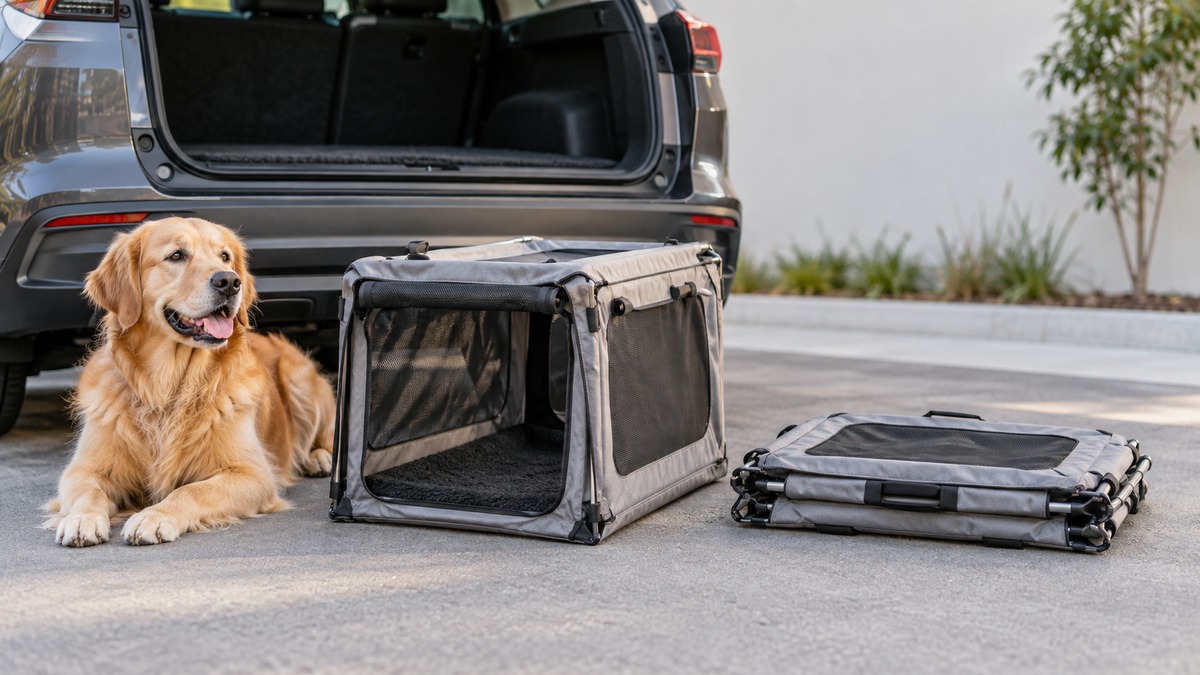
- For a car, check the folded size and the weight of the crate itself. Fabric crates are lighter, and wire or hard-sided crates are heavier but sturdier.
- Do not treat a travel crate as the only way to keep a dog in the car. AKC’s car guidance also lists the crash-tested seat belt as an option, and it is the right choice when the crate will not fit.
What a travel crate has to do
A travel crate has three jobs. On the road it keeps the dog in one place, which is the purpose AKC gives for car restraint: the guide says a crate or a crash-tested seat belt keeps the dog from being “injured or ejected from the car in the event that you have to brake quickly, or if you get into an accident.” At the destination it becomes a familiar space, and at home it folds away. A crate that does only one of these jobs is a poor buy, even if the listing is attractive.
The first job depends on the crate’s structure. AKC’s guidance on car travel points to a crate or a seat belt, and it asks owners to get the dog used to the restraint before the first trip. The AKC car training page says: “To start, get your dog comfortable and familiar with the restraint equipment (crate or seat belt) ahead of time outside of the car.” Practice with the crate at home, and the first drive is less of a shock.
The second job is comfort. A dog that will settle in a crate at home is more likely to settle in one on a trip. Cornell’s Riney Canine Health Center describes the crate as a safe space when a dog learns to settle down in it, and it says that such training helps “for multiple situations,” including travel. The crate is only useful on the road if the dog already accepts it.
Soft, hard and furniture crates
Collapsible crates fall into three groups in this set. Soft-sided crates use a fabric or mesh shell on a metal or plastic frame. Hard-sided collapsible crates use plastic or ABS panels that snap or fold. A third group is crate furniture, such as the HOOBRO end-table crate, which folds but is built to stay in the room. Each group has different weight, durability and folding behavior, and the choice depends on the trip.
Cornell’s veterinary school sets out the trade-off clearly: “Fabric or mesh crates are better suited for traveling or for short-term use for small breed dogs since they are lightweight and easily foldable.” It adds that “Wire crates are durable and can fold relatively easily for storage.” For travel, the lightness of fabric is the advantage, and the durability of a frame is the advantage for a dog that pushes the walls.
AKC’s crate guide makes a similar point. It says that “Fabric dog crates are an economical choice if you have a small breed dog who isn’t going to chew on it,” and that they are “lightweight, easy to assemble, and most fold down for storage.” The phrase about chewing matters. A fabric crate is a travel and storage choice for a dog that does not chew, and it is not the right crate for a dog that chews its way out.
The furniture style has its own trade-off. The HOOBRO listing says the tabletop comes off and the crate folds flat for travel, and it gives a static capacity of 110 pounds. The same listing gives an item weight of 47.1 pounds and describes particleboard and metal. That is a crate that is heavy to carry, and it suits a room where the crate stays in place.
Sizing: room to stand, turn and lie down
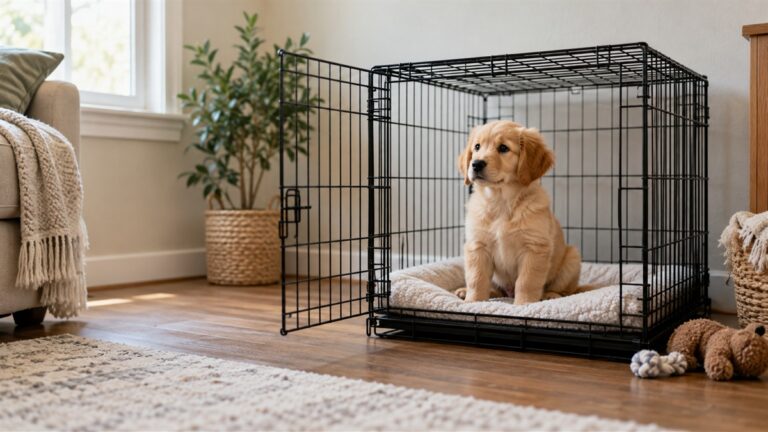
The size of the crate is the number that matters most, and AKC’s crate guide gives the rule in plain words: “Your dog needs enough room to sit, stand, and lie down comfortably within the crate.” The same guide adds a warning on the other side: “While you want a roomy crate, you don’t want one that’s too large.” For a travel crate, that balance matters because a crate that is too big is hard to move in a car, and one that is too small is uncomfortable for the whole trip.
AKC’s measuring method is simple. Measure the dog standing, from the top of the head to the bottom of the feet for the height, and from the tip of the nose to the tip of the tail for the length. Then add room to each figure. AKC says to “Add 3 to 4 inches to each measurement to compute the height and length of the dog crate you’ll need.” The table shows the arithmetic for three example heights, using only the addition AKC describes.
| Dog’s measured height (inches) | Crate height at +3 inches | Crate height at +4 inches |
|---|---|---|
| 14 | 17 | 18 |
| 18 | 21 | 22 |
| 22 | 25 | 26 |
Each cell is the measured height plus 3 or plus 4 (14 + 3 = 17 and 14 + 4 = 18, for example). Apply the same rule to length. Then compare the result with the listing’s inside or outside dimensions, and remember that a listing’s size may be the outside size of the folded or assembled crate.
The listings here range from small to large. The KindTail small crate lists 21 by 15.75 by 16 inches and is sold for dogs up to 12 pounds. The Morpilot crate lists 23.6 by 16.5 by 16.5 inches for a small dog, and the ZOMISIA XL lists 42 by 28 by 32 inches for a large dog. The sizes show how far the category runs, and they are a reminder to check the size against the dog’s own measurements, not the breed name.
Weight limits and what the listings state
Weight limits are where many travel crates go wrong, because a limit that looks generous can still be near the top of a dog’s weight range. The table lists the maximum weight each listing gives, using the figures in the listing’s own fields.
| Listing (short name) | Maximum weight in the listing | Where the listing states it |
|---|---|---|
| ZOMISIA XL collapsible | Up to 90 pounds | Title |
| Morpilot 24-inch | 26.5 pounds | Specification field |
| KindTail PAWD medium | 25 pounds | Specification field |
| Amazon Basics medium | 22.3 kg (about 49 pounds: 22.3 x 2.2 = 49.06) | Specification field |
| SportPet 24.5-inch | 20 pounds | Specification field |
| KindTail PAWD small | 12 pounds | Specification field |
| HOOBRO furniture crate | 110 pounds (static capacity) | Specification field |
The ZOMISIA 28-inch hard-sided crate, the ZOMISIA 28-inch medium crate, the PETSFIT 40-inch crate and the ZOMISIA 36-inch crate do not state a weight limit in the listing data, and their titles name a size or a dog size instead. The HOOBRO figure is a static capacity, which is a different measure from a dog’s weight in a moving car, so it should not be read as a travel rating.
The gap between the dog and the limit is the practical check. A 22-pound dog in a crate limited to 25 pounds has very little margin, and a 26-pound dog in a crate limited to 26.5 pounds has none. For a dog in the upper part of a crate’s range, choose the next size up if the listing offers one.
Materials, frames and the car
Materials decide how the crate handles a trip. The listings name Oxford fabric, polyester, ABS plastic, polypropylene, metal frames and wire or steel rods. Cornell’s point that “Size, material and durability are the main factors to consider when looking for a dog crate” is a good summary for a traveler. A fabric crate is light and easy to store. A hard plastic crate is more durable and easier to clean. A frame of steel rods holds its shape better, but it adds weight and bulk to the folded package.
Ventilation and closure matter as well. Several listings describe mesh panels on three or four sides, and the ZOMISIA XL lists three mesh windows. The Morpilot listing describes mesh for airflow, and the KindTail medium crate uses a latch rather than a zipper. A zipper can be an escape point for a determined dog, which is why the Morpilot listing says its auto-lock zippers are built to keep a pet secure.
The car fit is a separate check. The SportPet listing says the crate is not approved for airline travel, which is a clear limit for a buyer who plans to fly. The ZOMISIA 28-inch hard-sided crate says it fits most mid-to-large SUV trunks, which is a listing claim with no trunk measurements to check it against. Measure your own trunk, and check the folded size of each crate before you buy.
Folding, setup and the time it takes
Most of the crates here say they assemble with no tools or in a few minutes. The Morpilot listing says it sets up instantly and folds to an ultra-slim profile in about 30 seconds. The KindTail medium listing gives first-time assembly at about five to seven minutes, with snap-together panels and no tools. The ZOMISIA crates say they set up with no tools, and the Amazon Basics crate says it sets up in seconds and folds flat.
Folding speed matters on the road, because a crate that takes ten minutes to fold will be left out of the car. Practice the fold once at home, and time it. The trip is easier when the crate goes in and out in a few minutes.
Accessories matter for travel comfort, and several listings include them. The ZOMISIA 28-inch medium crate comes with a bed mat, and its cover is removable and machine washable, according to its bullets. The Morpilot crate includes a foldable bowl and a storage pocket, and its anti-escape leash is described as keeping a pet secure. The accessories are a convenience, and the card states which ones the listing gives.
Trips longer than a drive
A trip that takes a dog out of the car for a night or a week raises questions the crate cannot answer alone. Cornell’s veterinary guidance is clear that “A dog should never be left alone in a crate for an extended period of time without the opportunity to relieve themselves, play or exercise, and perform other natural behaviors.” The crate is a place to rest, and it does not replace the breaks a dog needs.
For a hotel or a friend’s house, set up the crate in the same place each time, with the bed, the bowl and a familiar blanket. Our guide to a blanket over a dog crate at night covers the bedding question in more detail, and it is useful when the crate has to work as a bedroom on a trip. For a dog that flies, none of the listings in this set claims airline approval, and two of them say the crate is not designed or approved for flights.
Our comparison of FXW and Amazon Basics crates covers two other crate lines, and it can help you place the travel crate in the wider range of crates that exist.
How we chose
We started from twelve listings in the research file for this query, and kept eleven. We used eleven. The one we left out is the Petmate Sky Kennel for air travel, whose title names an air-travel kennel for pets up to 15 pounds and whose listing gives no collapsible feature. It does not answer a question about a collapsible travel crate, and its listing has no bullets. Listings without a card: the Petmate kennel.
The cards use the listing’s stated size, weight limit, material, folding claim and use. Where a listing has no bullets or specification fields, the card says so and relies on the title. Nothing was added from outside the research file, and the listing data stays as supplied. The weight limits and sizes in the tables are copied from the listing fields, and the arithmetic is shown where it is used.
The sources are Cornell’s Riney Canine Health Center crate guide, AKC’s guide to choosing a dog crate and AKC’s dog car safety training page. Each quoted sentence in this post was matched against the saved text of its page.
What we could not verify
- Crash performance. The AKC car guidance says a dog should be in a crate or a crash-tested seat belt, but the listings do not say whether any crate is crash-tested, and the sources we opened do not test soft crates in a crash.
- Real folded size. Most listings give the assembled size. Only a few give a folded size, and those figures are the listing’s own.
- Weight limits on the ZOMISIA 28-inch hard-sided crate, the ZOMISIA 28-inch medium crate, the PETSFIT 40-inch crate and the ZOMISIA 36-inch crate. None of the four gives a weight limit in the listing data, and two of them give no bullets or specification fields at all.
- The warranty terms. The SportPet listing gives a six-month limited warranty, and the ZOMISIA 28-inch listing gives no warranty.
- Materials on the two listings with no specification fields. The PETSFIT 40-inch and ZOMISIA 36-inch listings state no material in the listing data.
- Trunk fit. The SUV claim on the ZOMISIA 28-inch hard-sided listing is not measured against any particular vehicle.
- Durability in use. Several listings describe the frame or fabric as durable, and none gives a test or a cycle count for folding.
The listings, one by one
Each card gives the stated size, weight limit, material and the travel points the listing makes. The skip line names the case where the crate does not fit the dog or the trip.
1. XL Collapsible Dog Travel Crate for Large Dogs, Portable Dog Crate | Soft Sided, Easy Fold & Setup (Extra-large soft crate for dogs up to 90 pounds)
Specs from the listing (checked ):
- Size: 42 x 28 x 32 in; 16.25 lb
- Materials: Iron pipes, 600D Oxford fabric
- Other sizes: 30x21x21, 36x25x25
Pros
- The title names an extra-large soft crate for breeds up to 90 pounds, and the specification gives 42 by 28 by 32 inches
- The listing includes a handle, a built-in safety leash, a plush pad and a side pocket, and says the door unzips and rolls up
Cons
- The listing says it does not state chew resistance, so a dog that chews is not covered by the description
Best for: A large dog that needs a big soft crate for car trips and indoor use
Skip if: Your dog chews its bedding or the crate, since the listing gives no chew resistance
View on Amazon (affiliate link)
2. Morpilot 24-inch Portable Collapsible Dog Crate for Small Dogs up to 27lbs (Small-dog soft crate with a slim fold)
Specs from the listing (checked ):
- Maximum Weight Recommendation: 26.5 pounds
- Product Dimensions: 23.6″L x 16.5″W x 16.5″H
- Material: Oxford fabric
Pros
- The bullets describe an instant setup and a fold to an ultra-slim profile in about 30 seconds, which fits a car trunk or a closet
- The bullets name auto-lock zippers, a metal frame and 600D reinforced Oxford fabric, with a mesh build the listing says is chew-resistant for crate-trained dogs
Cons
- The bullets say it is not designed for airline travel, and the specification field gives a maximum weight of 26.5 pounds
Best for: A small, crate-trained dog for car trips and a trip to the park
Skip if: Your dog is heavier than 26.5 pounds or you plan to fly
View on Amazon (affiliate link)
3. ZOMISIA 28″ L Collapsible Dog Crate for Dogs, Heavy Duty Dog Kennel Indoor (Heavy-duty hard-sided collapsible crate with wheels)
Specs from the listing (checked ):
- Product Dimensions: 27.95″L x 18.9″W x 21.65″H
- Material: Metal, Plastic
- Dog Breed Size: Medium, Small
Pros
- The bullets describe two rolling wheels and handles on both sides, which makes it easy to move in a car or around a room
- The listing describes a hard plastic and metal wire build with squeeze-latch locks, and says the crate fits most mid-to-large SUV trunks
Cons
- The listing gives no warranty, and its specification lists the dog breed size as medium and small
Best for: A small or medium dog that needs a hard-sided crate with wheels for car trips
Skip if: Your dog is large, since the listing names medium and small dogs
View on Amazon (affiliate link)
4. PETSFIT Portable Dog Crate for Large Dogs, 40 in Soft Dog Travel Crate (Forty-inch soft portable crate for large dogs)
Pros
- The title names a 40-inch soft portable travel crate sold for large dogs
- The listing is a soft travel crate, which fits the category for a car trip
Cons
- The listing has no bullets or specification fields, so the weight limit, folding method and materials are not stated
Best for: A large-dog owner who is willing to check the product page for the missing details
Skip if: You need a weight limit or material before ordering
View on Amazon (affiliate link)
5. KindTail PAWD Collapsible Dog Crate, Portable Indoor Outdoor Kennel for Dogs 15–25 lbs, French (Medium PAWD crate that folds flat)
Specs from the listing (checked ):
- Product Dimensions: 26″L x 20″W x 21″H
- Maximum Weight Recommendation: 25 pounds
- Material: Polypropylene (PP)
Pros
- The listing gives 26 by 20 by 21 inches assembled and 26 by 4 by 20 inches folded, which is a useful size for a car trunk
- The bullets describe tool-free, snap-together panels that take about five to seven minutes to set up the first time
Cons
- The listing says to measure the dog before buying, and the maximum weight is 25 pounds
Best for: A medium dog that weighs under 25 pounds and needs a crate that folds flat for trips
Skip if: Your dog weighs more than 25 pounds, since the listing sets that limit
View on Amazon (affiliate link)
6. ZOMISIA Collapsible Dog Crate with Bed Mat, 36'' Dog Kennel for Large Dogs (36 in L variant) (Thirty-six-inch collapsible crate with bed mat)
Pros
- The title names a 36-inch collapsible crate with a bed mat, sized for large dogs
- The bed mat is named in the title, so the listing includes a sleeping surface for the trip
Cons
- The listing has no bullets or specification fields, so the weight limit, material and warranty are not stated
Best for: A large dog owner who will confirm the details on the product page before buying
Skip if: You need the weight limit or material stated before you order
View on Amazon (affiliate link)
7. ZOMISIA Collapsible Dog Crate with Bed Mat, 28'' Dog Kennel for Medium Dogs (Twenty-eight-inch medium crate with wheels and mat)
Specs from the listing (checked ):
- Product Dimensions: 28.35″L x 19.17″W x 21.42″H
- Breed Recommendation: Medium
- Material: Metal, Plastic
Pros
- The bullets describe two smooth-rolling wheels and handles, and say the frame folds ultra-compact for storage under a sofa or bed
- The bullets say the cover is removable and machine washable, and the crate includes a mat in the listing data
Cons
- The title and the breed field name medium dogs, so the listing does not describe a large dog's crate
Best for: A medium dog that needs a wheeled crate for car trips and home use
Skip if: Your dog is large, since the title names medium dogs
View on Amazon (affiliate link)
8. HOOBRO Foldable Dog Crate Furniture with 360° Rotating Double Bowls, Dog Crate End Table, Foldable (Furniture-style foldable crate with a tabletop)
Specs from the listing (checked ):
- Max. Static Capacity: 110 lb
- Item Weight: 47.1 pounds
- Material: Particleboard, Metal
Pros
- The bullets say the tabletop comes off and the crate folds flat, with two stainless steel bowls that spin and adjust in height
- The listing gives a static capacity of 110 pounds and a steel frame with 15 millimeter tubes, which the bullets describe as sturdy
Cons
- The listing gives an item weight of 47.1 pounds and describes particleboard and metal, so it is heavy to carry on a trip
Best for: A room-based crate for a small or medium dog that stays home most of the time and travels occasionally
Skip if: You need a light crate to lift in and out of a car every trip
View on Amazon (affiliate link)
9. Amazon Basics Portable Folding Soft Dog Crate, Double Door, Collapsible Travel Kennel, Easy (Medium soft folding crate with two doors)
Specs from the listing (checked ):
- Size: M 30″ x 21″ x 21″
- Maximum Weight Recommendation: 22.3 kg
- Material: Polyester
Pros
- The listing says it sets up in seconds with no tools and folds flat for portability, with a top door and a front door
- The bullets describe zipper closures, fastening straps to hold the rolled-up doors, and mesh windows on all four sides for ventilation
Cons
- The bullets suggest medium breeds such as Blue Heelers and Golden Retrievers at 50 pounds, while the weight field reads 22.3 kg (about 49 pounds), so the two figures should be read together
Best for: A medium dog that weighs well under 49 pounds and needs a folding crate for car trips
Skip if: Your dog is at or near 49 pounds, since the crate's limit is almost the same figure
View on Amazon (affiliate link)
10. KindTail PAWD Collapsible Puppy and Dog Crate – Stylish Pet Kennel – Safe Indoor Kennel (Small white ABS collapsible crate)
Specs from the listing (checked ):
- Maximum Weight Recommendation: 12 pounds
- Material: Acrylonitrile Butadiene Styrene (ABS)
- Product Dimensions: 21″L x 15.75″W x 16″H
Pros
- The bullets describe a BPA-free ABS plastic crate with no sharp edges or corners, and say it folds flat in about a minute
- The door can stay open or lock as needed, according to the listing
Cons
- The listing says it is for dogs up to 12 pounds and is not for escape artists
Best for: A small dog up to 12 pounds that needs a hard-sided crate for trips and home
Skip if: Your dog is heavier than 12 pounds or is an escape artist
View on Amazon (affiliate link)
11. SportPet Designs Collapsible Small Pet Travel Carrier (Tan), Hard-Sided Kennel for Small Dogs (Tan collapsible hard-sided kennel for small dogs)
Specs from the listing (checked ):
- Product Dimensions: 24.5″L x 16.5″W x 16″H
- Maximum Weight Recommendation: 20 pounds
- Warranty Description: 6 Month Limited
Pros
- The bullets describe a durable twist-lock metal gate, side ventilation slots and a built-in carrying handle
- The listing gives a six-month limited warranty and says it folds flat in seconds
Cons
- The listing says it is not approved for airline travel, and its maximum weight is 20 pounds
Best for: A small dog up to 20 pounds that needs a hard-sided kennel for road trips and vet visits
Skip if: You plan to fly, or your dog weighs more than 20 pounds
View on Amazon (affiliate link)
Mistakes to avoid with a travel crate
- Buying by the breed name. Measure the dog and compare the result with the listing size, as AKC’s method describes.
- Choosing a weight limit at the top of the dog’s range. A dog near the limit needs the next size up.
- Leaving a dog in a crate for hours. Cornell advises giving the dog the chance to relieve itself, play and exercise.
- Choosing a fabric crate for a chewer. AKC’s guide says fabric crates suit a dog that does not chew on them.
- Assuming a crate is an airline crate. The SportPet listing says it is not approved for airline travel, and other listings say nothing about flying.
- Skipping the practice run. A dog that has already spent time in the crate at home is calmer in the car.
FAQ
What size collapsible crate do I need for a medium dog?
Measure the dog standing, add 3 to 4 inches to the height and the length as AKC describes, and then choose a listing whose inside or stated size covers the result. Check the weight limit as well. For a medium dog, several listings here are sized between about 24 and 28 inches, and the weight limits on those that state one run from 20 to 26.5 pounds, so a medium dog near the top of that range needs a larger size.
Is a soft-sided crate safe in a car?
AKC says a dog should be in a dog crate or secured with a crash-tested seat belt when riding in a vehicle. The sources we opened do not test soft crates in a crash, and the listings do not state a crash rating. A fabric crate can keep the dog in place, but for a crash-safe setup, check the crash rating from the manufacturer or use a crash-tested seat belt.
How long can a dog stay in a travel crate?
Cornell’s guidance says a dog should never be left alone in a crate for an extended period without the chance to relieve itself, play or exercise. Plan breaks on a long trip, and do not treat the crate as a place to leave a dog while you are out for a day.
Can I take a collapsible crate on an airplane?
The listing for the SportPet crate says it is not approved for airline travel, and the Morpilot listing says the crate is not designed for airline travel. For a flight, check the airline’s rules and the crate’s listing, and do not assume that a collapsible crate meets them.
How do I get my dog used to the travel crate?
AKC advises getting the dog familiar with the restraint, whether crate or seat belt, before the car. Let the dog investigate the crate at home, give treats and praise for approaching it, and build up from short sessions. Cornell’s guidance adds that a crate becomes a safe space when the dog learns to settle in it.
Bottom line
For travel, choose a collapsible crate by the dog’s measurements and weight, then check the folded size against your car. A fabric crate is the lighter choice for a dog that does not chew, and a frame is the sturdier choice for a dog that pushes the walls. Practice the crate at home, keep the weight margin wide, and treat the car safety requirement as a plan, not a feature.
Sources
- Cornell University Riney Canine Health Center, Dog crates: when to use them and how to pick one: fabric and mesh crates for travel; wire crates fold for storage; size, material and durability; never leave a dog alone in a crate for long periods
- AKC, Choosing the Best Dog Crate: room to sit, stand and lie down; not too large; add 3 to 4 inches to each measurement; fabric crates suit small dogs that do not chew
- AKC, Dog Car Safety Training: crate or crash-tested seat belt in a vehicle; prevents injury or ejection; practice the restraint before the trip