Best Dog Food Dispenser
As an Amazon Associate we earn from qualifying purchases. Details
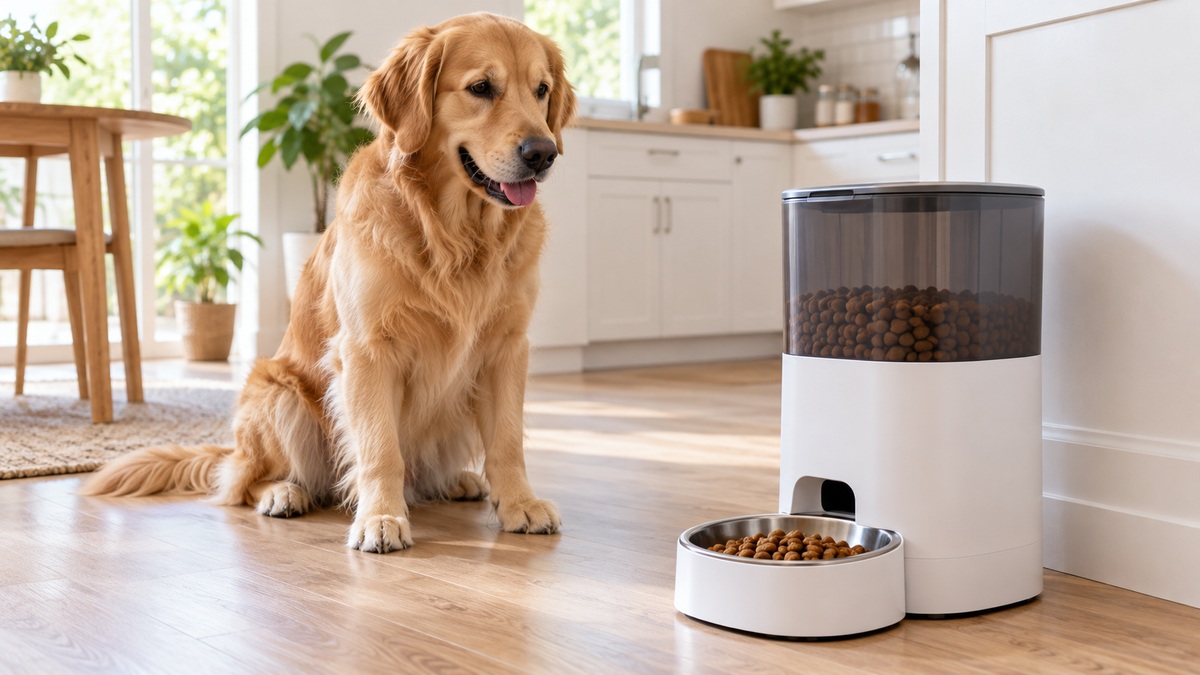
The best dog food dispenser is the one that holds enough dry food for your schedule, releases it at the meal times you set, and puts the bowl at a height your vet approves. This roundup compares six automatic dog feeders and gravity dispensers from six brands. For each one we read the title, the feature bullets and the specification table on its Amazon listing, then compared the capacity, meal schedule, bowl design and power figures the listings state. Where a listing is silent, we say so.
Quick answer
- Timed meals through the day: the PETLIBRO listing describes up to 10 meals a day with 1 to 50 portions per meal, and the Molly&Cody, Nityers and MUBBI listings each describe 6 meals a day.
- Large dog and large kibble: the Molly&Cody listing gives a 14 liter (60 cup) hopper and says it handles kibble up to 18mm.
- No timer needed: the cucurbita listing describes a gravity feed with a 3 gallon bucket, and the Meikuler listing describes a food and water set that feeds by gravity.
- Raised bowls: the Molly&Cody and MUBBI listings both describe elevated bowls or stands. Cornell and Merck advise avoiding raised bowls for dogs at high risk of bloat, so check with your vet first.
Why the feeding pattern matters more than the machine
A feeder is a tool for a feeding pattern, and the veterinary sources we opened tie the pattern to a serious condition. The AKC bloat guide calls bloat, also known as gastric dilatation-volvulus, “a medical and surgical emergency.” It also says bloat “still kills about 30 percent of the dogs it affects, even after extremely intensive treatment.” The guide lists several feeding habits linked to the condition, and two of them are the ones an automatic feeder can influence directly.
The first is meal count. AKC says “dogs fed one meal a day are twice as likely to bloat as those fed two meals a day.” Cornell’s advice is to “offer two or more meals per day with smaller kibble.” Merck’s professional guide lists “once-daily feeding” and “feeding only dry kibble” among factors associated with the condition, and for high-risk breeds it says owners may consider “feeding multiple small meals rather than one large meal.” A timer that releases food at set times is a direct way to split a day’s food into more meals.
The second is eating speed. AKC says “fast eaters have five times the risk than dogs that are slow eaters,” and it notes that “using slow feeder bowls with fingers (or center posts) or putting large rocks in the bowl slows dogs down physically.” Cornell lists “eating too quickly” as a risk factor, and Merck lists “rapid consumption of food.” A dispenser does not slow the dog down by itself. A slow-feed bowl or a timed portion does.
A feeder cannot cover the rest of the list. Cornell also names “exercising soon after eating” and “a first-degree relative with GDV” as risk factors, and the feeder does not control either one. The AKC guide also says “stressed dogs and those that are hyperactive are more likely to bloat,” so a calm feeding spot matters. Treat the dispenser as one part of a plan that your vet has approved, not as a protection on its own.
What the listings state, side by side
The table below uses only the figures in each listing. Where a listing gives no figure, the cell says so, and where the title and bullets differ, both are noted.
| Listing | Hopper capacity | Meals per day, per listing | Bowl design, per listing | Power, per listing |
|---|---|---|---|---|
| PETLIBRO | 5L sealed food tank | Up to 10 meals, 1 to 50 portions each | Stainless steel slow-feed tray | Battery backup, batteries not included |
| Meikuler | 5.2L (1.37 gal) | Not stated, gravity feed | Rubber-footed food and water set | Not stated |
| Nityers | 8L (34 cups) | 6 meals, up to 50 portions each | 6.7 inch stainless steel bowl | Type-C adapter or 4 AA batteries |
| Molly&Cody | 14L (60 cups) | 6 meals, 1 to 60 portions each | Elevated 304 stainless steel bowl | AC or 4 AA batteries, up to 84 days on battery |
| MUBBI | 7L (29 cups) | 6 meals per day | Elevated stand, four removable legs | Type-C cable or 4 AA batteries |
| cucurbita | 3 gallon bucket | Not stated, gravity feed | Gravity-fed bowl, anti-skid base | Not stated |
The hopper figures are not directly comparable, because each listing gives its capacity in a different unit. Converting is not needed to see the order, though. The Molly&Cody hopper holds 26 cups more than the Nityers hopper (60 minus 34 is 26), and the Nityers hopper holds 1 liter more than the MUBBI hopper (8 minus 7 is 1).
Portions, meals and the arithmetic of the top setting
A portion setting is a count, so it helps to multiply it by the meal count. The PETLIBRO bullets allow up to 10 meals a day with up to 50 portions each, which is 500 portions at the top settings (10 times 50 is 500). The Molly&Cody bullets allow 6 meals a day with up to 60 portions each, which is 360 portions (6 times 60 is 360). The Nityers bullets allow 6 meals with up to 50 portions, which is 300 (6 times 50 is 300). These totals are the maximum a listing allows, not what a dog should eat. Our planning estimate is that the portion size has to be set from your vet’s feeding plan, not from the top of the scale.
The Molly&Cody bullets also describe a refill that lasts “up to 30 days of meals,” and the cucurbita bullets give 6 to 15 days for large pets and 20 to 45 days for small pets. The MUBBI bullets give 7 to 14 days for small and medium dogs and 28 days for cats, so the figures depend on the animal the listing has in mind.
Bowls: slow-feed, elevated and floor level
The bowl is where the feeding-pattern advice meets the product. The PETLIBRO listing describes a “stainless steel slow-feed bowl” and says it “reduces eating speed by up to 2×.” That figure is a listing claim, and the AKC guide supports slow feeding in general terms without a figure. A slow-feed tray is the design the AKC guide describes, so it fits that part of the advice.
The Molly&Cody and MUBBI listings describe raised bowls. The Molly&Cody bullets say the bowl is “at the perfect height reduces neck strain and improves digestion.” That is a claim we did not verify. The MUBBI bullets describe four removable support legs that set the bowl height. Cornell advises “avoid raised food bowls,” and Merck’s list for high-risk breeds includes “avoiding elevated feed bowls.” The AKC guide takes a different view, saying “elevated food bowls are now known to be just as much of a risk” as floor bowls. The sources do not agree, and the safe reading is that a raised bowl is not a safer choice.
The cucurbita and Meikuler listings use a gravity-fed bowl that refills as the dog eats. A gravity bowl has no timer, so it does not split the day into meals by itself, but it does keep food available. Whether a gravity bowl suits a dog that eats fast is a question the listings do not answer.
Power and battery backup
Power matters for a timer. A feeder that stops when the power fails will miss a meal, so the battery backup in some listings is useful. The Molly&Cody bullets say the unit runs on AC power or 4 AA batteries and can run “up to 84 days” on battery alone under typical use. The PETLIBRO bullets say battery backup keeps feeding going during an outage, with batteries not included. The MUBBI bullets say its Type-C cable is bite-resistant and that 4 AA batteries are a backup.
Battery figures are listing claims. The listings describe typical use, and none gives the number of meals per battery set, so we cannot compare the backup periods directly. Buy batteries as part of the setup, and check the battery level on the display before a holiday or a trip.
Cleaning, kibble and freshness
Freshness claims appear in most of the listings. PETLIBRO describes a “5L sealed food tank and desiccant compartment,” MUBBI describes “desiccant packets,” and Nityers describes a “desiccant bag and secure locking lid.” A desiccant keeps moisture down in the food, and that is a reason to keep the lid closed. The cucurbita bullets say the food tank, base and other parts are dishwasher safe, and the cucurbita listing recommends a weekly wash.
Cleaning is simple for most listings but not identical. The Nityers bullets say the lid, hopper, rotor, bowl and bowl tray are removable. The Molly&Cody bullets describe a suction and locking design. Clean the hopper before you refill it when the food has been sitting, so that old kibble does not stay in the rotor.
How to choose: five steps
- Set the meal schedule first. If your vet has asked for two or more meals a day, a timer is the feature that does the work. The PETLIBRO, Molly&Cody, Nityers and MUBBI listings each describe a timed schedule. The Meikuler and cucurbita listings describe gravity feeds.
- Choose the bowl height with your vet. Cornell and Merck both advise against raised bowls for high-risk breeds, and the AKC guide does not treat a raised bowl as safer. If your vet agrees that a floor bowl suits your dog, drop the two raised listings from your list.
- Match the hopper to the refill you want. A 14 liter hopper at 30 days per refill suits a busy household. A smaller hopper means more refills, which is worth it for a dog that eats less or for a trial period.
- Check the kibble size. Molly&Cody gives an 18mm kibble limit, while the other listings state no kibble size. Measure your kibble before you order.
- Plan the power. Decide whether you need AC power, battery backup or both, and buy the batteries when you buy the feeder.
1. PETLIBRO Automatic Dog Feeder with Camera, Auto Cat Food Dispenser Slow Feeders Dogs Bowl, 1080P HD (Timed feeder with camera and slow-feed bowl)
Pros
- The bullets describe a stainless steel slow-feed bowl
- The bullets say up to 10 meals a day, with 1 to 50 portions per meal, set in the app
- The bullets describe an infrared anti-blockage outlet and battery backup, with batteries not included
Cons
- The bullets say the bowl prevents choking, bloating and indigestion, a health claim the sources we opened do not confirm
- The title and bullets mix dog and cat use, so check the sizing for your dog
Best for: A dog owner who wants a timed feeder with a camera and a slow-feed bowl
Skip if: Your dog is a large breed, since the title says the feeder is for small dogs
View on Amazon (affiliate link)
2. Meikuler Pets Auto Feeder 5.2L, Food Feeder and Water Dispenser Set for Medium & Large Dogs Cats (Gravity food and water set for medium and large dogs)
Pros
- The bullets give a 5.2 liter food capacity that the bullets say lasts 4 to 7 days for big pets
- The bullets say food slides down automatically and the non-skid rubber feet keep the set steady
- The bullets say the set uses BPA free plastic and 304 stainless steel
Cons
- The bullets describe a gravity feed with no timer, so meals are not set by the unit
- The bullets say the unit is not recommended for kittens, and give no portion control
Best for: An owner who wants a gravity food and water set and no timer
Skip if: You need portion control or set meal times, since the bullets describe neither
View on Amazon (affiliate link)
3. Automatic Dog Feeder – 8L/34 Cups Large Capacity Automatic Cat Food Dispenser with LCD Screen (Timed feeder with an LCD and an 8-liter tank)
Pros
- The bullets give an 8 liter, 34 cup capacity and say it can cover you being away for up to a month
- The bullets describe up to 50 portions per meal and 6 meals per day
- The bullets say the unit runs on a Type-C adapter or 4 AA batteries, with batteries not included
Cons
- The title and bullets say cat food dispenser, so check whether the sizing suits your dog
- Our extraction of the specification table was cut off, so the weight and dimensions are partial
Best for: A cat-and-dog owner who wants a large timed feeder with an LCD
Skip if: You want a listing labeled for dogs only, since the title names cat food first
View on Amazon (affiliate link)
4. 14L Automatic Dog Feeder for Large Breed, Extra Large Capacity, Anti-Blockage, Timed Auto Dog Food (Large-breed timed feeder with a 14 liter hopper)
Pros
- The bullets give a 14 liter (60 cup) capacity and say one refill lasts up to 30 days
- The bullets say the anti-blockage system handles kibble up to 18mm and freeze-dried food
- The bullets say the unit has suction cups and a locking mechanism, and runs on AC power or 4 AA batteries
Cons
- The bullets describe an elevated bowl, which Cornell and Merck both advise against for high-risk breeds
- The bullets claim up to 84 days on battery alone, a figure we did not verify
Best for: An owner of a large dog who needs a big hopper and large kibble
Skip if: Your vet has advised a floor bowl for your dog
View on Amazon (affiliate link)
5. Automatic Dog Feeder with Elevated Stand – 7L Cat Food Dispenser with Large Food Tray, Timed Auto (Elevated-stand timed feeder with a 7 liter hopper)
Pros
- The bullets describe four removable legs that set the bowl height, with non-slip pads on the base
- The bullets say the lid, hopper and control panel have safety latches
- The bullets say the unit has a Type-C cable and 4 AA batteries as a backup
Cons
- The title names a cat feeder first, and the bullets give 7 to 14 days per refill for small and medium dogs
- The bullets describe a raised stand, and AKC says elevated bowls are just as much of a risk as floor bowls
Best for: A cat owner who also feeds a small or medium dog and wants a raised stand
Skip if: Your dog is large, since the bullets give refill figures only for small and medium dogs
View on Amazon (affiliate link)
6. Automatic Dog Feeders, Dog Feeder Dispenser for Large Dogs, 3 Gallon Gravity Automatic Dog Cat (Gravity dispenser with a 3-gallon bucket and anti-skid base)
Pros
- The bullets describe a gravity system in which food refills the bowl as the dog eats
- The bullets give 6 to 15 days per fill for large pets and 20 to 45 days for small pets
- The bullets say the food tank and base are removable and dishwasher safe
Cons
- The bullets describe a gravity feed with no meal schedule or portion control
- The bullets say the feeder is healthy for pets, a claim we did not verify
Best for: An owner who wants a simple gravity dispenser with no timer
Skip if: You need meal times, since the bullets describe no schedule
View on Amazon (affiliate link)
Mistakes to avoid
- Expecting a dispenser to fix eating speed. A timer releases food at set times, but it does not slow a dog’s eating. A slow-feed bowl or a feeding plan from your vet does that.
- Using a raised bowl without asking your vet. Cornell advises avoiding raised food bowls, and Merck lists elevated feed bowls among the things to avoid for high-risk breeds.
- Exercising the dog straight after a meal. Cornell and Merck both list activity around meals as a risk factor, so plan a rest period after feeding.
- Trusting the portion maximum. A top setting of 50 or 60 portions is the most a listing allows. It is not a feeding amount for your dog.
How we chose
We searched Amazon.com in Chrome on 21 October 2026 for “best dog food dispenser” and read the first results page. Food storage containers were left out, because a container holds food but does not dispense it. Water-only dispensers were left out too. A listing counted if it described an automatic dog feeder, a timed food dispenser or a gravity dispenser that releases dry food to a bowl. Cat-only feeders were not included unless the bullets described dog use.
We opened six listings from six different brands and read each title and the feature bullets, plus the specification table where the page showed one. The Nityers and Molly&Cody specification tables were partly cut off in our extraction, so we record only the figures we can see. We left out a second PETLIBRO listing, because it repeats a brand already in the set, and we did not open the other listings on the page.
Each bullet was captured in pieces of up to 300 characters, so a few bullets end mid-sentence in the listing data. Figures in this post come from a title, a bullet or a specification table on the listing, or from the veterinary sources named in the post.
What we could not verify
- The health claims in the listings. The PETLIBRO bullets say the bowl “prevents choking, bloating, and indigestion,” the Molly&Cody bullets say the raised bowl “improves digestion,” and the cucurbita bullets say the feeder “is healthy for your pets.” The sources we opened do not confirm any of those statements.
- The PETLIBRO claim that the bowl “reduces eating speed by up to 2×.”
- The battery run times, including the Molly&Cody figure of up to 84 days on battery.
- Whether any feeder keeps food fresh for the period its listing gives. The desiccant claims are listing claims.
- How each dispenser performs with a large dog that eats fast, or with a dog that has a history of bloat.
- The Nityers specification table, which our extraction cut off, and the Meikuler manufacturer name, which the specification table gives as Meipire while the brand line says Meikuler.
- Whether the MUBBI and Nityers listings suit a dog, since both titles name cats first.
- Anything beyond the first bullets we captured.
- Prices and availability, which were not recorded for this post.
FAQ
Can an automatic feeder prevent bloat?
No feeder can promise that. The AKC guide calls bloat a medical and surgical emergency, and Cornell lists several risk factors, including feeding once a day, eating too quickly and exercising soon after a meal. A feeder can help with the meal count, but it does not remove the other risks. Ask your vet for a feeding plan.
How many meals a day should a dog have?
The sources we opened point the same way. Cornell advises “two or more meals per day,” and Merck describes multiple small meals for high-risk breeds. The AKC guide reports that dogs fed one meal a day are twice as likely to bloat as those fed two. Your vet can set the number for your dog.
Are raised food bowls a bad idea?
The sources disagree on the detail. Cornell says to avoid raised food bowls, and Merck lists elevated feed bowls among its recommendations for high-risk breeds. The AKC guide says elevated bowls are just as much of a risk as floor bowls. None of them says a raised bowl is safer, so ask your vet before you use one.
Does a slow feeder bowl help?
The AKC guide says slow feeder bowls, meaning bowls with fingers or center posts, slow dogs down physically. The listings describe their own slow-feed designs, but none gives a measured effect on eating speed that we could check.
What should I do during a power cut?
Choose a model with battery backup, such as the Molly&Cody or MUBBI listings, and keep spare batteries on hand. The PETLIBRO bullets say its battery backup keeps feeding on schedule during an outage, but the listing does not say for how long.
Is a gravity dispenser simpler than an automatic one?
It has fewer parts to fail, since a gravity bowl needs no motor or battery. It also has no timer, so it cannot split a day’s food into set meals. Choose a gravity feeder only if your vet is content with your dog eating from a bowl that is refilled as the dog eats.
Bottom line
Start with the meal schedule your vet recommends, then choose the bowl height with that same vet. A timed dispenser with 6 or more meals a day fits a dog on a split feeding plan, and a gravity dispenser fits an owner who does not need a timer. Avoid raised bowls unless your vet agrees, and treat every health claim on a listing as the maker’s claim. For related feeding and water products, see our slow-feed dog bowl guide, our stainless steel automatic water bowl guide and our PetSafe Drinkwell fountain guide.
Sources
- AKC, Bloat (or GDV) in Dogs: What Is it and How Is it Treated?: https://www.akc.org/expert-advice/health/bloat-in-dogs/
- Cornell University Riney Canine Health Center, Gastric Dilatation-Volvulus (GDV) or Bloat: https://www.vet.cornell.edu/departments-centers-and-institutes/riney-canine-health-center/canine-health-topics/gastric-dilatation-volvulus-gdv-or-bloat
- Merck Veterinary Manual, Gastric Dilation and Volvulus in Small Animals (professional version): https://www.merckvetmanual.com/digestive-system/surgical-problems-of-the-gastrointestinal-tract-in-small-animals/gastric-dilation-and-volvulus-in-small-animals