Best Way to Travel With a Large Dog in the Car
As an Amazon Associate we earn from qualifying purchases. Details
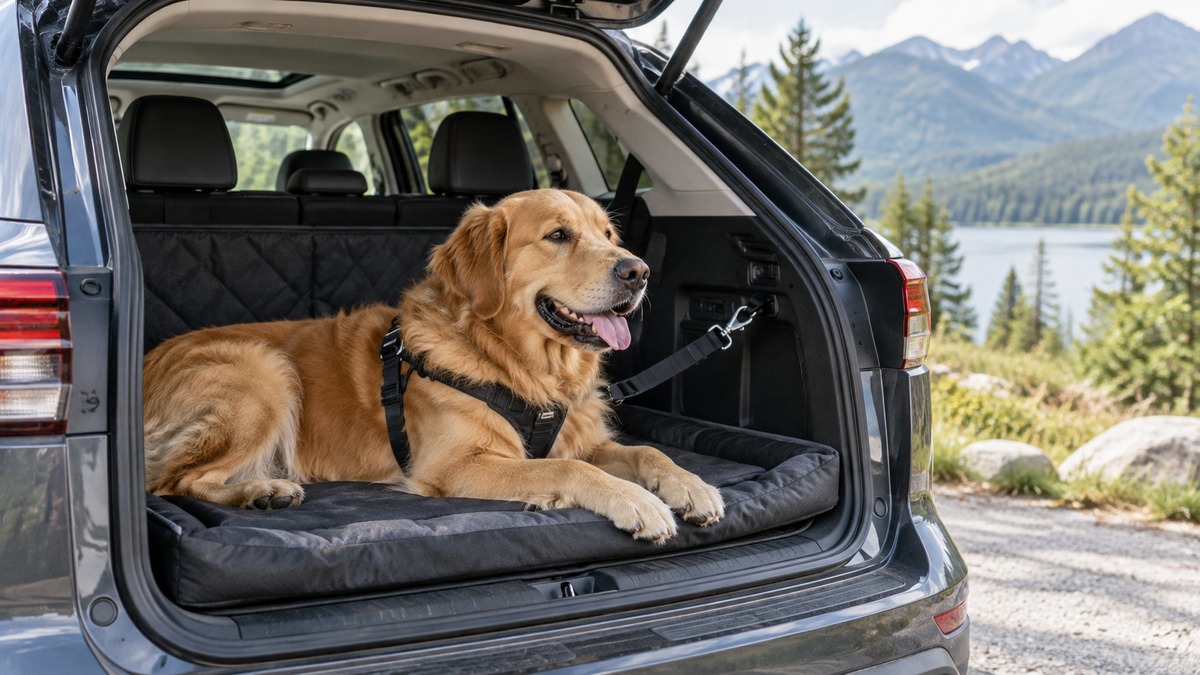
The best way to travel with large dog in car trips is to keep the dog restrained, either in a crate that is big enough to stand, turn and lie down, or in a harness that is fastened to the vehicle’s seat belt system. A loose dog can move around the cabin, and the sources we opened say a crate or a harness should be used whenever the dog rides with you. This guide walks through the steps in order: choosing the restraint, checking crate size, securing it, getting the dog used to the gear, planning food and breaks, packing, and identification. It does not recommend any product.
Quick answer
- Restrain the dog. The AKC says to use a dog seatbelt, car seat or safety harness whenever the dog rides with you in the car.
- If you use a crate, pick one that is large enough for the dog to stand, turn and lie down, and secure it so it cannot slide or shift.
- Never use a wire or collapsible crate for car travel. The ASPCA says these can collapse or break open in an accident.
- Do not let the dog put its head out the window. The ASPCA gives this advice for a dog that rides without a crate.
- Practice with the crate or harness at home before the trip, because a dog that is not used to a harness may get stressed by a change in routine.
- Keep the dog’s identification current, carry a copy of the essentials, and plan the trip around a dog that will not have a full stomach.
How we chose this method
We limited this guide to independent sources: the ASPCA and the American Kennel Club (AKC). We opened pages from both organizations on 2026-10-23 and quoted only sentences we confirmed in the text of the page we downloaded. We did not choose any product, did not rank brands, and did not include prices or ratings. Every step below either comes from a line in one of those pages or is a plain procedural suggestion that the sources do not contradict. Where a source is silent, we say so in the section “What we could not verify.”
Step 1: Choose between a crate and a harness
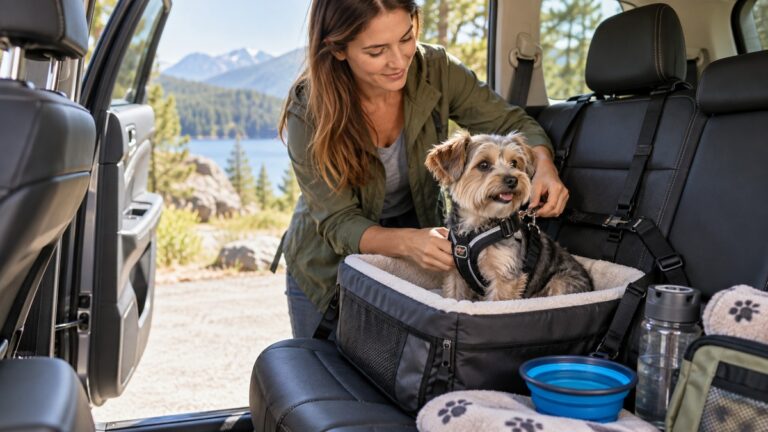
Both the AKC and the ASPCA describe a crate and a harness as options for car travel. The difference is how the dog is held in place. A crate creates a fixed space that can be anchored in the vehicle. A harness keeps the dog in the seat and attaches to the seat belt system. The AKC specifically says to use a seat belt, car seat or safety harness whenever the dog rides with you in the car, and the ASPCA says that if a crate is not used, the dog should stay in the back seat in a harness attached to the seat buckle.
For a large dog, the crate question is mostly about space and strength. The harness question is mostly about fit and about equipment that is made for dogs. The AKC’s advice is to buy equipment that is built for canine car safety.
Whichever option you choose, the goal is the same: the dog should not be free to move around the cabin, climb into the front, or be thrown forward when the car stops suddenly.
Step 2: Size the crate for a large dog
A crate for a large dog has to meet a size rule before anything else. The ASPCA says the crate should be large enough for your pet to stand or sit without touching the top, lie down and turn around. The AKC gives the same test in shorter form: large enough to allow the dog to stand, turn, and lie down.
Use the table below as a checklist when you shop or when you measure a crate you already own. The table uses only what the sources state. Where a source does not give a figure, the table says so.
| Feature | What the sources say | Check before you travel |
|---|---|---|
| Interior space | Large enough to stand, turn and lie down (AKC). Stand or sit without touching the top (ASPCA). | Measure your dog standing, then compare with the inside height. The sources do not give a height figure. |
| Build | Strong, with handles and grips, and free of interior protrusions (AKC). | Look for sharp edges, loose parts or bars that could catch a collar. |
| Ventilation | Ventilation on opposing sides, with exterior rims or knobs to prevent blocked airflow (AKC). | Confirm vents on two opposite sides and that nothing blocks them. |
| Base | Leak-proof bottom covered with absorbent material (AKC). | Check that the base is solid and that the covering can be cleaned. |
| Type | Never use a wire or collapsible crate for car travel (ASPCA). | Discard or do not use any crate that folds or has an open wire frame. |
| Labels | A “Live Animal” label, arrows showing the upright position, and the owner’s name, address and phone number (AKC). | Write your details on the label before the trip. |
If a crate is too small, the sources do not offer a workaround. Do not try to fit a large dog into a crate that is smaller than the stand, turn and lie down test.
Step 3: Secure the crate or the harness
A crate that moves in the car is a hazard for the dog and for people in the vehicle. The ASPCA advises that the crate be secured so it will not slide or shift in the event of an abrupt stop. The AKC also says that if the dog is in a crate, fresh air must be able to flow into it, which is why the ventilation check in Step 2 matters for the car as well as for the home.
For a harness, the ASPCA says to keep the dog in the back seat. The ASPCA also warns that airbags are not designed with pets in mind and that serious injury could occur if a pet is secured in the passenger seat during an accident. For a large dog, that means the back seat is the default position, and the sources advise against the front passenger seat for a restrained dog.
Practical checks before every trip:
- Confirm the crate is latched and cannot move when you press on it from the side.
- Confirm the harness is buckled to the seat belt system, not to a loose strap that could come undone.
- Confirm the dog cannot reach the front seats or the driver.
- Confirm the window is up or the dog cannot put its head out of it. The ASPCA says not to allow the pet to put its head out the window.
Step 4: Get the dog used to the gear before the trip
Practice matters more for large dogs because the gear is heavy and the routine is new. The AKC says that if you use a carrier, you should treat it like crate training. If you use a harness, practice putting it on the dog ahead of time. The AKC also notes that dogs that are not used to wearing a harness may get stressed by a change in routine.
A practical order that matches the sources is:
- Leave the crate open in the house with a bed and a toy inside, so the dog can go in and out.
- Put the harness on the dog indoors and let it wear the harness for short periods while you are at home.
- Sit in the parked car with the dog in its crate or harness and reward calm behavior.
- Take short drives, then longer ones, before a long trip.
The sources we opened do not say how many days or sessions this takes, so this guide does not give a number. Watch the dog. If it shows distress, slow down and go back to the earlier step.
Step 5: Plan food and breaks
The AKC says to avoid carsickness by letting the dog travel on an empty stomach. The AKC also suggests considering meals in the crate. The ASPCA packing list includes food and a bowl, so the dog’s food can travel with you.
Plan the trip so the dog can rest. Include stops where the dog can walk on a leash, drink water, and use the bathroom. The sources do not give a specific interval for stops, so choose a schedule that fits your route and your dog’s age and health. If your dog has a history of carsickness, talk with your veterinarian well before the trip. The sources we opened do not give medication guidance.
Step 6: Pack the travel kit
The ASPCA packing list for pets includes food, a bowl, a leash, waste bags, grooming supplies, medication, a first-aid kit, the veterinarian’s contact information, and any travel documents the pet may need for the ride and for time away from home. For a large dog, add a few items that make the trip easier to manage:
- A sturdy leash and a spare, so one can be used while the other is drying or cleaning.
- Towels or a washable mat for the crate or seat, for cleanup.
- A bag or container for dirty items, so the cabin stays manageable.
- Water and a bowl for the stops along the route.
Keep the kit within reach of the driver, not buried in the trunk under the crate.
Step 7: Identification and records
The ASPCA says to identify your pet with a tag attached to the collar or harness, along with a permanent form of identification such as a microchip. The AKC says that if a dog gets lost on a trip, the chances of recovery improve when it can be properly identified. Keep the ID current before you leave. Update the phone number on the tag and the microchip registry if you have moved or changed numbers. Carry a printed copy of the vaccination records and any travel documents your veterinarian gives you.
Common mistakes
- Using a wire or collapsible crate. The ASPCA says these can collapse or break open and cause serious injuries or death in an accident.
- Leaving the crate loose. The ASPCA advises securing the crate so it will not slide or shift during a sudden stop.
- Letting the dog ride in the front seat. The ASPCA warns about airbags and pets.
- Letting the dog put its head out the window, even if it is loose in the back seat.
- Skipping practice runs. The AKC says a dog that is not used to a harness may get stressed by a change in routine.
- Feeding a full meal right before the drive. The AKC advises an empty stomach to avoid carsickness.
- Forgetting the ID. The AKC says proper identification improves the chances that a lost dog is returned.
What we could not verify
- The sources we opened do not give a specific crate height, length or weight figure for large dogs. Measure your dog and the crate yourself.
- The sources do not state how the crate or harness performs in a crash, and this guide makes no claim about that.
- The sources do not give a number of practice sessions or days before a long trip.
- The sources do not say how often a large dog should stop during a drive.
- The sources do not list the paperwork needed for every state or country. Check with your veterinarian and with the rules of the place you are going.
- We did not verify any specific harness, crate or seat belt product, and we do not recommend any.
FAQ
Should a large dog ride in a crate or a harness?
Either can be used. The AKC says to use a crate or a seat belt, car seat or safety harness whenever the dog rides with you. The choice depends on the vehicle and the dog. The sources do not rank one above the other.
Can a large dog ride in the front seat?
The ASPCA warns that airbags are not designed with pets in mind and that serious injury could occur if a pet is secured in the passenger seat during an accident. The sources we opened recommend the back seat for a dog that is restrained.
Is a wire crate safe for a car trip?
The ASPCA says never to use a wire or collapsible crate when transporting a pet, because these can collapse or break open and cause serious injuries or death in an accident.
Should I feed my dog before a car ride?
Talk to your veterinarian about any medication before the trip.
How long should I practice before a long drive?
The sources we opened do not give a number of days or sessions. Practice in the house and in the parked car first, then move to short drives, and watch the dog’s behavior at each step.
What should be in the car with a large dog?
The ASPCA packing list includes food, a bowl, a leash, waste bags, grooming supplies, medication, a first-aid kit, the veterinarian’s contact information and travel documents. Add towels and water from home for a large dog.
Bottom line
For a large dog, the safest default is a crate that is big enough to stand, turn and lie down and that is secured against sliding, or a harness fastened to the seat belt system in the back seat. Practice before the trip, keep the windows closed enough that the dog cannot put its head out, plan a light meal, and carry identification and a full travel kit. For related reading, see our harness guide for no-pull walks, the comparison of collars and harnesses, the everyday harness guide, and the guide to leashes for bike riding.
Sources
- https://www.aspca.org/news/traveling-pets-follow-these-expert-dos-and-donts-keep-them-safe
- https://www.akc.org/expert-advice/travel/complete-guide-to-traveling-with-your-dog/
- https://www.akc.org/expert-advice/health/dog-road-trip-safety/