Best Dog Toy Rope
As an Amazon Associate we earn from qualifying purchases.
The best dog toy rope is large enough to keep teeth away from the handler’s hands, small enough for the dog to grip without straining, and easy to inspect after every game. Mammoth’s 20-inch, three-knot cotton-poly tug is the clearest medium-dog choice because it lists both a 30- to 50-pound range and 2.5-inch width. For a smaller dog, the 15-inch Mammoth version lists 15 to 30 pounds. LECHONG’s 36-inch, five-knot cotton rope creates more separation for a larger dog. No rope toy is indestructible; frayed, loosened, or shortened rope should be removed.
Quick answer
- Best documented medium rope: Mammoth’s 20-inch three-knot tug is 2.5 inches wide and listed for dogs weighing 30–50 pounds.
- Best documented small rope: Mammoth’s 15-inch three-knot tug is 2.5 inches wide and listed for 15–30 pounds.
- Best extra-long single rope: LECHONG measures 36 inches, weighs 700 grams, and uses five knots.
- Best assortment: SHARLOVY includes nine cotton rope shapes, including a 27-inch five-knot rope and rope balls.
Size the gripping zones, not just the dog
A tug toy needs at least two practical zones: one for the dog and one for the person. Knots can separate those zones, while extra length moves the handler’s hand farther from the dog’s mouth. A long rope is not automatically suitable, however. The dog must be able to close its mouth around the rope section and carry the toy without dragging an excessive mass.
Mammoth provides the strongest sizing evidence. Its small model measures 15 by 2.5 by 2.5 inches and is listed for dogs weighing 15 to 30 pounds. The medium is 20 by 2.5 by 2.5 inches and is listed for 30 to 50 pounds. Both use three knots. LECHONG is substantially longer at three feet, weighs 700 grams, and uses five knots for medium and large breeds.
FoxKnow identifies each toy in its two-pack as 22 inches in a bullet, though the structured overall package dimensions do not repeat that number. SHARLOVY identifies one 27-inch five-knot rope within a nine-piece set but does not state dimensions for every ball and rope. Aitmexcn lists eight included forms without individual measurements.
| Toy or set | Published length | Count | Material | Weight guidance |
|---|---|---|---|---|
| Mammoth small | 15 in; 2.5-in width | 1 | Cotton blend | 15–30 lb |
| Mammoth medium | 20 in; 2.5-in width | 1 | Cotton-poly yarn | 30–50 lb |
| LECHONG | 36 in; five knots | 1 | Cotton | Medium/large; no pound interval |
| FoxKnow | 22 in stated in bullet | 2 | Cotton | Small/medium/large labels; no pound interval |
| SHARLOVY | 27-in five-knot rope included | 9-piece set | Cotton | Large label; no pound interval |
| Aitmexcn | Individual sizes not stated | 8-piece set | Cotton | Large label; no pound interval |
Length changes hand separation and swing radius
The difference between LECHONG and the Mammoth small is 36 – 15 = 21 inches. LECHONG is 2.4 times as long, using the formula 36 ÷ 15 = 2.4. Compared with Mammoth medium, it adds 16 inches. Those figures matter for spacing, but they do not reveal flexible length after knots tighten or how much rope sits between the end knots.
A long rope requires more clear space. During tug, loose sections can swing into furniture, people, or another dog. During fetch, a 36-inch rope can strike the ground and collect debris. A compact 15-inch toy is easier to use indoors but leaves less distance between the dog’s grip and the handler’s hand.
Choose the shortest toy that still provides clearly separated hand and mouth zones for the intended game. Do not use the tail of a frayed rope as a makeshift handle. If the usable length shrinks because knots loosen or sections are removed, retire the toy rather than continuing with reduced separation.
Diameter and rope mass affect grip
Mammoth is the only selected family with a consistent 2.5-inch width/depth figure. LECHONG gives an item weight of 700 grams, or about 1.54 pounds, close to its structured 1.64-pound field, but it does not state rope diameter. FoxKnow’s two-pack weighs 1.46 pounds total, not per toy. SHARLOVY’s nine-piece set weighs 2.27 pounds total.
Package weight cannot be divided into identical pieces when the assortment contains different ropes and balls. For SHARLOVY, 2.27 pounds across nine items gives an arithmetic mean of about 4.04 ounces per item, using 2.27 × 16 ÷ 9. That average does not describe any actual toy because the pieces vary. Aitmexcn’s eight-piece set similarly contains multiple shapes and weighs about 2.97 pounds total.
The dog should be able to grip a rope without taking the entire knot into its mouth. A rope that is too thin may place the handler’s fingers close to the teeth; one that is too thick may be difficult for a small mouth to hold. The listings do not publish circumference, compressibility, or mouth-size guidance beyond Mammoth’s dog-weight ranges.
A set adds variety but reduces certainty about each piece
SHARLOVY includes nine toys: a 27-inch five-knot rope, rope balls, multi-knot ropes, and tug/ball combinations. Aitmexcn includes two knotted tug ropes, two rope balls, one ball with a handle, and three knotted chew ropes. The assortment can support different interactive games and rotation.
Variety does not guarantee that every item fits the same dog. A rope ball that can be taken deeply into the mouth may be too small even when the longest tug is suitable. Evaluate each object individually. Remove any piece whose size, shape, or weight creates an unsafe grip or whose construction deteriorates faster than the rest.
Forfon includes three ropes and two waste bags, but it omits dimensions for all three toys. TLAZZ supplies two cotton three-knot toys but does not give a clear length for each. Those sets were not elevated to the main cards because product count without usable dimensions makes fit harder to assess.
Cotton and cotton-poly labels do not establish durability
Every selected product uses cotton or a cotton blend. LECHONG, SHARLOVY, Aitmexcn, FoxKnow, Forfon, and TLAZZ identify cotton. Mammoth uses cotton blend or North American cotton-poly yarn. Construction varies through twist, braid, knot number, rope thickness, and finishing, none of which is standardized across the listings.
Seller descriptions frequently use absolute or near-absolute toughness language. No rope toy is indestructible, and none of the supplied listings provides a common chew test, pull-force result, fiber-loss measure, or knot-cycle result. The appropriate phrasing is chew-resistant when the construction appears intended for harder use, paired with inspection and supervised play.
A dog can damage a thick rope, and a smaller dog can unravel a loose end over time. Durability depends on the individual chewing style, not just body size. A toy used for interactive tug can also wear differently from one left for sustained chewing.
Rope fibers are not a substitute for dental care
Several listings say cotton fibers clean between teeth, remove plaque, massage gums, or improve oral health. The supplied sources and product fields do not establish those medical outcomes through a shared protocol. Rope may create friction during chewing, but that does not make it a toothbrush or a treatment.
Do not choose a toy to address dental disease, gum problems, broken teeth, pain, or odor. Ask a veterinarian about oral-health concerns and an appropriate care routine. Retire a rope that becomes stiff with debris, develops hard contaminated sections, or exposes an internal component.
Teething language also requires caution. A puppy still needs a size-appropriate toy, supervision, and inspection. The dog’s age does not make loose strands safe to swallow. Select by physical fit and behavior rather than assuming every cotton rope labeled for puppies is suitable.
Supervised tug needs simple rules
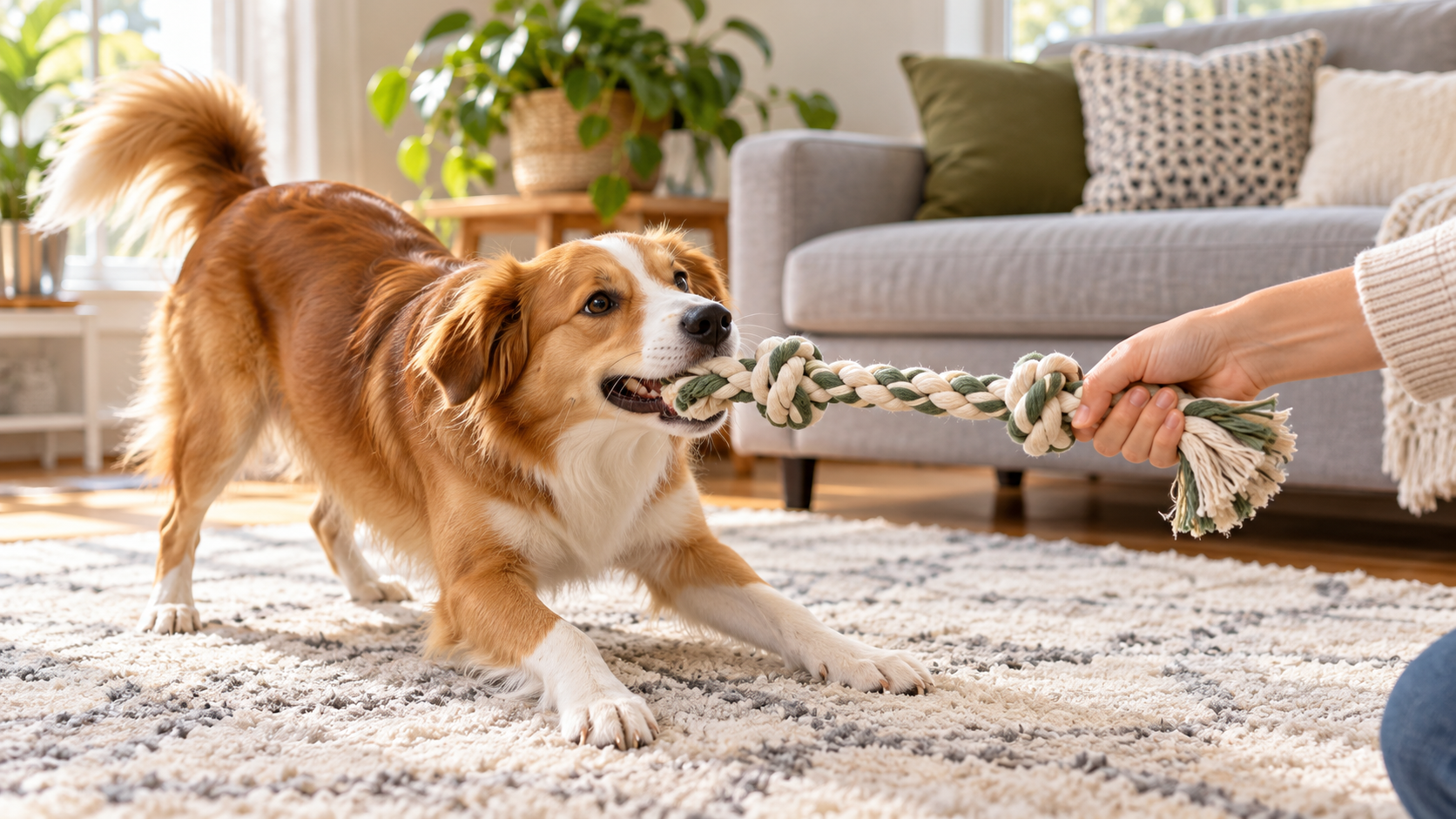
Present the toy by a designated end and wait for the dog to take the opposite zone. Keep movements smooth and mostly level rather than lifting the dog or twisting sharply. The goal is an interactive game, not a strength contest. Stop if teeth move toward the hand zone or the dog loses a stable footing.
Teach a release cue using a calm exchange, then resume when appropriate. This makes inspection possible during play and helps the handler end the game before the rope deteriorates further. Our dog tug toy guide compares other tug formats when rope is not the best material.
In a multi-dog home, one long rope does not automatically make group tug appropriate. Differences in size, play style, arousal, and resource behavior can change the interaction. Use separate toys or one-on-one sessions when needed. Aitmexcn and SHARLOVY supply multiple pieces, but quantity alone does not make shared play safe.
Inspect rope in sections, not with one quick glance
Begin at one end and rotate the rope through the hands. Check tassels, the transition into each knot, the knot body, straight rope sections, handles, and any junction with a ball. Look for long loose strands, thinning, separated twists, shortened ends, hardened contamination, and knots that slide.
Compare the toy with its original shape. A knot that has migrated can expose a long loop or reduce the intended separation. A ball that becomes smaller through fiber loss can change fit. Cut fibers should not be repaired into a smaller toy for continued use because the new dimensions and knot security are undocumented.
Rope toys are not water resistant in most structured fields. Wet cotton can hold dirt and takes time to dry. LECHONG calls its cotton washable, but the selected listings do not provide complete wash and drying directions. Follow the actual label, rinse only as permitted, and dry fully before storage.
Rotation is useful only when damaged items leave circulation
A multi-pack can support rotation between games and cleaning. Store dry pieces separately and return only intact toys to the available set. Count the toys when putting them away so a damaged or missing piece does not remain in the yard.
Do not treat a rope toy as an unlimited boredom solution. The listings use boredom language, but unsupervised access creates more time for strands to loosen unnoticed. For a different interactive format, see our article on the Moseyuh interactive dog toy. For a non-rope construction aimed at hard use, the HDSMNGY squeaky toy assessment covers another design.
Whatever the format, no toy lasts forever. Set a simple household rule: supervised access, frequent inspection, immediate removal when pieces loosen, and replacement before the dog can ingest material. The strongest product language does not override the condition of the object in front of you.
Match the rope shape to the game area
A straight knotted tug is easiest to divide into a dog end and a human end. A rope ball with a handle changes the game toward tossing and carrying, but the ball still has to be too large for the dog to swallow or lodge deeply in the mouth. A multi-knot rope offers several grips, although unused loops and tails can swing unpredictably.
Before fetch, remove people, breakable objects, and other dogs from the throw path. Rope toys do not travel like smooth balls: knots change the flight, long sections trail, and the toy can land end-first. Use an open space appropriate to the full toy length and stop throwing when the rope is wet, dirty, or beginning to separate.
Outdoor use should end with a complete count and inspection. Grass can hide a smaller rope ball from a multi-pack, and grit can work into wet cotton. Do not leave the set exposed to rain merely because a listing mentions outdoor play. Bring every piece inside, clean it only as directed, and return it to storage after it is fully dry.
How we chose
We compared the eight supplied products using their ASINs, titles, bullets, and specifications. Eligibility required an actual rope toy for chewing, tugging, fetching, or interactive play. We prioritized published length, width, dog-weight interval, knot count, material, item count, total weight, intended breed size, and explicit supervision warnings.
Physical measurements received more weight than toughness language. Dental, gum, stress, boredom, training-efficiency, and health statements were not treated as verified outcomes. We also avoided declaring any toy indestructible. Chew-resistant construction is always conditional on the dog, type of play, and toy condition.
Six products appear in the cards. Forfon and TLAZZ were omitted because they overlap the cotton multi-rope category while lacking individual length and width. Both remain in the research set, but item count alone did not provide enough fit evidence to rank them above measured options.
What we could not verify
The listings do not provide shared pull tests, bite simulations, knot-slip tests, fiber-loss measures, wash-cycle results, strand-ingestion evidence, or maximum play duration. Material labels do not specify yarn diameter, weave density, or tensile strength. Claims about tooth cleaning or oral health are not supported by a common clinical method in the supplied information.
Only the two Mammoth products provide pound intervals. LECHONG, SHARLOVY, Aitmexcn, FoxKnow, Forfon, and TLAZZ rely on broad size labels, so their cards state that no dog-weight range is available. Set-level package dimensions and weights cannot establish the dimensions of every included toy.
Best dog toy ropes by size and format
Mammoth medium 20-inch tug: best documented medium-dog option
This three-knot cotton-poly tug measures 20 by 2.5 by 2.5 inches, weighs 1.6 ounces, and is listed for dogs weighing 30 to 50 pounds. Those dimensions and the explicit interval make it the most transparent fit in the group. Colors vary.
Skip if: the dog cannot grip a 2.5-inch-wide rope comfortably or weighs outside the stated interval.
Limitation: no pull-force, chew-cycle, or wash instruction is stated.
Mammoth small 15-inch tug: best documented small-dog option
The small Mammoth is a 15-by-2.5-by-2.5-inch three-knot cotton-blend tug listed for dogs weighing 15 to 30 pounds. It weighs 1.9 ounces and supports indoor or outdoor interactive play. The shorter length suits a smaller play area but provides less hand-to-mouth separation.
Skip if: 15 inches leaves insufficient separation for the handler or the dog falls outside the listed range.
Limitation: no tensile result, fiber-loss result, or complete care method is stated.
LECHONG 36-inch five-knot rope: best extra-long single tug
LECHONG measures three feet and weighs 700 grams according to its bullet. The cotton rope has five knots and is aimed at medium and large dogs. Its 36-inch length offers the greatest documented hand separation, and the listing explicitly acknowledges that a sufficiently powerful chewer can destroy it.
Skip if: the rope is too heavy or thick for the dog, or the play area cannot accommodate its swing radius.
Limitation: no rope diameter or dog-weight range is stated.
SHARLOVY nine-piece set: best large assortment
SHARLOVY combines nine cotton forms, including a 27-inch five-knot rope, rope balls, multi-knot ropes, and ball-and-tug designs. The package weighs 2.27 pounds and is labeled for large dogs. Multiple shapes support rotation and different interactive games.
Skip if: you need exact dimensions and weight guidance for every piece.
Limitation: only one rope length is stated, no dog-weight range is supplied, and the durability claims lack a common test.
Aitmexcn eight-piece set: best disclosed assortment composition
Aitmexcn lists two knotted tug ropes, two large rope balls, one handled rope ball, and three knotted chew ropes. The cotton set weighs about 2.97 pounds and is labeled for large adult dogs. Its strongest feature is the clear breakdown of shapes rather than individual measurements.
Skip if: you cannot confirm that every ball and rope is suitably sized for the dog.
Limitation: individual dimensions and a dog-weight range are not stated.
FoxKnow two-pack: best rotation pair with a stated rope length
FoxKnow supplies two cotton rope toys described as 22 inches long, with reinforced knots and a handle/ball-knot layout. The package weighs 1.46 pounds and is labeled for small, medium, and large dogs. Two matching-purpose toys make rotation straightforward.
Skip if: broad all-size language is insufficient without rope diameter or a weight interval.
Limitation: the 22-inch figure appears only in the bullet, while individual toy weight, diameter, and dog-weight range are not stated.
FAQ
What size rope toy should I buy for my dog?
Choose a rope the dog can grip without taking an entire knot or ball deeply into the mouth, while preserving a separate hand zone. Mammoth provides the clearest ranges: 15 inches for 15 to 30 pounds and 20 inches for 30 to 50 pounds. For other products, verify physical dimensions rather than relying only on a breed label.
Are rope toys safe for aggressive chewers?
No rope toy is indestructible. A strong chewer can loosen fibers and knots, so use supervised sessions and inspect frequently. Remove the toy when strands lengthen, knots shift, the rope thins, or pieces can be swallowed. Select chew-resistant construction without assuming permanent durability.
Do rope toys clean dogs’ teeth?
The listings make flossing and plaque claims, but they do not provide a shared clinical method. Rope friction is not a substitute for veterinarian-recommended dental care. Ask a veterinarian about odor, gum changes, broken teeth, pain, or an appropriate oral-care routine.
How should I play tug with a rope?
Hold a designated end, keep hands away from the dog’s grip, and use smooth level movements. Do not lift the dog by the toy or twist sharply. Teach a calm release, pause when teeth move toward the hand zone, and end the game if footing or arousal becomes difficult to manage.
Can I leave a rope toy with my dog while I am away?
Unsupervised access gives damage more time to progress unnoticed. The selected listings themselves often recommend supervision for strong chewers. Use the toy in monitored sessions, count multi-pack pieces after play, and store intact ropes dry when the session ends.
Can a cotton rope be washed?
LECHONG calls its cotton washable, but the listings do not provide a common cycle or drying method. Follow the label on the specific toy. Dry it completely and inspect for loosened knots, hardened sections, odor, and strand damage before returning it to play.
Bottom line
Choose a measured rope that creates separate mouth and hand zones, then supervise and inspect it. Mammoth gives the clearest fit guidance at 15 inches for 15 to 30 pounds and 20 inches for 30 to 50 pounds. LECHONG offers extra separation for larger play, while SHARLOVY and Aitmexcn provide variety only if every individual piece passes the size check.
Sources
- VCA dog care library — opened October 25, 2026
- ASPCA dog care — opened October 25, 2026
- American Kennel Club training advice — opened October 25, 2026