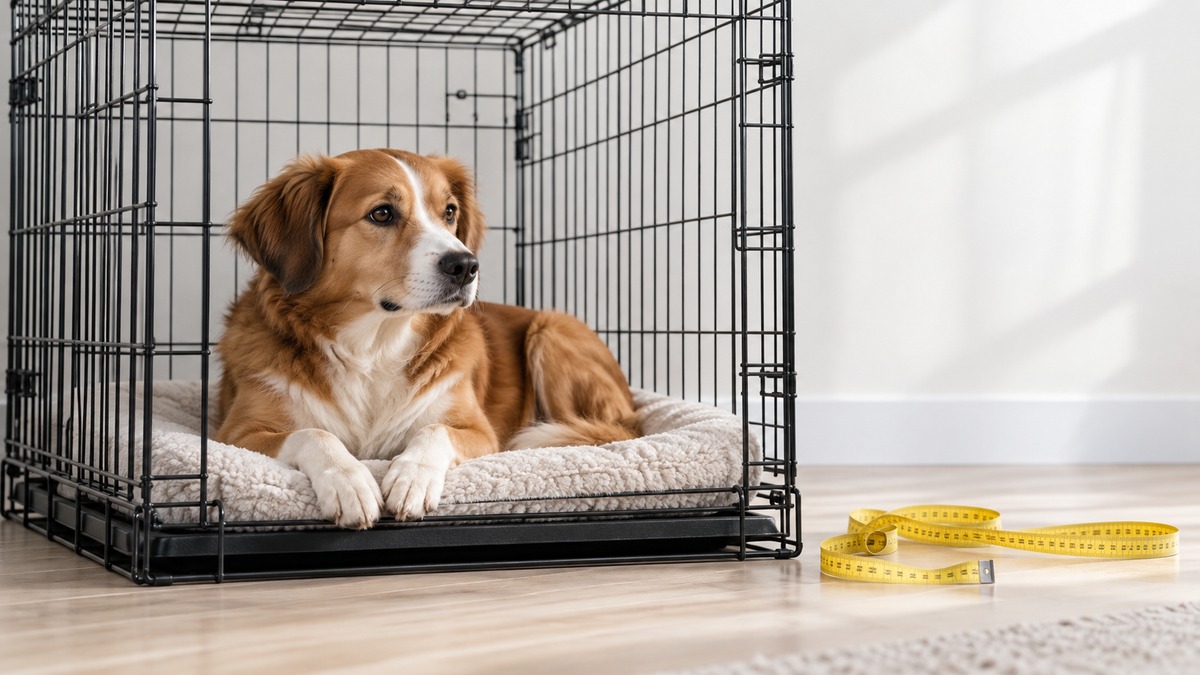
Best Cages and Crates for Dogs Boarding: Size Check First
As an Amazon Associate we earn from qualifying purchases. Details
By Ken
The best cages and crates for dogs boarding are the ones that clear your dog’s measured height and length, sit inside a stated size or weight band, and meet the rules of the place where the dog will stay. The question behind the phrase is which listed size fits a dog that will stay away from home. This guide covers measuring, listed size bands, six crates from our file and the points the listings leave open. None of the listings says it is approved for boarding. Six of the twelve items in the file are crates or cages. The other six are pads, a cover and pad set, and playpens.
Quick answer
- For a medium or large dog that needs a crate that rolls, the Gardner Pet collapsible crate lists 36.4 by 22.8 by 25.8 inches and names Large and Medium breeds.
- For a dog under 20 pounds, the 24-inch rechgosh crate matches the listed weight band, but check its height against your dog first.
- For a large dog in a soft-sided crate, the XVISHX 36 by 25 by 25 inch crate has two doors and mesh windows.
- For a toy dog under 10 pounds, the 24-inch rechgosh furniture crate is the smallest crate in the file; the MidWest SUV crate names dogs up to 70 pounds but gives no dimensions in the listing data.
What a boarding stay changes
The listings in our file describe their crates for home, travel and car use. None of them names a kennel, a boarding facility or a trainer as the approving body. That leaves two things you can check yourself: the dog’s measured size, and the written rules of the facility that will hold the dog. Ask the facility what crate type and size it requires before you buy, because a crate that works in your home may not be the one it accepts. Our pages do not give a boarding standard, and this guide does not claim one.
The reason a crate matters during a stay is the one AKC gives for crates in general: they are a helpful aid “to keep them safe when you can’t supervise them.” During a stay, the dog is not under your eye, so the crate has to hold it without gaps, sharp edges or weak latches. The listings state some of those details and leave others unstated. The sections below separate the two.
Measure the dog before you compare
AKC gives a simple method, and it is the same for a boarding crate as for a home crate. “With your dog standing, measure them from the top of the head to the bottom of the feet to determine height.” Then: “Next, measure your dog from the tip of the nose to the tip of the tail to determine length.” AKC then says to “Add 3 to 4 inches to each measurement to compute the height and length of the dog crate you’ll need.”
AKC also warns against a crate that is too large. The guide says “While you want a roomy crate, you don’t want one that’s too large.” Texas A&M’s veterinary college puts it the same way: “The crate should be just large enough for the dog to stand up, turn around, and lay down comfortably,” in the words of Kit Darling, the college’s infection control coordinator.
Here is a worked example. Our setup estimate uses a possible dog that measures 16 inches from the top of the head to the feet and 24 inches from nose to tail. For height, 16 + 3 = 19 and 16 + 4 = 20, so the crate should be 19 to 20 inches tall. For length, 24 + 3 = 27 and 24 + 4 = 28, so it should be 27 to 28 inches long. Use your own dog’s numbers in place of these.
Next, compare that example with the dimensions each listing states. The table uses the listing’s own product dimensions and marks whether the example height and length are met.
| Crate (listing) | Listed size, inches (L x W x H) | Example height of 19 to 20 met? | Example length of 27 to 28 met? |
|---|---|---|---|
| Gardner Pet collapsible | 36.4 x 22.8 x 25.8 | Yes, 25.8 | Yes, 36.4 |
| rechgosh 24-inch small | 24 x 16.5 x 16.26 | No, 16.26 | No, 24 |
| XVISHX soft-sided | 36 x 25 x 25 | Yes, 25 | Yes, 36 |
| rechgosh extra small furniture | 24 x 12 x 16 | No, 16 | No, 24 |
| DONORO collapsible metal | 24 x 18 x 20 | Yes, 20 | No, 24 |
| MidWest SUV crate | Not stated in the listing data | Not stated | Not stated |
Two of the five crates with listed dimensions meet both figures in the example: the Gardner Pet and the XVISHX. The DONORO meets the height figure but not the length. The two rechgosh crates meet neither. The example is a comparison tool, not a fit guarantee for any dog, and the listing numbers are the listing’s own.
Weight and size bands in the listings
Size claims in the listings are not all in the same form. Some name a breed size, some name a weight, and one gives only a title. The table shows what each listing states, in its own words where a quote is needed.
| Crate | Stated dog size or weight | Where the listing states it |
|---|---|---|
| Gardner Pet collapsible | Large and Medium breeds | Breed recommendation field; no dog weight limit stated |
| rechgosh 24-inch small | Dogs under 20 lbs | Bullet text |
| XVISHX soft-sided | Large or medium breeds | Breed recommendation field |
| rechgosh extra small furniture | Under 10 lb | Bullet text |
| DONORO collapsible metal | Small size dogs and cats | Breed recommendation field |
| MidWest SUV crate | Dogs up to 70 lbs | Title only |
Where a listing gives a weight, that is the band to check against your dog’s current weight, not an estimate. Where a listing gives only a breed size, the dimensions in the table are the better test. The Gardner Pet listing states an item weight of 27.5 pounds for the crate itself, and that figure is the crate’s weight, not the dog’s limit.
Questions to ask a boarding facility
The listings cannot answer the facility’s rules, so bring a short list of questions when you call. Ask whether the facility requires a particular crate type, a set size or a metal frame. Ask what bedding it permits inside the crate, and whether the dog’s own crate can be used. Ask how the facility handles a dog that chews, and whether it has a rule for dogs above a stated weight. Write the answers down with the date, so that the crate you buy matches the rule on the day the dog arrives. If the answers conflict with a listing, the facility’s answer is the one that counts for the stay, and the listing still describes the crate for home or travel use.
How to choose a boarding crate
Four checks come before the choices. Work through them in order, and stop at any check the crate fails.
- Measured fit. Use AKC’s method, add 3 to 4 inches, and compare with the listed height and length. A crate that fails the height check is out, even if the length is right.
- Weight or breed band. Use the stated band. If the listing states no band, say so in your notes rather than assuming one.
- Material and chewing. AKC says that “Metal dog crates are best for dogs who tend to chew through other materials.” A soft-sided or wood-look crate can suit a calm dog, but it is a weaker match for a dog that chews.
- Facility rules. Check the boarding facility’s written requirements before you buy. No listing in the file states approval for a boarding facility.
Doors and latches come next. The Gardner Pet listing describes squeeze-latch locks that “prevent clever dogs from opening them,” and the rechgosh 24-inch listing describes an upgraded safety lock that prevents escapes. Those are listing claims, and our pages do not test them. Compare them with the facility’s rule on latches, and ask the facility before you buy.
1. Collapsible Dog Crate for Large/Medium Dogs – 36″ L Foldable Dog Cage No-Tool Assembly, Travel Dog (Best for medium and large dogs that need wheels)
Specs from the listing (checked ):
- Product Dimensions: 36.4″L x 22.8″W x 25.8″H
- Item Weight: 27.5 pounds
- Breed Recommendation: Large, Medium
Pros
- The specifications give 36.4 by 22.8 by 25.8 inches and list Large and Medium as the breed recommendation
- The bullets describe two smooth-rolling wheels and sturdy handles on both sides for moving the crate
- The bullets describe squeeze-latch locks on the door that the listing says prevent clever dogs from opening them
Cons
- The listing gives a 27.5-pound item weight and no dog weight limit, so the dog's maximum weight is not stated
Best for: A medium or large dog that needs a crate that rolls between rooms or into a car
Skip if: You need a crate with a stated dog weight limit or a boarding approval
View on Amazon (affiliate link)
2. 24 Inch Small Dog Crate, Dog Cage for Small Dogs & Puppies Under 20 lbs (Best for dogs under 20 pounds)
Specs from the listing (checked ):
- Product Dimensions: 24″L x 16.5″W x 16.26″H
- Breed Recommendation: extra small, small
Pros
- The bullets say the crate is for dogs under 20 lbs and give 24 by 16.5 by 16 inches
- The bullets describe thicker wire that the listing says resists damage and noise from energetic dogs
- The bullets say an upgraded safety lock prevents escapes
Cons
- The listed height is 16.26 inches, so a dog that needs more standing height will not fit this crate
Best for: A puppy or small dog under 20 pounds that needs a crate in a home or a small room
Skip if: Your dog is over 20 pounds, which the listing names as its size band
View on Amazon (affiliate link)
3. Dog Crate,36x25x25 Inch Large Dog Crate for Large or Medium Dogs, Portable and Foldable Design (Best for a large dog in a soft-sided crate)
Specs from the listing (checked ):
- Material: 600D Oxford cloth
- Dog Breed Size: Large
- Number of Doors: 2
Pros
- The specifications give 36 by 25 by 25 inches and list large breeds as the dog breed size
- The bullets describe a thickened steel pipe frame, 620D Oxford cloth and breathable mesh
- The specifications give two doors, which the listing describes as a multi-door design
Cons
- The specifications list no warranty, and the chewing claim in the bullets is not backed by a test in the listing data
Best for: A large or medium dog that rides in a car or sleeps in a soft-sided crate at home
Skip if: You want a crate with a metal or wire frame, since this one is fabric
View on Amazon (affiliate link)
4. 24in Extra Small Dog Crate Furniture, Indoor Kennel End Table under 10 lb,Stylish Durable Indoor (Best for toy dogs under 10 pounds)
Specs from the listing (checked ):
- Product Dimensions: 24″L x 12″W x 16″H
- Breed Recommendation: Small Breeds
- Material: Wood
Pros
- The bullets say it is for small breeds under 10 lbs and puppies under 5 lbs
- The bullets describe a reinforced top that works as a storage shelf or end table
- The specifications give 24 by 12 by 16 inches and list Small Breeds
Cons
- The listing caps the fit at dogs under 10 pounds, so a small dog above that weight is outside the listing
Best for: A chihuahua or other toy dog under 10 pounds in a living room or bedroom
Skip if: Your dog is over 10 pounds, which the listing does not cover
View on Amazon (affiliate link)
5. DONORO Dog Crates for Small Size Dogs Indoor Double Door Dog Kennels & Houses for Puppy and Cats (Best for a small collapsible metal crate with a tray)
Specs from the listing (checked ):
- Product Dimensions: 24″L x 18″W x 20″H
- Dog Breed Size: Extra Small, Small
- Material: 600D oxford cloth, ABS plastic tray, Metal
Pros
- The bullets describe a double-door design for front and side entry
- The bullets say the kit includes a cover, a carrying handle and a leak-proof removable tray
- The specifications list collapsible construction with metal wire and a 600D Oxford cover
Cons
- The listing gives 24 by 18 by 20 inches and marks it for extra small and small dogs, so it does not suit a large dog
Best for: A small dog or cat that needs a folding metal crate with two doors and a removable tray
Skip if: Your dog is large, or you need a crate with a stated boarding rating
View on Amazon (affiliate link)
6. MidWest Homes for Pets Solutions Series Side-by-Side SUV Dog Crate, Double Door Folding Metal Cage (Best for an SUV or van, from the title alone)
Pros
- The title says it is a double-door folding metal cage designed to fit in SUVs and vans
- The title says it is for dogs up to 70 lbs
Cons
- Our data holds no bullets or specifications for this listing, so its interior size and door layout are not stated in the data
Best for: A dog up to 70 pounds that rides in an SUV or van
Skip if: You need exact interior dimensions, which this listing does not give in the listing data
View on Amazon (affiliate link)
Crates and car rides
Many boarding stays start with a car ride, so the travel rule matters too. AKC’s guide to car safety says: “When dogs are riding in a vehicle, they should be in a dog crate or secured with a crash-tested dog seat belt.” It also says that “Seat belts are great choices if your vehicle isn’t large enough to accommodate an appropriately sized crate for your dog.” None of the six listed crates in our file states a crash test, so this guide does not claim one for any crate. If a crate is too large for your vehicle, AKC’s point is that a seat belt is the alternative, and the seat belt has to be crash-tested to meet AKC’s rule.
Before the first long car ride, AKC’s car-safety guide describes getting the dog used to the crate or seat belt ahead of time, outside the car. Put the crate where the dog can see it, let the dog investigate, and reward calm approach with treats and praise. Texas A&M’s crate-training guidance follows a similar route: slowly encourage the dog to enter with treats or toys, close the door for short periods, and lengthen the time gradually. The same guidance says crates “should not be used for excessive amounts of time or to punish the dog.”
Common mistakes with boarding crates
The first mistake is measuring only the weight. Weight tells you the band; height and length tell you whether the dog can stand, turn and lie down. The second is buying a crate far larger than the dog needs. Texas A&M’s guidance says the crate should be just large enough, and it notes that dogs usually avoid soiling the area where they sleep, so extra space can get in the way of housebreaking.
The third mistake is assuming approval. Nothing in the file says a crate is approved for boarding, so check the facility’s list before you buy. The fourth is treating a pad as a crate. The four pad and mat items in the file change the inside of a crate, not its size, and a pad that fills the floor does not add height. The fifth is using a playpen where a crate is required. The two Love’s cabin items are pop-up playpens, and their titles describe them that way.
How we chose
We started from the twelve items in our local research file for this keyword, dated 2026-10-20. The file holds titles, bullets and specifications only. It does not hold purchase data, and none is used here. We set three rules. The main product had to be a crate or cage. The listing had to give a size, a weight band or dimensions that a buyer can check. And the choice had to stay within the claims its own listing makes, with no boarding approval assumed. Six items met those rules. The order of the cards is not a ranking.
Listings without a card. The BALANCE crate pad, the Zutbouc reversible pad and the Pet Dreams crate pad were not used because they are pads that go inside a crate, not crates. The Pet Dreams three-piece set was not used because it is a cover, bumper and pad set. The two Love’s cabin items were not used because they are pop-up playpens, and their titles describe them as playpens rather than crates.
What we could not verify
The points below are not in the listings or the pages we opened. Treat each one as open until the facility or the seller confirms it.
- Whether any crate is approved for boarding or kennel use. None of the listings in the file says so.
- The dog weight limit for the Gardner Pet crate. Its listing gives a breed recommendation and the crate’s own weight, but no dog weight limit.
- The interior size of the MidWest SUV crate. Our data gives its title and no dimensions.
- Chew resistance of the XVISHX soft-sided crate. Its listing describes it as “Durable and Chewing Resistant,” but our pages do not test fabric crates.
- The chewproof description on the rechgosh 24-inch crate. The listing uses that word, and the listing data gives no test behind it.
- The warranty on each crate. The DONORO listing states a one-year manufacturer warranty, and the XVISHX specifications say the warranty description is not given. The other listings do not give one in the data.
- Whether the rechgosh extra small crate suits a dog that is over 10 pounds, since its listing sets that limit and gives no further detail.
FAQ
How do I measure a dog for a boarding crate?
Stand the dog and measure from the top of the head to the feet for height, and from the nose to the tail for length. AKC says to add 3 to 4 inches to each measurement to get the crate size you need. Compare those numbers with the listed height and length, not only the weight band, because a crate can fit a weight band and still be too short for a dog that stands tall.
Is a larger crate better for a boarding stay?
Not always. AKC says the dog needs room to sit, stand and lie down, and warns that a crate much too large is not better. Texas A&M’s guidance says the crate should be just large enough for the dog to stand up, turn around and lie down comfortably. A larger crate can also let a dog sit away from its own mess, so the fit matters for housebreaking as well as comfort.
Does any listing say a crate is approved for boarding?
No. The listings in our file describe home, travel and car use. A boarding facility sets its own rules, and it is the only source that can say which crate it accepts. Ask before you buy, and keep the facility’s written rule with the order.
Is a soft-sided crate safe for a dog that chews?
AKC’s guide says metal is best for dogs who tend to chew through other materials. The XVISHX listing calls its fabric crate chewing resistant, but our pages do not test that claim, so a dog that chews should be checked against the facility’s rules before a soft-sided crate is used. If you are unsure, start with a metal crate.
Can I put a pad inside a crate for a stay?
Yes, if the facility allows it, and if the pad fits the crate’s floor without raising the dog’s height. Each pad listing in our file gives its own size, and a pad changes the inside of the crate, not the listed outer size. Check the inside height with the pad in place, using the AKC measurement, before you decide.
Bottom line
Choose a crate whose listed height and length clear your dog’s measured height and length by 3 to 4 inches, whose stated size or weight band fits your dog, and whose structure meets the facility’s written rules. If your dog chews, begin with metal. If you are unsure whether the facility accepts a crate, ask before you buy, not after the stay begins.
Related reading on the site: a guide to using a blanket over a dog crate at night and our comparison of FXW crates, houses and pens with the Love’s cabin playpen.
Sources
- AKC, How to Choose the Best Crate for Your Dog: measuring height and length and adding 3 to 4 inches; room to sit, stand and lie down; not too large; metal crates for chewers; crate as a way to keep a dog safe when unsupervised
- AKC, Dog Car Safety Training: dogs in a crate or crash-tested seat belt in a vehicle; seat belts when the vehicle cannot fit a crate; getting the dog used to the crate before car trips
- Texas A&M College of Veterinary Medicine, Pet Talk, The Benefits of Crate Training: crate just large enough to stand, turn and lie down; crate training slowly with treats; crates not for excessive time or punishment