Best Dog Paw Boots Summer: Hot Pavement Picks and Sizing
As an Amazon Associate we earn from qualifying purchases. Details
By Ken
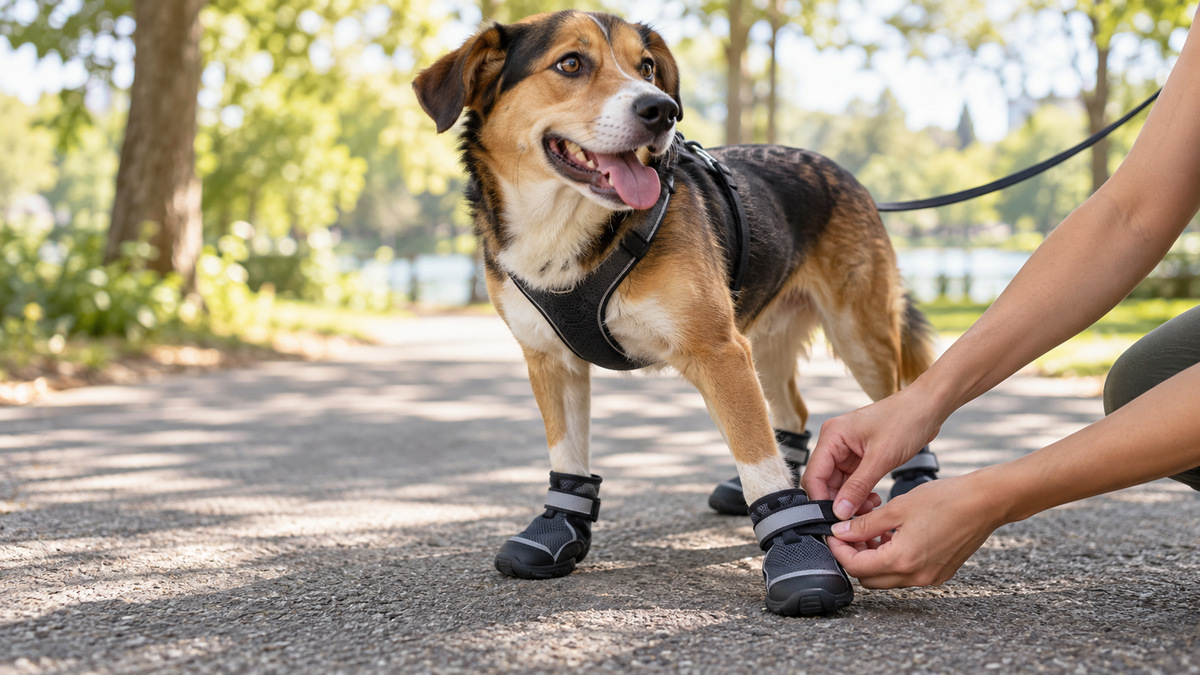
Dog owners searching for the best dog paw boots summer need a light boot with a sole that handles hot pavement and an upper the listing describes as breathable or open, sized by paw width rather than weight. This guide explains why hot pavement hurts paws, what a summer boot needs, how to measure paw width, and four picks from our local research file. Of the twelve listings in the file, four boots carry enough summer detail to describe. The rest are rain or winter boots, wound-care kits, a cooling vest, or items whose data is a title alone.
Quick answer
- For a small or medium dog on hot pavement and summer walks, the paatata knob boot names an airy mesh upper and thick rubber soles.
- For a large dog that needs hook-and-loop closures on hot pavement, the QUMY boot names summer and hot pavement in its recommended uses, though its title also names winter boots.
- For a dog that walks on hot pavement and wet grass and needs reflective straps at night, the QBLEEV suspender boot names hot pavement and rainy days, but its listing describes it as waterproof and does not describe a mesh upper.
- For light walks on dry days, the TEOZZO drawstring boot names hot summer and hot pavement, and its listing says it is not waterproof.
Why hot pavement is a paw problem
The ASPCA’s hot-weather guidance gives the reason in two sentences. “Don’t let dogs linger on hot asphalt when the temperature is very high.” And: “Being so close to the ground, your pooch’s body can heat up quickly, and sensitive paw pads can burn.” The same page adds a practical rule: “Keep walks during these times to a minimum.” The ASPCA does not give a number for what counts as very high, so this guide does not give one either. Judge the surface as well as the air, and keep walks short on days when the pavement feels hot to you.
AKC’s guide to dog boots makes the same point from the boot side. “If you want to protect your dog’s feet from a burning sidewalk, look for lightweight boots that conform to the shape of their feet.” That single sentence sets three of the criteria in the next section: weight, fit to the foot, and a sole that keeps the foot off the hot surface. AKC also says “Note that different boots are geared for different activities.” A boot made for rain, snow or hiking is not automatically a summer boot, and the listings in our file show that clearly.
AKC also treats a small injury as a real one. Its guide says that a seemingly minor ailment, such as a blister from a hot sidewalk, “could limit your dog’s mobility, affect their playtime, and even lead to secondary ailments, such as infection.” A boot helps with that, but it does not replace a plan for shorter walks, so use both.
What a summer boot needs
Four features matter for a warm-weather boot. Each one should be stated in the listing, not inferred from a photo or a general claim.
- Weight and fit to the foot. A light boot that follows the shape of the paw is the AKC’s own starting point. A heavy boot with a stiff shell is a different tool.
- A sole that holds the foot off the surface. The paatata listing describes “thick, wear-resistant rubber soles” that “shield paws from scorching asphalt, sharp rocks, broken glass, thorns and winter salt.” That is a listing claim, and it is the kind to check against the boot in hand.
- An upper that breathes, or says nothing about water. Waterproof and breathable are separate features. AKC notes that “Some dog boots can even double as rain boots because they’re made of a waterproof, wear-resistant material.” A waterproof boot is a rain feature. For summer, the listing should name a mesh or open upper if it claims breathability at all.
- A closure the dog can live with. Pull-on, drawstring, buckle and hook-and-loop closures all appear in the file. The closure should stay on during a walk and come off without a fight.
AKC also notes that a dog may need time to adjust: “It may take a little time for your dog to get used to wearing dog booties.” The paatata listing says that “Most dogs adapt within a few walks,” which is a listing claim rather than a study result, and it is a reasonable starting expectation.
Measure paw width before you order
Boots are sized by paw measurements, and the listings in this file say so. The QUMY listing says: “Please be sure to measure the width of your dog’s paws carefully, it is key to choosing the correct size for your dog, weight can only be used as an additional reference.” The paatata listing says to “Measure paw WIDTH (not length) and choose by the chart; size up for wide paws.” The TEOZZO listing tells you to “Measure all paws, use the Widest measurement.”
AKC’s method is the same: “Draw a line across the widest part of the paw tracing and measure it.” Put the dog’s paw on paper, trace it, draw a line across the widest part of the tracing, and measure that line. Measure each paw you plan to cover.
Here is a worked comparison from the paatata listing. Its bullets give the size 6 chart as 1.97 by 1.57 inches, for 13 to 15 pounds. Its specifications give size 6 as 1.9 by 1.5 inches, for 13 to 16 pounds. The width figures differ by 0.07 inch: 1.97 – 1.9 = 0.07. That gap is small, but it is the gap that decides whether a boot slips off or pinches, so measure the paw and choose the chart that matches your number. AKC’s gear-sizing guide adds this rule: “When in doubt, always opt for the larger size, especially if your dog is between sizes.”
How to choose a summer boot
Work through these checks in order before you read the picks.
- Hot pavement named in the listing. The boot’s own text should name hot pavement, summer or hot weather. A boot described only for rain or snow is not a summer pick here.
- Upper and water. Note whether the listing says breathable, mesh or waterproof. A summer walk does not need a waterproof claim, and a waterproof claim does not replace a breathable one.
- Paw width and size band. Use your measured paw width, then the listing’s chart, then the breed size named in the listing. Where the chart and the specifications disagree, use the chart and note the gap.
- Closure. Check that the closure stays on the dog and comes off easily. The paatata and TEOZZO listings name closures, and the QBLEEV and QUMY listings name straps.
- Light weight. Choose the lightest boot that meets the first four checks.
The table compares the four picks on the points the listings state. A blank cell means the listing does not state that point in the listing data.
| Boot (listing) | Summer or hot-pavement use named | Closure | Water or breathability stated | Breed size named |
|---|---|---|---|---|
| paatata knob boot | Hot pavement; summer walks | Pull-on knob | Breathable mesh upper | Extra small, small, medium |
| QUMY hot-pavement shoe | Hot pavement; summer in recommended uses | Hook and loop | Not stated | Large |
| QBLEEV suspender boot | Hot pavement; rainy and snowy days | Buckle | Waterproof | Extra small in specifications; six sizes in bullets |
| TEOZZO drawstring boot | Hot summer; hot pavement | Drawstring | Not waterproof | Medium, small |
All four picks name hot pavement in their own listing text, so each one has a stated summer use. The table is a comparison of what the listings say, not a test of how the boots perform.
1. Dog Shoes for Large Small Medium Dogs Knob Breathable Dog Boots & Paw Protectors Non-Slip Dog Shoes (Best for summer walks on hot pavement)
Specs from the listing (checked ):
- Closure Type: Pull-On
- Dog Breed Size: Extra Small, Medium, Small
Pros
- The bullets say thick, wear-resistant rubber soles shield paws from scorching asphalt, sharp rocks, broken glass and thorns
- The bullets describe an airy mesh upper that the listing says keeps paws cool on summer walks
- The quick-adjust knob closure is described as locking a snug fit in seconds
Cons
- The size lines do not agree: the bullets give size 6 as 1.97 by 1.57 inches, while the specifications give 1.9 by 1.5 inches
Best for: A small or medium dog that needs a pull-on boot for hot pavement and summer walks
Skip if: Your dog is large, since the listing gives extra small to medium breed sizes
View on Amazon (affiliate link)
2. QUMY Dog Shoes for Hot Pavement, Dog Snow Boots & Paw Protectors for Winter (Best for large dogs on hot pavement)
Specs from the listing (checked ):
- Dog Breed Size: Large
- Closure Type: Hook & Loop
- Recommended Uses For Product: dog boots for winter, dog rain boots, dog shoes for hot pavement, dog shoes for summer, dog snow boots
Pros
- The recommended uses name dog shoes for hot pavement and dog shoes for summer
- The bullets describe two adjustable reflective straps and a wide split seam opening that makes the boot easy to put on
- The bullets describe a tough slip-proof sole that gives traction and protection from rough terrain
Cons
- The title also names winter snow boots, so the listing covers cold weather as well as summer
Best for: A large dog that walks on hot pavement and needs hook-and-loop closures
Skip if: Your dog is small, since the specifications name a large breed size
View on Amazon (affiliate link)
3. QBLEEV Dog Suspender Boots, Waterproof Dog Rain Boots Paw Protector Shoes (Best for hot pavement, wet grass and night walks)
Specs from the listing (checked ):
- Recommended Uses For Product: Hot Pavement, Muddy and Grassy, Outdoor Adventures, Protect Wounds, Rainy and Snowy Days
- Closure Type: Buckle
Pros
- The recommended uses name hot pavement, muddy and grassy ground, and rainy and snowy days
- The bullets describe reflective details on the leggings for night walks
- The bullets give six sizes from XS to 2XL
Cons
- The listing is waterproof and built for rain, snow and icy ground as well, so it covers more than summer
Best for: A dog that walks on hot pavement and wet grass and needs reflective straps at night
Skip if: You want a boot the listing describes as breathable, since its bullets do not describe a breathable upper
View on Amazon (affiliate link)
4. Dog Shoes Dog Boots & Paw Protector, Anti-Slip Sole Winter Dog Booties with Reflective Straps Dog (Best for light walks on dry days)
Specs from the listing (checked ):
- Material: Rubber
- Closure Type: Drawstring
- Dog Breed Size: Medium, Small
Pros
- The bullets say the soft fleece lining suits claws and protects paws in cold weather or hot summer
- The bullets say the non-slip sole helps on tile and sand and protects paws from hot pavement
- The drawstring and reflective straps are described as ensuring a tight fit and safety on night walks
Cons
- The listing says the boots are not waterproof and suit indoor use and walks on dry days
Best for: A small or medium dog that walks on dry days and needs a light boot
Skip if: You need a waterproof boot, which the listing says this is not
View on Amazon (affiliate link)
A summer walk routine
The steps below use the ASPCA and AKC guidance. They do not add a temperature rule that the pages do not give.
- Plan walks for the cooler part of the day when you can, and keep walks short when the pavement is very hot. The ASPCA says to keep walks during those times to a minimum.
- Fit the boot before you leave, then give the dog a few short walks to adjust. AKC’s point is that adjustment takes time, so do not expect a full walk on the first try.
- Check the boot’s fit during the first walks. A boot that slips or seems to hurt the dog should come off, and its fit should be rechecked against the chart.
- After the walk, take the boots off and check the paws. AKC says that “Gently part your dog’s toes as you clean to check for debris and irritation, and dry thoroughly.”
- Look for cuts, scrapes, and dry or cracking pads. AKC’s paw-care guide treats cleaning as a good moment for that check.
- If a cut, blister or swelling shows, call your veterinarian. This guide does not give medical advice for paw injuries.
Mistakes to avoid
The first mistake is sizing by weight. The QUMY listing says weight is only an additional reference, and the paw width is the key measure. The second is treating a waterproof claim as a summer feature. The QBLEEV listing describes a waterproof boot for rain and snow as well as hot pavement, so it is not the same product as a breathable mesh boot. The third is skipping the adjustment period, which AKC expects. The fourth is buying a winter boot for summer: the LESYPET and Canada Pooch listings are built around cold weather, so they were not used here. The fifth is walking on hot pavement at the hottest part of the day, which the ASPCA warns against.
How we chose
We started from the twelve items in our local research file for this keyword, dated 2026-10-20. The file holds titles, bullets and specifications only. It does not hold purchase data, and none is used here. We set three rules. The item had to be a boot, not a vest or a wound-care kit. The listing had to name a summer or hot-pavement use in its own text. And the listing had to give enough detail to describe the closure, the size band or the water feature. Four items met those rules.
Listings without a card. The Spark Paws cooling vest is not a boot, and its listing describes evaporative cooling of the dog’s body. The VORDAKEM paw wound kit and the Sunnymove paw wound recovery boots are wound-care products, and their listings describe post-surgery and injury use rather than summer walks. The Canada Pooch suspender boots and the LESYPET waterproof boots are built around cold, wet and snowy conditions. The Mxinron suspender rain boots name rain and wet weather, and their specifications list all seasons without naming a summer use. Two boots, the waterproof stay-on boots for small and medium dogs and the boots for large dogs for hardwood floors and hot pavement, have only a title in the listing data, with no bullets or specifications, so we did not build a card from a title alone.
What we could not verify
The pages we opened describe why hot pavement hurts paws and how to fit a boot. They do not test any boot, and they do not give the temperature at which a surface becomes unsafe. The points below are open.
- Whether any boot keeps the paws cool. None of the listings gives a surface test, and the ASPCA says “very high” without a number.
- The breathability of the QUMY boot. Its listing gives no mesh or breathable detail, so the summer use rests on the recommended uses alone.
- The QBLEEV upper. Its bullets call it waterproof, and they do not describe a breathable upper.
- The paatata size chart. The bullets and the specifications give different width and length figures for size 6 and different weight bands, so the chart must be checked against a measured paw.
- The QUMY size line. Its specifications name size 8, while its bullets give a chart that starts at size 1, so the size has to be read from the chart.
- The durability of any sole or fabric. No listing in the file gives a durability test, and the pages do not test boots.
- Whether any boot suits a dog with a wound, a nail problem or a sensitive paw. That question belongs with a veterinarian.
FAQ
Do dogs need summer boots?
Some do, and the answer depends on the surface and the day. The ASPCA warns that sensitive paw pads can burn on hot asphalt when the temperature is very high. AKC says a lightweight boot can protect the paws from a burning sidewalk. A dog that walks mainly on grass may not need boots, but the pavement you walk on is the thing to check, not only the air temperature.
What is the difference between a summer boot and a winter boot?
The listings show the difference. The LESYPET listing describes a waterproof outer shell with a soft interior lining for cold winters. The TEOZZO listing describes a fleece lining that it says suits cold weather or hot summer, so a lining alone does not settle the season. AKC says some boots double as rain boots because of a waterproof material. For summer, look for a breathable or open upper and a light sole, and read the listing’s water claim as a rain feature.
How do I measure my dog for summer boots?
Trace the paw on paper, draw a line across its widest part and measure that line, as AKC describes. Use paw width, not length, for the chart, as the paatata and TEOZZO listings say. If the number falls between two sizes, AKC’s gear guide advises that “When in doubt, always opt for the larger size, especially if your dog is between sizes.”
How long should my dog wear the boots at first?
Start with a few short walks. AKC says that “It may take a little time for your dog to get used to wearing dog booties,” and the paatata listing says most dogs adapt within a few walks. Watch for limping, lifting the paw or pulling off the boot, and stop the walk if the dog seems uncomfortable.
What should I check after a walk in boots?
Take the boots off, part the toes, check for debris, and dry the paws thoroughly. AKC’s paw-care guide says a quick towel-dry with a microfiber towel helps with wet paws. A pad that looks dry or cracked deserves a second look. Call your veterinarian if you see a cut that will not close, swelling, or a limp that lasts.
Bottom line
Choose a summer boot whose listing names hot pavement or summer use, a breathable or open upper, and a light sole, then size it by measured paw width. If the listing says waterproof, that is a rain feature, not a summer one. Keep walks short when the pavement is very hot, and give the dog a few short walks to adjust before you go far.
For more on cooling apparel and dog boots, see our Spark Paws and QUMY apparel comparison and our Baobicute and QUMY apparel comparison.
Sources
- ASPCA, Hot Weather Safety Tips: hot asphalt and paw pad burns; keep walks to a minimum when very hot
- AKC, Best Dog Boots for Any Weather: lightweight boots for a burning sidewalk; waterproof boots doubling as rain boots; different boots for different activities; tracing the paw to measure width
- AKC, How to Clean and Care for Your Dog’s Paws: getting used to booties; parting toes and drying after a walk
- AKC, How to Measure Your Dog for Clothes and Gear: check listed measurements; size up when between sizes