Best Dog Crate Furniture
As an Amazon Associate we earn from qualifying purchases. Details
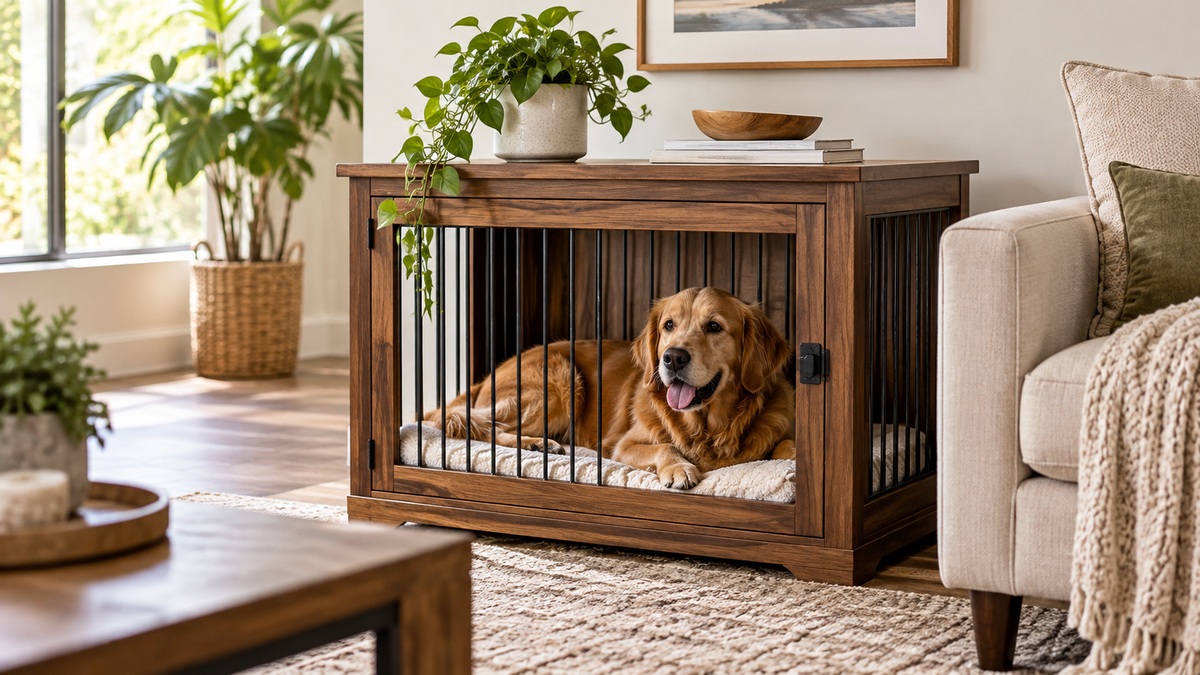
The person typing best dog crate furniture wants a crate that also works as a piece of living-room furniture, usually a side table or nightstand with a door for the dog, and needs to know which sizes and builds will fit. This guide compares six furniture-style dog crates from six different brands. It uses what each listing says about size, door design, frame, cushion and extras, and it sets the sizing rule from the AKC before the picks. The dog’s measurements come first and the furniture look comes second.
Quick answer
- Measure the dog before the style. The AKC says to “add 3 to 4 inches to each measurement” to find the crate size you need.
- Check the door count. The Dwanton bullets describe double doors, while its specification row lists one door, so confirm it on the product page before you buy.
- Check the frame if your dog chews. The AKC says “metal dog crates are best for dogs who tend to chew through other materials,” and four of the six listings are built mainly from wood, engineered wood or particleboard.
- Check any built-in power strip. The Viviendo listing describes one, and the listing does not state a safety certification for it.
What a furniture crate has to do
A furniture-style crate has two jobs, and they pull in different directions. The first job is the crate’s: the dog needs enough room to stand, turn and lie down, with airflow and a door it can use without strain. The second job is the furniture’s: the piece has to sit in a living room or bedroom as an end table or nightstand, with a top that holds a lamp or a book. The listings in this set lean on the second job in their titles and bullets, so the dog’s needs are easy to skip. Start with the first job, and check the look afterward.
The AKC’s crate guidance frames the decision the same way. It says that choosing the right crate size “is also an important part of successful crate training,” which means size is a training question as well as a shopping one. A crate that is too small for a dog to stand in, or too large for the room, does not give the dog a secure space to rest, however good the top looks.
Sizing: measure the dog before the table
The AKC gives the measuring steps. “With your dog standing, measure them from the top of the head to the bottom of the feet to determine height. Next, measure your dog from the tip of the nose to the tip of the tail to determine length. Add 3 to 4 inches to each measurement to compute the height and length of the dog crate you’ll need.”
Our planning example uses a made-up dog for illustration, not a real measurement. Suppose the dog measures 20 inches in height and 26 inches in length. Adding 3 to 4 inches gives a crate height of 23 to 24 inches (20 + 3 = 23, 20 + 4 = 24) and a crate length of 29 to 30 inches (26 + 3 = 29, 26 + 4 = 30).
Compare that range with the dimensions each listing gives. Hzuaneri’s bullets state an internal size of 29.3 by 19.8 by 22.4 inches, so its length clears the 29-inch low end, while its height falls short of the 23-inch low end by 0.6 inch (23 − 22.4 = 0.6). The KAOBAS title gives a 24-inch length, which is 5 inches short of the 29-inch low end (29 – 24 = 5). Amazon Basics gives a 41-inch figure in its title and product dimensions, which is well past the range, though the bullets do not say whether that figure is inside or outside. The check is simple: compare the listing’s stated interior size with your dog’s measurement plus the AKC allowance, and skip any crate that falls short on either side.
Six furniture crates compared
The table gives each listing’s stated size, door design, frame and extras. Dimensions are as the listing gives them, and the table says so where the bullets state an interior size.
| Brand | Size as stated | Door design (per the listing) | Frame and material | Cushion or extras |
|---|---|---|---|---|
| Amazon Basics | 41 by 23.6 by 29.5 inches | Not stated in the bullets we read | Wooden boards | Two bowls included, top works as a side table |
| KAOBAS | 24.05 by 17.99 by 20 inches in the specs; 24 by 18.5 by 20 in the title | Lockable door | Crack-resistant polycarbonate, aluminum strips, alloy steel | Clear walls, flat top, detachable handle |
| Hzuaneri | 31.5 by 22 by 24 inches; internal 29.3 by 19.8 by 22.4 inches | Three doors with an arch design | Engineered wood and iron pipe | Decorative top, 0.4 inch bar gap |
| Viviendo | 23.6 by 20.5 by 26.2 inches; internal 22.6 by 18.5 by 19.3 inches | Not stated in the bullets we read | Particleboard | Cushion 1.4 inches thick, drawer, built-in power strip |
| Dwanton | 32.5 by 21.9 by 25.6 inches | Double doors in the bullets; one door in the specification row | Engineered wood and wire | Cushion, adjustable feet, wooden plate at the bottom |
| HavenlyYouth | 31.5 by 23.62 by 23.38 inches; internal 31.5 by 23.6 by 22.8 inches | Front and small door with spring locks | Reinforced steel frame, chew-resistant materials | Waterproof top, no assembly required |
Weight is the other difference. The specification rows show Amazon Basics at 64.9 pounds, Viviendo at 42 pounds, HavenlyYouth at 40.4 pounds, Dwanton at 39.3 pounds, Hzuaneri at 39.2 pounds and KAOBAS at 16.76 pounds. A heavier crate is harder to move between rooms, and the Dwanton bullets address uneven floors with adjustable feet rather than weight.
Doors, locks and escape claims
Door design decides how the dog gets in and out, and it is where the listings make their strongest claims. The Hzuaneri bullets say each door has two locks “to provide multiple layers of protection to reduce your dog from escape.” The HavenlyYouth bullets describe a front door and a small door with spring locks, and say the small door lets you feed the dog “by opening only the small door.” The KAOBAS bullets describe a lockable latch that “stay[s] tight through daily opening, closing, and cleaning.”
Those are listing claims. The sources we opened do not say how any particular lock or latch performs over time. The AKC’s crate guidance is more general: it says to “choose a crate that is secure enough to prevent an escape,” which is a goal every listing here addresses in its own way. Check the door and the lock by hand before you rely on either one.
Door count is the one conflict we found. The Dwanton bullets describe double doors, while its specification row gives the number of doors as one. Both cannot be right for the same listing, so ask the seller or read the product page before you buy.
Frame, chewing and ventilation
The AKC’s metal-crate guidance is the most direct point for a chewer: “Metal dog crates are best for dogs who tend to chew through other materials.” Most of the listings here are wood, engineered wood or particleboard. Two of them describe metal parts. Hzuaneri’s bullets say it uses “0.4 inch heavy duty iron pipe,” and HavenlyYouth’s bullets describe a “reinforced steel frame” with “chew-resistant materials.” If your dog chews, those two listings are the ones to read most closely, and the rest need a check of the chew claims before you buy.
Ventilation is the other point the AKC covers. Its guidance says that “all dog crates require proper ventilation holes or mesh fabric on the sides for your dog to breathe properly.” The KAOBAS bullets say its “ventilated panels keep air moving.” The other listings do not state ventilation holes in the bullets we read, so check the sides of a solid-walled piece before you buy, and look for an opening that the dog can breathe through.
Cornell’s crate guidance adds a point about the feel of the space. It says that “many dogs feel comforted by being in a den,” and it recommends covering a wire kennel with a sheet that still leaves one or two sides open. A solid-sided furniture crate gives some of the den effect without a cover. The sources we opened do not compare a solid-sided piece with a wire one, so the choice between them is yours.
Cushion, drawer and the power strip
Cushions are a clear difference in this set. The Viviendo listing includes a 1.4-inch cushion, and its bullets describe it as a “great-value custom cushioned mat.” The Dwanton listing describes a matching cushion, and its item highlight calls it waterproof. Amazon Basics and HavenlyYouth do not describe a cushion in the bullets we read. A cushion you have to buy separately is one more cost to plan for, although the listings do not give a figure for it here.
The Viviendo bullets also describe a built-in power strip with two AC outlets and USB-A and USB-C ports, and they state that it is part of a charging station for the crate. The listing does not state a safety certification for that strip. Before you plug anything in, check the product page, the cord and the outlet, and keep the cord out of reach of a chewer. That is the electrical safety point this set needs, and it is the one that most depends on the product page rather than the bullets.
How we chose
We searched Amazon.com for “best dog crate furniture” in Chrome on 21 October 2026 and read the first results page. We kept listings whose title or first bullets describe a crate that also works as a piece of furniture. We set aside collapsible travel crates and wire crates shown in the results, because they are not furniture-style pieces. Where one brand had several listings, we kept one, so the six picks come from six different brands: Amazon Basics, KAOBAS, Hzuaneri, Viviendo, Dwanton and HavenlyYouth.
For each listing we read the title, the first five or six feature bullets and the specification rows that the page showed. We did not record price, rank or availability, because the browser read does not give reliable figures for them. Some bullets were cut at a fixed length during capture, so the sections above quote only the text we read.
How to choose from these six
- Measure the dog’s height and length, add 3 to 4 inches to each figure, and write the result down before you look at any style.
- Check the interior size against that figure, using the internal size where the listing gives one and the outside size only as a second check.
- Confirm the door count and the lock on the product page, especially where the bullets and the specification row disagree.
- If your dog chews, look for a metal frame in the listing before you choose a wood or particleboard piece.
- Check the sides for ventilation openings, and check any built-in power strip against the product page before use.
1. Amazon Basics Furniture Style Dog Crate, Sturdy Wooden Pet Kennel, Two Bowls Included, 41″ x 23.6″ (Wooden furniture-style crate with two bowls)
Pros
- The bullets describe a wooden build with sturdy, reliable strength
- The bullets say two bowls are included in the set
- The bullets say the top works as a side table with room for decor
Cons
- The bullets name a 41-inch crate but give no interior dimensions
- The specification rows give a weight of 64.9 pounds, the heaviest figure in this set
Best for: An owner who wants a large wooden crate that reads as a side table
Skip if: You need to move the crate between rooms often
View on Amazon (affiliate link)
2. Dog Crate Furniture, Clear Indoor Dog Kennel for Small to Medium Dog, Durable Crack-Resistant PC (Clear polycarbonate crate with lockable door and flat top)
Pros
- The bullets describe crack-resistant polycarbonate panels with aluminum strips that keep the panels square
- The bullets say the lockable latch and ventilated panels are built in
- The specification rows give a light weight of 16.76 pounds
Cons
- The title gives a 24-inch length while the specification rows give 24.05 inches, and the unit count row reads 30.5 pounds
- The bullets say clear walls help reduce anxiety, a claim our sources do not cover
Best for: A small or medium dog owner who wants a clear crate that looks like furniture
Skip if: Your dog is larger than a small or medium breed
View on Amazon (affiliate link)
3. Hzuaneri 31.5 in Dog Crate Furniture,Dog Kennel Indoor for Small/Medium Dog (Engineered wood crate with three doors and an arch design)
Pros
- The bullets describe three doors that give front and side access
- The bullets give an internal size of 29.3 by 19.8 by 22.4 inches
- The bullets describe two locks on each door and 0.4 inch iron pipe in the frame
Cons
- The bullets say the crate is engineered wood and metal, with no finish detail
- The bullets describe an escape-reduction claim that our sources do not cover
Best for: A small or medium dog owner who wants arch doors and a stated internal size
Skip if: Your dog needs more than 22.4 inches of interior height
View on Amazon (affiliate link)
4. Dog Crate Furniture with Cushion and Charging Station for Indoor (Furniture crate with cushion, drawer and built-in power strip)
Pros
- The bullets include a 1.4-inch cushion, so no separate mat is needed
- The bullets describe a waterproof, scratch-resistant top that wipes clean
- The specification rows give a maximum weight recommendation of 60 pounds
Cons
- The bullets describe a built-in power strip, and the listing states no safety certification for it
- The bullets make quiet-drawer and safety claims that our sources do not cover
Best for: An owner who wants a bed, a drawer and a charging spot in one piece
Skip if: You do not want a power strip built into the furniture
View on Amazon (affiliate link)
5. 32.5″ Dog Crate Furniture with Cushion, Wooden Kennel Table Indoor (Medium furniture crate with cushion and adjustable feet)
Pros
- The bullets describe adjustable feet for a floor that is not level
- The bullets describe a wooden plate at the base that the listing says avoids foot jamming
- The bullets say the cushion matches the crate for a warmer rest
Cons
- The bullets describe double doors while the specification row lists one door
- The waterproof cushion appears only in the item highlight, with no fabric detail
Best for: A medium-dog owner who wants an adjustable table with a matching cushion
Skip if: You need the door count confirmed before you buy
View on Amazon (affiliate link)
6. Dog Crate Furniture, No Assembly Heavy Duty Dog Kennel Indoor for Medium Dogs, Double-Door Dog Cage (Double-door crate with spring locks and no assembly)
Pros
- The bullets describe front and small doors with spring locks
- The bullets say no assembly is required and the crate stores easily
- The bullets describe a reinforced steel frame with chew-resistant materials
Cons
- The specification rows list indoor and outdoor use, which the bullets do not explain
- The bullets give an internal size of 31.5 by 23.6 by 22.8 inches for dogs of 20 to 45 pounds
Best for: A medium-dog owner who wants a crate with no assembly and a metal frame
Skip if: You need outdoor use confirmed in the bullets
View on Amazon (affiliate link)
Where a furniture crate fits in a home
A furniture crate suits a room where people spend time, because the dog is near the family and the piece is in plain view. The sources we opened do not compare placement, so the choice of room is yours. Put the crate where the sides are not blocked for airflow, and check the top before you put a lamp on it.
The listings suggest a few uses beyond the crate itself. Amazon Basics describes a side table, Hzuaneri describes a TV stand and nightstand, and Viviendo describes an end table and nightstand. Those uses depend on the top holding the weight of the items you plan to put on it. The Viviendo bullets state a maximum weight recommendation for the top, while the other listings do not give a figure in the bullets we read.
For a crate that grows with a puppy, our crates for puppies guide covers size changes over time. For a crate that needs to fold for trips, our collapsible travel crate guide covers that case. For a wire crate with a mat, our dog kennel mats guide covers the floor layer.
Mistakes to avoid
- Buying by the furniture look first. The AKC says size is part of successful crate training, and a crate that is too small does not give the dog a secure space.
- Trusting a lock or latch claim without looking. The escape and lock claims are listing claims, and none of our sources covers how a given lock performs over time.
- Assuming a wood or particleboard crate suits a chewer. The AKC points to metal for chewers, and most listings here are wood-based.
- Leaving the sides closed without checking airflow. The AKC says every crate needs proper ventilation holes or mesh for the dog to breathe properly.
- Plugging in a built-in power strip without checking the product page first.
- Putting heavy items on a top that the listing does not rate. Only the Viviendo bullets state a weight figure for the top.
What we could not verify
- Whether any crate here fits your dog. The sizing example is illustrative, and we did not measure a real dog.
- The door count for the Dwanton crate, where the bullets say double doors and the specification row says one door.
- The KAOBAS dimensions, where the title gives 24 by 18.5 by 20 inches and the specification rows give 24.05 by 17.99 by 20 inches, and where the unit count row reads 30.5 pounds against a stated weight of 16.76 pounds.
- Whether the Viviendo internal size of 22.6 by 18.5 by 19.3 inches matches the outside size of 23.6 by 20.5 by 26.2 inches once the walls and base are counted.
- Whether the Viviendo power strip meets any safety standard. The listing does not state a certification, and our sources do not cover this product.
- Whether the Hzuaneri, HavenlyYouth and KAOBAS lock and latch claims hold over time. None of our sources covers those products.
- The noise claims for the Viviendo drawer slides, and the anxiety claim in the KAOBAS bullets, which our sources do not cover.
- The outdoor use stated in the HavenlyYouth specification row, which the bullets do not explain.
- The contents of any bullet beyond the first five or six, and the lines cut during capture.
FAQ
How big a furniture crate does my dog need?
Measure the dog standing: height from the top of the head to the feet, and length from the nose to the tail. The AKC says to “add 3 to 4 inches to each measurement” to find the crate size. Compare that result with the listing’s internal size, and skip any crate that falls short.
Are furniture-style dog crates safe for chewers?
The AKC says “metal dog crates are best for dogs who tend to chew through other materials.” Most furniture crates here are wood or particleboard, so a chewer needs a close read of the frame. Hzuaneri and HavenlyYouth describe metal parts in their bullets, and the chew claims in the other listings are listing claims that we did not check.
Do dog crates need ventilation?
Yes. The AKC’s crate guidance says “all dog crates require proper ventilation holes or mesh fabric on the sides for your dog to breathe properly.” Check the sides of any solid-walled piece for openings, because the bullets for most listings here do not describe them.
Can I put a lamp or a TV on top of the crate?
The listings describe the top as a place for lamps, books, decor and a TV stand in some cases. The weight limit for the top is stated only for Viviendo, at 60 pounds, so check the limit for any other listing before you put heavy items on it.
What should I check on a crate with a built-in power strip?
Check the product page for a safety certification, look at the cord and the outlet, and keep the cord out of a chewer’s reach. The Viviendo listing describes the strip but does not state a certification, so the check has to happen before the crate goes into service.
Bottom line
Measure the dog first, add the AKC allowance, and compare that with the listing’s interior size. Then choose the style, checking the door count, the frame for a chewer, the sides for airflow, and any built-in power strip against the product page.
Sources
- AKC, How to Choose the Best Crate for Your Dog: https://www.akc.org/expert-advice/lifestyle/choose-best-crate-dog/
- Cornell University, Riney Canine Health Center, Dog Crates: When to Use Them and How to Pick One: https://www.vet.cornell.edu/departments-centers-and-institutes/riney-canine-health-center/canine-health-topics/dog-crates-when-use-them-and-how-pick-one
- AKC, Crate Training Your Dog: https://www.akc.org/expert-advice/training/crate-training/