Car Restraints for Small Dogs: Types, Fit and Limits
As an Amazon Associate we earn from qualifying purchases. Details
Updated 19 October 2026 | Author: Editorial team, bestdogsstuff.com
Car restraints for small dogs keep a dog in one place during a drive, so a sudden stop does not throw it forward or out of an open door. The person typing car restraints for small dogs usually has a dog that rides well but roams the cabin, or a dog that is small enough that a standard seat belt setup does not fit. The AKC car-safety and crate guidance we opened agree that a restrained dog is safer than an unrestrained one, and that any restraint has to fit the dog and the vehicle. This post compares the three main types and what each listing states about fit.
Quick answer
- A small dog should ride in a crate or be secured with a restraint, never loose on a lap or unrestrained in the cabin.
- Crate, seat-belt harness and booster are the three main types. Match the type to the dog’s weight, the vehicle and how the dog settles.
- Check the stated weight or size range on the product, because small-dog labels vary and the picks below each state a different limit.
- Introduce any restraint at home first, then keep the first drives short.
Why restraint matters even for a small dog
Small dogs are often treated as less of a risk in a car, but the AKC car article does not make that distinction. It says: “For everyone’s safety, dogs shouldn’t be riding on the driver’s lap, or unrestrained in the car.” A dog on a lap can block the driver’s view, and a dog in the cabin can move into the footwell or the pedals. Size changes the setup, not the principle.
The article also states the purpose of a restraint in plain terms: it “will prevent your dog from being injured or ejected from the car in the event that you have to brake quickly, or if you get into an accident.” That sentence is the reason to restrain a small dog even on a short drive. A small body moves just as fast in a sudden stop, and a restraint that holds the body in one place is what the article describes.
The three main types
Restraints fall into three groups. Each suits different dogs and vehicles, and the table below sets out what each one does, what the AKC article says about it, and what to check before buying.
| Type | What it does | What the AKC sources say | What to check |
|---|---|---|---|
| Crate | Holds the dog in an enclosed space | Dogs should be in a crate or secured by a seat belt when in a vehicle | Crate size for the dog, and a crate that fits the car’s space |
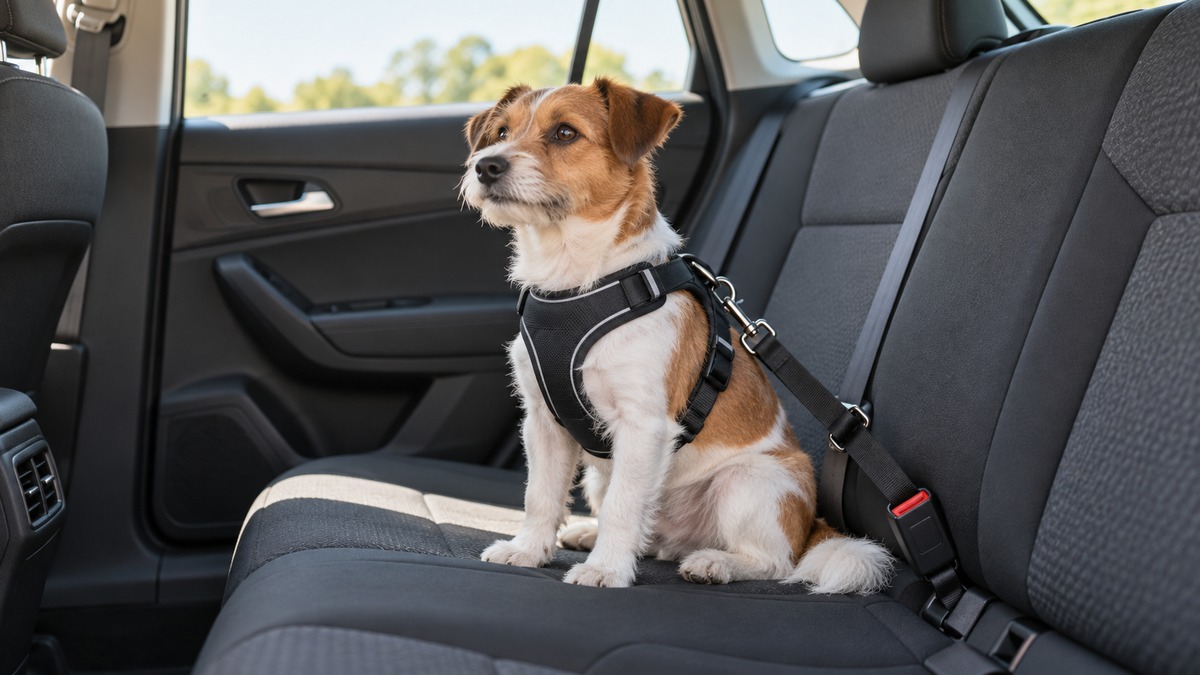
| Seat-belt harness | Clips the dog to the seat belt through a harness | A seat belt suits a vehicle too small for an appropriately sized crate | Harness size, belt tether length and attachment points |
| Booster seat | Raises the dog and holds it in a seat with safety buckles | The AKC pages we opened name crates and seat belts, not boosters; the same hold-in-place logic applies | Weight limit, installation method and fit in the car |
The AKC article says seat belts are the choice when the vehicle is too small for an appropriately sized crate: “Seat belts are great options if your vehicle isn’t large enough to accommodate an appropriately sized crate for your dog.” For many owners of small dogs, a crate is the simplest option in a larger vehicle, and a harness or booster suits a compact car or a dog that will not settle in a crate.
Crate fit for a small dog, with a worked example
The AKC crate guidance gives a simple method for sizing. It says: “With your dog standing, measure them from the top of the head to the bottom of the feet to determine height.” It then says to measure from the nose to the tail tip for length, and to “Add 3 to 4 inches to each measurement to compute the height and length of the dog crate you’ll need.”
Worked example, with a made-up dog measurement for illustration only: a small dog measures 10 inches tall and 16 inches long. The height of the crate is 10 plus 3 equals 13 inches at the low end and 10 plus 4 equals 14 inches at the high end. The length is 16 plus 3 equals 19 inches at the low end and 16 plus 4 equals 20 inches at the high end. Use your own measurements. The example only shows the AKC method, and it does not describe any product.
The AKC crate article also says the dog needs room to sit, stand and lie down, and warns against a crate that is too large. The reason is in the same article: a crate that is too roomy can encourage a dog to eliminate in one end and rest in the other. For a car crate, the ideal is a snug fit that still lets the dog turn around.
Weight limits and conversions in the picks
The three picks below each state a weight or size range, and the ranges do not match, so it helps to put them on one scale. One listing states its maximum in kilograms. Converting it to pounds is a calculation with a standard factor of about 2.2046 pounds per kilogram: 11.34 times 2.2046 equals 25.0 pounds. That puts the kilogram figure in line with the 25 pound limit on another listing.
The Kurgo size chart runs from X-Small at 5 to 10 pounds up to X-Large at 75 to 105 pounds. Its Medium size is listed for 25 to 50 pounds. A small dog under 25 pounds will sit in the Small or X-Small size on that chart, not the Medium. Read the chart against the dog’s weight before choosing a size.
Picks from the listing records
The three picks below come from our research records for this keyword. Each entry states what the listing says, the weight or size range it gives, and when to skip it. The records include marketing wording, so the post uses only the fit details that a buyer can check on the page.
1. PETSFIT Dog Car Seats for Small Dogs – Patented Safety Buckles – Safety Tether – Foldable Travel (Booster seat with safety buckles)
Specs from the listing (checked ):
- Dog Breed Size: Small
- Maximum Weight Recommendation: 25 pounds
Pros
- The listing says it has patented safety buckles and a stable internal support frame
- The listing describes a two-level design that raises the dog up to 3.15 inches
- The listing says it installs with the vehicle seat belt and fits sedans, SUVs, trucks and crossovers
Cons
- The listing gives a maximum weight recommendation of 25 pounds
- The bullets describe safety buckles but give no certifying-body or certification detail that the post can confirm
Best for: A small dog up to 25 pounds that wants to sit higher and see out
Skip if: Your dog is above 25 pounds, or your dog needs an enclosed crate-level restraint
View on Amazon (affiliate link)
2. BurgeonNest Dog Car Seat for Small Dogs & Cats Under 25 lbs,Black (Detachable booster seat for small dogs)
Specs from the listing (checked ):
- Maximum Weight Recommendation: 11.34 kg
- Material Type: Nylon
Pros
- The listing says the stuffing is removable and the cover is machine washable
- The listing describes two storage pockets and two-sided cushions
- The listing describes an adjustable buckle design for the front or back seat
Cons
- The listing's maximum weight of 11.34 kg is about 25 pounds (11.34 times 2.2046 equals 25.0)
- The bullets say Oxford fabric, but the spec table says nylon, so the material is unclear
Best for: A small dog under about 25 pounds that will sit in a booster on the front or back seat
Skip if: Your dog is above 11.34 kg, or you need a material you can confirm from one source
View on Amazon (affiliate link)
3. Kurgo Enhanced Strength Tru-Fit Smart Harness, Black, Medium (Walking and car harness with seat-belt tether)
Specs from the listing (checked ):
- Size chart (lb): X-Small 5-10, Small 10-25, Medium 25-50, Large 50-75, X-Large 75-105
- Includes Tether for Car Restraint: yes
Pros
- The listing describes five adjustment points and a padded chest plate
- The listing gives leash attachments at the front and back and a 10 inch seat-belt tether with a carabiner
- The size chart runs from X-Small for 5 to 10 pounds up to X-Large for 75 to 105 pounds
Cons
- The Medium size is listed for 25 to 50 pounds, so a small dog needs a smaller size on the chart
- The bullets make a safety-certification claim that the post has not verified, so this post does not repeat it
Best for: A dog between 10 and 25 pounds that will wear a harness and ride with a seat-belt tether
Skip if: Your dog weighs under 25 pounds on the chart, or you need a crate-level restraint
View on Amazon (affiliate link)
A worked choice between two small-dog options
Suppose a dog weighs 11 pounds and rides in a compact car with a seat belt in the back. A booster seat with a stated maximum of 25 pounds falls inside the dog’s weight, and a harness in the Small size would also fit if the chart says so. The booster keeps the dog in a seat above the floor, and the harness keeps the dog clipped to the seat belt. Both are restraints under the AKC logic, but the first is a seat and the second is a tether. Choose the one that the dog settles in and that you can install correctly every time.
If the same dog weighed 30 pounds, the booster’s 25 pound limit would be exceeded, and the harness would need the Medium size, which the Kurgo chart lists for 25 to 50 pounds. The weight rule decides the choice before any other feature does.
How to introduce a restraint
The AKC car training article gives a clear order. Get the dog familiar with the crate or seat belt outside the car first, let the dog sniff and reward it, then move to short drives. The article also says that when the car stops, the dog should not bolt out the moment a door opens or a belt is removed: “it’s important that your dog not bolt from the car the minute a crate door is opened or your dog’s seat belt is removed.”
Start with a short drive around the block, not a long trip. Praise and treat calm behavior, including lying down and not barking. Keep the first sessions short and positive, and stop before the dog is stressed.
Steps for a safe setup
- Weigh the dog and measure it. Use the AKC method for a crate, and the stated weight range for a harness or booster.
- Check the vehicle. Note whether a crate fits the cargo area or the back seat, and whether the seat belt anchors are reachable.
- Choose the type the dog settles in. A crate suits dogs that settle in an enclosed space. A harness suits dogs that do not. A booster suits a small dog that wants to see out.
- Install the restraint and check the fit by hand. There should be no slack that lets the dog slip or twist. Do the fit check before the dog is in the car.
- Keep the dog restrained for the whole trip, including short drives and stops.
- Recheck the setup after a few weeks, because harnesses and seat belts can loosen with use.
Mistakes to avoid
- Letting a small dog ride on your lap while you drive. The AKC article says dogs should not ride on the driver’s lap.
- Using a harness outside its weight range. Check the stated range for the size.
- Leaving a dog in a parked car in warm weather. The AKC heatstroke article says temperatures inside vehicles can rise rapidly to dangerous levels.
- Assuming a crate of the wrong size is safe. A crate that is too large can encourage eliminating inside it, and a crate that is too small leaves the dog no room to lie down.
- Skipping the introduction. A restraint that the dog fights at every trip is hard to keep in place.
Signs the restraint is wrong
Stop and check the setup if the dog slips out of the harness, chews the belt, paws at the door latch or sits with its neck twisted. A harness that is too loose can let a dog wiggle out, and a harness that is too tight can be uncomfortable. If the dog shows signs of distress, such as heavy panting, pacing or drooling, pull over somewhere safe, give water and a short break, and check the fit before the next drive.
How we chose
We started from the question a dog owner would type: which restraint works for a small dog in a car. We read the AKC car safety and crate guidance, and kept only sentences that appear word for word in the saved text. We opened both AKC pages on 19 October 2026 and used the car-safety article for restraint logic and the crate article for sizing.
For the picks, we read our research records for this keyword. We kept three records whose listings state a weight or size range that a buyer can compare, and we set aside records where the only content was marketing wording. We opened no product page for this post, so the picks reflect the saved listing data only.
What we could not verify
- Crash-test results or certifications for any restraint. Some listings make safety claims, and this post does not repeat or confirm them.
- How much a booster seat or harness reduces injury in a real crash. The sources we opened do not compare restraint types for injury outcomes.
- The strength of the belt tether, the anchor points or the buckles in any product.
- Whether a particular small dog will settle in a given restraint. That depends on the dog and should be tried at home first.
- Vehicle-specific fit, such as whether a booster sits flat on a particular seat. Check the vehicle and the product page before buying.
FAQ
What is the safest car restraint for a small dog?
The AKC guidance says a dog should be in a crate or secured with a restraint, and it does not rank crates against harnesses or boosters for safety. Choose the type that fits the dog’s weight and size range and that you can install correctly every time.
Can a small dog sit on my lap in the car?
No. The AKC car article says dogs should not ride on the driver’s lap or unrestrained in the car.
How do I measure a dog for a car crate?
Measure the dog standing, from the top of the head to the bottom of the feet for height, and from the nose to the tail tip for length. Add 3 to 4 inches to each measurement, as the AKC crate guidance describes.
Do I need a seat belt harness if my dog has a crate?
Not necessarily. The AKC article says a seat belt is an option when the vehicle is too small for an appropriately sized crate. If you use a crate, it can serve as the restraint.
What should I do if my dog bolts when the door opens?
Keep the dog leashed when you open the door, and cue it to wait before it leaves. The AKC training article says the dog should not bolt the moment a crate door opens or a seat belt is removed.
Bottom line
For a small dog in a car, choose a restraint that matches the dog’s weight and size range, install it correctly before every trip, and keep the dog restrained for the whole drive. Introduce the restraint at home and keep the first drives short.
For related car-safety reading, see our guide to dog seat belts for the back of an SUV and our guide to car hammocks for bucket seats.
Sources
- AKC, dog car safety training: dogs should not ride on the driver’s lap or unrestrained; seat belts when a crate does not fit; restraint prevents injury or ejection; introduce restraints at home; do not bolt when the door opens
- AKC, how to choose the best dog crate: room to sit, stand and lie down; avoid a crate that is too large; measure height and length and add 3 to 4 inches
- AKC, heatstroke in dogs: temperatures inside vehicles can rise rapidly to dangerous levels